A burst suburban water main can cause a lot of damage

Infrastructure might not be a popular topic but when something that works every day suddenly does not work, numerous lives can be disrupted. See this example from suburban Skokie:

Photo by Darya Grey_Owl on Pexels.com

Skokie residents are trying to recover from the huge water main break Feb. 14 that sent icy floodwater into nearby basements, blocked streets, prompted a boil water order for the population of 65,000 lasting nearly three days, shut down Westfield Old Orchard Shopping Center, forced Skokie Hospital to transfer trauma surgery patients and surgeons, closed most businesses, shut schools and barred restaurants’ doors on Valentine’s Day…

Though flooding problems were contained in a residential area of northeastern Skokie, locally known as Skevanston, and the northwestern portion of Evanston, a lack of clean water impacted businesses, homes, and institutions throughout Skokie. Village officials said they are preparing, at their Feb. 18 Village Board meeting, to declare a state of emergency, a necessary step before applying for federal and state disaster funds…

According to a news release from the village, the water main break was caused by a failed fitting cap installed in 1963. The part has an expected lifespan of between 80 and 100 years.

Neighbors in the vicinity of Prairie and Emerson told Pioneer Press that the village conducted emergency repairs in the same area the night before the main burst, which made some skeptical of the cause of the break.

Water is basic for everyday life. And not just any water; clean water that flows continuously. Suburbanites might not think much of these water flow on a daily basis but this broken water main disrupted residential, business, medical, and school activity. Streets and buildings were flooded. Regular suburban life was put on hold.

Skokie could be one of many suburbs across the United States that face similar issues. Skokie boomed in population after World War Two, going from just over 7,000 residents in 1940 to over 59,000 in 1960. All of this growth required infrastructure. The particular water main in question had a cap from 1963. Even with an expected life of 80 to 100 years, that cap is over 60 years old. At some point, those pipes will need to be replaced. What will that cost and how easily will it be accomplished? Regular maintenance can help address these issues but bigger replacement projects are sometimes necessary.

If all goes well, suburbs like Skokie will not experience events like these that lead to declaring a state of emergency and the infrastructure that supports suburban life will be regularly maintained so that suburban life can go on.
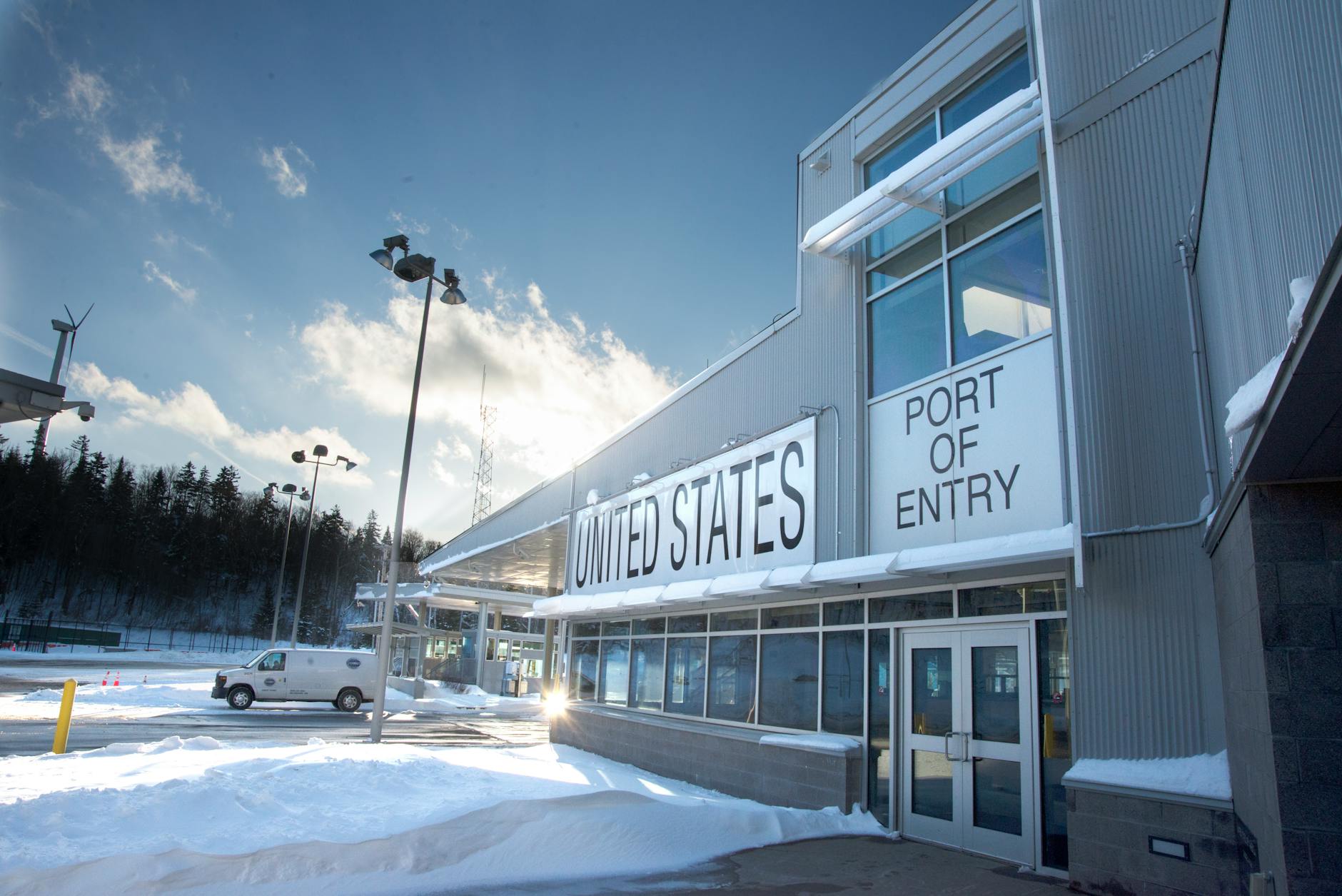

Two Chicago suburbs: one reinforcing its “welcoming city” status, one “reaffirmed…it is not a sanctuary city” and would work with ICE

How will different suburbs respond to the current situation in the United States regarding immigration? Two Chicago area suburbs are pursuing different approaches. Start with Skokie:

Photo by Matt Barnard on Pexels.com

Village of Skokie officials indicated at last week’s Village Board meeting that they will strengthen the village’s “Welcoming City” ordinance.

Trustee Khem Khoeun asked Mayor George Van Dusen if the village needed to update its welcoming village ordinance given recent immigration enforcement raids and the anxiety that some people in Skokie’s immigrant community are dealing with…

Van Dusen said Skokie’s existing ordinance was established during Trump’s first term in office, when the administration attempted enacting a travel ban for seven Muslim majority countries. The ban was ultimately blocked, but the effort apparently impacted Skokie residents.

Van Dusen recalled an incident in 2017 when a personal friend of his said her daughter in grade school was concerned she could be deported because she was Muslim, despite being born in the United States.

And then Orland Park:

Orland Park says its police will work with federal immigration agents on cases involving undocumented immigrants charged with or convicted of criminal offenses.

The Village Board recently adopted a resolution that also supports Senate Bill 1313 that would undo provisions of existing state law concerning law enforcement coordination with federal agencies such as Immigration and Customs Enforcement.

Trustees also reaffirmed Orland Park is not a sanctuary city, citing an ordinance approved by the board in January 2024…

The village said copies of the approved resolution would be sent to Gov. JB Pritzker and leaders in the Illinois General Assembly as well as Orland Park’s representatives in Springfield.

These suburbs could represent two opposite ends of a spectrum. They are different places with different locations in comparison to Chicago, different histories, and different residents. It is hard to know how many suburbs would have views similar to either one. There are hundreds of suburbs in the Chicago area and thousands across the United States. There will likely be a wide range of municipal reactions to immigration, including not making any resolution at all for a variety of reasons.

Will these resolutions be influential in the suburbs and in the state? Would businesses and residents make decisions to move to or stay in these suburbs when they pass these resolutions?

Another factor to consider: many immigrants to the United States move to and live in suburbs. They move to these two suburbs and suburbs like them. How much do these resolutions affect long-term patterns in the character of these suburbs?

Adding hundreds of luxury apartments to a shopping mall – and not affordable housing

Why add affordable housing to the suburban shopping mall when a developer and community can add hundreds of luxury apartments to the mall? Such a plan is under discussion in Skokie, Illinois:

Photo by Terje Sollie on Pexels.com

The Skokie Village Board gave tentative  approval at its Oct. 8 meeting for developers to build hundreds of luxury apartments across three buildings at the upscale Westfield Old Orchard Shopping Center.

The first phase of construction would create 425 apartments between two mixed-use buildings, one five stories tall and one seven stories tall. The second construction phase would be for an additional seven-story building that could be used for more apartments or a hotel, said Stephen Fluhr, Unibail-Rodamco-Westfield’s senior vice president of development…

The additions to the mall were met with criticism by an affordable housing group, which blasted the Village Board for approving plans they saw as having too few affordable apartments.

The first phase would put two buildings in the area of the former Bloomingdale’s retail space in the northwest part of the mall, south of Old Orchard Road and east of Lavergne Avenue.  The developers’ intention is to create a new neighborhood complete with parks, restaurants and spaces for concerts and farmers markets, according to Fluhr. The development is a partnership with the mall’s owner URW and Focus, a development group that is also in the process of building apartments near malls in Vernon Hills and Aurora.

Many malls would like to add housing to their property (examples from the Chicago suburbs to southern California): it makes use of vacant shopping space and provides local residents who might visit stores, restaurants, and entertainment options at the mall.

I would also guess many mall and community would like to add luxury apartments. These apartments will attract certain kinds of residents, those with resources to spend more in the community and contribute to a certain status. Luxury apartments at malls would go along with the idea that only the wealthiest malls will survive.

But, as communities consider affordable housing, why not include affordable housing as part of redeveloped housing at the mall? Many suburbs have limited greenfield development options so redevelopment provides an opportunity for affordable housing. Or affordable housing could provide housing for people working at the mall or working near the mall as shopping malls tend to be close to all sorts of businesses and jobs.

The bigger issue at hand is likely this: how many suburbs are truly willing to add affordable housing? And if they say they want to add such housing or have local regulations that require it, where will they allow it be located?

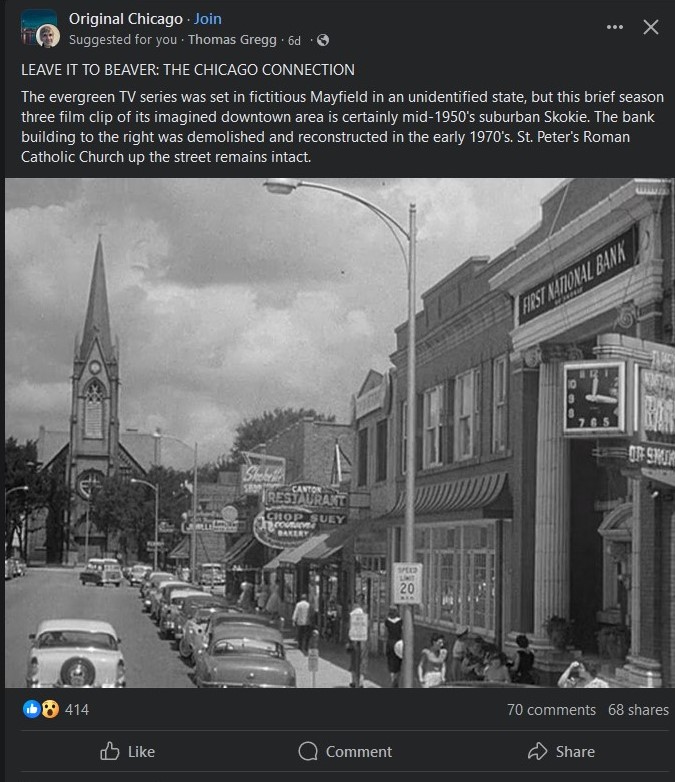
Leave It to Beaver’s downtown and Skokie, Illinois

Television shows may use a variety of settings to film scenes. Given my research on suburbs depicted on television, this example struck me as it combines a famous suburban show and a Chicago suburb:

A variety of websites back up this claim (IMDB, blog). The first home in the show, what I describe as having “two stories, a one-car garage, three bedrooms, and at least two bathrooms (Bennett 1996),” was on a Universal Studios backlot. The show is often held up as an exemplar of suburban-set TV shows in the postwar era yet I noted that it “ran six seasons but never cracked the top 30” most popular TV shows.

As a fictitious show set in an unnamed community, it is interesting to consider why Skokie might have been chosen. Was there existing footage that could be used? Did someone connected to the show or studio have a personal connection to Skokie? Did Skokie represent the experiences of American suburbs at this time? Would someone watching the show then or now see this scene and connect to particular places?

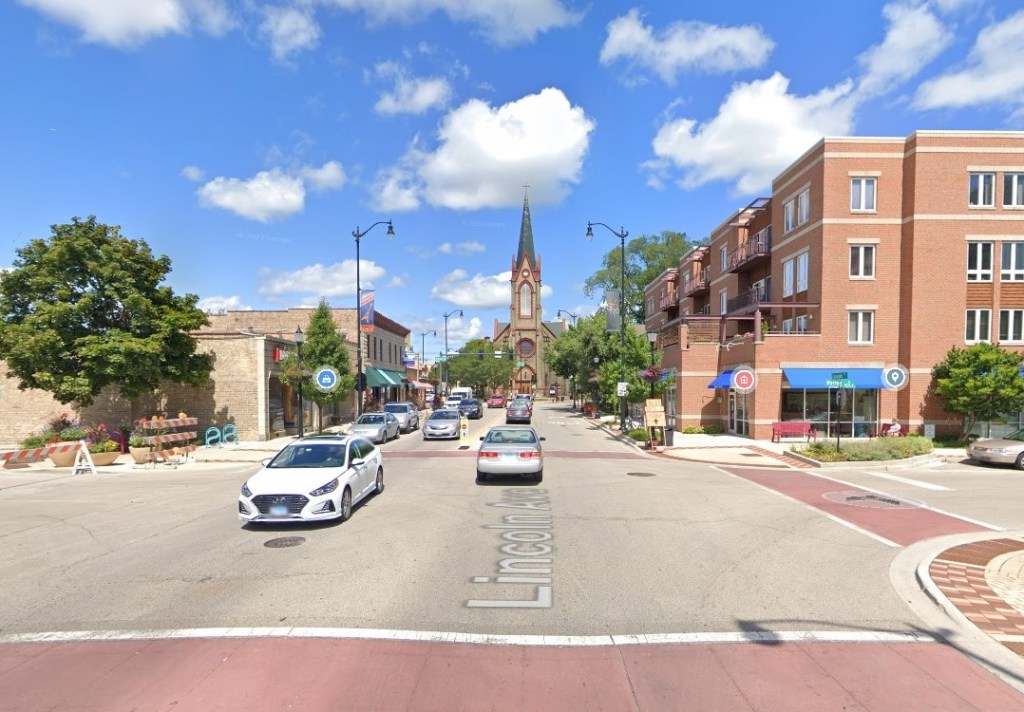
Here is a similar view from Google Street View in August 2019:

The sort of construction on the right – what looks like mixed-use four-story buildings – is common in suburban downtowns where they hope that increased numbers of downtown residents will patronize local businesses and restaurants in addition to those who want to visit such locations. These streetscapes have often replaced one- to two-story structures such as those in the top image.