More than ten year gap in life span among rich and poor

New data shows that the difference in life spans between richer and poorer Americans continues to grow:

The poor are losing ground not only in income, but also in years of life, the most basic measure of well-being. In the early 1970s, a 60-year-old man in the top half of the earnings ladder could expect to live 1.2 years longer than a man of the same age in the bottom half, according to an analysis by the Social Security Administration. Fast-forward to 2001, and he could expect to live 5.8 years longer than his poorer counterpart.

New research released on Friday contains even more jarring numbers. Looking at the extreme ends of the income spectrum, economists at the Brookings Institution found that for men born in 1920, there was a six-year difference in life expectancy between the top 10 percent of earners and the bottom 10 percent. For men born in 1950, that difference had more than doubled, to 14 years.

For women, the gap grew to 13 years, from 4.7 years…

It is hard to point to one overriding cause, but public health researchers have a few answers. In recent decades, smoking, the single biggest cause of preventable death, has helped drive the disparity, said Andrew Fenelon, a researcher at the Centers for Disease Control and Prevention. As the rich and educated began to drop the habit, its deadly effects fell increasingly on poorer, uneducated people. Mr. Fenelon has calculated that smoking accounted for a third to a fifth of the gap in life expectancy between men with college degrees and men with only high school degrees. For women it was as much as a quarter.

In the set of the right to life, liberty, and pursuit of happiness, you can’t have as much of the second and third if the first is not the same. While we often discuss inequality of opportunities or outcomes, we spend less time focusing on the body though commentators like Ta-Nehisi Coates have recently drawn more attention to the role of bodies in racial differences.

The article does suggest that evidence shows access to healthcare is not a big driver of this gap.

Can’t ignore race when discussing poverty in America

Ta-Nehisi Coates cites several sociologists in making the argument that white and black poverty is different in the United States:

In its pervasiveness, concentration, and reach across class lines, black poverty proves itself to be “fundamentally distinct” from white poverty. It would be much more convenient for everyone on the left if this were not true—that is to say if neighborhood poverty, if systemic poverty, menaced all communities equally. In such a world, one would only need to craft universalist solutions for universal problems…This chart by sociologist Patrick Sharkey quantifies the degree to which neighborhood poverty afflicts black and white families. Sociologists like Sharkey typically define a neighborhood with a poverty rate greater than 20 percent as “high poverty.” The majority of black people in this country (56 percent) live in high-poverty neighborhoods. The vast majority of whites (94 percent) do not. The effects of this should concern anyone who believes in a universalist solution to a particular affliction…

But the “fundamental differences” between black communities and white communities do not end with poverty or social mobility.

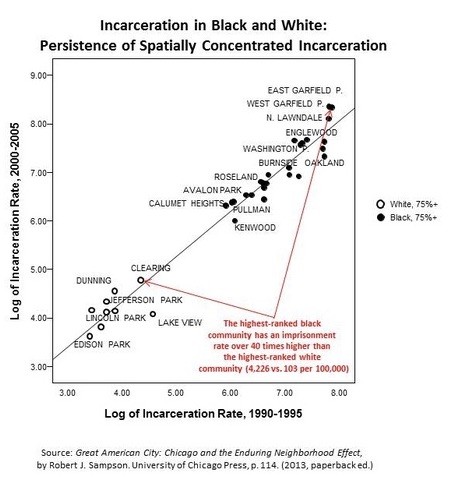
In the chart above, Sampson plotted the the incarceration rate in Chicago from the onset imprisonment boom to its height. As Sampson notes, the incarceration rate in the most afflicted black neighborhood is 40 times worse than the incarceration rate in the most afflicted white neighborhood. But more tellingly for our purposes, incarceration rates for white neighborhoods bunch at the lower end, while incarceration rates for black neighborhoods bunch at the higher end. There is no gradation, nor overlap between the two. It is almost as if, from the perspective of mass incarceration, black and white people—regardless of neighborhood—inhabit two “fundamentally distinct”worlds.

Coates might also cite Massey and Denton’s classic American Apartheid that convincingly shows residential segregation between whites and blacks is of a different magnitude than residential segregation between other groups. Additionally, there is evidence that whites and blacks with equal characteristics are not treated equally (see a number of audit studies involving mortgages, renting, car loans, and jobs) and even that blacks who are wealthier than whites do not have access to the same opportunities. Ultimately, Coates uses these sociological findings to argue policies intended to float all lower-class boats won’t really work because they ignore the fundamental differences between black and white poverty.

Put another way, given America’s history perhaps we should require scholars and policy makers to show that race doesn’t matter in the issue they are addressing rather than the other way around.

Therapy for those making the city to suburb move

For families that are having a hard time leaving the city behind, the move to the suburbs can be easier if others help:

People move for many reasons. Brokers, however, see a familiar thread: Couples move to the suburbs after having kids. And, as people marry later and live in the city longer, moving becomes more than just packing. Mentally and emotionally, experts say, people wrestle with changing from city dweller to suburbanite.

“I see this all the time with my practice,” said David Klow, owner of Skylight Counseling Center, which has offices in Chicago and Skokie. “Where we live gives us a sense of identity.”

Swapping city life for the suburbs is different from moving to another town or neighborhood. Real estate agents say city-to-suburbs folks often need special hand-holding…

In September, Alison Bernstein launched Suburban Jungle in Chicago, which she started after moving from New York City to the surrounding area and feeling lost on which neighborhood would best fit her family. The company’s sole purpose is helping families transition from, for example, Lincoln Park to Lake Forest. Employees meet with shoppers, aiming to best match a town to their personality. They connect clients to suburb experts and locals at no cost, taking a commission from the sale.

“Our job is literally 98 percent therapy and not real estate,” Bernstein said. “It’s like, ‘Am I making the right move?’ It’s a lot of stress, and it’s a big change.”

Even as Americans move quite a bit (see evidence here and here), it can be a stressful process. However, two things strike me about this particular article:

  1. All the people cited here are on the higher end of the socioeconomic spectrum. The moves invoked include going from Lincoln Park to Hinsdale or Lake Forest. These are people who can afford to use a company like Suburban Jungle.
  2. Some of the fear of the suburban life might be driven by negative stereotypes of the suburbs. Some of these may have some truth – such as having fewer entertainment spots in the suburbs – but the typical suburban critiques (which have a long history dating back nearly a century) present a very one-sided view.

All together, being able to move to these kinds of suburban communities – wealthy, safe, good schools, clean, high property values – would be a dream for many people. On the other end of the socioeconomic spectrum, people often move to the suburbs seeking necessities such as work or cheaper housing but can end up in suburbs that have many problems that cities feature.

Comparing HMDA 2014 data to previous years

The Home Mortgage Disclosure Act requires lenders to report on mortgage applications. Here is what the 2014 data on over 9 million applications reveals about mortgages:

How difficult was it to obtain financing last year? “While mortgage credit stayed generally tight, conditions appeared to ease somewhat over the course of the year as the fraction of mortgage lending to lower-credit borrowers increased,” according to the Fed. “However, growth in new housing construction was slow throughout the year, suggesting some persistent softness in new housing demand.”

What percentage of the nearly 10 million applications in 2014 actually became mortgages? About 6 million. The dollar volume of those loans totaled almost $1.4 trillion, which is lower than 2013’s volume, but somewhat higher than most industry pundits predicted…

Of the $2.5 trillion in applications made to lenders last year, about 59 percent came from whites, and just over 20 percent came from minorities (blacks, Latinos, Asians, American Indians, native Hawaiians or people of mixed race). More than 1 in 5 applications were in the “unknown” or “N/A” categories, because many people do not fill in the “race” blank. But with minorities now around 38 percent of the American population, it appears that they continue to be underserved…

Beyond those figures, HMDA also offers a wide-angle snapshot of the country’s appetites for home loans. Of the 10 million applications, 89 percent were for owner-occupied units, with just 10 percent non-owner-occupied. Applications to purchase homes were just slightly more popular (51 percent) than those to refinance loans (41 percent), with just seven percent seeking home-improvement lending.

This data can be very interesting in itself but it helps to be able to take a longitudinal view to know how 2014 compares to prior years. This sort of data is available in a Federal Reserve report:


HMDAData2014

As this table shows, the number of applications is still down dramatically. Also note the number of refinance loans in the late 2000s compared to today – much of the mortgage activity in the last decade has actually involved refinancing.

Here is a table regarding the applicants:

HMDAData2014Borrower

As noted above, the data on race/ethnicity suggests small declines among non-white groups and an increase for whites. Borrower income has not changed much though the neighborhood income has increased a bit compared to 2004.

“Why Parents Can’t Resist Buying…the Hottest Gifts”

A sociologist discusses the compulsion parents across social classes feel to purchase the season’s hottest gifts:

After observing and interviewing children and parents from a range of socioeconomic backgrounds, Pugh published “Longing and Belonging: Parents, Children, and Consumer Culture” in 2009, which explored commercial culture and how it relates to economic inequality and community. Since then, the spending trend hasn’t let up – even through the recession – and she typically fields media calls around this time of year on the topic.

Parents often have trouble deciding what to do in response to their children’s “I want’s,” Pugh found when she studied a range of families in Oakland, California. She found that both affluent and low-income parents disliked the pressure they felt to buy the most popular gifts for their kids; affluent parents were worried about giving in to materialism, while low-income parents knew that popular items cost money they would prefer to spend on household essentials…

Affluent parents often said they were uncomfortable about buying the latest popular items and they didn’t want their children to be so materialistic. Nevertheless, even if they decided to forego a certain product – which Pugh calls “symbolic deprivation” – they bought a lot of other things for their children that they thought added to what’s perceived as a good childhood.At the other end of the spectrum, lower-income parents were willing to forego some basic needs at times to buy products for their children, to show that they were capable of fully caring for their children – which Pugh called “symbolic indulgence.”

Wanting to belong – or on the flip side, not to be left out – is a powerful human motivator. And what American parent wants to be held responsible for their kid not fitting in? Arguably, this sort of logic drives much consumerism: as a number of scholars have shown, companies decades ago shifted advertising from emphasizing what products could do to what lifestyles were associated with having the product. Do you need the latest smartphone because it has such revolutionary technology or you do you want to be seen as part of a certain group? Do you need the clothing with the brand label to signal your status or to cover yourself?

It would be interesting to follow some of these same families to see how these choices about buying the hottest gifts influences children. Does it lead to more materialistic attitudes and behaviors? Do families who do not purchase such items encourage different kinds of behaviors?

Tracking American parenting through the New Yorker’s cartoons

Two sociologists examined over 6,000 New Yorker cartoons that involved parenting:

In their study, “The Parent Trap: What New Yorker Cartoons Reveal About Competing Trends in Childrearing,” Tabor and I.U. assistant professor Jessica Calarco looked at 70,439 cartoons to identify and index about 6,000 cartoons that related to children or parenting…

The most negative portrayals of children were found in the ’20s and ’30s, but also in the 1990s and first decade of the new millennium, the pair discovered. Some of the drawbacks focused on the financial burdens caused by children. Others noted how parents sacrificed much of their own lives to make things better for their children…

“You’ll see the least-critical cartoons in the ’40s and ’50s,” Tabor says. Those decades showed lots of cartoons featuring parents proud of children’s accomplishments, such as playing a musical instrument or getting good grades in school. The 1970s and ’80s also saw an uptick in cartoons that were more positive about child rearing. The 1960s featured cartoons showing the positives and negatives for parents…

“Our data suggest that when cultural standards increase child-rearing’s degree of difficulty, and especially when parents are judged harshly for failing to meet those cultural standards, the decision to become a parent becomes a much more difficult one,” the study concludes. “Faced with these mounting pressures, would-be parents feel compelled to either keep up or opt out. And as more parents opt out, society sees an increase in the number of individuals and families who decide to be ‘child-free.'”

I assume the academic article discusses this but I imagine there are at least a few intervening variables:

  1. The gatekeeping done by the editors at the New Yorker. Cartoons, like other magazine content, likely has to go through an approval processes. The cartoonist could want to present a particular narrative but that doesn’t necessarily mean the magazine would go for it. So, who were the editors making these decisions and what influenced their perspectives on parenting?
  2. The New Yorker appeals to a particular audience. According to 2012 Pew Research data on American’s news sources, 41% of their readers earned more than $75,000 and 64% had a college degree or more education, and 57% of readers are Democrats. (The magazine leads the pack in the most educated and is nearly the most Democratic. Do these cartoons then reflect an educated, monied, liberal perspective on parenting?

Still, going through 6,000 cartoons over time from a prominent source could lead to some interesting findings. And given the number of New Yorker cartoon books out there, why not have one dedicated to just parenting?

A need to better measure financial support and wealth passed to Millennials

A look at how race affects the financial support given by parents to Millennials includes this bit about measurement:

Shapiro said the numbers of Millennials receiving support from family are “absolutely underestimated” because many survey questions are not as methodical and specific as those a sociologist might ask. “As much as 90 percent of what you’ll hear isn’t picked up in the survey,” he said.

Shapiro’s more careful research found this:

Shapiro’s work pays special attention to the role of intergenerational family support in wealth building. He coined the term “transformative assets” to refer to any money acquired through family that facilitates social mobility beyond what one’s current income level would allow for. And it’s not that parents and other family members are exceptionally altruistic, either. “It’s how we all operate,” Shapiro said. “Resources tend to flow to people who are more needy.”

Racial disparity in transformative assets became especially striking to Shapiro during interviews with middle-class black Americans. “They almost always talk about financial help they give family members. People come to them,” Shapiro said. But when he asked white interviewees if they were lending financial support to family members, he said, “I almost always get laughter. They’re still getting subsidized.”…

To many Millennials, the small influxes of cash from parents are a lifeline, a financial relief they’re hard pressed to find elsewhere. To researchers, however, it’s both a symptom and an exacerbating factor of wealth inequality. In a 2004 CommonWealth magazine interview, Shapiro explained that gifts like this are “often not a lot of money, but it’s really important money. It’s a kind of money that allows families to obtain something for themselves and for their children that they couldn’t do on their own.”

Two quick thoughts:

  1. Americans tend not to like to talk about passing down wealth but decades of sociological research (as well as research from others) shows that it happens frequently and is quite advantageous for those who have wealth passed to them. I recommend looking at Shapiro and Oliver’s book Black Wealth/White Wealth.
  2. Polls like those cited here from USA Today could lead to lots of problems just because the measurement is not great. Why not ask better poll questions in the first place? I understand there are likely limits to how many questions can be asked (it is costly to ask more and longer questions) but I’d rather have sociologists and other social scientists handling this rather than the media.

Designing “porous cities” for regular interactions by all people

Sociologist Richard Sennett observes a heterogeneous marketplace in India and wonders why more urban spaces can’t have a broad mix of people:

Nehru Place is every urbanist’s dream: intense, mixed, complex. If it’s the sort of place we want to make, it’s not the sort of space most cities are building. Instead, the dominant forms of urban growth are mono-functional, like shopping centres where you are welcome to shop but there’s no place to pray. These sorts of places tend to be isolated in space, as in the offices “campuses” built on the edge of cities, or towers in a city’s centre which, as in London’s current crop of architectural monsters, are sealed off at the base from their surroundings. It’s not just evil developers who want things this way: according to Setha Low, the most popular form of residential housing, world-wide, is the gated community.

Is it worth trying to turn the dream of the porous city into a pervasive reality? I wondered in Nehru Place about the social side of this question, since Indian cities have been swept from time to time by waves of ethnic and religious violence. Could porous places tamp down that threat, by mixing people together in everyday activities? Evidence from western cities answers both yes and no…

If the public comes to demand it, urbanists can easily design a porous city on the model of Nehru Place; indeed, many of the architects and planners at the Urban Age events now unfolding in London have made proposals to “porosify” the city. Like Nehru Place, these larger visions entail opening up and blurring the edges of spaces so that people are drawn in rather than repulsed; they emphasise true mixed use of public and private functions, schools and clinics amid Tesco or Pret; they explore the making of loose-fit spaces which can shift in shape as people’s lives change.

Three quick thoughts:

  1. These thoughts sound similar to what sociologist Elijah Anderson was getting at in The Cosmopolitan Canopy. Anderson asked of American cities: what happens in the rare public spaces where people of different class, race, and ethnic backgrounds regularly mix? Sennett has asked this of international contexts which have their own unique mixes of people.
  2. Key to the mixing of people may be the presence of “normal” commercial activity. Anderson observed a shopping mall in central Philadelphia; Sennett references an electronics market in India. Prices have to be low enough for everyone to have access and there needs to be a range of mixed use activity with some nearby places to work, shop, and eat.
  3. It strikes me that exclusivity is something imposed by the upper classes. One function of higher priced stores is that it tends to keep certain people out. Gated communities, cited by Sennett, are a function of class. As people acquire more wealth, they tend to design or buy into settings where people below them are minimized or removed. Thus, having more porous cities or spaces within cities would likely require significant changes from those with more power and wealth.

Can we have both protected open spaces and affordable housing?

Conservatives argue that the affordable housing issue is simple: stop protecting open space and let developers build more housing units.

But, beginning in the 1970s, housing prices in these communities skyrocketed to three or four times the national average.

Why? Because local government laws and policies severely restricted, or banned outright, the building of anything on vast areas of land. This is called preserving “open space,” and “open space” has become almost a cult obsession among self-righteous environmental activists, many of whom are sufficiently affluent that they don’t have to worry about housing prices.

Some others have bought the argument that there is just very little land left in coastal California, on which to build homes. But anyone who drives down Highway 280 for thirty miles or so from San Francisco to Palo Alto, will see mile after mile of vast areas of land with not a building or a house in sight…

Was it just a big coincidence that housing prices in coastal California began skyrocketing in the 1970s, when building bans spread like wildfire under the banner of “open space,” “saving farmland,” or whatever other slogans would impress the gullible?

When more than half the land in San Mateo County is legally off-limits to building, how surprised should we be that housing prices in the city of San Mateo are now so high that politically appointed task forces have to be formed to solve the “complex” question of how things got to be the way they are and what to do about it?

The argument goes that this is an example of supply and demand: open more space for development and housing prices will have to drive as supply increases. Is it really this simple? Here are at least a few other factors that matter in this equation:

  1. The actions of developers. Even if more housing units could be built, there is no guarantee they could build cheap or affordable housing. They want to make money and they argue the money is not in affordable housing.
  2. Is cheap suburban housing (what is typically promoted by conservatives in these scenarios – keep building further out) desirable in the long run? Opponents of sprawl might argue that having a cheap single-family home 30-50 miles out from the big city is worse in the long run than a smaller, more expensive unit close to city amenities and infrastructure.
  3. What exactly is the value of open space? Conservatives sometimes argue this is another sign of the religion of environmentalism but there are realistic limits to how much housing and development land can hold before you end up with major issues. (For example, see the regular flooding issues in the Chicago area.) If green or open space is simply about property values – keep my home values high by not building nearby housing – this is a different issue.
  4. There is a larger issue of social class. I’m guessing there are few Americans of any political persuasion that would choose to live near affordable housing. There is a stigma associated with it even if the housing is badly needed. Lots of people might argue affordable housing is needed but few communities want it in their boundaries and middle and upper class residents don’t want to be near it.
  5. Another option for affordable housing is to have denser urban areas. Think cities like Hong Kong where a lack of land and high demand have led to one of the highest population densities in the world. If a region wants to protect its open and green space, why not build up? Many city residents don’t want this – the single-family home urban neighborhood is a fixture in many American cities – and conservatives fear a government agenda pushing everyone into dense cities.

Opening more land to development might help lead to cheaper housing but it would take a lot more to get to affordable housing that is within a reasonable distance from job and population centers.

Californians to be free to hang laundry on clotheslines

In a move toward energy conservation, California will soon have “laundry liberation“:

In what a legislative analysis called a “modest energy conservation and freedom of choice measure,” Gov. Jerry Brown on Thursday signed legislation requiring property managers to let renters and homeowner association members string clotheslines in private areas.

Assembly Bill 1448, by Assemblywoman Patty Lopez, D-San Fernando, comes amid heightened concern about greenhouse gas emissions in California – and the energy consumption of driers.

One columnist notes the class dynamics at work:

As a class signifier, the clothesline has always been highly charged. In the late 1960s, tumble dryers began to creep their way into middle-class households — according to the U.S. Energy Information Administration, fewer than half of American households had dryers in 1980; by 2009, it had jumped to 80% — the clothesline has connoted a certain unsophistication if not downright poverty.

That’s especially true in big cities, where clotheslines hanging between buildings are an indelible marker of tenement living and overall blight. I visited Beijing a couple of years ago, and hanging laundry was ubiquitous even on the balconies of expensive high-rises. During the 2008 Olympic Games, I was told, the Chinese government prohibited outdoor clotheslines as part of an overall image-control effort. As soon as the Games were over, the laundry went back up.

The primary argument against clotheslines is the perceived effect on property values. Yet, why not give people the choice to dry clothes outside rather than put it in the hands of homeowner associations or local governments? I would guess that many middle and upper class residents still won’t hang clothes outside even if they can. At the same time, it could be a nice economic benefit for households with less money.

Is the status tied to using a clothes dryer in your own home more about consumption (having the ability to buy such an object and pay for its ongoing use) or the ability to keep personal items (like dirty laundry) within private areas?