Can McMansions ever add to the charm of a neighborhood or community?

I’ve seen many stories over the years of how teardown McMansions ruin the charm of older neighborhoods. Here is a recent case from the north shore of Long Island:

Call it a neighborhood dispute over home sizes. A small village on Long Island is seeing more and more small homes torn down to make way for so-called ‘mcmansions.’

Some neighbors have been pushing back, saying the huge homes are taking away from the charm of their community.

Are there any conditions under which a new McMansion might be considered charming? While I can’t recall seeing such a positive description used, here are a few scenarios in which it might work:

  1. The replaced home was small, decrepit, and in severe disrepair. McMansions may not be the preferred replacement option but some homes can be terrible shape and such eyesores are appreciated by few neighbors.
  2. The owners of the new home go significantly out of their way to placate neighbors. Regular deliveries of baked goods? Lots of volunteering for local duties? Handwritten notes asking for forgiveness? Hosting regular parties for neighbors in their spacious new home?
  3. The McMansion meets certain conditions: it is not so large compared to nearby homes, it does not seem to be bursting out of its lot, and the architecture is tasteful and consistent with nearby homes. Even with these, I suspect some neighbors will never be able to get past the idea of a McMansion.

Critics of McMansions tend to pick out clear-cut cases but not all larger teardowns are so easily categorized.
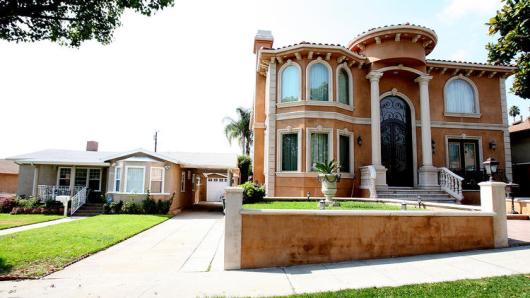
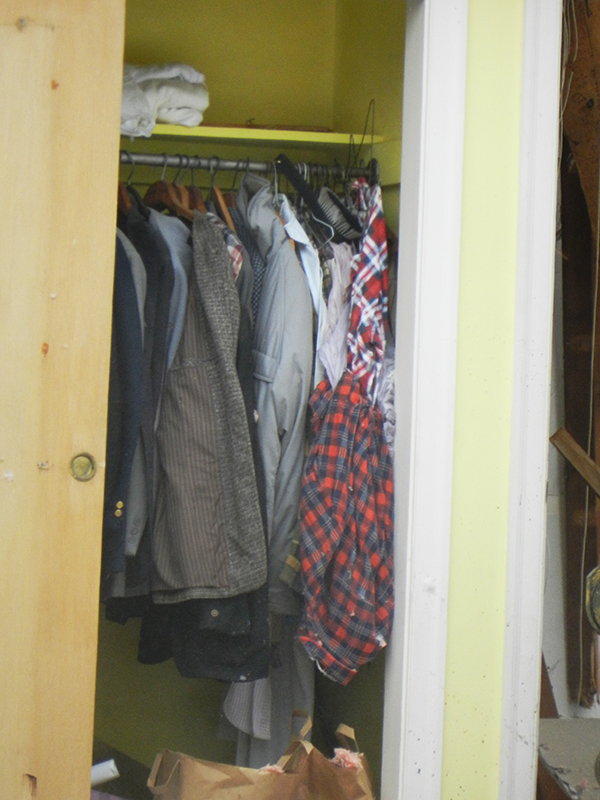
Photo illustrates two of the concerns about teardown McMansions

A news story about possible changes to Burbank’s guidelines for single-family homes includes a great depiction of a teardown McMansion:

burbankteardownmcmansion2013


The image illustrates two common issues neighbors have with such new homes. First, the new home is significantly larger. Not just a little larger; a lot larger. Next to a postwar ranch home now sits a two story property that extends almost to the side property lines and partly due to its higher base now looms over the older, smaller home. Second, we don’t even have to go so far as to claim the architecture of the new home is garish; rather, it is significantly different from the next door ranch home. The small ranch home common to many suburban communities may not be much to look at (though they do have their own enthusiasts) but at least such homes are on blocks of other such homes. Once teardowns begin, the architectural continuity is lost and a hodge podge of homes emerges. A new owner of a teardown could attempt to do a lot to smooth over hard feelings among neighbors but the task is probably more difficult when such a disparity in size and architecture exists.

At the same time, pictures of teardowns can be taken in such a way that either highlight or downplay the differences between adjacent homes. However, I don’t think the picture above can be explained away by angles or camera lenses.


Sprawl McMansions okay, teardown McMansions not

One writer in Princeton suggests not much can be done about the big McMansions of the suburbs but the trend of new teardown McMansions in older neighborhoods should be slowed and regulated:

We don’t really have quantity-over-quality McMansions in uniform subdivisions in Princeton. We were largely developed by the 1980s when the term and the phenomenon originated. If individual ersatz estates infest outlying parts of Princeton, they’re no problem — except for their owners and the environment — because the lots are large. No one has to see such a house up close — not even the owners, who are typically inside it.

So suppose those owners are content with their veneer Versailles and its Styrofoam crown molding, faux-stucco skim-coated wallboard, and travertine made from epoxy and marble dust. Suppose they can afford to heat and cool their particle-board palazzo. Suppose they trust Merry Maids to clean their tyranno-kitchen. Suppose they plan to sell their schlock Schloss and move on before it curdles. Fine. We’ve already paid for the extra roads and utility lines their large house and lot required.

No, Princeton’s current McMansion problem is when counterfeit castles replace modest tear-downs — an odd problem in a town with many actual mansions. From a 1905 description of Princeton’s Western section: “The residents build on the same street according to their means, but the hand of taste is visible in almost every house. Here is a stately Colonial mansion and beside it is a roughcast cottage overgrown with climbing roses. There is a costly stone house of the Elizabethan style, and beyond, an artistic combination of stucco and timber. … [But] as each house has a sufficient garden space about it to overcome incongruities of juxtaposition, the village becomes more and more attractive as the rivalry progresses.”

Unfortunately, McMansions in Princeton’s denser neighborhoods lack space to overcome “incongruities of juxtaposition.” And, if you live beside a McMansion, your bedroom, which once got morning sun, may now face your neighbors’ Jacuzzi, while the terrace, where you once read today’s paper in pajamas, now abuts their breakfast room. You deplore your neighbors’ sham chateau because it diminishes your privacy and privileges — and maybe raises your property value and taxes.

Based on this reasoning, you could fit McMansion opposition into two camps:

  1. All McMansions are bad.
  2. Already-built McMansions in sprawling suburbs are not so bad; ones that threaten the character of older neighborhoods should be fought.

Perhaps the first camp is the purist one: McMansions represent bad architecture, standardization, and overconsumption, wherever they are located. Even if the sprawling McMansions have already constructed roads and infrastructure, they are still costly to provide services to and a poor use of land.

The second camp is the realist group: those suburban McMansions were built a long time ago and some people might even like them (despite all the negative traits we can name in a few paragraphs). However, we don’t want those McMansions to break the containment zone in the suburbs.

Both battles are fought, depending on the location (whether there is still sizable plots of undeveloped land) and the reactions of neighbors (suburban residents can also dislike a new development of big homes going in next door). The first can veer toward the repudiation of all American suburbs while the second can involve heated interactions with neighbors on a micro scale.

Do teardown McMansions pit developers against residents?

An op-ed suggests there are two sides in debates over teardowns:

Can we please focus on what neighborhood residents want and not what developers want?

Two quick thoughts on this simplistic breakdown:

  1. It is very easy to make this claim because it suggests there are money-hungry outsiders – developers – and then average residents who don’t have the same resources. However, this is not always the case: what if the home or property was sold to the developer by a resident? Or, a new buyer wants to live in the neighborhood and wants to construct a larger home? There are plenty of cases where teardowns pit neighbors against neighbors and this gets a lot more complicated than just having an evil outsider at work.
  2. Should neighborhood residents always have complete control over what happens near them? Having input into a process is different than being able to control the process. A lot of residents might want to freeze their neighborhoods in time when they purchase their home. After all, the liked the neighborhood the way it was. However, few neighborhoods undergo no changes and urban neighborhoods can undergo significant changes over the decades.

While this op-ed is based on a particular case in Raleigh, all together, the developers-who-want-McMansions vs. residents may be true some of the time but many teardown McMansion situations are different.

Australia losing 800 older houses a week

One writer highlights the demolition fate of numerous older homes in Australia:

A record 800 heritage and “character” houses are falling under demolition hammers each week, destroying miles of unique streetscapes and slicing billions off their value…

Original houses remaining in a streetscape transformed by a “McMansion” (a house or apartment considered to be ostentatious or lacking in architectural integrity) can lose between 10 and 25 per cent of their value from the loss of street appeal, say property specialists.

It could also be a short-sighted strategy for owner-developers because scarcity of character houses, which in many cases can be adapted to modern living requirements, will continue to increase their value, according to buyers’ agents (independent consultants acting for property purchasers)…

The “nightmare on main street” for home owners who want to retain the integrity of their neighbourhoods is worsened by the multiplicity of planning rules and codes, which often provide contradictory outcomes.

This sounds very similar to American arguments against teardown McMansions: (1) the large new homes often do not fit the character of the neighborhood; (2) this change in character affects the property values of people in the neighborhood; and (3) local governments and agencies are often limited in what they can or will do in response. Aesthetics is not an unimportant point nor is historic preservation but the economics work for someone (particularly builders/developers as well as the new owners, as noted above) if teardowns keep happening in American and Australian communities.

This article seems to appeal to local authorities to check the spread of teardowns; there are a variety of ways to combat McMansions.

What to do if “a McMansion is going up next door”

If a McMansion is built next to existing houses, what can neighbors do?

“It’s built so much higher than my house, virtually every window looks out into my backyard,” she says. Desperate to protect her privacy, she planted Italian cypress trees as a natural barrier. She tried to reason with the builder, whose unsympathetic response was: “Shouldn’t everyone be able to build their dream home?”

What’s going on in Mountain View is an extreme version of a problem cropping up all over the country: Huge houses are being built on plots of land originally meant to accommodate smaller dwellings, sparking a heated debate over what’s best for the community. Some argue that owners of larger homes pay more taxes, which can benefit all. But if your home happens to have its air and light blocked by a behemoth next door, you would likely be very, very upset — and can most likely kiss the idea of cashing out on your home sale goodbye…

A similar drama is playing out in Arcadia, CA, where more than 30 homes larger than 5,000 square feet (some as large as 8,000 — 9,000) have been proposed in the 850-home community over the past six years. In response, a group of longtime residents formed Saving Arcadia, which is currently battling the municipal government and City Council. Its argument: Overly lenient rules for developers have led to the proliferation of McMansions on lots that were zoned back in the 1950s for smaller homes. Plus, these oversize dwellings overburden the city’s water, gas, electricity, and other utility services…

Another option is finding a creative solution. One example is building downward (if a property is set on a hill) in order to increase square footage while preserving neighboring views, which is increasingly happening in various areas near Newport Beach. So maybe there’s hope that we can all play nice after all?

A homeowner who doesn’t like the nearby McMansion has a number of options available to them – these are sorted roughly in order of severity:

  1. Talk to the neighbor and builder. Might they be willing to make changes? They don’t have to but perhaps they are also unaware of what neighbors think of their actions.
  2. Modify your own lot or house to avoid having to see the new dwelling (if this is possible given its new size). For example, buy some artificial plants.
  3. Fight for local regulations. Many communities (see examples like Austin and Los Angeles) have considered rules about teardowns in recent decades and try to balance the interests of property owners versus those of neighborhoods. A variety of tools can be used including design guidelines, lot to house size ratios, approval processes, and historic districts.
  4. Buy up the properties that may become McMansions. This requires money but then you can control the fate of the nearby properties. See examples here and here.
  5. Sue your neighbor. You have to have resources to fight this out and it is likely to sour relations for a long time. But, some neighbors choose this option. See an example here.
  6. Move away. This is what the resident in this particular article does. This may be a last resort option or one favorable to those who don’t like open conflict (which is often minimized in suburbia).

In many places, the teardown McMansion cannot be stopped, particularly if there are not existing guidelines which are likely based off earlier cases or if the neighbor is not independently wealthy. Still, the neighbor who does not like it can pursue a number of options and each is likely to affect their relationship with the teardown neighbor.

Demolition for a teardown, clothes in the closet and all

Many neighbors don’t like teardowns and one residents highlight that the new property owners didn’t even empty the old home:

This house is two houses away from us. The lady who lived in this house passed away a few months ago. A builder bought the house for $660,000 and a mortgage was taken out for $1,178,000 on it. So what this means is it’s probably going to be sold for a minimum of $1.5 million dollars…

The builder didn’t even empty the closet.

On one hand, if the whole house is going, why not simply trash everything inside rather than spend the time sorting it all out? On the other hand, displaying such a picture highlights several features:

  1. It increases the tragedy factor many claim are inherent in teardowns. These aren’t just houses; these places where people have lived for decades and threatening the character (and social life) of the neighborhood is not a trivial matter.
  2. Americans have so much stuff through our consumption patterns that it simply doesn’t make sense to try to salvage any of these items. It often may not be worth it to even donate the items as it is too easy to throw it out and/or obtain more.

Now that I think about, there are numerous photographers and artists in recent decades who highlight ruins in big cities – like Detroit or New York City. Where is the major project that documents the sadness of teardowns? It may not quite have the noir allure of the city but there is long history of suburban critiques to draw upon: the mass produced raised ranch of the post-war era is even more desolate in the snow and shadow of the wrecking ball.

Tampa McMansions block the sun, loom over older ranches

A hot housing market in Tampa has led to a number of teardown McMansions that loom over the older homes of neighbors:

If there’s one trend that has characterized Tampa Bay’s new-home market in recent years, it’s the proliferation of huge new houses replacing or overwhelming smaller ones in established neighborhoods like Davis Islands and St. Petersburg’s Snell Isle. Many Realtors and property owners welcome the new construction, which is boosting sales and driving up value.

But it can be less than wonderful for homeowners who live next to these enormous abodes. They must endure months of banging and pounding, only to face the prospect of diminished privacy and an inevitable change in the look and feel of the neighborhood…

Because of federal flood insurance rules, the new house had to be elevated so much that its first floor was above the level of the Dodges’ 6-foot fence. “Where their feet walk is higher than our fence,” Dodge said. “The fence didn’t give us privacy any more.”…

Levine said she and Lentz aren’t opposed to new homes, only to huge ones that sit a few feet from neighboring property and loom over everything around them. The couple have stopped trimming their large fan palms, but even those aren’t big enough to block the view of their yard from the McMansion’s second floor.

These are common complaints about teardowns: the new homes are significantly larger than the original homes in the neighborhood. The pictures accompanying the story provide the image: mid-twentieth century ranch homes next to hulking McMansions (that also are now following new guidelines to help limit flooding damage). This story doesn’t contain much reference to another common complaint – changing the character of the neighborhood – but it is easy to see why having such big houses suddenly show up next door could draw negative reactions.

The next step in this process would likely involve going to the municipal level and trying to get develop restrictions on teardowns. However, this doesn’t always happen: there likely needs to be a critical mass of teardowns, enough of the existing residents of these neighborhoods may not mind selling their properties for big money, and it can be daunting to try to push forward such regulations.

Another downside: McMansions threaten trees

McMansion critics may have another argument at their disposal: constructing McMansions may often require removing trees.

About 2,000 street trees, or trees near Los Angeles roadways, are removed annually, according to Los Angeles City Hall leaders.

The trees are removed in some cases because of disease or death, but in other instances, they’re taken down because of the construction of so-called McMansions.

Concerned about the loss of trees at the hands of developers, a City Council committee called for a report back on new policies for the removal of street trees…

With some tear-downs, a “double driveway is needed where one used to be sufficient,” she said, resulting in the loss of a tree.

This doesn’t seem like that many trees, particularly since there could be multiple reasons behind the removal of street trees. Yet, losing trees could be another blow dealt by teardown McMansions to neighbors: not only will the new home fill up the lot and look out of place with nearby homes, it will require losing some of the greenery that residents tend to like. This is probably less about nature and more about appearances and quality of life where mature trees on residential properties lend gravitas and pleasant barriers between the street and sidewalks, lawns, and homes.

If the problem is the larger driveways for the new large homes, it would be interesting to see how Los Angeles regulates their width. Is there a ratio or size that could be invoked to fit all kinds of situations?

How about this crazy idea: builders of McMansions, teardowns or otherwise, should spend a little bit more money and cover their properties with decent-sized trees. Neighbors and others may still not like the house but who can argue with a number of new trees?

Australian architects to demolish McMansions, reuse materials for multiple homes

Three Australian architects have plans to create multiple, more sustainable homes out of McMansions:

The project aims to demolish existing McMansions which have seen better days and reuse as much of the materials as possible – up to 80 per cent – to build between two and four new homes on the site using minimal new materials and sustainable practices.

Mr Gallois said the project aimed to show how housing could be more affordable and could also deliver zero emissions green homes…

“In the face of Sydney’s housing affordability crisis, the Reincarnated McMansion Project provides a real solution to the financial challenges of owning a home in Sydney in 2015,’’ he said…

Australia has some of the biggest homes in the world and the largest CO2 footprint per capita in the world so the aim was to work on both of these issues.

While many don’t like McMansions, few have developed plans of what to do with the many that have already exist. This sounds interesting: find ways to reuse the materials (cuts down on a lot of waste) and split the property into multiple single-family homes (denser housing but still lets people own single-family homes). I’m not sure there are many redevelopment projects that use a lot of the demolished materials – perhaps it requires detailed planning or builders and architects want to start with a blank slate rather than be constrained by older materials.

I wonder how neighbors would view these projects. In a neighborhood full of McMansions, would a group of smaller homes be met with approval? Teardown McMansions in particular prompt criticism because they interrupt the existing aesthetic of a neighborhood. Plus, homeowners want houses nearby to match their housing value, not units that provide less space and drive down prices. Would would the prices be for these new homes and what kind of architecture would they feature?