Starbucks moved away from being a third place, emphasized drive thru and mobile orders

Is Starbucks no longer a gathering place?
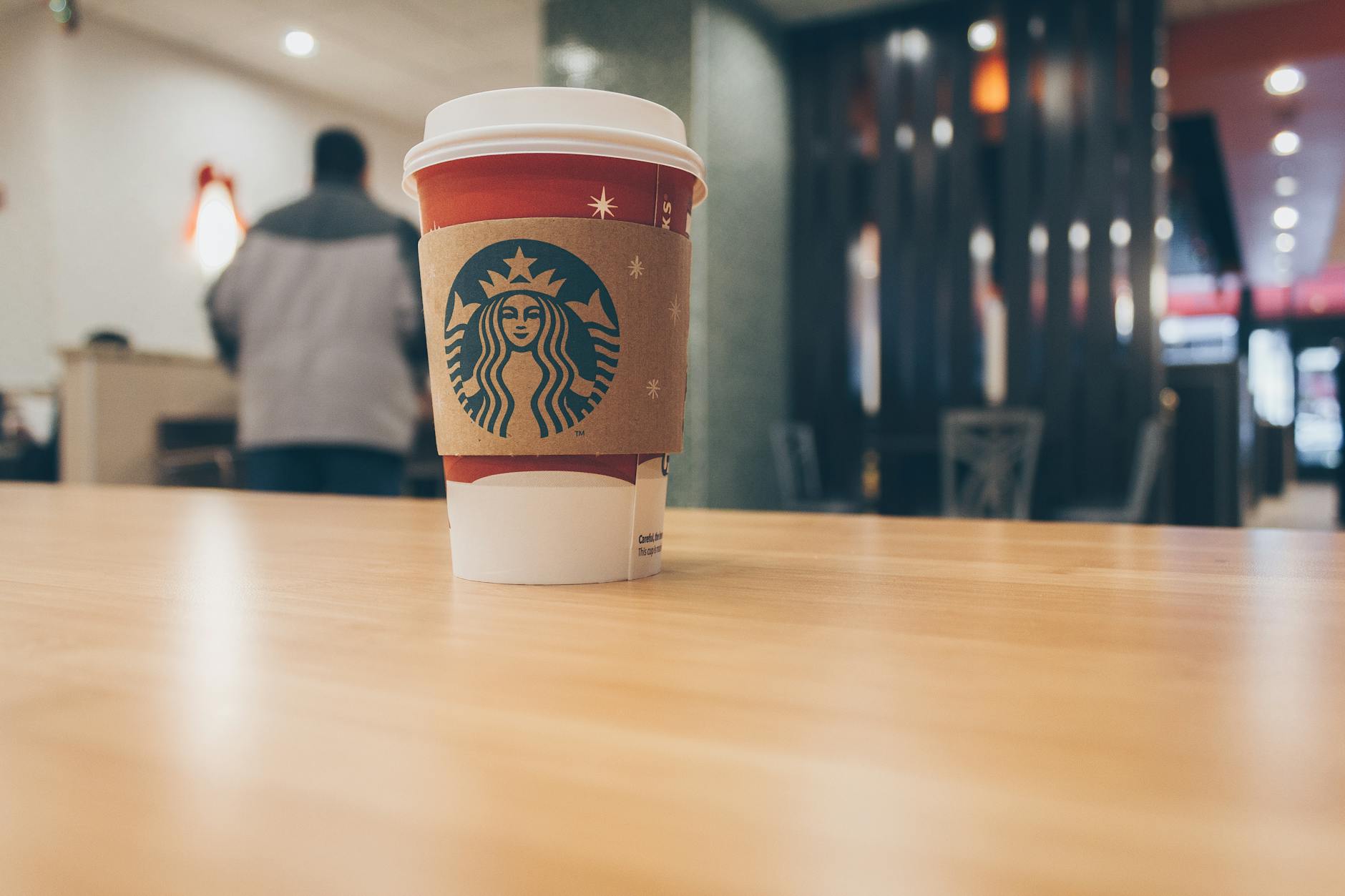
Photo by Josh Sorenson on Pexels.com

The idea of Starbucks as a third place became part of its corporate mythology. Starbucks aimed to create a welcoming environment for coffee drinkers and employees with comfortable seating, jazz music and the aroma of freshly-brewed coffee. Employees who brewed and served Starbucks coffee, whom Starbucks called baristas, handwrote customers’ names on their drink orders…

Mobile app and drive-thru orders make up more than 70% of Starbucks’ sales at its approximately 9,500 company-operated stores in the United States. In some stores, customers complained online that Starbucks pulled out comfortable chairs and replaced them with hard wooden stools. Starbucks has also built pickup-only stores without seating. Machines that print customers’ names have replaced baristas’ handwriting on cups.

“Third place is a broader definition,” current Starbucks CEO Laxman Narasimhan said last year. The “classic definition of third place — it’s a box where I go to meet someone — it’s frankly not relevant anymore in this context.”…

Starbucks’ changes to its sit-down business model came in response to several trends — demand from customers for ordering coffee from their cars in drive-thru lanes or on their smartphones. The shift from a business serving hot coffee to one in which cold coffees, teas and lemonades make up more than half of sales. The Covid-19 pandemic, which forced cafes to shut indoor seating.

Starbucks shifted to meet Wall Street’s demands, too. Starbucks found it could reduce labor costs and increase order volume by running a mostly drive-thru and take-away coffee business. Starbucks also found difficulties with being America’s third place and did not want to become the public space and bathroom for everyone, including people coming into stores who were homeless or struggling with mental health challenges on city streets. Starbucks has closed some stores and restricted bathroom access over safety concerns.

The shifts make sense: more consumers want quick service and coffee to go, the company and shareholders want to make more money, and serving the public can be difficult.

But this is a different approach to coffee, food, and places more generally. Getting coffee to consumers as cheaply and quickly as possible and when and where they desire it treats place differently. Arguably, you might not even need a location any longer. Can we get Starbucks via drones or by drivers within ten minutes of an order? Why bother going to a location at all? Why not have a huge centralized Starbucks that sends out drinks at light speed in all directions?

The purpose of third places is less about consumption and more about social interaction and conversation. Yes, third places like cafes and pubs have food. But the food helps people talk and relax. All humans need to eat – and they also need social connections. Having a refresher in the car while driving – often a solo experience – is a different experience than sitting with friends for half an hour near other people.

Starbucks is not alone in this. McDonald’s is a gathering place for some. But if coffee and fast food places limit seating and primarily want to serve people who do not stay, where can or will people go? Maybe nowhere else. Perhaps this helps give momentum to sociologist Eric Klinenberg’s argument that public schools and libraries should be designed in ways that encourage social interaction.

Can a relaxed, suburban “third place” get away with selling a high sugar, high caffeine lemonade drink?

Since I am not a regular patron of Panera’s – though there are several within a several mile radius of my suburban address – I was not aware of a new drink in these pleasant and sociable spaces:

Photo by Gilmer Diaz Estela on Pexels.com

Technically, one could do the same thing at a McDonald’s or another more casual fast food spot. But given that McDonald’s isn’t exactly relaxing, it may not be people’s first choice for a leisurely afternoon hang. Panera, on the other hand, is what’s known as a “third place,” a special type of social environment that blurs the lines of work and home.

This concept originates from sociologist Ray Oldenburg’s 1989 book The Great Good Place, wherein he separates daily life into three distinct spaces. The first is the home, the second is the workplace, and the third is any other environment where people can freely gather and exist in public without obligation. Starbucks, notably, is explicitly designed with the third place in mind. As Forbes first wrote in 2015, Panera has increasingly been chasing this idea as well, arranging their stores more like living room spaces and encouraging customers to stick around by offering free Wi-Fi. Particularly with its Unlimited Sips program, Panera has shaped itself to be a third place where people can hang around with a low barrier to entry—even more so than Starbucks, where two drinks would cost as much as a month’s worth at Panera, and there aren’t even free refills.

All of this helps explain what makes this Panera lemonade situation so compelling. If it were a 7-Eleven selling chaos in a cup, nobody would think twice. Instead, it’s this suburban-feeling sandwich retailer that has shaped itself as a simulacrum of the neighborhood cafe. And that’s weird—a Charged Lemonade would be a better fit for the X Games vibe of Taco Bell, a chain that already flavors everything with Mountain Dew and Doritos dust. Panera seems so innocent—until you remember that they’re essentially feeding you a loaf of sourdough with every meal. At Panera, the mayhem is merely disguised by the presence of words like Napa and brioche, and the dissonance of it all abounds.

Nevertheless, for Baus, who says in the video that she hates working from her home, Panera is the perfect environment for both work and leisure. “It’s close to my house and it’s actually quiet,” she said. “I kept going to coffee shops that had loud music and very limited seating. Plus, Panera has the Unlimited Sip Club, which is much cheaper than paying for a coworking space.” For all these reasons, she says, she’ll continue to work from Panera—and yes, continue to glug the lemonade. “I have started watering it down about 70/30, though, because I don’t need that much sugar or that much caffeine,” she said.

My first two thoughts are these:

  1. Panera knows its audience.
  2. This is an embodiment of America today.

Imagine this scene: a semi-busy fast causal restaurant on a December morning with light snow. People are scattered around the tables and seats, some talking quietly, some working on devices. They all have a drink in front of them. Some have coffee, others water, more have a lemonade in different hues. As they drink and work or socialize, the levels of the drinks go down and then are quickly refilled. Some people leave, replaced by others and eventually the lunch crowd raises the volume of the place.

What powers the activity in this third place? Whether in coffee or soda or a lemonade drink, it is caffeine. For a country that sleeps poorly, this is the answer in suburbia.

Third place lesson from Borders and Starbucks locations in NYC: they still need to bring in money

The story that Borders is closing many locations (see earlier posts here, here, and here) is related to news that some Starbucks locations in New York City are going to cover up their electrical outlets to discourage people from staying too long:

Well, now some Starbucks in New York City are reportedly pulling the plug on that idea, actually covering up their electrical outlets to discourage squatters.

“Customers are asking (for it). They just purchased a latte and a pastry and there is nowhere to sit down in some of these high-volume stores,” Starbucks spokesperson Alan Hilowitz said…

It is a move that has some Starbucks regulars saying … it’s about time.

Some, including Starbucks CEO Howard Schultz, say these two businesses provide “third places” between home and work. Thus, if the companies do things that inhibit social behavior, such as close locations, the suggestion is that they weaken the social realm as people will then be more isolated. (See a recent example of this argument here.)

But these businesses are not just providing a public good and this is one lesson that joins these two stories: they need to make enough money to keep the third places open. At Starbucks, the people who sat too long and used the free Wi-Fi ended being a nuisance to customers who wanted to pay for coffee, sit down for a short while, and then leave. At Borders, the best way to make sure the locations would stay open was to purchase more. Sure, a book at Borders might cost more but the purchase helps subsidize the cafe and the social life that may come with it.

This leads to a bigger question: would Americans be willing to pay for third places with their consumer dollars? If given the choice between a cheaper book at Amazon.com or a book at the nearby Borders, which would most people choose?

This is also a reminder that these locations are not public spaces: they are privately owned and can set their own priorities and values for the space. There still are public spaces in the United States: public parks like Rittenhouse Square in Philadelphia draw attention (in this book – though it also talks about shopping malls and markets, both privately owned). Instead of lamenting the loss of Borders or Starbucks, one could fight instead for taxpayer supported public spaces that should be open to all people.

Don’t romanticize the loss of bookstores: rue the loss of tax dollars and jobs

One response to the closing of bookstores is to lament the loss of a place to browse for books and drink coffee. But another reason to rue the loss of these stores is the loss of tax dollars and jobs. Here is how this plays out in Wheaton:

The eventual closure of Borders books will have an impact on Wheaton in terms of lost sales tax revenue and jobs, said Jim Kozik, the director of planning for the city. And replacing a large retailer isn’t easy in times like these…

Locally he said Borders absence will mean a loss of jobs, a loss of tax revenue for the city and a loss of lease income for the management company that runs the shopping plaza at Butterfield and Naperville roads. But he said the amount of revenue the city will lose is hard to quantify because it is not spelled out by state government…

Kozik said the city has had discussions with Anderson’s Bookshop, an independent seller with locations in Downers Grove and Naperville. But ultimately the talks didn’t produce.

With liquidation plans announced for Borders books, Wheaton could face having two large vacant former bookstores – the other being a space in the Town Square shopping plaza formerly occupied by Barnes and Noble. That store closed a few years ago, said Kerry O’Brien of the Wheaton chamber of commerce.

It is little wonder that more states are looking to gather sales taxes off internet sales. The loss of bookstores has an economic impact that is perhaps more important than the cultural and social implications of the loss of a potential “third place.”

This story is also a little more intriguing because it is Wheaton, a community that is fairly educated and yet has lost two big chain bookstores. If they can’t survive in Wheaton, where else can they survive? (I wonder how the Barnes & Noble in downtown Naperville is viewed.) In general, the Chicago suburbs are lacking in independent bookstores, a type of business that might mark a more educated demographic.

San Fran “coffeehouse and tech incubator” inspired by idea of “third places”

Starbucks CEO Howard Schultz has said in recent years that the company seeks to become a “third place,” a space between work and home. This term was popularized by sociologist Ray Oldenburg in The Great Good Place. But exactly how a coffee shop should operate in order to be a third place is up for debate. A new San Francisco firm, The Summit Cafe, envisions a coffeeshop plus a center for technological incubation:

With its copious power outlets, Gouda-wrapped meatballs, and a curated magazine rack featuring vintage Steve Jobs covers, the Summit café sits at the intersection of San Francisco’s three most conspicuous tribes: techies, foodies, and yuppies. Yet what separates the Summit from being just another Wi-Fi boîte is the dual-purpose nature of the 5,000-square-foot space. One floor above the Laptop Mafia, the café features a cluster of offices where groups of programmers and developers toil away in an effort to launch the next Twitter—or at least the next OkCupid. Created by i/o Ventures, a Bay Area startup accelerator comprising former executives from MySpace (NWS), Yahoo! (YHOO), and file-sharing site BitTorrent, the Summit is equal parts Bell Labs and Central Perk—and probably the country’s first official coffeehouse tech incubator. Every four months, i/o selects and funds a handful of small tech ventures to the tune of $25,000 each in return for 8 percent of common stock. In addition to the cash, each team gets four months of office space at the Summit, mentoring from Web gurus like Russel Simmons of Yelp, and discounts on all the Pickle & Cheese Plates or White Snow Peony Tea they could possibly need. Since the café opened on Valencia Street last fall, two companies have already been sold, including damntheradio, a Facebook fan management tool. To hedge against any potential risk, i/o also rents half of the Summit’s other desk space to independent contractors and fledgling Web entrepreneurs. It’s even experimenting with an arrangement in which customers can pay $500 for a dedicated desk—on top of a $250 membership fee.

Is this sort of thing only possible in San Francisco (high-tech culture) or perhaps just in major cities?

But this space does seem more like a work space than a true third place. Are there people who come here just to hang out? Do fledgling companies that come here mix with other fledgling companies to form new ideas and firms?