Many years can pass – at least 17 for one suburban development – between proposing and completing a project

Some development projects take a long time from beginning to end. Here is a recent example from the Chicago suburbs:
Photo by Markus Spiske on Pexels.com

The Glen, a large residential development that was to be built in Elgin 17 years ago, has come back to life with the help of a new builder.

Moda Homes is partnering with Lennar Homes to build the first phase of a project that calls for 83 single-family homes, 54 age-restricted homes, a 150-unit senior assisted living facility and a neighborhood park on 73 acres off Nolan Road, according to plans presented to the Elgin Planning and Zoning Commission.

The unincorporated property was zoned in the early 2000s for a subdivision. Moda Homes is requesting the site be annexed into the city and a preliminary plat for the project be approved, both of which are now headed to the Elgin City Council for approval…

Elgin council members must approve the annexation agreement and the preliminary plans before construction can begin. A meeting date at which the project will reviewed has not been set.

If this is approved, this development may take about 20 years to complete.

This may seem like a long time. But lots of factors can slow down the process. This story does not say but I wonder if the 2007 proposal was shelved by the housing bubble of that era. Developers can face money issues or there can be a decrease in demand. With the current proposal, local officials might have concerns about annexation and the plans. Questions about or changes to the plan might slow or stop the process. And numerous other issues could pop up.

Perhaps a different question to ask is how long a development proposal “normally” takes. Then could such a prediction factor in local conditions (municipalities can vary), economic conditions, and particular developers or builders? If twenty years seems long, is 4-5 years “normal” from start to finish?

Of course, some developments are proposed – some seriously, some not so much – and never get built. In the Chicago area, think of the Burnham Plan or Frank Lloyd Wright’s idea for a one mile high skyscraper. For any development to be completed, lots of things have to go right.
Do sports fans want shorter games, more action, or a higher action to time ratio?

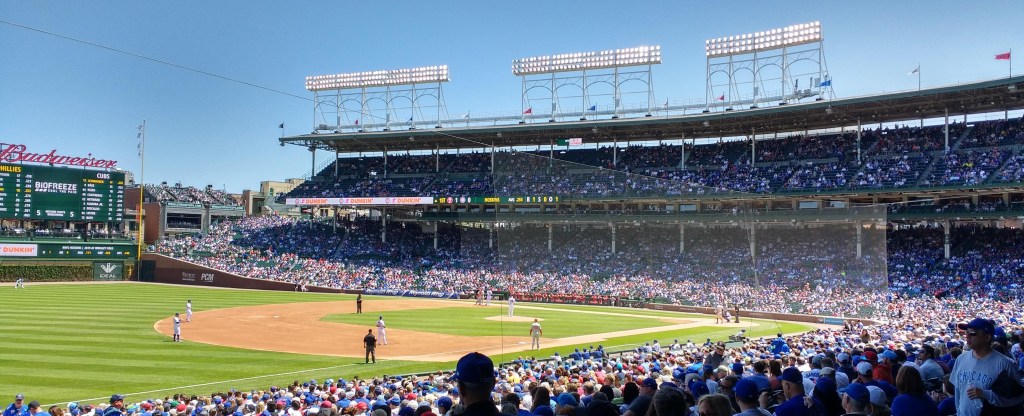
Baseball has taken significant steps this season to shorten the game through new features like a clock for pitchers and batters. A growing consensus over recent years has suggested fans want shorter games. College football is considering shortening games. However, in the absence of data I have encountered about what fans actually want, I wonder if it is really about shorter games. These might be two other options that sports fans in America want:

-More action. Studies have shown sports like baseball and football actually do not have much game action across the multiple hour experience. Pitch clocks make the action happen quicker but do not necessarily mean there will be more balls in play or runners on base. Baseball has moved in recent years to more three true outcomes: strikeouts, walks, and home runs. These involve limited action.

-A higher action to time ratio. Perhaps what fans want is not shorter time but more action within the time of the game. Shortening the time with no change to the action would provide a higher ratio. Shortened times plus more action would further increase the ratio. Other sports have more flow or continuous action, like hockey or soccer (though many American fans might consider these action low-stakes or boring action). Or, watching a condensed game where the time between all pitches or all football plays is removed can be an interesting experience.

I suspect there might be plenty of experimentation in the coming years regarding finding formulas for sports in order to retain or attract the attention of fans. This will also happen with ongoing interaction with other forms of entertainment that offer different experiences and timelines.

Eleven years to complete Bay Bridge, 4 minutes to watch time-lapse video of its construction

The Bay Bridge connecting San Francisco and Oakland is a key traffic artery. The bridge opened recently and you can watch a time-lapse video of its long and expensive construction here. Quick thoughts:

1. This is an impressive undertaking. San Francisco Bay is a large body of water with lots of shipping. But, I’m usually impressed by big infrastructure projects.

2. This illustrates the problems that arise when so much traffic is dependent on one bridge. While there are other bridge options to get over the bay, they are out of the way to the north or the south for reaching much of San Francisco.

3. The new span is much better aesthetically. The old bridge was a truss structure that didn’t look very impressive. The new bridge has cable towers and the more minimalistic look is good. I look forward to seeing it from the waterside on my next trip to San Francisco.

3. The music on this official time-lapse video could be better. As an official video, it is likely that the music is licensed from some provider. However, it is rather bland rather than inspirational.