How watching the TV show “Cribs” affected what viewers expected from their own homes

What did Cribs teach viewers about homes?

Photo by Hongyue Stone-Jon Lee on Pexels.com

The show’s audience of Millennials, coming of age in an era defined by consumption, learned to take their cues from celebrities. These role models accumulated traditional markers of wealth while also having fun subverting them: In their respective episodes of Cribs, the That ’70s Show actor Wilmer Valderrama highlighted red Solo cups and paper plates on display in a china cabinet, and Missy Elliott gestured to her decorative, seminude Greek statues, remarking, “Naked a-s-s all around the house.” The show featured nouveau riche celebrities who proudly referred to themselves as outsiders; the rapper Juelz Santana was still a “hood dude,” and the record producer Master P claimed that he’d come “from the ghetto.”

These scenes were designed for the average young viewer to enjoy, yet their appeal was offset by their unattainability. Even the celebrities themselves hadn’t always attained Cribs’ vision of the so-called good life. On occasion, the show constructed complete fantasies: Bow Wow and 50 Cent supplemented their car collections with luxury rental vehicles, and the singer JoJo presented her uncle’s lake house as her own. On camera, T-Pain and Missy Elliott admitted to staging their homes—with a frosted cake and a colony of goldfish, respectively—several hours before filming. These contrivances became so well known that, in 2009, the All-American Rejects guitarist Nick Wheeler spent much of his appearance mocking them. “I went down to Enterprise and picked up what they had,” he said, standing beside his Mitsubishi and Mazda sedans, before flaunting his notably sparse kitchen. “I didn’t just do this for Cribs,” he said, evoking an earlier episode in which Kim Kardashian insisted that the cookies on display in her kitchen were homemade, despite their striking resemblance to a popular prepackaged variety…

The secret of Cribs, though, was that even amid its less relatable moments, the show found a way for viewers to feel included in the fantasy: It taught the audience what to consume as well as why they should, by demonstrating how a person’s property—both its literal value and its aesthetic qualities—could define them. Viewers could seek to understand a celebrity’s personality by studying their domestic environment. “The subject of house furnishing is more important than is often realized,” said the Cribs companion book, explicitly articulating this connection:

Everyone is free to change his surroundings. Hence the furniture and the decorations of a house, and the condition of the house and grounds, are properly considered as index to the character of its occupants.

It sounds like one lesson is that the ways someone inhabits a space says a lot about them. Sure, some people have more resources to work with but decorating a home is about self-expression. The homeowner gets to narrate their choices and what they are trying to say about themselves. (Now I am wondering how often this happens when someone provides a house tour to someone visiting; is the focus on the residence or what the house says about the people living there?)

At the same time, I wonder if the size of the dwellings depicted and the amount of things within those spacious spaces affects viewers. I first read sociologist Juliet Schor’s book The Overspent American in graduate school. She argues that watching television shows helped shape what Americans expected from homes. If you watch a typical drama or sitcom, you tend to see people living in large residences with nice furnishings. With Americans watching a lot of television in the postwar era, they could consider the characters on television as a reference group. Rather than just looking at family or neighbors for what is normal or possible regarding housing and consumption, they could now turn to TV depictions of regular life. For example, how did those young adults on Friends afford those apartments and lifestyles? Did regular viewers of Cribs then envision larger homes for themselves?

I have not read any studies that look specifically at that question: did watching specific television shows directly affect choices about where to live? Broader data can look at the possible relationship between how many hours of TV people watched and their consumer choices. Did watching Cribs or HGTV or any number of shows that prominently feature well-appointed spaces change real behavior, and if so, how?


How to make Toronto’s suburban streets look like Chicago’s suburban streets on screen

A new Peacock show on John Wayne Gacy filmed many scenes in Toronto but wanted them to look like Chicago. Here is how they did it:

Photo by Andre Furtado on Pexels.com

The series was filmed largely in Toronto, though the sets bear a striking resemblance to Chicago’s suburban sprawls in the 1970s. Macmanus works with a private researcher, Patrick Murphy, on most projects; Murphy scoured local reports from the Chicago Sun-Times and the Chicago Tribune, as well as news footage, and produced a “great bible of photos” that was passed off to the production team to scout and replicate.

And they needed the scenes to look like a particular Chicago neighborhood (Norwood Park):

“I didn’t realize how close he was to O’Hare. That was just shocking, in the sense that he truly was hiding in plain sight. The house wasn’t in some remote area, it was a suburban street like so many other suburban streets, with houses right next to each other, right next to the airport,” Chernus said in a recent chat over Zoom.

Will the average viewer be able to tell that the filmed scenes are in Toronto and not actually in Chicago? Probably not. If the production team found similar settings and then adds a combination of establishing shots and internal sets (that could be located anywhere), it may be hard even for people with lots of Chicago experience to spot differences.

I have heard people suggest Toronto and Chicago are similar in character (and population). How much harder would it be to make it look like Chicago if it were filmed in Vancouver (a common Canadian setting for American production) or Atlanta (still in the same country but different landscape) or another American city with bigger tax breaks?

Is there any evidence that filming in the actual location improves the final product? If filming elsewhere is about saving money, what could be gained by filming on location in Chicago? Are there particular producers or networks that prioritize filming in the actual location?

A show set in a Detroit suburb filmed in Atlanta

The recently-cancelled TV show Grosse Pointe Garden Society was set in the Detroit suburb Grosse point but it was filmed elsewhere:

Photo by u041eu043bu044cu0433u0430 u041fu0443u0441u0442u043eu0432u0441u0438u043au0445 on Pexels.com

NBC’s recent cancellation of the quirky, stylish mystery made it official that the bloom was off the primetime show set in suburban Detroit. Premiering in late February, “Grosse Pointe Garden Society” wrapped its first season in mid-May, leaving behind 13 episodes about four members of the green-thumbs club with secrets buried amidst the greenery…

Although “Grosse Pointe Garden Society” looked convincing in its stately affluence, the actually series was filmed in Atlanta because of Georgia’s film tax incentives.

Can one wealthy suburb or neighborhood be easily swapped for another? I have not seen the TV show but I can imagine some of the ways this could be done. Establishing shots from one place while close-up action filmed elsewhere. A limited number of views of the community or neighborhoods or exteriors. Using studios or back lots.

I wonder if there are signs on the show that it is not actually filmed in Grosse Pointe. Differences in architecture? How about local trees? A lack of wear and tear on vehicles from winter that would be present in Michigan but not in Georgia?

This happens all the time on TV shows and in films: they are said to be set in one place but are filmed in other places. Perhaps the average viewer cannot tell the difference between the two or does not notice. Maybe it does not matter in many cases as the primary action follows a set of characters and the setting is just in the background. But if a show is named after a specific place, might it help a little to film it in that place?

Americans will watch TV where they could learn something – if it is competitive

Could the Spelling Bee bring Americans together? One commentator makes the case:

Photo by Nataliya Vaitkevich on Pexels.com

The Spelling Bee is the rare event that would get people to tune in due to word of mouth. It would become the rare communal event in 2024.

You have to watch it live.

Thursday night, the Spelling Bee went to a lightning-round tiebreaker and 12-year-old seventh grader, Bruhat Soma, came out on top.

Sounds awesome. It would’ve been fun to watch it with everyone else.

That is a tall order for the fragmented world – entertainment-wise, politically, socially, economically – of 2024.

Jeopardy! is another show that comes to mind as contestants show off their knowledge and win money. It has a good audience and show happenings can generate strong online/social media debate.

But how many shows involving learning or knowledge would Americans watch if there was not competition? Can learning itself make for compelling television?

Friends was almost exclusively filmed on studio backlots

Friends is a television show closely tied to New York City. Yet, almost all the show was shot in Hollywood studios:

Photo by Nino Souza on Pexels.com

Although the producers always wanted to find the right stories to take advantage of being on location, Friends was never shot in New York. Bright felt that filming outside the studio made episodes less funny, even when shooting on the lot outside, and that the live audience was an integral part of the series.[58] When the series was criticized for incorrectly depicting New York, with the financially struggling group of friends being able to afford huge apartments, Bright noted that the set had to be big enough for the cameras, lighting, and “for the audience to be able to see what’s going on”.[58] The apartments also needed to provide a place for the actors to execute the actions in the scripts.[58]

The fourth-season finale was shot on location in London because the producers were aware of the series’ popularity in the UK.[58] The scenes were shot in a studio with three audiences each made up of 500 people. These were the show’s largest audiences throughout its run. The fifth-season finale, set in Las Vegas, was filmed at Warner Bros. Studios, although Bright met people who thought it was filmed on location.[72]

The show has a close tie to New York City. Could Friends have even existed in another American city? If it had been in Chicago or Atlanta or Austin, would it have been the same show or had the same success?

Yet, almost all of this was done with away from New York City. It was filmed in an environment that could be made to look like New York.

I would guess most viewers do not care whether the show was filmed in New York; it was set in New York, it had enough to look somewhat convincing of being in New York, and that’s enough. I, however, find this disconnect interesting as it commonly happens in TV shows and movies. When we see a “place” on screen, is it really that place?

Depicting Chicago’s public housing residents on a 1970s sitcom

Set in Chicago’s Cabrini-Green public housing project, the TV show Good Times first aired fifty years ago:

Photo by Huu1ef3nh u0110u1ea1t on Pexels.com

This year marks the 50th anniversary of the groundbreaking Good Times sitcom on CBS, which ran until 1979. Mike Evans, who played Lionel Jeffferson in The Jeffersons, and Chicago native Eric Monte created the television show, which the legendary Norman Lear developed.

The opening credits showed an aerial view of the red towers with Chicago’s skyline in the background as its iconic gospel-tinged theme song played. Good Times was an honest depiction of a loving Black family trapped in poverty. The show never shied away from racism — whether taking on crooked Chicago politicians, critiquing the lack of jobs in African American communities or being unapologetic about racial pride. And the youngest son, endearingly dubbed the “militant midget,” aspired to be on the U.S. Supreme Court.

White American sitcoms often depicted a sanitized version of real life, a la Father Knows Best, The Donna Reed Show and The Adventures of Ozzie and Harriet. By contrast, Good Times did not…

While the show has been lauded, it also has taken in criticism over the way the family was depicted in a never-ending cycle of keeping their heads above water. Walker’s character, J.J., became the breakout character, but some saw his portrayal as playing to a negative stereotype with his signature “dynomite” line. Amos has said he was fired from the show because he spoke out against some of the stereotypical elements of the show.

Public housing is not generally popular in the United States. More popular is the ideal of owning a single-family home in the suburbs. TV networks and producers have put together an endless stream of shows depicting families living in suburban homes; fewer shows portray life in public housing. To depict people living in public housing on a show that was popular is a feat in itself.

Today, a low percentage of people in the United States live in public housing. According to the U.S Department of Housing and Urban Development, there are roughly 970,000 public housing households. What would a Good Times type show in 2024 look like in terms of depicting their experiences? In a more fractured media landscape, could such a show find a decent-sized audience?

Tax breaks and Chicago suburban locations standing in for other locations in films and TV shows

The state of Illinois offers tax breaks for filming in the state. This means the Chicago suburbs can stand in for numerous other locations:

Photo by Stephan Mu00fcller on Pexels.com

The state’s film production tax credit allows qualified productions to receive a 30% transferable tax break on most production costs and certain salaries. Producers can also receive 15% more for hiring workers living in “economically disadvantaged areas.” In return, these productions generate jobs and draw business from outside the region.

According to a new report commissioned by Dudley’s group, the state’s film incentive is the biggest box office draw for Hollywood. A survey of producers included in the report indicates more than 90% of the productions shot in Illinois would not have occurred without the incentive…

Producers of the television series “Fargo” used Elgin and other suburban locales as a stand-in for Kansas City a few years ago. Acclaimed director David Fincher turned downtown St. Charles into upstate New York for his recent Netflix film, “The Killer.” And parts of Warrenville and Lockport are used as substitutes for Manhattan, Kansas, in the HBO series “Somebody, Somewhere.”…

This commonly happens in movies and television shows: a filming location stands in for another place. This could include filming on a backlot or in another city or community.

Yet, it still is a strange experience to see a location you recognize on-screen that is supposed to be somewhere else. Imagine you live in a suburb listed above. These communities have their own history roughly 30-40 miles outside of Chicago. They exist alongside dozens of other suburbs. But, you could be watching what is supposed to be Kansas City and you recognize this suburb. Or, Manhattan, Kansas is on-screen and it happens to look like Lockport. Do these geographic switches make the on-screen presentation less real? How many people notice the disconnects?

The article also emphasizes the role of finances: tax breaks help drive where filming takes place. I assume there are also efforts to try to make sure the stand-in location looks similar to what is supposed to be depicted. Do certain suburbs make good stand-ins for all suburbs or are particular metropolitan regions good to offering the variety of locations studios might want?

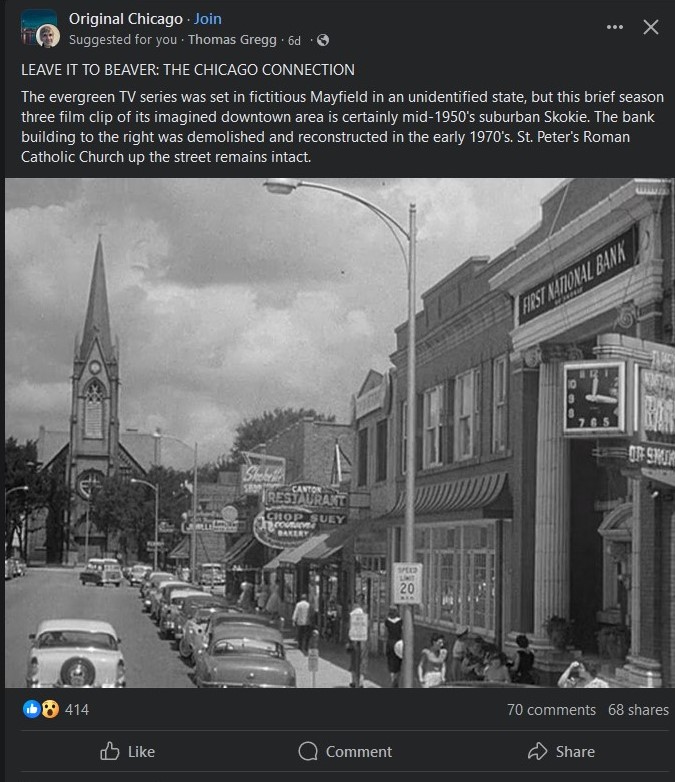
Leave It to Beaver’s downtown and Skokie, Illinois

Television shows may use a variety of settings to film scenes. Given my research on suburbs depicted on television, this example struck me as it combines a famous suburban show and a Chicago suburb:

A variety of websites back up this claim (IMDB, blog). The first home in the show, what I describe as having “two stories, a one-car garage, three bedrooms, and at least two bathrooms (Bennett 1996),” was on a Universal Studios backlot. The show is often held up as an exemplar of suburban-set TV shows in the postwar era yet I noted that it “ran six seasons but never cracked the top 30” most popular TV shows.

As a fictitious show set in an unnamed community, it is interesting to consider why Skokie might have been chosen. Was there existing footage that could be used? Did someone connected to the show or studio have a personal connection to Skokie? Did Skokie represent the experiences of American suburbs at this time? Would someone watching the show then or now see this scene and connect to particular places?

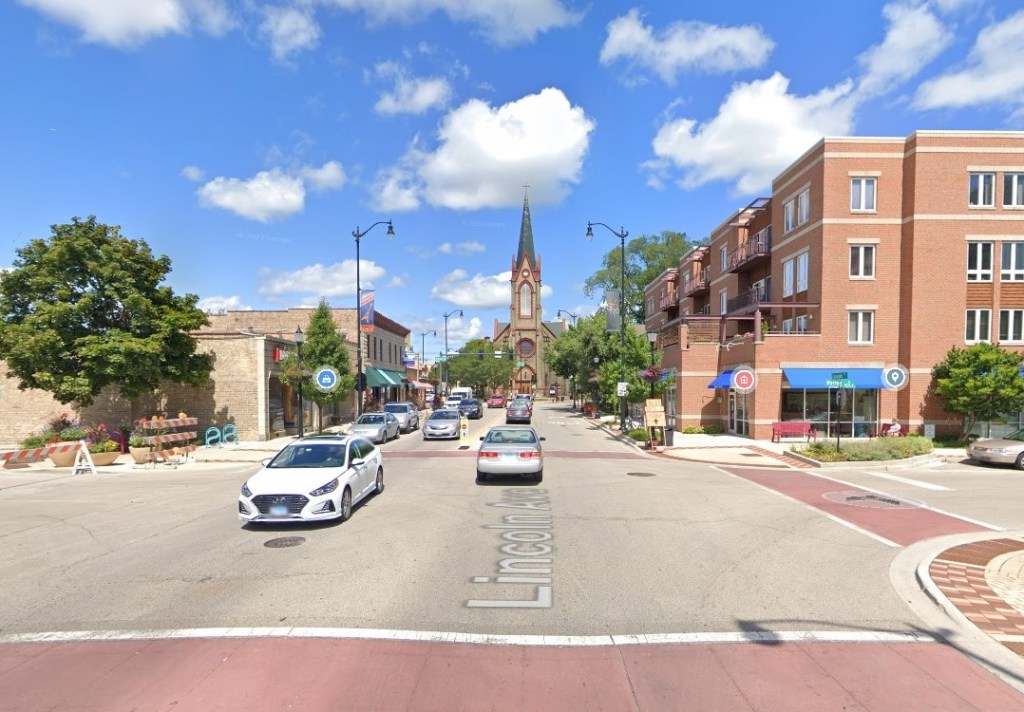
Here is a similar view from Google Street View in August 2019:

The sort of construction on the right – what looks like mixed-use four-story buildings – is common in suburban downtowns where they hope that increased numbers of downtown residents will patronize local businesses and restaurants in addition to those who want to visit such locations. These streetscapes have often replaced one- to two-story structures such as those in the top image.

Cannot unsee the studio backlot, snowy Christmas commercial edition

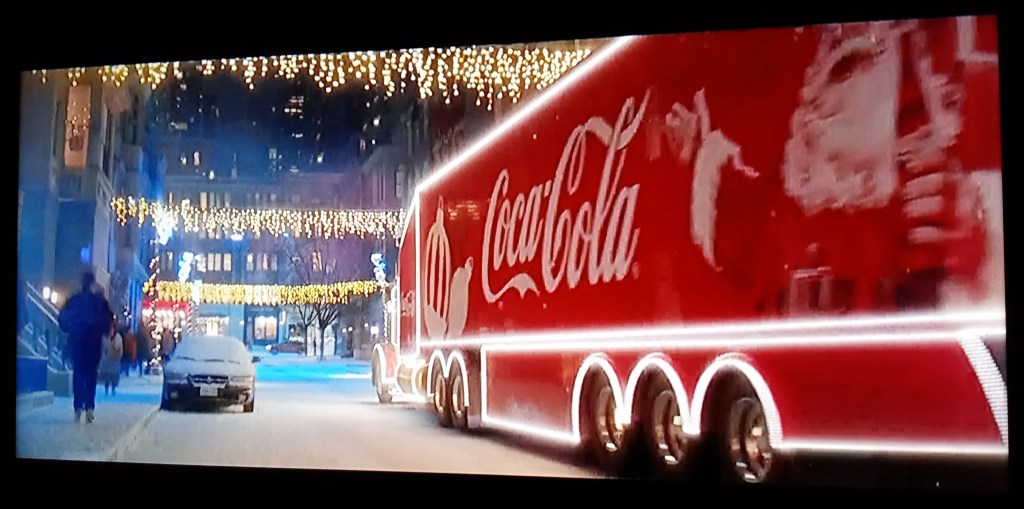
After touring several Hollywood backlots years ago, I see them pop up in many places. Here is a Coca-Cola television advertisement with a closing scene from a southern California backlot:

I am pretty sure that this scene was filmed here.

On one hand, it is exciting to be watching a film, TV show, or commercial and recognize a place. It pops out at you out of the other anonymous scenery. On the other hand, this is not a real place. It is a backlot where all sorts of “places” can be made. With some work and added elements, these backlots can look like a lot of different places.

As I have found in studying suburbs on TV shows, places are presented on screens in particular ways. It is hard to communicate the feel and experience of a place on a two-dimensional screen when the emphasis is often on a few characters. Backlots can be changed up but if you know what you are looking for, you can spot them in all sorts of displays. Or, films, shows, and commercials tend to be shot in some places and not others. With these patterns, we do not necessarily see real places or the range of places within the United States.

Barbie could only live in the Los Angeles region

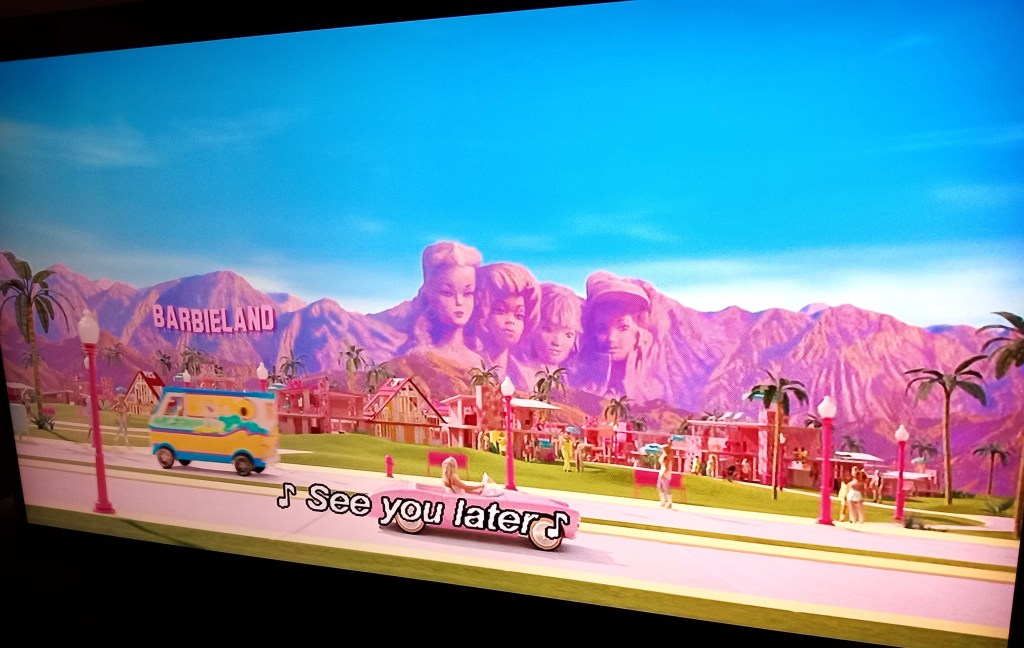
Barbie is one of the most famous toys and she resides near Los Angeles. Could she live anywhere else? I pondered this when seeing Barbie:

This scene, along with others in the movie, firmly place Barbie in and around Los Angeles. There are palm trees. Beach scenes along the ocean and boardwalk. The mountains looming in the background. A replacement for the “Hollywood” sign. Her dreamhouse is in Malibu.

Could Barbie live in other locations? How about Manhattan Barbie? Atlanta Barbie? Omaha Barbie? These are harder to imagine. Barbie has a lifestyle tied to a postwar vision of the American Dream exemplified by life in Los Angeles. She was not alone; TV shows endlessly showed life in southern California, Disneyland first opened there, and sprawling suburbia became a model.

A new city and/or region could become the marker of a new era and new toys. Perhaps Houston? A different city that will grow rapidly and look different or exhibit different patterns of life and development?