Suburban moratoriums on data centers and warehouses; what might be built instead?

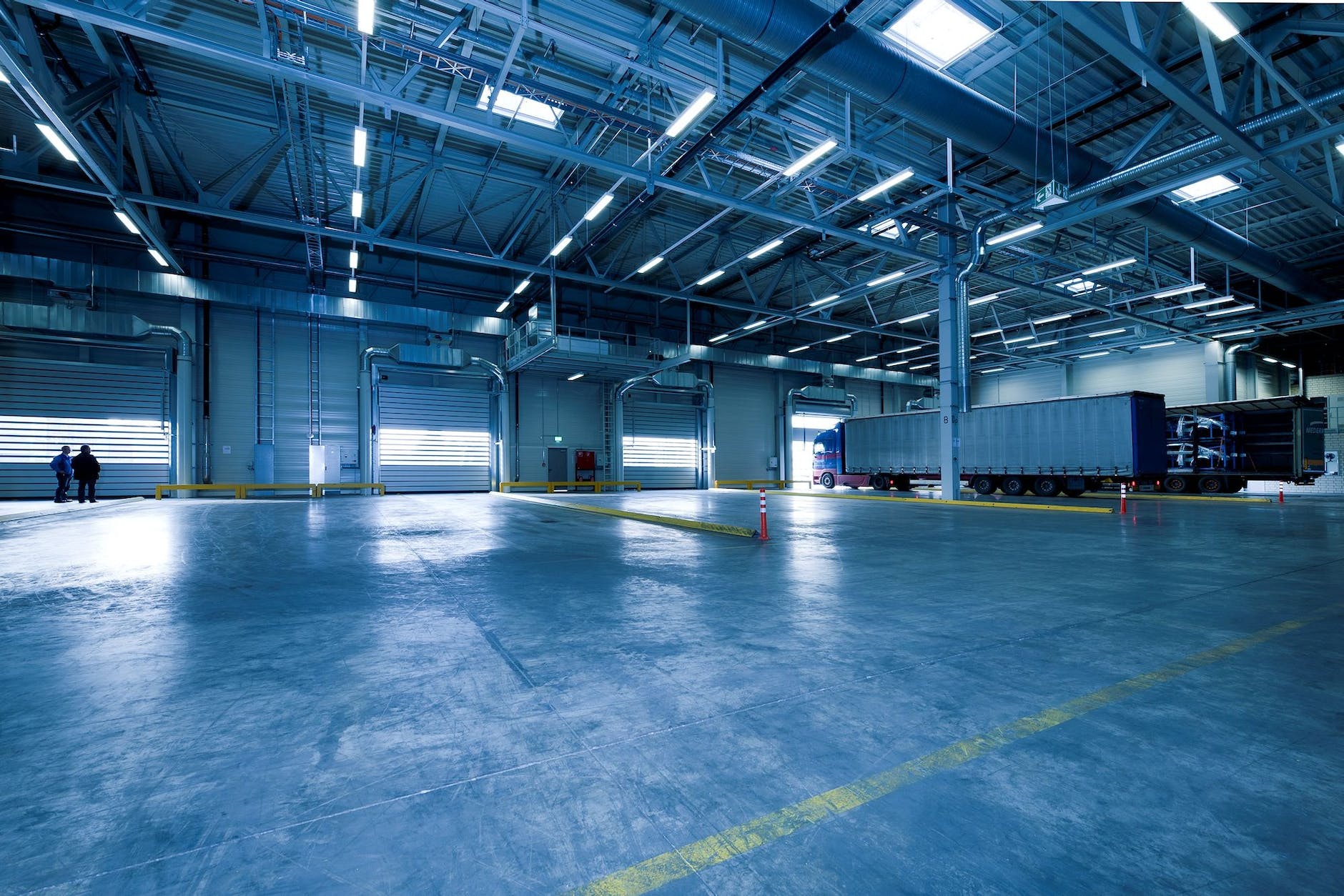
The suburb of Aurora has put a temporary hold on approving data centers and warehouses in the community:

Photo by Field Engineer on Pexels.com

Such concerns led Aurora’s city council to enact a temporary zoning moratorium on data centers as well as warehouses. Mayor John Laesch made clear officials are not against data centers as a whole.

“It’s just trying to give us time to make sure that we have the proper guardrails in place,” he said.

In neighboring Naperville, at least one city council member said he’s exploring the idea of a similar pause.

My longer-term question for Aurora, Naperville, and suburbs with similar concerns: what will they approve for the land that might be used by data centers and warehouses? Several options they could pursue:

  1. Green or open space on this land. This might be hard to do with land zoned for commercial and industrial use as suburbs hope such land will generate tax revenue and jobs. But residents might like this option if the alternative is something that generates noise and traffic.
  2. Pursuing office space or industrial uses with limited noise and pollution. The problem with this could be whether there is demand for such structures. How much vacant office space is there already in office parks and buildings along I-88? How long could a community pursue these options if the market is not favorable?
  3. Approving housing. There is a need for housing in the Chicago area and both Aurora and Naperville have experienced population growth in recent decades. But what kind of housing – expensive units without too many kids (so as to not burden local school systems)? Housing for seniors or young professionals? Affordable housing? Would neighbors like more housing – noise, traffic, potential water issues, etc. – near them?

Perhaps some suburbs can wait this all out. Will the boom in warehouses and data centers end at some point? If some suburbs say no to data centers and warehouses, they will end up somewhere. Will the warehouses end up not being in wealthier suburbs?

A vast majority of Americans within range for a 3 hour or less delivery from Walmart

If Walmart’s rise in the decades at the end of the twentieth century included logistical prowess, their CEO recently discussed how many Americans can get quick deliveries:

Photo by Artem Podrez on Pexels.com

CEO Douglas McMillon announced that Walmart is close to reaching 95% of the U.S. population with three-hour or less delivery, with a 91% increase year-over-year in deliveries under three hours in Q1.

This is remarkable to consider: 95% of over 340 million Americans can be reached by a Walmart delivery within 3 hours. Need something from Walmart? It can get to the vast majority of Americans within 180 minutes.

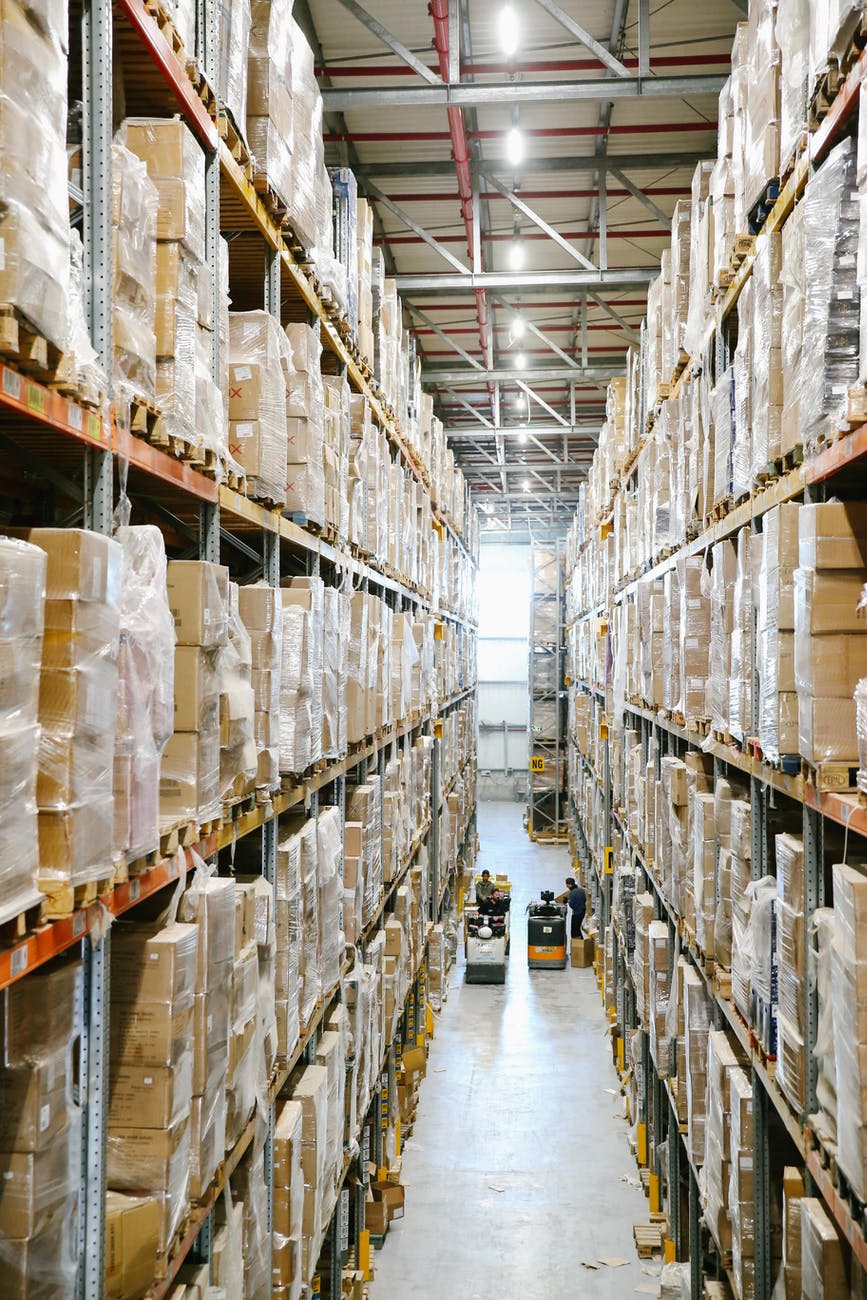
What is required to make this happen? Numerous locations, including warehouses and stores. Lots of employees and equipment. A strong inventory system. And more.

With this level of delivery possible, how does this change the calculus regarding all of the Walmart stores? Will fewer people visit them in the future because they prefer delivery? Will more of these stores be about deliveries rather than in-person shopping? Could Walmart significantly reduce its store footprint while continuing to extend its reach?

Proximity to population centers means warehouses for rural areas

If you live in a rural town in the United States that is close to a number of population centers, warehouses may be in your future (if they are not already):

Photo by ELEVATE on Pexels.com

Shippensburg, Pennsylvania, and nearby rural towns like it are being drastically transformed into distribution hotspots for major retailers like Amazon and Walmart – to the dismay of some longtime residents.

With its endless acres of farmland, the tiny town is seemingly the perfect location for huge warehouses – and it is at most a day’s drive away from one-third of the US population and half of Canada‘s, making it the ideal delivery truck epicenter…

P&G, which owns Charmin, Crest, Gillette and Pampers, was one of the first to do so in 2014, followed by Amazon.com, DHL, FedEx, Home Depot, Kohler, Lowe’s, Office Depot, Pepsi, SC Johnson, Staples, Target, Ulta Beauty, Unilever and UPS, among many others…

What’s happening in Shippensburg is similar to what’s already happened to California’s Inland Empire, which used to be a major center of agriculture. Now, this area of southern California is the nation’s warehouse capital, home to Amazon and Walmart facilities.

Take out a map, draw circles around major population centers, and see the places where these circles intersect. That places like Shippensburg could be so close to so many people marks it for these changes.

This could help remind people of the ongoing connections between cities and rural areas. In today’s changing world, it is not just about farming versus commercial and industrial activity; the two spaces are tied together by trade, social networks, and an awareness of each other.

Turning down a big proposed warehouse, thinking about affordable housing for certain members of the community

The spread of warehouses in suburban areas can meet opposition:

Photo by Thijs van der Weide on Pexels.com

For the second time in less than a year, the Geneva Planning and Zoning Commission is recommending the denial of a request to allow a 719,200-square-foot warehouse on the northeast corner of Kirk Road and Fabyan Parkway.

The commission voted 4-1 Thursday against Venture One Acquisitions LLC of Rosemont’s requests to amend the city’s comprehensive plan for the 55.62-acre site, changing it from rural single-family residential to light industrial, and approving a site plan.

If not warehouses at a site of suburban open space, what else could go there?

Walendziak said the east-side residents do not want more diesel pollution and truck noise.

“What the residents do want is residential,” Walendziak said. “We need affordable housing in Geneva. This is one of the last big sites left. … Housing for starting families, for seniors that they can afford to stay living here in Geneva.”

Commissioner Mim Evans also suggested that housing is the best use for the site.

“We need housing in this town, even if it isn’t technically affordable housing,” Evans said. “Housing is needed everywhere at every price point, at every level of density.”

If warehouses are the enemy – traffic, noise, out of character for a community due to their scale and industrial aspects – then housing may be more desirable. And housing for certain people groups, including families or young professionals starting out and older residents of the community who want to downsize and stay.

It may be helpful to look at the longer trends. Suburban residents and leaders have had heated debates about land use since at least the beginning of the postwar era. Big proposals could generate conversations about what the community could become. Community needs shift over time as social and economic conditions change.

At the same time, I wonder if there is extra urgency these days due to two factors. First, many suburbs have few large parcels left. This means that decisions like those above feel extra consequential. Second, housing prices are high enough in many places that people want to protect their housing values and extend housing opportunities to certain people.

Figuring what happens with this particular property might take years from additional discussions to planning to actual construction.

Want goods delivered quickly? There are numerous local impacts

An overview of warehouse construction in southwest Chicago and southwest suburbs highlights a current conundrum in American life: people want cheap goods delivered quickly to their home or business. But, making this happen has consequences for neighborhoods and communities. Here is how the article ends:

Photo by Craig Adderley on Pexels.com

Whatever the outcome, Archer Heights and Joliet already illustrate one of the stark lessons of Chicago’s warehouse boom — that Americans can’t expect to enjoy the benefits of rapid, ever-growing freight shipments without paying for the necessary infrastructure and without encountering increasingly sophisticated demands from the towns being smothered by trucks.

Some of the listed negative consequences of all this trucking and shipping: traffic, noise, air pollution, extra stress on roads, and industrial neighbors for residents.

The primary positive consequences for a community: money from the land use and local jobs. The indirect consequence for many inside and outside the community: goods get to them faster.

Is it worth it? Would it work better to have giant shipping and trucking zones outside metropolitan areas where the pollution and noise and traffic could be minimized for nearby communities? This would require both foresight and resources. It reminds me of airports that are now surrounded by development or other major necessary infrastructure that is now folded into metropolitan landscapes.

Could one city or region figure this out? Imagine a special trucking and train zone outside of the metro region. The transportation actors get some tax breaks to locate there. The revenues from the land use are shared throughout the metropolitan region. Some current facilities are relocated to the new area.

Trucking may be essential to the American economy but it does not necessarily have to conflict with goals local residents and leaders have for their communities. It would require acting creatively and quickly to move shipping facilities away from people.

When you can build a suburban warehouse where an office building used to stand

With less demand for suburban office buildings, the void is being filled with warehouses. One example from the northern suburbs of Chicago:

Photo by Pixabay on Pexels.com

The old Allstate campus was a traditional suburban office environment with lush landscaping, reflecting ponds and thousands of workers. That property now is called the Logistics Campus, a massive industrial development underway in Glenview…

“The ability to put modern industrial in the middle of an established community — it’s unique in the sense that there will be very few other sites of this size that can replicate what we’re doing,” said Neal Driscoll, Dermody’s Midwest region partner.

Development of big-box industrial space in the Chicago region set a record in 2023 with construction of 70 buildings totaling nearly 33 million square feet, according to a recent report by commercial real estate company Colliers International.

The shift to warehouses in the suburbs has been going on for a while. What I noticed in this story was this thought: the unique opportunity to put warehouses (“modern industrial”) in “an established community.” Translation: many upscale suburbs would not chose to put in warehouses. They might generate noise and traffic. They do not provide many white-collar jobs. They are not attractive buildings.

But, empty office parks are also not desirable. Suburban offices or headquarters for Fortune 500 companies are attractive: quality jobs, status, most likely a glass building. No one working in these buildings and companies leaving these spaces leads to issues.

Thus, warehouses might now be found in communities that would not necessarily select them if they had such options. A set of warehouses might be preferable to vacant office buildings or unwanted office buildings. Figuring out the best land use or zoning in a suburb can be less about the most ideal use of land but rather about the possible alternatives at that moment.

Call them “logistics centers” rather than warehouses and I do not think suburbanites will like trading suburban HQs for them

With reduced demand for large suburban office buildings and headquarters, properties around the Chicago region are turning into logistic centers:

Photo by Pixabay on Pexels.com

Catalyzed by the pandemic, the demise of corporate campuses has created a development explosion, as dormant office space is transformed into industrial use for the digital age. Data centers provide the infrastructure for online commerce, while logistics centers deliver the goods to your doorstep.

The warehouse facilities also deliver tax revenue for municipalities, construction jobs and depending on the use, some permanent jobs as well. But the economy-boosting days of 5,000 employees descending on a community may be a thing of the past…

Chicago has the most transportation, distribution and logistics firms in the U.S., and Illinois ranks No. 4 among states with 20,500 companies employing more than 331,000 people, generating nearly $39 billion in annual economic output, according to Intersect Illinois.

In October, with many of its 5,400 Chicago-area employees working remotely, Allstate sold its north suburban corporate campus along the Tri-State Tollway for $232 million to Dermody Properties. The Nevada-based developer is turning the 232-acre property, which was annexed by Glenview, into a 10-building, 3.2 million-square-foot logistics park…

The project, which is expected to cost more than $500 million including land acquisition, will be one of the largest urban logistics developments in the U.S., bringing a projected 1,900 jobs, a new streetscape and vastly different traffic patterns than the former insurance headquarters.

It is best to state this at the outset: empty properties are not desirable in suburbs. Even if something is paying the property taxes, empty properties decrease the status of a community and do not bring in additional benefits like jobs and tax revenues.

That said, many communities and suburbanites would see the trade from a prestigious headquarters or office park to warehouses as a big downgrade. They will not be fooled by calling them “logistics centers.” Gone are white-collar jobs and a Fortune 500 company. In are trucks, traffic, and blue-collar jobs. Gone are steel and glass buildings that signify progress and higher status. In are preformed panels and boxy structures. Residents like having goods delivered to them quickly but they do not necessarily want to see the fulfillment and delivery process happen next door.

The truth is that not every community will attract developers who want to build a large mixed-use development. Or, waiting for a developer who has an attractive idea and does not want too much public money might take a long time. Some communities will move faster than others to turn vacant structures into working properties. Others will resist and be able to turn down these options.

But, the spread of warehouses in suburban areas to even middle- and upper-class suburbs means changes for these communities. Once marked by pristine offices serving as status symbols, some of these communities will now be home to logistics centers sending out goods far and wide.

Amazon was opening a warehouse every 24 hours…but not now

Amazon was building warehouses at a rapid pace during COVID-19:

Photo by James Anthony on Pexels.com

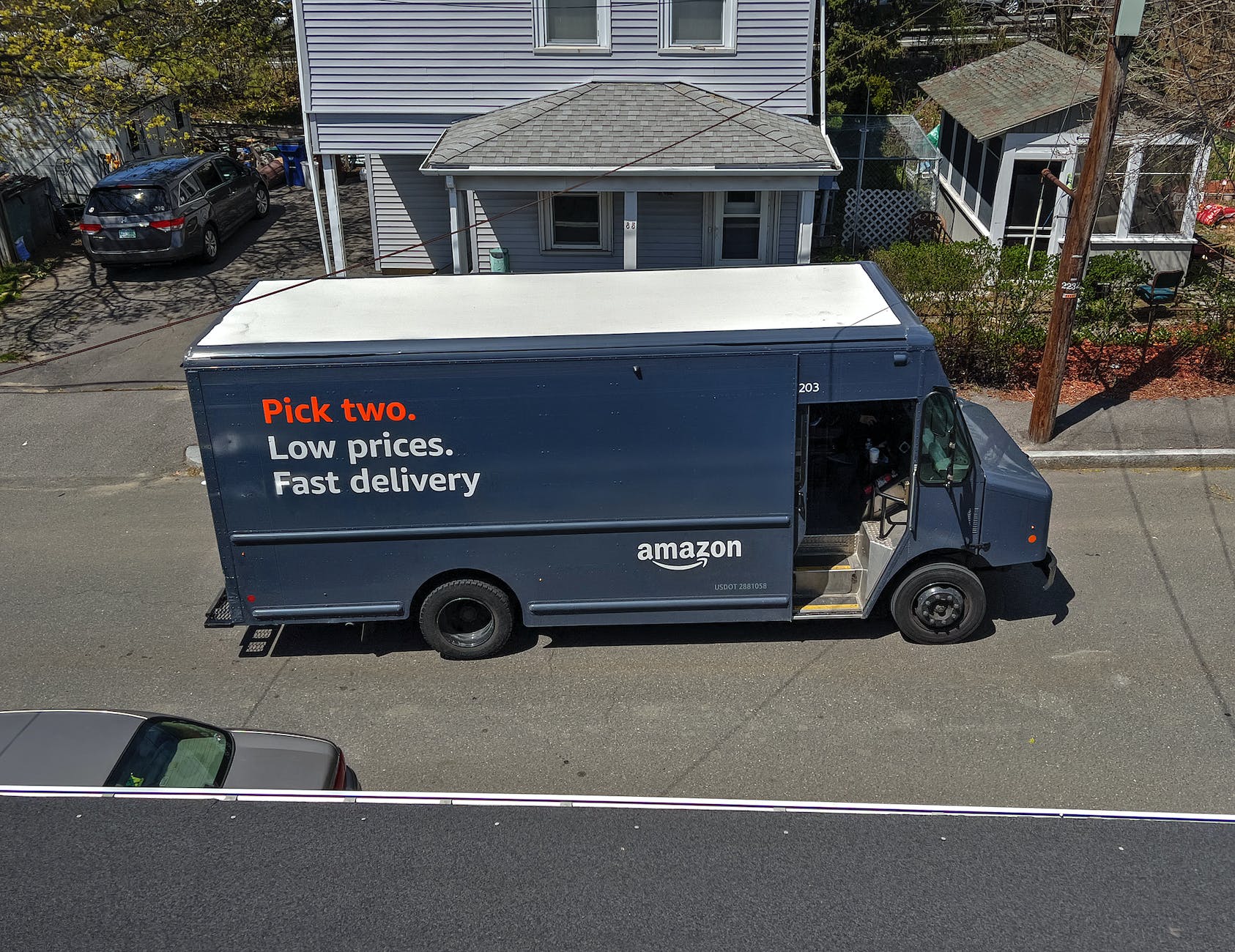
When homebound shoppers stampeded online during the pandemic, Amazon responded by doubling the size of its logistics network over a two-year period, a rapid buildout that exceeded that of rivals and partners like Walmart Inc., United Parcel Service Inc. and FedEx Corp. For a time, Amazon was opening a new warehouse somewhere in the U.S. roughly every 24 hours. Jassy told Bloomberg in June that the company had decided in early 2021 to build toward the high end of its forecasts for shopper demand, erring on the side of having too much warehouse space rather than too little. 

But, now the opposite is happening:

MWPVL International Inc., which tracks Amazon’s real-estate footprint, estimates the company has either shuttered or killed plans to open 42 facilities totaling almost 25 million square feet of usable space. The company has delayed opening an additional 21 locations, totaling nearly 28 million square feet, according to MWPVL. The e-commerce giant also has canceled a handful of European projects, mostly in Spain, the firm said.

The scale of this is worth marking: a new warehouse every day.

Companies act in such ways given economic conditions. Yet, these are not just business decisions; they affect communities. As Amazon rapidly expanded, many communities sought out such a facility and/or offered tax breaks and incentives. This happened in the Chicago region. If Amazon contracts, this affects local decisions and revenues.

As conditions change, will communities operate differently toward Amazon or will they reassess their approach to attracting businesses, jobs, and revenues? Many communities would still probably prefer to have an Amazon facility in the long run but they may be harder to entice or the competition might be stiffer. Or, if Amazon facilities come and go, they might be inclined to look toward other firms or industries.

More warehouses coming to the Chicago region

Chicagoland will be adding a lot more warehouse space in the near term:

Photo by Maor Attias on Pexels.com

Molto plans to break ground this month on a 1.1-million-square-foot distribution facility, the first phase of its 110-acre Minooka Ridge Business Park in Minooka, a village near I-80 and southwest of Joliet. The company is also developing Weber55 Logistics Park, a two-building complex on 60 acres at the northeast corner of Weber and Taylor roads in Romeoville, another Joliet suburb. That site will include distribution facilities of 627,840 square feet and 270,000 square feet…

Other developers are just as active. At the end of March, 44 buildings of more than 200,000 square feet, a record-breaking 23.7 million square feet in total, were underway across the Chicago metropolitan area, according to Colliers International.

And tenants are plentiful. In the second quarter alone, Amazon leased a 1-million-square-foot warehouse in Joliet, and another in Kenosha, while other companies, including NFI, SC Johnson and RJW Logistics, signed deals for more than 500,000 square feet.

The amount of big-box industrial space that is vacant in the Chicago area tanked during the first quarter of 2022 because so much space was leased or occupied. The industrial vacancy rate fell ”by more than a full percentage point to 2.61%, a record low by a wide margin,” Colliers reported.

As shopping malls and downtown brick and mortar sales struggle, warehouse space is booming. This helps service online shopping as well as big box stores.

Elsewhere in the article, the increase in warehouse space is tied to jobs and possibly cheaper prices for consumers. But, adding such space may not always work out so well in comparison to how else land could be used. And the locations cited in the article suggest Will County is a warehouse center as are other locations more on the edges of the Chicago region.

Many goods come via truck, few want to encounter those trucks on a suburban road

Trucking is essential to the American economy. However, it is not desirable to encounter many trucks on local roads. Here is how one Chicago area county wants to address the issue:

Photo by Craig Adderley on Pexels.com

“The key is really getting trucks onto the interstate as safely and efficiently as possible,” said Patricia Mangano, senior transportation planner with the Chicago Metropolitan Agency for Planning.

As the county grows and the region continues to be an important national transportation hub, the study recommends strategies to minimize the negative impact of freight traffic to residents and the environment…

The report says that high volumes of truck traffic have led to safety and congestion concerns, especially in sensitive areas such as historic districts, neighborhoods or environmentally protected areas. The study notes western Will County’s natural and cultural assets, such as Midewin National Tallgrass Prairie, Abraham Lincoln National Cemetery and the Kankakee River, could be negatively affected by new development and traffic…

“We are the proverbial crossroads of America,” he said, noting residents just want to ensure they can get from work to home to their children’s activities without being caught in traffic.

In recent decades, Will County has become home to an increasing number of warehouses and intermodal facilities. This could be viewed as a positive for economic activity and growth which then leads to more tax revenues, jobs, and prestige.

Yet, certain industries do not necessarily mesh well with the suburban single-family home ideal. Trucks are related to a number of concerns residents have about all sorts of land uses: noise, traffic, lights, threats to the residential ideal they hope for.

I see the point of routing truck traffic along particular roads. This also has the effect of altering those roads. I can think of several major thoroughfares near here that are full of truck traffic during the day. Driving on these roads can be quite different than driving on other main roads. And because the way many suburban communities are laid out, there are often not good alternative routes since traffic in general is funneled from smaller residential streets to larger volume roads.

An impractical suggestion that might please suburban residents: have truck only roads that lead from industrial and commercial properties straight to highways. In many locations, this might work as warehouses and distribution centers are clustered together as are big box stores and shopping malls. On suburban roads without big trucks, suburbanites might occasionally find the opportunity to drive like people do in car commercials: on the open road.