Another way to see if you’ve made it to the upper-middle class is to simply look at where you live. According to Rose, if “your home is in a ZIP code where folks want to live,” that’s a good sign that you’re there.
Keep in mind that it’s not all about appearances. People in the middle class might try to keep up with the Joneses — that is, they might compare themselves with their neighbors and try to match their level of wealth or status.
Those in the upper-middle class, however, do not. They don’t need to worry about whether their house is big enough or their car is luxurious enough. They can afford many of these high-end things without stretching their financial means.
Those in the upper middle class have the financial resources to live in places with higher housing prices. This means the houses may be bigger, the local amenities more plentiful, and the population more exclusive.
While the description above hints at this, why not just say that the upper middle class can afford a house that costs more? And how “expensive” is this neighborhood? In a typical metropolitan area, what percent of neighborhoods or communities are upper middle class, beyond the reach of the middle class or those around the median income and below the super wealthy enclaves?
How often then do those in the upper middle class use their community or neighborhood to signal their status? Just as a vehicle driven or a college attended or clothes worn or hobbies engaged in might signal class status, how much do they mention their community to highlight their status? If they say they live in “X,” is such a place widely known as being upper middle class?
Lately, though, there’s a rash of billionaires breaking ground on new golf clubs for reasons that seem to defy economic logic and environmental sanity. It seems they are so rich that they are willing to spend whatever it takes to build their dream playgrounds, and it’s less important, in many cases, whether the new enterprise makes money or not.
“Many are ‘financed’ by wealthy people who want to do something great, and know how to work the system to get tax breaks etc. from localities eager to have a great project providing jobs and tourism [dollars] in their backyard,” Tom Doak, the great golf-course architect, wrote on Golf Club Atlas, a popular blog, last year…
Last year, more than 25 new golf courses were opened around the country, the most in the past decade. Many of these were add-ons to existing resorts or in remote private locations, such as Mauk. Land and building costs have become too pricey to justify the construction of new golf courses and clubs in Metropolitan areas, according to the National Golf Foundation, but in remote locations like Mauk, there’s plenty of room and the costs are often low…
Ground zero of golf madness is almost certainly Florida, which has more courses than any other state in the country by far, with nearly 1,200. Between the warm, humid weather; the flat, sandy terrain; and the abundance of wealthy retirees with plenty of time and money on their hands, the state is incredibly attractive to developers. It doesn’t hurt that the rich are flocking there in droves, thanks in part to the fact that there’s no state income tax…
“It’s all about controlling the number of people who have access to maintain the quality of the experience,” Nathan explains. “That’s the funny thing about golf. Every golfer’s dream is to be on this amazing piece of land, on this perfectly manicured golf course. And to be out there alone with their group.”
I am interested to know the scale of tax breaks available for such courses. If local governments are willing to offer tax breaks, does this mean they find a golf course and associated development to be an improvement over the current state of the land? If so, how much money do they expect that course to generate (vs. how much it could generate without the same tax break or with the ongoing non-golf course use of the property)? It sounds like this is a tool for more rural areas to quickly jump start development but it is harder to know the longer-term consequences.
It would also be interesting to know what happens to golf courses and clubs long-term after they get past their opening and first generation of members. It is one thing to plan the course and see it come to fruition. Do kids and grandkids then continue that legacy or do they sell their portion? Do these courses become their own institutions that go on for generations beyond or even in different directions compared to the original vision cast?
A new list of the “Best Places to Live” was recently released. Reading through the list, I was reminded of what kind of communities often dominate the top of these lists: large and wealthy suburbs. All the top ten communities have median household incomes of over $116,000, six are over $131,000, and the top two are over $146,000.
U.S. News & World Report’s Best Places to Live rankings help readers make the most informed decisions when choosing where to settle down. Cities in the rankings are evaluated using data from Applied Geographic Solutions (AGS) and U.S. News’ own internal resources. AGS develops its core database and specialized indexes from both private and government sources, including the U.S. Census Bureau, Department of Commerce, the Federal Reserve and the Bureau for Economic Analysis, as well as state and local sources.
This data was categorized into the five indexes listed below and evaluated using a methodology determined by Americans’ preferences. The percent weighting for each index follows the answers from a February 2025 public survey in which people from across the country voted for what they believed was the most important factor to consider when choosing where to live.
Another might be that these are the kinds of communities Americans say they want. The ratings methodology above suggests this but generally Americans like, no, love, suburbs. And wealthy suburbs tend to have traits Americans like in suburbs: big houses, nice amenities, a quiet lifestyle. How many suburbanites want to be successful and then live around other successful people?
But if we keep naming the same kind of places as the best places to live, does this reinforce a particular story about places to the exclusion of other places? Many people will not have the opportunity to live in these communities, whether because of a lack of resources or ties and connections to other places within metropolitan regions. Could it be better to focus on helping more communities be places where people can thrive? Can many suburbs within a region be successful, even if they never make it to the top of lists with particular criteria?
There’s no shopping to speak of and there are barely any sidewalks to stroll on. Bradbury is almost entirely comprised of gated sub communities and homeowners associations, SFGate reported.
If you don’t already have a friend that lives there, it’s not wise to go up to someone’s house looking to make some. That’s because the town has an ordinance banning people from walking up to front doors and knocking without permission.
And since its founding in 1957, a time when the suburbs were expanding in Southern California, Bradbury and the residents who live there have said they don’t even want cars passing by to stop for even the briefest moment, urging them to keep driving.
The town is so locked down that most of the public roads that abut its borders are dead ends or run straight into tall, guarded gates with signs that read ‘Royal Oaks’ and ‘Bradbury Estates.’
The landscaping also does quite a bit to send the message that outsiders aren’t welcome, with most homes being shrouded by towering hedgerows and bushy trees.
Why? This is an small exclusive suburb. These are scattered across the American landscape where wealthy homeowners have their own community. According to the US Census, the community has 921 residents, the median household income is over $158,000, the population skews older, more than 90% of homes are owned, and over 80% of homes are worth over $1 million. The community’s website starts with text saying “Preserving Rural Tranquility” and features numerous images of the landscape and horses.
One thing wealth can do is enable people to live exactly where they want. This often involves living near other wealthy people. And this can mean putting distance or barriers between those with money and others. It sounds like this community has a variety of methods to discourage visitors who might threaten that rural tranquility, including gated subdivision, large landscaping features, no soliciting, and no sidewalks.
I recently found a list of wealthy American with the most population growth. But I noticed that the list ends with two suburbs that lost population during the time period of interest (2018-2023). I suspect this might be because how they selected the communities on the list.
Methodology: For this study, GOBankingRates analyzed suburbs to find the fastest-growing wealthy suburbs in America. First GOBankingRates found the places with a population between 25,000 and 100,000 according to the U.S. Census American Community Survey. The metro area for each location was found and only the metro areas with a population of 1 million or more were kept. With these suburbs isolated, the numerical and percentage change in population from 2018 to 2023 were found for each city using data from the American Community Survey Census from 2018 and 2023. For each location, GOBankingRates found total population, population ages 65 and over, total households, and household median income all sourced from the American Community Survey. Only places with a median household income of $150,000 or more were kept for this study. Using this data the percentage of the population ages 65 and over were calculated. The cost-of-living indexes were sourced from Sperling’s BestPlaces and include the grocery, healthcare, housing, utilities, transportation, and miscellaneous cost of living indexes. Using the cost-of-living indexes and the national average expenditure costs, as sourced from the Bureau of Labor Statistics Consumer Expenditure Survey, the average expenditure cost for each location were calculated. The livability index was sourced from AreaVibes for each location and included as supplemental information. The average single-family home value was sourced from Zillow Home Value Index for November 2024. Using the average single-family home value, assuming a 10% down payment, and using the most recent national average 30-year fixed mortgage rate, as sourced from the Federal Reserve Economic Data, the average mortgage can be calculated. Using the average mortgage and average expenditure costs, the average total monthly and annual cost of living were calculated. The cities were sorted to show the highest percentage population increase first to show the places with the fastest-growing wealthy suburbs in America. All data was collected on and is up to date as of Jan. 6, 2025.
The bigger question is this: how many suburbs in the United States of population 25,000 to 100,000 have median household incomes over $150,000? I suspect this is not a huge list. Hence, there are only 28 suburbs who meet this criteria and grew between 2018 and 2023.
But it may not take much to change the parameters to include more suburban communities on the list. For example:
What if the median household income was $140,000? Is there a strong reason for leaving the cutoff at $150,000?
Why limit the population to communities between 25,000 and 100,000? If the list could includ communities between 10,000 and 100,000, are there now more growing wealthy suburbs?
Limiting the analysis to metropolitan areas with 1 million people reduces the number of possible regions and suburbs. If the cutoff is 1 million people in an MSA, this means a little over 50 regions are included. Lower the region’s population and you would have more suburbs that might meet the criteria.
Change the list from 30 suburbs to 20 and then the last one on the list would have 5% population growth.
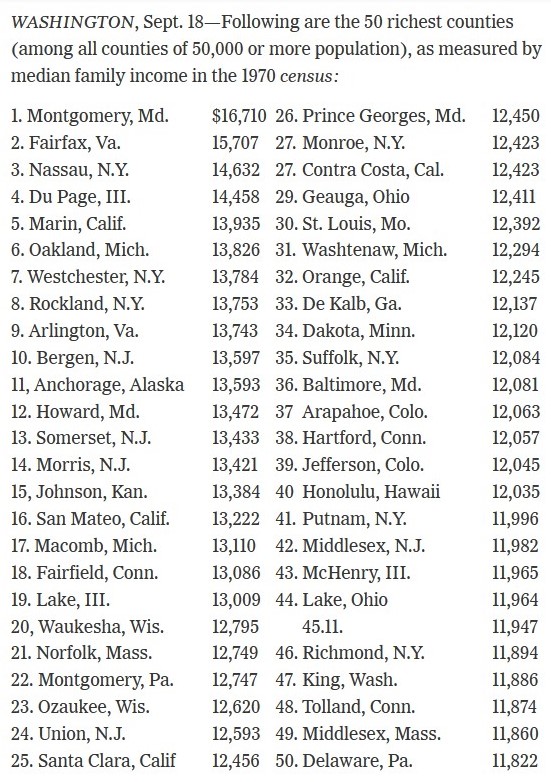
As the article notes, all these counties are suburban counties.
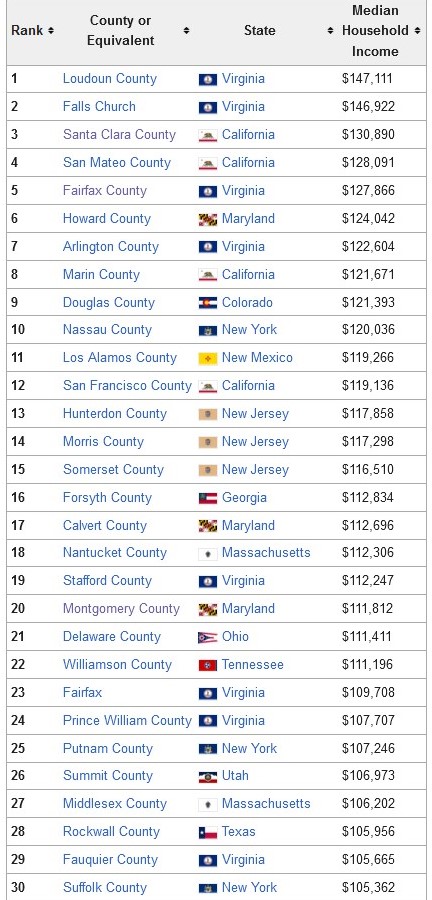
According to Wikipedia, here are the wealthiest counties today:
Almost all of these top 30 are suburban. But the wealthiest counties have shifted toward more counties in the South and West. Some of the same counties are at the top of the list but there are also new counties there as well. What might have happened in 50+ years? Some guesses:
Some of the wealthier counties in the 1970 Census matured, now have slower growth, and have more diverse populations. In contrast, the rapidly growing counties today are more in the South and West.
Shifts in industry. Manufacturing jobs declined in many places and growing sectors, such as tech and the federal government, generated wealth elsewhere.
Measuring at the county level might obscure patterns at the municipality level and at the regional level. For example, this may be less about individual counties and more about a region – say like the Washington, D.C region – growing.
I would be interested to hear how many companies and residents think at the county level these days. If someone were going to move, would they think in terms of Westchester or Nassau Counties outside of New York City like they might have in 1970 or would they think instead of specific communities and suburbs they have heard about?
Over the past decade and a half, however, the dynamic has dramatically shifted. In 2008, the top fifth of earners favored Democrats by just a few percentage points; by 2020, they were the group most likely to vote for Democrats and did so by a nearly 15-point margin. (Democrats won the poorest fifth of voters by a similarly large margin.) Democrats now represent 24 of the 25 highest-income congressional districts and 43 of the top 50 counties by economic output. A similarly stark shift has occurred if you look at college education rather than income. Perhaps most dramatic of all has been the change among wealthy white people. Among white voters, in every presidential election from 1948 until 2012, the richest 5 percent were the group most likely to vote Republican, according to analysis by the political scientist Thomas Wood. In 2016 and 2020, this dynamic reversed itself: The top 5 percent became the group most likely to vote Democratic…
That realignment leaves both parties in a strange place heading into November. Voters consistently say that the economy is the most important issue of the 2024 election. And yet the affluent overwhelmingly support Kamala Harris, whose administration favored bold redistribution and big government spending, while a critical mass of working-class voters favor Donald Trump, whose economic agenda consisted largely of cutting taxes for the rich and trying to kill the Affordable Care Act.
This is not the only political shift in recent years but an interesting one nonetheless. Are these political shifts enduring? Such a shift disrupts short-term activity but there could also be long-term consequences. With the resources and connections elites have, does a shift like this lead to other consequential changes?
While the article focuses on whether these voters are voting in their material best interests, another part is intriguing: how then does this fit with the American obsession on the middle-class and the political rhetoric and activity that goes along with this? Does the composition of who comprises the electorate for a political party than affect how much the party talks about the middle-class or pursues policy aimed to help that group?
And since I think about the suburbs a lot, how does this affect how the two parties view suburbs in the United States? Traditionally viewed as middle-class places with powerful local control, does this shift with new political bases at play?
“How big is a house?” mused Jeremy Samuelson, planning director for East Hampton, N.Y., where a working group recently proposed slashing the town’s maximum-allowed house size in half, from 20,000 square feet to 10,000 square feet…
Towns from Aspen to Martha’s Vineyard are in a big-house brouhaha. Critics say mushrooming mansions cramp scenic vistas and local charm, consume excessive energy and inflate prices…
Truro capped new homes at 3,600 square feet in 2017, but then, Shedd says, officials stuck in an amendment allowing bigger builds with special permits. “I’m not saying it was done on the sly,” says Shedd. “Our town meetings drag on. I was probably glazed over.”…
Routt County, Colo.—home to Steamboat Ski Resort—adopted a proposal capping house sizes at 7,500 square feet in June. Debated for months, the hot-button issue packed public meetings…
In Pitkin County—home to Aspen—officials slashed the maximum new home from 15,000 to 9,250 square feet last November, noting that a big house raises “greenhouse gas emissions and increases environmental havoc.”
What strikes me about these discussions is something I first discovered when researching the use of the term McMansion: the size of a big house is relative in terms of size and quantity. In the case of McMansions, a 3,000 square foot new house might be normal in newer neighborhoods but it can be considered a monstrosity next to a 1,100 square foot postwar ranch house. Or is an 8,000 square foot home a McMansion or a mansion? Depends on who is considering the home and where it is located. Or one teardown McMansion might not be a big deal but dozens or hundreds over a decade or two might be considered going too far.
In the cases of these even larger homes, how big is too big or how many is too many? The discussions here do not appear to be taking place within communities where they are contemplating going from no big houses to some. They are considering whether to have no more big houses. Apparently there is some limit to be reached soon or no more might be allowed.
Will such moves push those who desire giant houses to other communities? Will they end up in municipalities just outside these jurisdictions? Are there other communities who would see this as an opportunity rather than a problem?
The biggest of these latter-day Xanadus, a colossal 41,000-square-footer, is about midway through construction in a far less plum location in the southwest suburbs: an out-of-the-way cul-de-sac outside Burr Ridge. Its only neighbor is a modest ranch house; a pizzeria, a gas station, and the entrance ramp to Illinois Highway 83 are just around a bend in the road…
What’s more, that whopper of a house will be home to only three people. Nick Memeti, the 30-year-old owner of Freedom Mortgage Team, is building it for himself and his parents-and the hundreds of guests he plans to have at the frequent parties he expects to throw in the cavernous basement. Down there, he will have an indoor pool (he is also planning an outdoor pool), slot machines, a dance floor, a 30-seat movie theatre, and a full gym. “It’s really built for entertaining,” Memeti says. “I have about 200 employees, and this will be the place for them to come and break bread with the boss and hang out.”
This is another burg that’s not cheap, but you get “a lot more for your money in terms of space inside and out,” notes Jack Brennan of Second City Agents. A six-bed, five-bath home that was listed for $860,000 this spring, for instance, boasts 4,553 square feet, a four-car garage, and a full acre lot. The $189-per-square-foot price is good value compared with the $213 you’d pay for a comparable listing five miles north in Hinsdale. Burr Ridge offers the kind of quiet living you’d expect 19 miles southwest of the Loop. Yet the days when residents had to drive to Hinsdale or La Grange for dinner are gone: The Burr Ridge Village Center, built in 2007, features familiar names from the city, like the restaurant and bar Hampton Social and the breakfast joint Yolk.
Nestled 19 miles west of the Chicago loop, Burr Ridge is home to distinguished houses on large lots in quiet neighborhoods, fine dining, upscale shopping, quality hotels, excellent recreational opportunities, highly rated schools, open land for new business and a progressive business environment. The thriving business community ensures that Burr Ridge, year after year, maintains one of the lowest tax rates in DuPage County.
Worth magazine named the community one of the top 250 wealthiest communities in the country. In 2011, The Business Journals exclusive ‘On Numbers’ report ranked the quality of life in Burr Ridge second out of 955 Midwestern communities.
Straddling the border of DuPage and Cook Counties, Burr Ridge is conveniently located at the intersection of I-294 and I-55, just minutes from I-355 and 290. These expressways provide direct access to O’Hare and Midway airports. Three train stations in neighboring communities, hotel shuttles, and a Pace Bus facility in downtown Burr Ridge provide easy access to regional transportation and downtown Chicago without all the congestion.
Home to over 500 large and small local and national businesses, occupying more than 6 million square feet of floor area and employing over 10,000 people, Burr Ridge has a carefully planned mix of office and industrial parks and two well-designed retail areas in a natural setting. The two retail centers, County Line Square and Burr Ridge Village Center, are conveniently located at the southeast corner of County Line Road and host exciting community events each year. From an annual 5k race and Car Show to a weekly outdoor summer concert series, thousands of residents and visitors come from the region to enjoy the amenities in Burr Ridge.
The biggest houses tend to be located in certain communities with resources (Burr Ridge has a median household income over $174,000), desirable locations, and zoning that allows large homes.
Aside from the quirkiness of this 90s film staple, another aspect of the movie that continues to captivate audiences is the question: just how rich were the McCallisters? The New York Times set out to find out by speaking with economists and professionals at the Federal Reserve. It turns out, according to the report, they were indeed rich — to the tune of being in the top 1%.
The article goes on to say that the McCallisters’ stunning home is proof of just how much money they have. The real house used for its exterior shots in the film is actually located on Lincoln Avenue in Winnetka, a Chicago suburb that happens to be one of the most expensive neighborhoods in the United States, the NY Times reports, citing Realtor.com.
At the time that the film came out in 1990, this massive Georgian-Colonial style home was affordable to only the 1%. It turns out, 32 years later, the house is still only within reach of the 1%, according to economists at the Federal Reserve Bank of Chicago, the NY Times reports. Three economists poured over data, including household incomes of the area for 1990 and 2022, the property value, mortgage rates at the time, taxes and insurance to come to this conclusion…
“In the middle of 2022, a similar house would cost about $2.4 million, based on the Zillow estimate for the ‘Home Alone’ house. A home of that value would be affordable to a household with an income of $730,000, which would be in the top 1 percent of Chicago-area households,” the economists said.
Can you have madcap Christmas capers that end well without a large expensive house? I would guess that an analysis of houses depicted in Christmas movies would show they tend to be larger than normal – this is common in movies and television.
Imagine Home Alone in a 1,000 square foot 1950s ranch home or a 1 bedroom apartment. Would it be better? Significantly different?







 Legally Sociable