
I enjoy reading and I enjoy reading good work by scholars in areas I am interested in. This reading recently included three books about different aspects of the suburbs and metropolitan regions for which I wrote book reviews in recent months. Here are the three books:
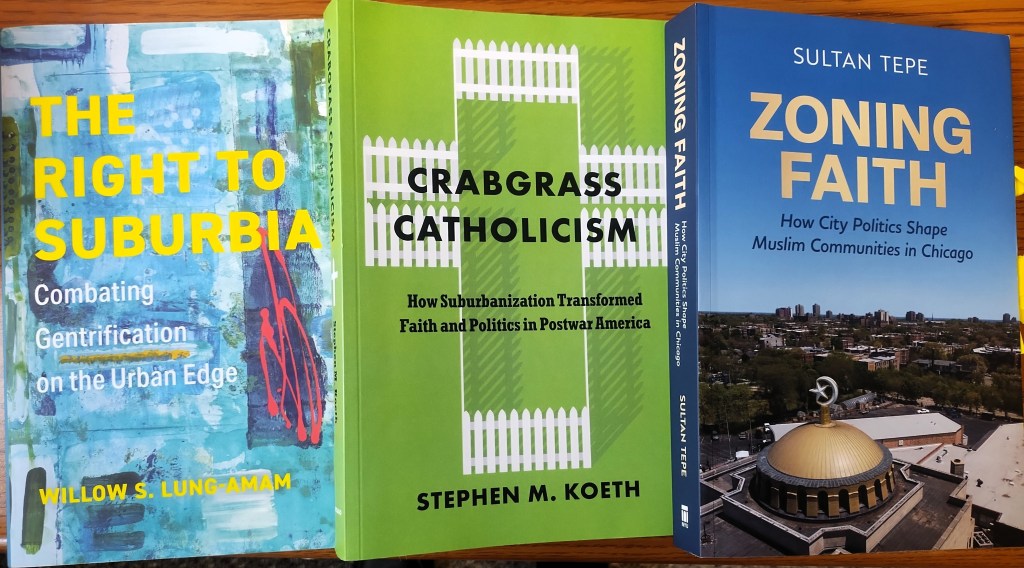
The Right to Suburbia: Combating Gentrification on the Urban Edge by Willow S. Lung-Amam (my review here)
Crabgrass Catholicism: How Suburbanization Transformed Faith and Politics in Postwar America by Stephen M. Koeth (my review here)
Zoning Faith: How City Politics Shape Muslim Communities in Chicago by Sultan Tepe (my review here)
Even as each book addressed particular topics and settings (the first about gentrification and responses to it in three Washington, D.C. suburbs, the second about Long Island Catholic parishes in the immediate postwar suburban boom, and the third about three Muslim congregations approaching zoning and theology in the Chicago region), several themes stand out across the books:
- Suburban communities are diverse and dynamic. Each author describes significant changes that impact and are shaped by residents, businesses, local leaders, and religious groups. These communities, organizations, and residents are not the same as they were in the past. Suburbs are changing places.
- The topics each author discusses are both broader across places and highly local. Take Lung-Amam’s cases of suburban gentrification outside Washington, D.C. Gentrification and redevelopment takes place across a number of American communities. How exactly it plays out with local coalitions for and against the gentrification differs. Comparing the experiences of three suburbs can help us think broadly of what has or could happen in other suburban settings.
- The collective life of suburban communities and religious congregations is worth studying. There are thousands of such groups across the United States. They each impact more people on a regular basis. A majority of Americans live in suburbs. Many Americans are connected to religious congregations. To live in a particular suburb shapes all sorts of daily experiences and outcomes as does participation in a religious congregation.
- There are multiple methods that can help us understand these communities and changes. The ones utilized across these books include working with historical documents and archives, ethnography and observations, interviews, and surveys. To work to explain changes can lead to creativity in collecting and analyzing data on what has happened and how people understand it.

