Claim: popular 90’s TV shows prompted people to move to cities

This is not the first time I’ve seen this argument: Friends wasn’t just entertainment…it helped make cities cool again.

I tested out my hypothesis—that “Friends” triggered the proliferation of boutique coffee shops across the nation—on Facebook a few days ago, and found some agreement. My good friend Kenyon Farrow, an award-winning writer and advocate for HIV/AIDS awareness, who’s based in D.C., was with me on this, writing, “I think ‘Friends’ (and ‘Seinfeld’) are totally responsible for marketing cities to young white suburbanites, [which] helped fuel the market-demand side for gentrification to take place in the ‘90s and 2000’s.

”

That was about the extent of agreement on my “Friends” theory, though—my barista cred all damned to hell now. But others in the debate made the gentrification connection Farrow offered. Wrote Ben Adler, who I worked with at Grist: “Americans have increasingly become alienated by the social isolation of suburban, car-dependent life. That’s fueled both the urban gentrification that brings the cafes, and the cafes themselves.”

For others on our Facebook thread, the secret of the coffeehouse’s mainstream appeal was pure and simple: It’s just “a good idea,” wrote my buddy Justice Rajee, a family advocate at the Portland Opportunities Industrialization Center. “Having someplace to sit have a beverage and do what you need when you can’t go home is good.”

This is the reverse of the argument I’ve been thinking about in recent years: the proliferation of popular TV shows depicting happy suburban life in the 1950s and 1960s helped push Americans to the suburbs. At face value, this might seem to make sense as Americans are influenced by what they watch on TV (and they watch a lot of it). However, I have some data that suggests the connection is not as clear. (There is an upcoming paper coming out of this; more on the particular topic when it sees the light of day.)

Generally, we don’t know as much as you might think about how much television influences people’s behaviors. The argument for Friends or Seinfeld and cities suggests people viewed the shows and wanted to emulate that lifestyle. Is the link that direct? If we asked people why they moved to the city, would they cite a television show or would they be more likely to mention things like jobs, cultural opportunities and the lifestyle, or housing options? The influence of television may indeed be subtle which begs the question of how we might uncover as social scientists the empirical link between viewing and deciding where to live. If seeing things on TV mattered, wouldn’t others be turned off by city life with so many crime and police procedural shows?
The cultural bubbles of popular TV shows tell us what exactly?

This is a cool set of maps of the popularity of 50 different TV shows across zip codes in the United States. But, what is the data and what exactly can it tell us? Here is the brief explanation:

When we looked at how many active Facebook users in a given ZIP code “liked” certain TV shows, we found that the 50 most-liked shows clustered into three groups with distinct geographic distributions. Together they reveal a national culture split among three regions: cities and their suburbs; rural areas; and what we’re calling the extended Black Belt — a swath that extends from the Mississippi River along the Eastern Seaboard up to Washington, but also including city centers and other places with large nonwhite populations.

Some quick thoughts:

  1. Can we assume that Facebook likes are an accurate measure? How many people are represented per zip code? Who tends to report their TV show preferences on Facebook? Why not use Nielsen data which likely has a much smaller sample but could be considered more reliable and valid?
  2. How exactly does television watching influence everyday beliefs and actions? Or, does it work the other way: people have certain beliefs and behaviors and they watch what confirms what they already like? Sociologists and others that study the effects of television don’t always have data on the direct connections between viewing and other parts of life. (I’m not suggesting television has no influence. Given that the average American still watches several hours a day, it is still a powerful medium even with the rise of
  3. The opening to the article both suggests TV viewing and the related cultures fall along an urban/rural divide but then also split across three groups. The maps display three main groups – metro areas, rural areas, and areas with higher concentrations of African Americans. I would want to know more about two areas. First, political data – and this article wants to make the link between TV watching and the 2016 election – suggests the final divide is really in the suburbs between areas further out from the big city and those closer. Can we get finer grained data between exurbs and inner-ring suburbs? Second, does this mean that Latinos and Asian Americans aren’t differentiated enough to be their own TV watching cultures?
  4. The introduction to this article also repeats a common line among those that study television:

In the 1960s and ’70s, even if you didn’t watch a show, you at least probably would have heard of it. Now television, once the great unifier, amplifies our divisions.

We certainly are way into the cable era of television (and probably beyond with all of the options now available through the Internet and streaming) but could we argue instead that the earlier era of fewer channels and viewing options simply papered over differences? As numerous historians and other scholars have argued, the 1950s might have appeared to be a golden era but most of the benefits went to white, middle class, suburban families.

In other words, I would be hesitant to state that these TV patterns are strong evidence of three clearly different cultures in the United States. Could these television viewing patterns fit in with other cultural tastes differentiating various groups based on class and race and ethnicity? Yes, though I’d much rather see serious academic work on this developing Bourdieu’s ideas and encompassing all sorts of consumption items treasured by Americans (homes, vehicles, sports fandom, making those hard choices like Coke and Pepsi or McDonald’s and Burger King or Walmart and Target). Also, limiting ourselves to geography may not work as well – this approach has been tried by many including in books like The Big Sort or Our Patchwork Nation – as it did in the past.

HGTV is the third highest rated cable network after “embrac[ing] the real America” and avoiding conflict

American viewers – at least those still paying for cable – like what HGTV is showing:

The escapist appeal of looking at other people’s beautiful homes turned Home & Garden Television into the third most-watched cable network in 2016, ahead of CNN and behind only Fox News and ESPN. Riding HGTV’s reality shows, parent company Scripps Networks Interactive Inc. has seen its shares rise more than 30 percent this year, outperforming bigger rivals like Walt Disney Co., 21st Century Fox Inc. and Viacom Inc.

HGTV’s formula is relentlessly consistent: a shabby house gets a makeover, and a happy couple moves in. A variation on the theme — house-flipping for fun and profit — works too. The network has aired 23 different flipping shows over the past few years. Today “Flip or Flop” and “Masters of Flip” run in prime time…

“If you watch a lot of our competitors, it’s about bling-y expensive real estate in New York or crazy flipping in L.A.,” said Scripps chief programming officer Kathleen Finch. “For the most part, our viewers live in suburban houses with yards. We embrace the real America.”…

The key, Scripps executives agree, is a refusal to upset HGTV’s audience. There’s no profanity, and on-air conflicts are confined to paint colors or tile choices. Instead of making the network feel trivial, its fans say, the relentlessly pleasant programming is a comfort, especially in hard times.

Americans like houses, both in terms of what they might aspire to themselves (the home may be their number one opportunity to define themselves) as well as knowing what their “neighbors” have (don’t those people on TV count as neighbors in today’s world of limited deep social ties?). The lack of open conflict could also tie in nicely with M. P. Baumgartner’s work The Moral Order of a Suburb which argued suburbanites create community by avoiding conflict.

I’m also intrigued by the idea that showing “the best side” of suburbanites could be a winning formula on television. I’ve been working on several projects in recent years about the depictions of suburbia on television. In the 1950s and early 1960s, there were numerous shows that presented everyday suburban life (obviously, a very sanitized white, upper middle class perspective) but since that period, many shows that do this are doing it with a wink and nod or to laugh at suburbanites. Do the fairly wealthy viewers of HGTV enjoy seeing themselves on screen when few other shows or TV networks offer such an opportunity?

The state of reading books in America in 2016

Pew Research has recently put out several reports on book reading in America. First, the broad overview:

Yet even as the number of ways people spend their time has expanded, a Pew Research Center survey finds that the share of Americans who have read a book in the last 12 months (73%) has remained largely unchanged since 2012…

Americans read an average (mean) of 12 books per year, while the typical (median) American has read 4 books in the last 12 months.

Second, those who do read still do so in print most of the time:

Readers today can access books in several common digital formats, but print books remain substantially more popular than either e-books or audio books. Roughly two-thirds of Americans (65%) have read a print book in the last year, which is identical to the share of Americans who reported doing so in 2012 (although down slightly from the 71% who reported reading a print book in 2011).

By contrast, 28% of Americans have read an e-book – and 14% have listened to an audio book – in the last year. In addition to being less popular than print books overall, the share of Americans who read e-books or listen to audio books has remained fairly stable in recent years…

Nearly four-in-ten Americans read print books exclusively; just 6% are digital-only book readers.

Third, on why people read:

Among all American adults:

  • 84% ever read to research specific topics of interest (29% do so nearly every day).
  • 82% read to keep up with current events (47% nearly every day).
  • 80% read for pleasure (35% nearly every day).
  • 57% read for work or school (31% do so nearly every day).

Fourth, who isn’t reading:

Several demographic traits correlate with non-book reading, Pew Research Center surveys have found. For instance, adults with a high school degree or less are about three times as likely as college graduates (40% vs. 13%) to report not reading books in any format in the past year. A 2015 Pew Research Center survey shows that these less-educated adults are also the least likely to own smartphones or tablets, two devices that have seen a substantial increase in usage for reading e-books since 2011. (College-educated adults are more likely to own these devices and use them to read e-books.)

Adults with an annual household income of less than $30,000 are about twice as likely as the most affluent adults to be non-book readers (33% vs. 17%). Hispanic adults are also about twice as likely as whites (40% vs. 23%) to report not having read a book in the past 12 months.

Older Americans are a bit more likely than their younger counterparts not to have read a book. Some 29% of adults ages 50 and older have not read a book in the past year, compared with 23% of adults under 50. In addition, men are less likely than women to have read a book, as are adults in rural areas compared with those in urban areas.

Fifth, the book reading trends haven’t changed too much in recent years:

The share of Americans who report not reading any books in the past 12 months is largely unchanged since 2012, but is slightly higher than in 2011, when the Center first began conducting surveys of book-reading habits. That year, 19% of adults reported not reading any books.

While Internet use (with the included possibilities of streaming audio and video) is taking up more and more time in daily life, it may take quite a while for reading books to becoming an activity for a small minority. And how could is disappear completely from certain settings such as schools and colleges?

Board games for which I am thankful

On Thanksgiving, I’ll take this opportunity to highlight some board games I enjoy and some I wish to explore further. On a sociological note, these games are great ways to both enjoy time with friends and family as well as have structured competition. To the lists:

Games I enjoy the most (in rough order starting with my current favorites):

  1. Agricola. My favorite game set in Germany several centuries ago in an agricultural setting. This game has its complications but if you play with the card decks (which provide occupations and minor occupations), there is a lot of variety even as you try to acquire the same elements each game. In other words, it has some predictability alongside intriguing variation. And with the Farmers on the Moor expansion we recently acquired…
  2. Diplomacy. Awesome game, difficult to actually finish since you need seven players and lots of time. It is like Risk but there are no dice: your armies can only advance at the beginning by either cooperating with other players (who support your moves or don’t block them) or fighting them. There is a lot of negotiation. I’ve played a few complete games via email – a round per week – and this involved hundreds of emails.
  3. Race for the Galaxy. It took us forever to read the instructions and understand all the different symbols but the payoff has been really good.
  4. Innovation. This card game is like pursuing the technology tree in the game Civilization but with each player seeing different cards and paths from the Stone Age to now each time. There is a nice mix in the cards allowing actions you can take against other players, things you and other players can both do, and things you can do with your own tableau.
  5. Puerto Rico. Even though the rough idea is similar – build your own social group – to Settlers of Catan, I prefer this one much more. Perhaps it is because you can be a different role each turn? Perhaps because they are no numbers on your hexes deciding your fate?
  6. Trivial Pursuit. Yes, it is often seemingly random knowledge. Yes, the games can take forever – in recent years I have been part of several family games that took over three hours. Still, where else can people who know all sorts of “trivial” information come together?
  7. Stratego. In my mind, the key to this game is that you don’t know what pieces your opponent has across from you until you risk an attack. Few games have this much secrecy.
  8. Suburbia. I’m a sociologist who studies suburbs. The board game does a nice job simulating suburban growth (and the recent expansion pack we purchased adds some new elements). See my earlier quick review.
  9. Carcassonne. The building aspect plus seeing random tiles adds up to fun.

Games that were close to the favorites list: Guild Hall, 7 Wonders, Bohnanza, Chess (a game I am not very good at but is still alluring).

Games I would like to explore further/play for the first time:

  1. Memoir ’44. I haven’t played many war strategy games but this one consistently receives high marks.
  2. Splendor. This is on my Wish List for this year.
  3. Patchwork. It is hard to find good two player games and even though I have only played this once, I think this one could have a lot of replay value.
  4. For Sale. I’ve played this a few times and it is a rare filler game I would want to play a lot.

Games I used to like more but would still be happy to play:

  1. Monopoly. Still fun at times. However, too many family games of this ended in predictable ways.
  2. Scrabble. I like the game. However, different people want to play with different variations (i.e., not using a dictionary at all, using the latest official dictionary, looking up words in said dictionary).
  3. Careers. Lots of fond memories of playing this as a kid. But, if I only played once every years now, that would be enough.
  4. Settlers of Catan. The game that may have introduce Euro games to the United States. I generally like it but it is not a favorite and would almost always prefer a game from the favorite list above.
  5. Pandemic. Cooperative games can be interesting and this one, particularly with some of the expansions, offers some fun opportunities. But, it is almost too hard: even on the easiest levels, those epidemics break out too often.
  6. Ticket to Ride. This game always plays out the same way for me: I reject the long routes early on because I’m not sure I can complete them, I build a lot of short routes, and few points result. Still, the concept is fun.
  7. Risk. Somewhere between my notes above on Diplomacy and Monopoly.

Perhaps I tend to like longer building games with structured variety. These can take up a lot of time but they do require both more attention (with the player often thinking they alone hold their fate in their hands) as well as prolonged interaction with other players. I’m not entirely convinced that Euro games are more enjoyable for everyone just because they get to build something but most of the favorite games I listed above do allow for multiple strategies for winning.

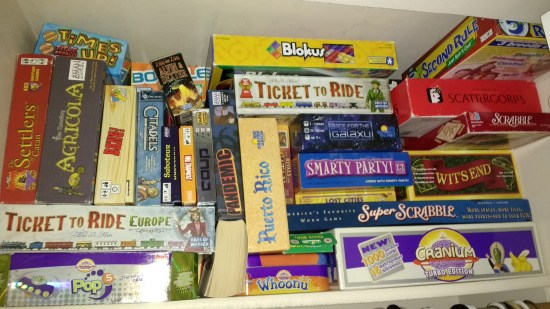
To close, a quick peek at our main game storage area (though other games, both classic and new, are scattered elsewhere):

gameclosetnov2316


Architecture based comedy: “McMansions have taken all of the Australianness out of the burbs”

An Australian comedian has several complaints about the McMansions of his country:

“They don’t work with the site, they’re too big on the block of land so you lose all your outdoor space. They’re too close to the neighbours and the real sadness is they’re also not great from an energy point of view,” Ross explains.

Ross says McMansions have taken all of the Australianness out of the burbs — “you could be driving down the streets of America” — and that the fashion for driving into the carport and walking into the house disconnects people from their neighbourhoods…

You might consider a comedian telling people how to live is some sort of joke. But Ross has corned a gap in the entertainment market — architecture based comedy — and it’s taken him around the world from London to Venice…

Ross’s two part series Streets of Your Town is about the contrast between the classic, well designed mid-century modernist homes and the not-so-great McMansions of today.

The TV series is coming up in a few days. As I’ve discussed before (see the most recent example here), I’m skeptical of the claim that modernist homes would entice more buyers or admirers in the United States. They may please the architectural community but not necessarily homeowners.

I am, however, very intrigued by the idea of “architecture based comedy.” I don’t know if this will be present much on the TV show – it sounds more documentary like – but seeing a standup routine based around architecture would be fascinating. For my money, one of the better architecture and urban planning based routines I have seen is James Howard Kunstler’s TED talk “The Ghastly Tragedy of the Suburbs.” On the other hand, another attempt at this – the film Radiant City – didn’t quite work as well.

The “night mayor” looks to improve the urban overnight experience

The head of an advisory NGO in Amsterdam is looking to make the overnight experience better both for city residents and night owls:

“I think that to really build a 24/7 economic system in Amsterdam, we should focus on creating one 24-hour area in the city,” Milan tells CityLab. “You could have working spaces there, and a library open 24 hours a day for students. It would also be a place for food. In Holland you can’t have a proper meal after 9.30 p.m., and when friends arrive late from out of town, all you can really offer them is fries.”

The idea might sound ambitious, but then forward-thinking about Amsterdam after dark is actually Milan’s job: he’s the Dutch capital’s “night mayor.” This innovative office, unique to Amsterdam when created in 2014 (as the development of a project itself begun in 2003), has helped to clear up a blind spot that many cities face. Too often, public officials view their city’s nighttime existence with suspicion—as a sinister doppelgänger of its daytime form but with added sex and crime, sleep-spoiling noise, and sidewalks slicked with vomit. Even liberal politicians can have little experience with this twilight zone, given that they’re often tucked up in bed by 10 p.m.

It’s the role of the night mayor to bridge this gap. The incumbent’s job is to manage and improve relations between night businesses, residents, and City Hall. Milan and his team have proved so successful in Amsterdam that the concept has taken off internationally. Paris, Toulouse, and Zurich now all have night mayors, while London and Berlin are considering creating their own. Within the Netherlands two other cities, Groningen and Nijmegen, also have their own professional nocturnal managers, part of a total of 15 Dutch municipalities that have some form of night mayor role…

“In the nighttime economy, there’s a lot of talent,” he says. “Think of all the graphic designers, party promoters, DJs—all these people that use the night as a serious playground to develop their skills and in the end, have their daytime job. Definitely the creative industries are really important for Europe and especially for cities like Amsterdam or Berlin, but actually for everywhere in the world.”

The big city is supposed to be the place where you can find all sorts of activities at all times of day. One of the biggest surprises for visitors to the city is the amount of activity in some places all night long. Imagine Times Square or The Strip with all the lights and people. (I’ve been to both late and it is remarkable just how many people are wandering around.) But, those places are not necessarily where a lot of people live and they are filled with tourists. What is the average urban night owl supposed to do, particularly if they are a resident and not a tourist?

It would be interesting to see every major city develop a night district. Presumably, such a district would need good public transit, a variety of uses to serve different interests (from restaurants to arts spaces to music venues to gyms to coffee shops), temperate weather (I assume this would be very helpful), and probably should be composed of smaller buildings in more of a neighborhood feel rather than within a set of tall, modern structures. Would enough people flock to such a place if it was located far from primary residential areas?

Housing prices drive punk music to the suburbs

Punk music is associated with gritty urban life – until that urban life becomes too expensive:

Shows like that are increasingly common in Santa Rosa, and it has a lot to do with the prohibitive cost-of-living in nearby San Francisco. “I had every intention of moving down to the city,” said Ian O’Connor, 23, who organized the gig. “But when the time came, it was too expensive.” Instead, in the last three years, he has booked dozens of all-ages gigs in Santa Rosa, mostly at unofficial venues: detached garages, living rooms, lobbies of sympathetic businesses. The scene thrives on the participation of people like him, area natives in their early 20s who, not so many years ago, would’ve likely moved an hour south to Oakland or San Francisco…

One hallmark of punk’s inception in the Bay Area and throughout the Pacific north-west was the notion of cities as places of possibility, so hollowed out by eroding tax bases and selective civic neglect that they seemed “deserted and forgotten”, as music journalist Jon Savage wrote of his 1978 trip to report on San Francisco punk bands such as Crime and the Dead Kennedys. “It was there to be remapped.”

But with the same cities stricken by intensifying affordability crises – premiums on space that make somewhere to live, let alone rehearse and perform, available to a dwindling few – they don’t beckon young punks like they used to. And though reports of music scenes’ deaths tend to overstate, news of shuttering venues (see eulogies for The Smell, The Know, and LoBot) deters some of the intrepid transplants needed for invigoration. Dissipating metropolitan allure, however, helps account for the strength of scenes in outlying towns…

According to Samantha Gladu – bassist in the feminist, wrestling-themed hardcore band Macho Boys and chief advisor to state senator Chip Shields – recent revelations about what a state investigation found to be cripplingly over-burdensome nightclub regulations have done little to calm the Portland punk scene’s nerves: “Rising rents and recent reporting on the city government’s apparent selective regulation for venues leave punks with the impression that not only can they not afford Portland, they aren’t part of some officials’ vision for Portland.”

Given that more urban features – including denser housing, more non-white and less wealthy residents, and urban issues – have moved to the suburbs, it isn’t too surprising that artistic ventures could move there as well. Yet, I imagine this is not easy for many artists or others who dislike the suburbs and celebrate cities. Can places that are still criticized for conformity, whiteness, and materialism nourish new artistic ventures? Can suburban communities tolerate people who go against convention or who seek space to spread out and explore? If given the resources, I imagine that most bands would want to be in the big city where there is more energy, similar artists, and venues.

However, this represents an opportunity for suburbs to pursue a more creative vision. Many suburbs hold and promote festivals and fairs committed to the arts, both as a way to generate revenue as well as a way to signal openness and engagement. It is something different to have permanent venues devoted to some ventures; could a middle to upper-class suburb give its blessing to a punk music music site? Or a collaborative of experimental artists? In other words, if cities and/or certain neighborhoods are too expensive, numerous suburbs could join the competition to attract musicians and artists and possibly transform their own communities.

LA suburbs welcome raves for their economic benefits

Suburbs aren’t usually known for wanting to host raucous music events but the economic benefits are hard to resist for some Los Angeles suburbs:

All of the region’s biggest electronic dance music festivals are now held deep in the suburbs and exurbs of Southern California, centered in San Bernardino County. There, the rave scene has been largely welcomed by government officials and local businesses hoping for an economic boost from the large crowds.

But many of the problems that dogged the concert in L.A. — rampant drug use, overdose deaths and overwhelmed emergency rooms — have persisted…

In the Inland Empire, rave organizers have tapped large venues that can hold more concertgoers…

The debate over rave safety has largely focused on whether government agencies should allow the concerts to be held in publicly owned spaces. Some emergency room doctors have called for such a ban, saying hospitals are overwhelmed by drug overdose patients after raves.

Many suburbs are looking for ways to bring in more revenue through the arts events, whether that be art, theater, music, or some other form of creative expression. The primary advantage of such events is that they are temporary: vendors and people descend for a limited amount of time and money is generated. However, suburbs usually don’t take too kindly to noise, damage from a lot of concertgoers, and drug use and drug-related deaths. Suburbs tend to want to promote themselves as safe and family friendly.

Thus, we get a set of trade-offs: communities that need money versus typical suburban propriety. I would imagine the drug-related deaths will scare off more suburbs even as many communities look to bring in more money through similar events.

The suburbs as a “Great Wrong Place”

In a review of mysteries written by women, one critic explains why suburbs are a common setting:

In the books I’ve been reading, the Great Wrong Place is sometimes suburbia, sometimes social media, sometimes high school, sometimes the marriage bed—everywhere something feels missing in contemporary life.

There is not much explanation here. However, this taps into a familiar suburban critique: the suburbs are a darker place than they appear. Even though they might be the image of the American Dream, many disturbing situations are underneath the surface. The key is the contrast between the displayed success of the single-family home and happy family and the tension that threatens to bubble to the surface.

What then exactly is missing from suburbs? Authentic displays of human difficulty and anguish (residents don’t talk about this stuff, perhaps because being vulnerable in the suburbs leads to social problems)? A lack of diversity in who lives there (the typical suburb is white and middle-class and shuts out other experiences)? Public spaces where residents can regularly mingle without having to have strong interpersonal relationships (everyone is cooped up inside their private spaces)? Whatever the reason, the suburbs provide rich spaces for today’s mystery (such as Gone Girl) and horror stories.