Science fiction is not my favorite fiction genre. But, having recently read The Sparrow, watched Project Hail Mary, and read plenty of Isaac Asimov, Arthur Clarke, Jules Verne, and Ray Bradbury, among other novels, I was reminded that science fiction and sociology often ask the same big questions. These include:
How do humans deal with big social and/or technological change? These changes mark the modern era but we do not always have opportunities to reflect.
Can humans and societies come together to tackle common problems? Under what conditions would people set aside differences and conflicts or will these hinder human efforts to address problems or changes?
What does it mean to be human and work together in large groups? This can come to the fore when humans come into contact with other beings.
How do humans make meaning when their worlds are disrupted? Humans are meaning-making creatures who have to fit major changes into the way they approach the world.
These different fields might not approach the questions in the same way and they may not come to the same answers but there is some overlap in what they consider.
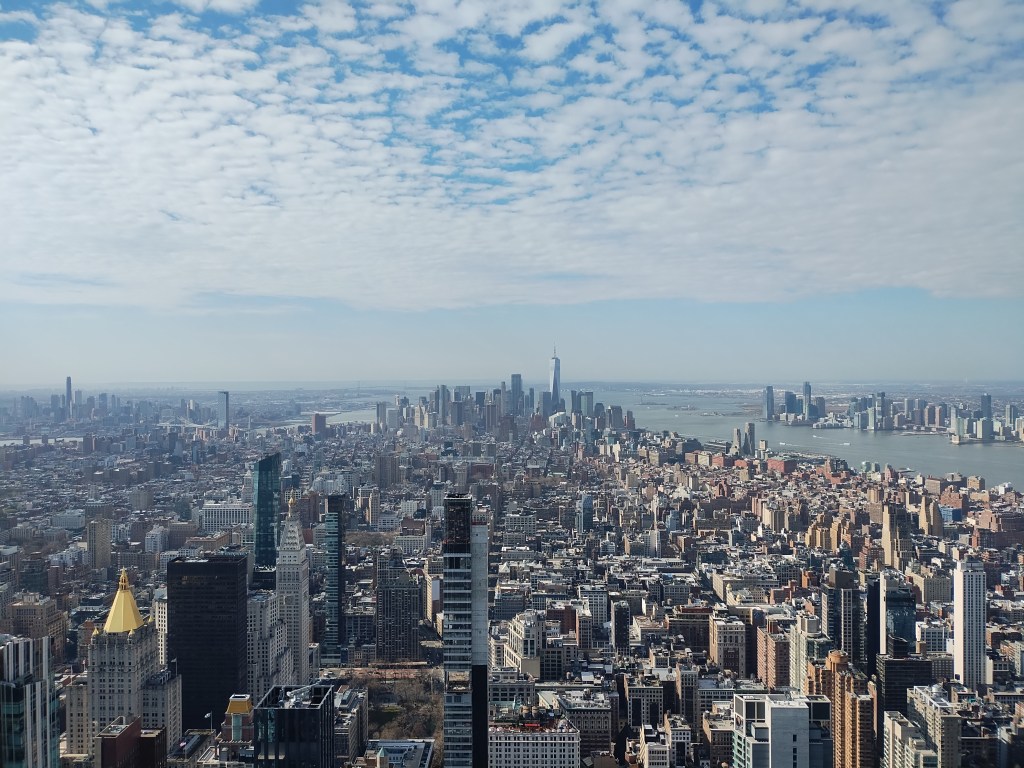
As a sociologist who studies places, this always stands out to me when I visit New York City: its scale and size. Other American cities and places have small aspects of what New York has but NYC has more. Density, skyscrapers, mass transit, large parks, commercial activity, waterways, sidewalk life, a variety of neighborhoods, and history going back to the mid-1600s.
This might be most visible from up above. Coming in via airplane over New York City, you see the reach of the metropolitan region even before you get to the five boroughs. You see the tall buildings, not just in one location, but in multiple settings (midtown Manhattan, downtown Manhattan, along the rivers, in Brooklyn, in Jersey City, etc.). Development and human activity is evident everywhere. Standing at the top of the Empire State Building (picture above), you can hear some of the street noise even as you observe people and vehicles moving around.
But this is also evident at the street level. There is a level of activity across the city. Denser residential buildings and close-together single-family units. Tons of small businesses and restaurants as well as multinational corporations. Street traffic and overlapping mass transit systems that mean you can traverse the city without cars. Busy outlying neighborhoods in addition to the activity of Manhattan.
There is an argument that larger cities are scaled up versions of smaller cities. (See this book for an example.) I am more familiar with Chicago than New York City and for the Midwest, Chicago is the big city. But then travel to Los Angeles or New York – and I have been to both numerous times – and Chicago looks and feels smaller (even as LA and NYC are very different places). New York City is the big city for the United States. It is the leading global city in numerous lists and studies. Other big cities have their own unique features or have smaller versions of what New York has. As one quote says, “America has only three cities. New York, San Francisco, and New Orleans. Everywhere else is Cleveland.”
I have been in even larger cities like Tokyo and Hong Kong. From above and on the ground, both of these cities are on a different scale compared to New York City. But that is a possible story for future posts. For now, New York City is the big American city.
He doesn’t even really root for the Chicago Bears, but U.S. Sen. Bernie Sanders says he wants to ensure Bears fans — and sports fans of all stripes — are protected from the heartbreak he suffered as a teenager, when his beloved Brooklyn Dodgers left for Los Angeles.
Sanders, the independent Vermont senator and two-time presidential candidate, threw his support behind long-shot legislation Thursday that would give communities a chance to keep their professional sports teams if their owners threatened to leave. Under the proposal, local leaders would have a year to find another buyer for the sports team or to organize a community ownership structure, like that used by the Green Bay Packers, to take over the team instead…
The penalties under the new proposal would apply if team owners relocate their home facility across state lines or out of metropolitan areas.
“Professional football is America’s religion,” Sanders said, when touting the need to promote activities like professional sports that bring people of different backgrounds together…
The impact of those moves can linger for generations, the lawmakers said. Casar talked about the loss he felt when the Houston Oilers left the city for Nashville in 1996.
Three things stick out to me from this overview:
Childhood commitments to teams stick with people. Jerry Reinsdorf has also discussed how the move of the Dodgers to LA affected him. Plenty of Americans have experienced this, including lots of kids.
The moving across state lines strikes me as not the same thing as moving out of metropolitan regions. I know it involves different bodies of government but the metro area is the more important factor here for fans. If the Bears end up in Indiana and the Chiefs are in Missouri, fans have not lost a team.
Sanders suggests football is religion and he is right in certain ways: it prompts vast followings, fans come together across different backgrounds, stadiums are sacred spaces, the Super Bowl is a sacred event, and so on. Sports is a kind of functional religion.
It sounds like the goal of this legislation is to limit the benefits wealthy team owners can derive from playing places against each other regarding stadiums and teams. If an owner threatens to leave in order to get more taxpayer money or a better deal, this legislation gives communities other options. Whether this saves the children of America from sports heartbreak might be a secondary benefit.
A 29-acre site in St. Charles — one of the last remaining open properties in town for residential development — is becoming a flashpoint for housing affordability in the city.
With a new proposal on the table, some city officials are requesting affordable units while the project’s developers argue it would hurt their private equity-backed bottom line…
The developers said they are trying to support retail along the Randall Road corridor by “attracting residents with disposable income.” City officials responded by saying there are people who work for the city who can’t afford to live there.
During the March 16 meeting, the developers said offering affordable units, such as a $1,070-per-month studio, would “provide a revenue gap.”
The basics of the story are not unusual for suburban residential development projects. A developer sees an opportunity. Upscale residential units can bring a good profit and upscale suburban communities tend to like residential properties that enhance their status and character. The city responds to the proposal with a few requests, including requesting some affordable housing units for several groups in the community the suburb would like to retain or attract. A period of negotiation or dialogue commences.
What is different here is that the developer has clearly stated that substituting affordable housing units will lead to a revenue problem. Why? Because there are expectations from the private equity supporting the development. The article does not discuss the details (and they may not be publicly available) but it sounds like it can be put another way: not enough money will be made on this development if affordable housing is included.
Profit-making is not unexpected. The clash between private equity money and affordable housing is less often in the public view. What amount or percentage does private equity expect to make on residential development? Can it make room for any affordable housing or is it completely about profit maximization?
During a year marked by Canadian wildfire smoke and an unprecedented dust storm, which worsened transportation emissions, Chicago ranked as the third-most polluted major U.S. city in 2025, according to a report released Tuesday.
The average concentration of small particulate matter in the city last year was 9.7 micrograms per cubic meter of air — almost double the World Health Organization’s recommended limit of 5 micrograms per cubic meter, and a more than 15% increase from 2024, when Chicago dropped to seventh place among the most polluted major cities in the country. It was second in 2023. Smaller communities in the Joliet area — Ingalls Park, Lockport and Crest Hill — recorded the highest concentrations in the state, and all averaged above 10 micrograms per cubic meter…
But PM2.5 concentrations can also vary from town to town and even from one neighborhood or one city block to another. For instance, in Chicago, primarily Black and Latino neighborhoods with more traffic and heavy industry can have higher concentrations of particulate matter over time. That can be exacerbated by temporary factors such as fireworks on July Fourth.
Forty miles southwest of the city, Ingalls Park, Lockport and Crest Hill topped the state’s list with a yearly average of 11.3, 11.2 and 10.9 micrograms of particulate matter per cubic meter of air, respectively. Joliet ranked No. 6. According to census data, the Hispanic and Latino population is 41% in Ingalls Park, 35% in Joliet and 27% in Crest Hill. For context, 19% of the state’s population is Hispanic…
Nearby, the Des Plaines River also contributes to barge traffic. And I-80 — the second-longest interstate highway in the country, crucial for long-haul freight — also fills the air with smog and particulate matter. According to the Illinois Department of Transportation, I-80 through Joliet and Will County carries approximately 80,000 vehicles a day, about 25% of which are trucks.
Chicago, like a number of cities, has a long history of industrial suburbs. These locations outside city limits became popular in the nineteenth century for industrial use because of cheaper land and fewer residents around affected by pollution. But industrial facilities attracted workers and other businesses and cities and metropolitan areas expanded, bringing these industrial suburbs into the fold.
And factories and power plants, two typical producers of air pollutants, are not the only polluting members of suburban communities. As noted above, highways and roads contribute to this as do warehouses and other industrial facilities. Joliet and the nearby area have become home to many warehouses as its location lends itself to intermodal facilities where companies can load and unload outside of a major city in the middle of the country. Suburban life depends on driving and residents want their goods delivered to them or their nearby stores.
What possible solutions are there? Facilities or property owners can face restrictions or pressure regarding pollutants produced. Communities can push back against the ongoing proliferation of facilities. This is hard within a region. One community might say no to more warehouses or data centers. However, among hundreds of municipalities within a region, another one might say yes to the jobs, growth, and status. A regional approach where communities and other bodies of government come together to have an approach could be helpful. It could also help suburbanites to look beyond just their municipality or immediate neighborhood context; air pollution can cover a broader area and becoming familiar with a broader area could help.
Many major American sports teams have names referencing cities or states. Some of these teams are located in the suburbs while they refer to cities in their names. But I recently was thinking about teams that are intentionally suburban. Perhaps they never were located in the city (versus teams that started in cities but moved out later). Perhaps their name refers to a suburb or suburban area. These four teams came to mind:
Anaheim Ducks. They started in a large suburb in southern California and are still there today. Makes sense given that it is in the sprawling Los Angeles area?
New Jersey Devils. Named after a state but this team has been in the suburbs of New York City (in the named state) for a number of years after an earlier homes in Kansas City and then Denver. Newark is also a large suburb but the state is largely caught between the big cities of New York City and Philadelphia.
New York Islanders. Named after the state but located from the beginning in the Long Island suburbs (with a short time in Brooklyn in the 2010s).
Arizona Cardinals. Since moving to this state, they played in Tempe and Glendale. (The team played in St. Louis and Chicago in their previous stops – they were a city team until they moved to a new region.)
On one hand, a few other teams might seem to fit this bill. Take the New England Patriots who play in the suburbs and whose name refers to a larger region. They were initially founded as the Boston Patriots. There might be others.
Two questions emerge from these quick thoughts:
Was there something about hockey teams founded in the last 50 years that some aimed at suburban audiences moreso than other sports?
Does being a major sports franchise in the suburbs or associated with the suburbs make a substantive difference to the team and its results? Given that more Americans live in suburbs than other settings, do these suburban locations tend to make it easier for residents of the region to attend?
Take Rockford, the most popular housing market from the Zillow report. Although it’s within easy driving distance of Chicago, the average home value is about $170,000, to Chicago’s $300,000. A hybrid worker could conceivably work from Chicago a day or two a week while paying much less for a house than if they lived in the city. The same goes for Milwaukee, which is also an hour and a half from Chicago…
In addition to proximity to a large city, what distinguishes bright spots such as Columbus and Indianapolis from less desirable midwestern cities is the availability of good-paying jobs. After all, few people can buy a house, even for $300,000, if they can’t find work nearby. According to OSU’s Partridge, the midwestern cities that were less reliant on manufacturing in the 1950s are the ones doing well now. These places were never dependent on factory jobs, so they were better able to weather the steep decline in U.S. manufacturing that began decades ago. “Because they had a more service-oriented composition of businesses, they did much better,” Partridge said. Today, these cities offer plentiful finance, tech, and health-care jobs. JPMorganChase employs 18,000 people in Columbus, for example; the pharmaceutical company Lilly is headquartered in Indianapolis.
Two kinds of people are referenced: people who work remotely at least part-time and those who can access good-paying white collar jobs. This may require certain levels of education and/or job experience.
For years, I have read discussions about how Americans who need cheaper housing could move to places with cheaper housing. Particularly in comparison to the most expensive housing markets, often on the coasts, there is decent housing to be had in other places. This is easier than it looks. People have ties to particular social and family networks as well as places. Additionally, if a lot of people moved to these cheaper places, this drives the prices up.
What might a more accurate version of this story be (and someone must have some data to support or counter this)? Something like: those with some resources and education can move to the Midwest for particular jobs and take advantage of comparatively cheaper housing compared to high-priced housing markets. This means this potential opportunity is not necessarily available to everyone.
Voter turnout Tuesday was greater than 2022’s midterm primary in suburban Cook, DuPage and Kane counties, but lower than four years ago in Lake, McHenry and Will counties…
DuPage County is currently reporting the highest turnout level at 24.6%, which could increase when mail-in stragglers are eventually reported. In the 2022 midterm primary, DuPage was the only county with more than 20% turnout among the suburban collar counties…
Lake County had the lowest voter turnout in the suburbs at 17.7% Tuesday. That’s down from 18.4% in 2022…
McHenry County is currently reporting 18% voter turnout, down from 19.6% in 2022. In Will County, turnout was 19.1% Tuesday, down slightly from 19.5% in 2022.
Most of the article tries to explain why these numbers are what they are. The underlying question seems to be this: have Americans eligible to vote lost interest in voting? About a fifth of suburban voters do so. What, if anything, would really change that number?
The apathy of suburban voters also matters because candidates will want their votes in numerous elections in November and in 2028. In plenty of states, suburbanites will determine elections because of the number of people who live in such places and the presence of both Democrats and Republicans.
Of course, in later races that are not really contested, these low turnout primary votes then set who will win the November election. To not vote in some primaries means voters will have limited choices in November.
Every day, an estimated 215,000 people donate plasma, the yellowish liquid component of blood. Mr. Briseño is among them. He is not jobless or facing eviction, but, like many in the American middle class, he is caught in the vise of rising expenses and wages that aren’t growing fast enough to cover them. So he is turning to a method more commonly associated with the lowest-income Americans. For people like him, an extra $600 or so a month can mean making a mortgage payment or covering increased health-insurance costs.
While no one publishes statistics on the exact incomes of people who sell their blood plasma, the location of the centers suggests a shift toward a less financially desperate clientele. A recent study by researchers at Washington University in St. Louis and the University of Colorado, Boulder, observed that while older plasma centers are clustered in low-income areas, newer centers were increasingly likely to open in middle-class neighborhoods. A New York Times analysis shows the trend has continued: Centers have sprung up in more than 100 such neighborhoods, in suburbs and wealthier sections of cities, since researchers finished collecting their data in 2021…
For decades, plasma centers have been concentrated largely in impoverished and under-resourced neighborhoods and faced charges of exploitation. In her 2023 book, “Blood Money: The Story of Life, Death, and Profit Inside America’s Blood Industry,” Kathleen McLaughlin explored how plasma centers targeted, among others, laid-off autoworkers in the Rust Belt and communities along the U.S-Mexican border.
The article interprets the findings as even the people who made it to suburbia – often assumed in American society to be wealthier – also feel the financial need to donate plasma.
But I wonder if this is the best way to interpret this. Suburbia is much more complex and diverse than the images of white and wealthier bedroom suburbs in the postwar era. The era of a single earner supporting a growing suburban family is long gone. Across metropolitan regions, a variety of residents live with wealthier communities right next to working-class communities, places with lots of white collar jobs near places with manual labor and working-class jobs.
And what if this is not just about financial need. For Americans of different social classes, what do they see as moral or permissible to sell or do if they need money? What if the perceptions about selling plasma have changed more broadly in American society?
Or what if this is more about expanding markets. If there are already concentrations of plasma centers in lower-income neighborhoods, perhaps this is the next stage of finding more people to donate. The other areas are already saturated; this is a growing industry. The article says there are billions of dollars at stake in the industry.
I have not seen any local suburban concerns about this but I wonder if some communities or leaders or residents see plasma centers as a negative use of land in the kind of community they are in.
This was the sight I saw a few days ago while driving away from my house: two Canadian geese sitting on my roof. It is not a surprise to see geese in the area. They fly overhead. They walk in the field in the park around the corner. They sit on the pond behind us and walk up into our yard. They occasionally try to cross local roads and tie up traffic.
But I have never seen geese on top of a house. Why would they want to go up there? There hopefully is a not good food up there. If they need a better view, they can fly. Is it safer from predators? Is it somewhere different?
I do not usually look up at my roofline while in front my house. Maybe I should. Perhaps there is more wildlife up there. How about the coyotes that have moved into suburban spaces? The hawk that sometimes sits in the big tree in our backyard? The many squirrels running? Or maybe the one-time appearance of the geese will keep others away.







 Legally Sociable