Imagining 1.65 million people in the two Chicago airports

The airports in Chicago are used to big crowds but I still have a hard time imagining over 1.5 million going through the two airports over Thanksgiving:
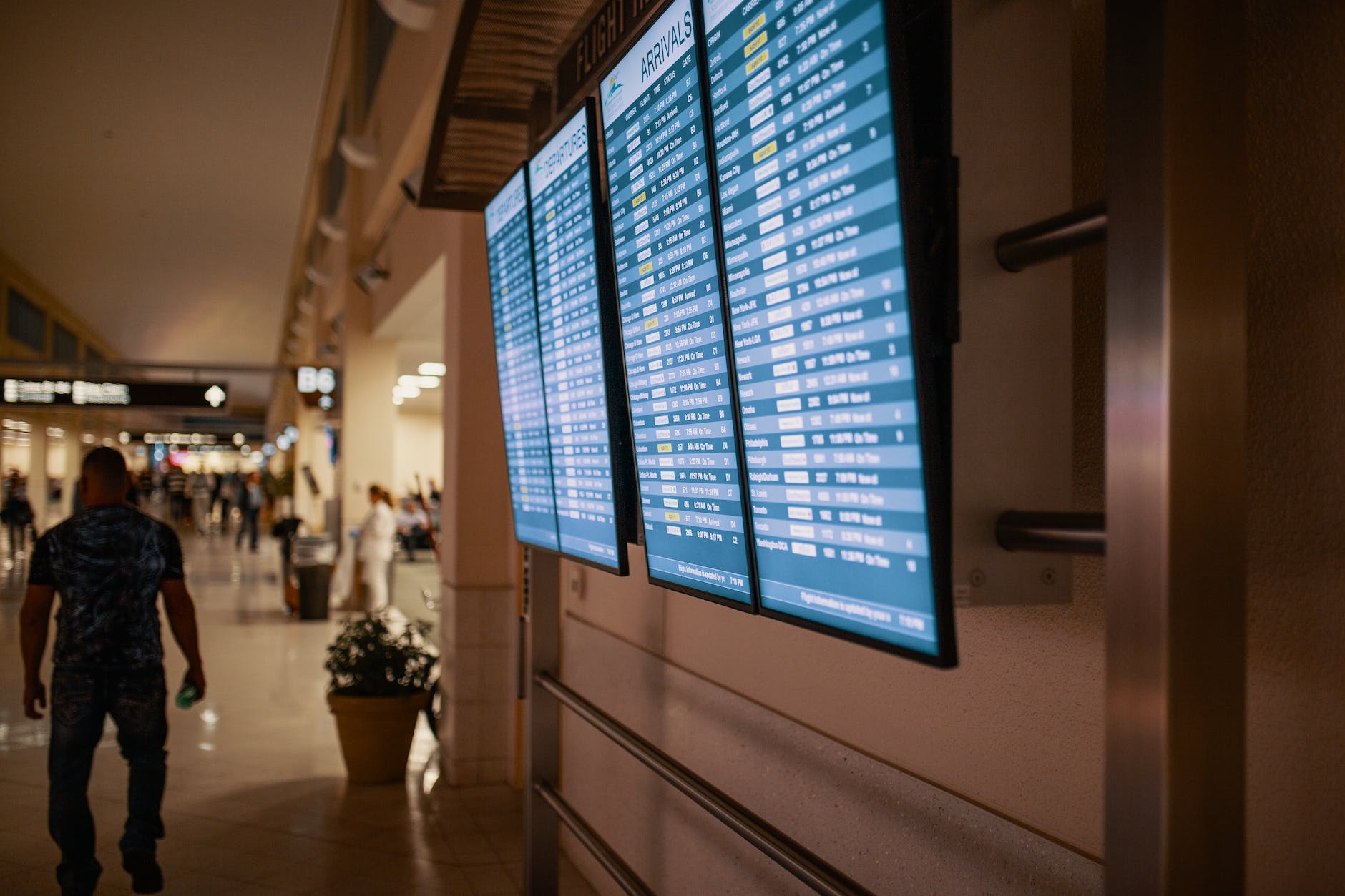
Photo by Josh Sorenson on Pexels.com

The Chicago Department of Aviation projects 1.65 million passengers will stream through O’Hare and Midway airports this Thanksgiving season, surpassing 2022 totals. Sunday will be the busiest day at both airports with nearly 300,000 people expected, the CDA reported.

I do not think I have ever flown during the Thanksgiving week due to having a lot of family within driving distance. But, I have been to these airports during Thanksgiving week to pick up and drop off people. There are a lot of cars and big crowds. One memorable trip included a two hour return drive – typically a 35 minute journey – because of lots of traffic and heavy snowfall.

I suspect airports need to be built kind of like big box store or shopping mall parking lots: enough capacity to handle the busiest days of the year but usually not near full use. If airports did not have room for Thanksgiving week travel, people would be upset and airlines would not be able to move as many people as they do. In the times with fewer passengers, everyone can adjust staffing and resources.

For all of those making their way through O’Hare and Midway this week, best wishes to you. Hopefully, the weather here does not wreak havoc on schedules.
How many roundabouts can the suburbs have?

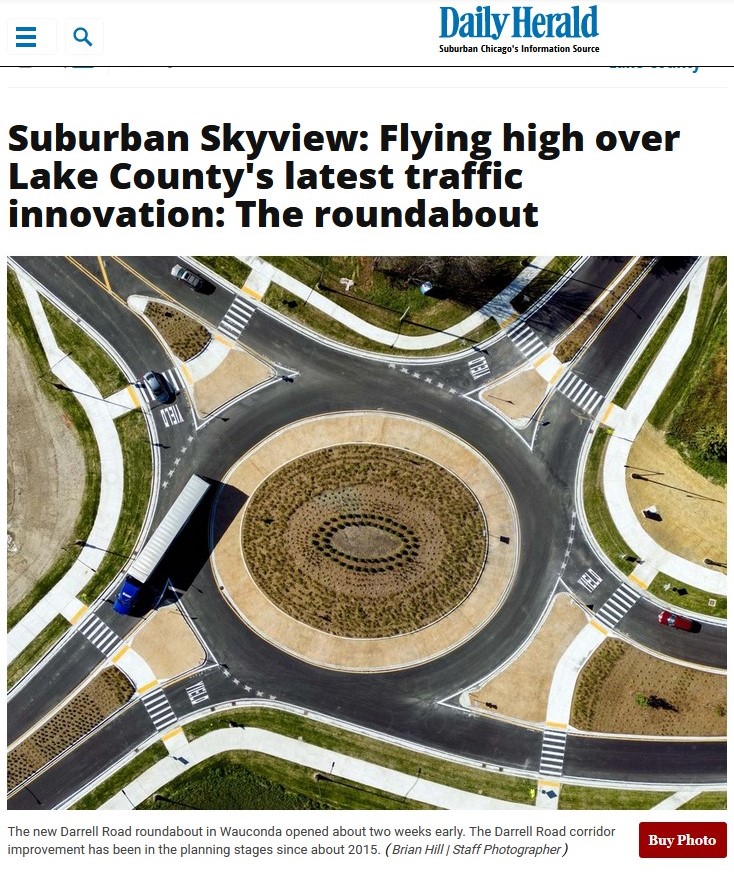
Roundabouts are slowing spreading in Lake County, Illinois:

The Lake County Division of Transportation (LCDOT) closed Darrell, Neville and Case roads in Wauconda to through traffic for 110 days to construct a roundabout and realign the intersections…

This is the ninth roundabout in the Lake County Division of Transportation system. The $8.1 million project is the first of three roundabouts to be built as part of the Darrell Road corridor improvement.

Suburbanites are used to traffic lights and stop signs. Adding roundabouts or diamond interchanges presents a new dimension to driving. The roundabout offers the possibility of a smoother journey – if there is not too much traffic – but requires a different level of attention as there are multiple yield points.

Suburbanites can come to like roundabouts with experience. But, local drivers will likely need some time to get used to them. I am curious to see how many roundabouts will eventually populate the suburbs. They are likely not possible in many places due to existing land uses. However, if they help move traffic, are safe, and people can drive through them, we will probably see more of them in the Chicago region.

Could all the Chicago region transportation agencies merge? Unlikely

A new report from the Chicago Metropolitan Agency for Planning includes a recommendation to bring all of the mass transit agencies together:

Photo by Nachelle Nocom on Pexels.com

CMAP suggests merging Metra, Pace and the CTA into one mega-agency, or giving more authority to the Regional Transportation Authority over budgeting, fares, planning and capital projects.

The process of setting up governance for either could result in turf wars between the agencies along with Chicago and the rest of the region…

But figuring out membership on a super-agency board “is a tough one,” he noted. “Put yourself in the shoes of the mayor of Chicago. Do you want to give up control of the CTA to a super agency he’s not going to control?”…

Villivalam acknowledged, “We’re going to have a robust conversation; it might be tough at times.”

“At the end of the day, though, we need to take a regional perspective. The average commuter is not interested in whether it’s CTA, Metra, Pace, or RTA, they’re interested in having a public transit option that gives them an opportunity to get from Point A to Point B.”

The last quote is instructive: a regional group could better address needs and budgets across a sprawling region with over 9 million residents and lots of transportation systems. If the overriding goal is to help people choose high quality mass transit, a centralized group could help.

But, as also noted above, this would cut across decades of practice within the Chicago region. Each agency has its own history, budget, and priorities. They do not necessarily get along with each other. Political leaders have connections to and oversight with different boards.

Even if the Illinois legislature decided to follow this recommendation, how long would it functionally take for an all-inclusive agency to operate effectively?

I will guess that this will not happen. Perhaps the different agencies and leaders will be encouraged to work together more closely. Perhaps they can partner more. But, putting them all together is a difficult task with fallout for many involved.

The United States has somewhere between 700 million and 2 billion parking spots. Is that enough? (/s)

One expert recently put some numbers to the amount of parking in the United States:

Photo by Pok Rie on Pexels.com

According to Donald Shoup, an urban planner and parking research pioneer at the University of California, Los Angeles, the government doesn’t track the number of parking spaces. But speaking with WSJ, he estimates that on the low end, the U.S. has at least 700 million parking spaces, and on the high end, the estimate is more like 2 billion. That works out to somewhere between 2.5 and 7.0 parking spaces per registered vehicle in America.

As this article goes on to note, some believe that is way too many parking spots. (Hence, the /s tag on the post title.) All of that parking takes up a lot of space, continues to further the commitment in communities to driving, and has negative environmental consequences.

At the same time, I could imagine many drivers in the United States like having all of this available parking and might even want more spots. In a car-dependent society, people need a place to park. People expect to be able to find parking quickly and close to their destination. If parking is limited and/or costly, drivers will express frustrations. Some might note that even if they wanted to use other forms of transportation (and avoid parking issues), these are not always available or convenient.

Commitments to reduce the number of parking spots in the United States long-term probably requires a lot of small changes to different parts of planning and communities. Just as a quick example, increased mass transit use and service would help reduce the number of drivers and reduce the need for parking spots. But, that chain does not happen quickly and there are multiple levers to move. I wonder if one of the important moves would be for some key communities to change their parking guidelines, find that it works or is successful (and also enables other good opportunities for land use), and this becomes a model for others to follow.

Vehicles are dangerous for humans – and lots of animals

Traffic deaths are up in the United States but vehicles also harm lots of animals each year:

Photo by Pixabay on Pexels.com

But roadkill is also a culprit in our planet’s current mass die-​off. Every year American cars hit more than 1 million large animals, such as deer, elk, and moose, and as many as 340 million birds; across the continent, roadkill may claim the lives of billions of pollinating insects. The ranks of the victims include many endangered species: One 2008 congressional report found that traffic existentially threatens at least 21 critters in the U.S., including the Houston toad and the Hawaiian goose. If the last-ever California tiger salamander shuffles off this mortal coil, the odds are decent that it will happen on rain-​slick blacktop one damp spring night.

Driving is an ingrained and often unconscious part of American society and culture.

But, it has costs. It is expensive. Driving pollutes. It is part of sprawl. And it is dangerous to life, whether other drivers or pedestrians or animals.

There may innovative solutions. See the construction of bridges or overpasses over roads and highways that enable wildlife to cross roads without danger.

Yet, the danger to animals appears to be a cost Americans are willing to bear for what driving brings. Whether it continues this way remains to be seen.

The environmental consequences of big (electric?) trucks on the roads

The United States depends on goods shipped by truck. This comes at an environmental cost:

Photo by 500photos.com on Pexels.com

According to the Department of Energy, even though medium- and heavy-duty trucks account for only 4% of the vehicles in the United States, they consume 25% of total highway fuel and create nearly 30% of highway carbon emissions. Stricter standards on smog-forming emissions on trucks will take effect in 2027, which could force companies to turn to electric versions such as this Tesla fleet.

Since trucking is essential, even small improvements to gas mileage and emissions could go a long ways. I am not sure that having full fleets of electric trucks or even autonomous electric trucks in a few decades time would look that futuristic but it sounds like they could help.

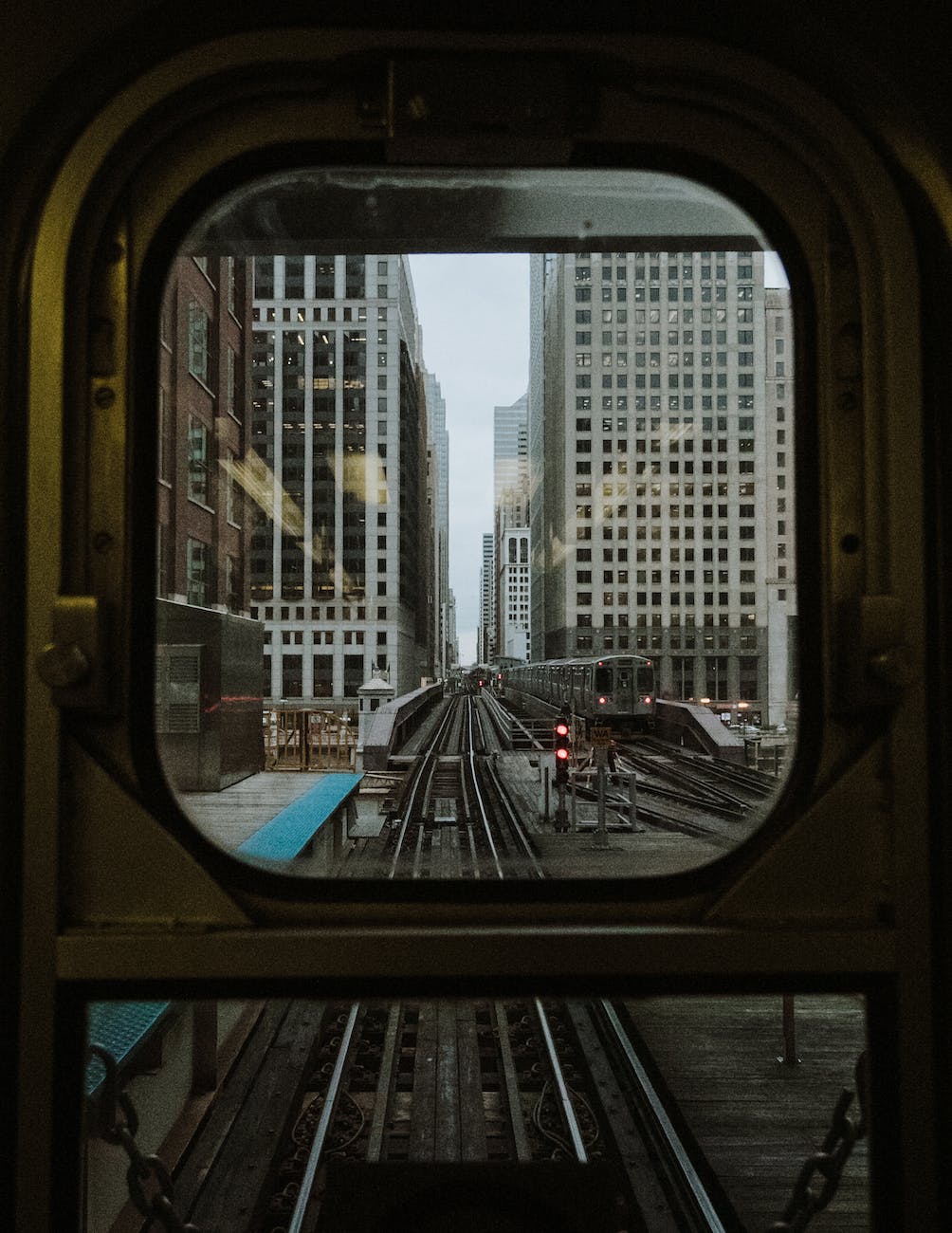
Adjusting rail transit to a decline in the 9-5 commuter

The Chicago region is built around a hub-and-spoke railroad system. But, what happens to those railroads when fewer people take the train into the city five days a week?

Photo by Josh Hild on Pexels.com

The 9 a.m.-5 p.m., five-days-a-week-in-an-office commuter is an endangered species on the brink of extinction. And that reality poses an existential crisis for transit agencies, especially commuter rails like Metra.

Now the agency’s post-pandemic recovery plans are coming into focus, and commuters could soon feel changes, from some increased fares to new ridership packages that will make a popular 10-ride card obsolete.

But perhaps the most interesting shift is Metra’s attempt to market itself as more than a vehicle to get white-collar workers downtown…

The plan is also focused on promoting non-downtown trips, which Metra sees as a growth opportunity. To encourage a trip to the zoo, for example, one-way tickets that don’t include a downtown starting point or destination would cost $3.75 regardless of distance…

Even if Metra wanted to add more frequent trains — which Gillis said it does — that change can’t happen overnight. Mixing up schedules would likely require infrastructure updates and new agreements with the freight railroads that share the tracks Metra trains travel on. All that would come at a cost, which may be out of reach for an agency barrelling toward a budgetary crisis.

One issue that is very difficult to address: is the railroad infrastructure in the Chicago region just not in the right places? The hub-and-spoke model worked for decades but more commuting is suburb to suburb. The region needs rail lines and other mass transit options that link suburbs and suburban job centers. Even just adding one or two dependable connector options between the Metra lines could be a big help. (See the proposed STAR Line.)

Another route to pursue: continue to encourage communities to build more transit-oriented development that can help create a larger residential base who can easily hop on and off railroad lines. I was recently on a suburban railroad line and saw a family with small kids hop on for three stops and get off. If more people can easily walk to a station, travel quickly and reliability, and find something interesting within a short walk a few stops away, they will do so. What might be good for local development can also be good for Metra.

Chicago once had the country’s busiest port

Chicago is a transportation center, and it once was home to a thriving port:

Photo by Pixabay on Pexels.com

In 1871, the city’s one-of-a-kind water link between the Great Lakes and the Mississippi River helped make it the country’s busiest port, one that lured more ships than New York, San Francisco, Philadelphia, Baltimore, Charleston and Mobile combined, according to the Encyclopedia of Chicago

These days, Chicago is much better known for busy railroad lines, air traffic, and highways.

Intriguingly, Chicago still has access to major bodies of water. Whether they are in as much demand as the past and whether they are in good enough shape to handle more traffic (the subject of the article cited above) are other matters. Could there be a future world where more goods and materials go by ship and Chicago benefits from its location that can link the Atlantic, the Great Lakes, and the Mississippi?

Equating the population of a good sized American small town and the world’s new largest cruise ship

Americans like small towns. What if a small town was always on the water? The world’s new biggest cruise ship will carry a sizable number of people:

Photo by Shawnna Donop on Pexels.com

Royal Caribbean’s luxurious new vessel Icon of the Seas is nearing completion in the Turku shipyard on Finland’s southwestern coast, its maiden voyage scheduled for January 2024…

Resembling a village more than a ship, the mammoth vessel boasts colourful waterparks, more than 20 decks and can carry nearly 10,000 people…

Papathanassis noted that “there are obvious economic benefits” to mega-sized ships, reducing the cost of individual passengers.

With its seven pools, a park, waterslides, shopping promenades, ice skating rink and “more venues than any other ship”, larger vessels like the Icon of the Seas also offer more options for spending money on board.

Here is a breakdown of who will on the ship/floating village:

Royal Caribbean International’s Icon of the Seas is a mammoth 365 meters long (nearly 1,200 feet) and will weigh a projected 250,800 tonnes. For comparison, that’s like trying to keep two CN Towers afloat.

When it sets sail on Caribbean waters in January 2024, it will comfortably hold some 5,610 passengers and 2,350 crew.

Imagine a large American small town or a small suburb floating on the ocean around the world. What might take up several square miles on the American landscape can be packaged on one boat. The density is a lot higher and it has a lot of recreational amenities in a small space. Besides space, what else is missing?

I am reminded of the ideas of floating communities outside of international waters and/or apocalyptic scenarios where humans do not have access to land. Could a ship this sized be turned into a permanent settlement and how would this alter what is on board?

Why not try more memorable speed limits – like 13 mph?

Could more unusual speed limits help improve safety on the roads? Here is one speed limit I saw recently along a road coming out of a shopping plaza:

Most speed limits are in increments of 5. I assume this is, in part, due to standardization of roadways throughout the United States. But, why not throw in some more unusual numbers to catch the attention of drivers? Would I be able to stick to the occasional 13 or 31 or 67 more easily than the standard 15, 30, or 65? If every speed limit was a number off of the 5/10s pattern, they might make the problem worse. The key could be to have some numbers off from typical numbers.

The switch to more digital speedometers in cars could help with this. A good number of speedometers are also in increments of 5 and 10 so matching 13 mph could be hard. If more drivers have digital displays where a 5/10 increment does not exist, then escaping the rigidity of 5/10s could be easier.