Local histories online and thrown into the AI training process

Arcadia Publishing is presenting its authors of local histories the opportunity to join or opt out of their texts being part of AI processes:

Photo by Olena Bohovyk on Pexels.com

Such hyperlocal histories are a crucial resource, a way for particular communities to preserve and chronicle their cultures, as well as a means for marketing their regions to tourists and chance visitors. But their audiences are consequentially limited, so Arcadia does not usually approach its authors with hundreds of dollars on offer. In its email to Brown, the publishing house even pointed out that these opportunities for author compensation “could be very limited in the future,” pointing to summertime court verdicts that recognized the A.I. training process as fair use—even with copyright material. Arcadia was offering its authors a favor, while making clear it didn’t have to, and pointing out that this could be their only chance…

Arcadia is hardly the only book publisher to ink such opaque contracts with the A.I. overlords, despite the spirited objections and lawsuits brought by various authors. University and scholarly presses—which have been confronting the fallout from the Trump administration’s mass grant cancellations, higher printing and shipping costs from tariffs, and industry headwinds—are providing the model. Taylor & Francis, an academic publisher based in the United Kingdom, signed a $10 million deal with Microsoft last year to share a portion of its catalog for A.I. training, in exchange for annual payments from the tech giant through 2027. Authors were reportedly given no notice and their royalties were measly in turn; Bloomberg quoted one anonymous Taylor & Francis author who claimed to earn only $97 for ceding their book to the training maw. (A T&F spokesman told Bloomberg that the payments were “in accordance with the licensing terms and royalty statement periods in their contracts,” while parent company Informa declared in a press release that “the agreement protects intellectual property rights.”) Wiley, an over-200-year-old academic publishing house, has already struck multiple A.I. deals for licensing and product integration, offering up its works to inform the output of Perplexity’s LLM and Amazon Web Services’ chatbot.

For the publishers, the arrangements were lucrative. For the authors, the payouts were much less so. In July, Johns Hopkins University Press gave the authors of its 3,000-title catalog an Aug. 31 deadline to opt out of having their works become A.I. training fodder in a new tech partnership. If they opted in, they would receive a little under $100 per work. Like Arcadia, Hopkins Press did not disclose the A.I. company involved or the money it was hoping to earn. It did press the urgency of signing now while writers still had some agency, and reminded them who here really has the power. “In your contract, you provide us with the rights to go ahead with this kind of licensing,” Barbara Kline Pope, executive director of Hopkins Press, wrote to her writers. “However, we would like you to have the ability to opt out if you so choose.” The press was not suffering businesswise, she clarified, but it was “exploring how our financial model may need to evolve.” One author who went for the opt-out contract addendum with Johns Hopkins Press shared the resultant language with Inside Higher Ed; it warned that “sales and reach” of their work might suffer due to the A.I. opt-out…

A lot is still unclear, but a few things are apparent: A.I. companies are aggressively reaching out to book publishers to strike deals that will allow them to sidestep the litigation that led to the Anthropic settlement and avoid the heftier payouts. Whichever unnamed firm approached Arcadia, it took a particular interest in the wordier History Press, indicating that generative text remains the lodestar. And if the Theodore/Franklin Roosevelt mix-up is representative of other chatbot hallucinations, that perhaps indicates the need not just for these bots to brush up on history and text, but to ramp up the representation of local history in the mix in order to make the LLMs more universal.

It sounds like AI companies want large bodies of texts and academic publishing provides that.

It might just be about the words and texts but I wonder if any of the AI services actually wants the research information. Imagine one of them builds and advertises a specialty in local history. To look for local history online right now might require some digging (see steps for investigating suburbs here and here). What sources to trust? Where can I find specific information about people and places?

For example, I was recently looking at the different presentations about suburban communities between Wikipedia and Grokipedia. In some ways, the pages were similar in terms of their headings and the kinds of information presented. However, they drew on some different sources. Does a community’s website provide the best overview of a community? Where might published histories fit? Who can incorporate “official” overviews and the lived experiences of residents and those studying the history?

Perhaps there would be a market for accurate local history AI. Would it help people doing genealogies or interested in local development or looking to move to a new place?

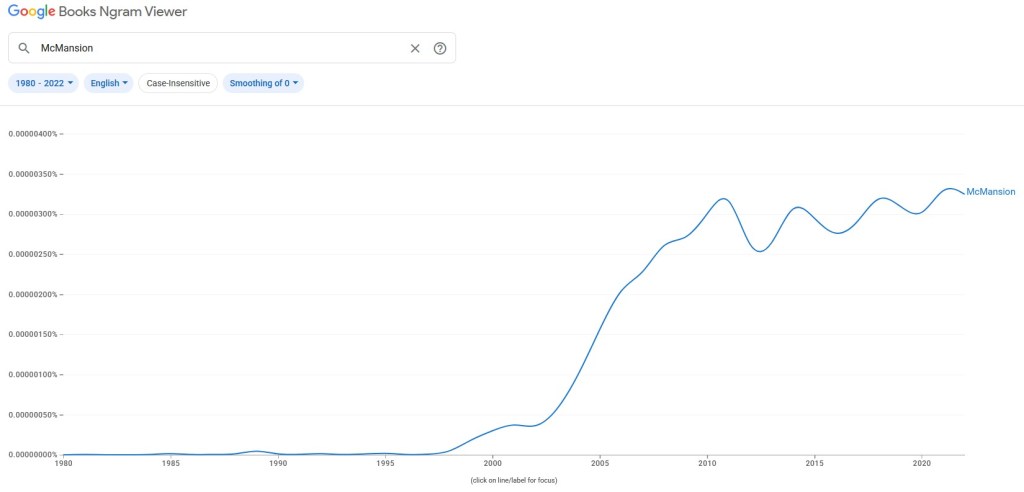
White House construction turning building into a McMansion?

One political commentator recently argued the changes President Trump is making to the White House are turning the home into a McMansion:

Photo by Aaron Kittredge on Pexels.com

Discussing the makeshift tents for large events used by previous administrations, which the Trump administration has cited as proof a larger event space was needed, Lemon said, “The tents don’t bother me. I don’t think everything has to be a McMansion. He’s turning the white House into a McMansion.”

Applying the term McMansion is a critique. Rather than being a stately, public structure, the suggestion is that the White House is becoming too large, architecturally garish, a building to be mocked rather than admired. The new addition will detract from the coherence of the existing building. (The White House is already large with around 55,000 square feet in the central structure.)

Two related thoughts:

  1. President Trump is often associated with tall buildings and a particular interior design style. Neither necessarily go with the Neoclassical design of the outside. What will the new ballroom look like outside and inside compared to the rest of the architecture?
  2. I would imagine politicians in general would not like their homes to be called McMansions. Even if some live in large homes, to call those houses McMansions says something about their tastes. I have not seen anyone look systematically at the architecture of the homes of major politicians but considering how many might qualify as McMansions would be interesting.

    The amount of building going on in the US to support AI

    Perhaps contrary to those who argue the United States struggles to build, an AI construction boom is underway:

    Photo by Victor Moragriega on Pexels.com

    Many people believe that growth will only continue. “We’re gonna need stadiums full of electricians, heavy equipment operators, ironworkers, HVAC technicians,” Dwarkesh Patel and Romeo Dean, AI-industry analysts, wrote recently. Large-scale data-center build-outs may already be reshaping America’s energy systems. OpenAI has announced that it intends to build at least 30 gigawatts’ worth of data centers—more power than all of New England requires on even the hottest day—and CEO Sam Altman has said he’d eventually like to build a gigawatt of AI infrastructure every week. Other major tech firms have similar ambitions.

    Listen to the AI crowd talk enough, and you’ll get a sense that we may be on the cusp of an infrastructure boom.

    Throughout American history, growth is good. Construction is a sign of growth and provides jobs. A new industry is underway. Society is progressing. Data centers are all over the place (and will end up somewhere even if some communities do not all them). Americans are used to booming construction as this happened across housing and numerous industries throughout the country’s history.

    What that growth might lead to is another matter. How do these data centers contribute to communities and landscapes? Do all the data centers in suburbs transform suburban life? When the growth slows, what happens then? Will the data centers still be there in 50 or 100 years or will they be vacant properties?

    All this is a reminder that while many Americans will encounter AI through devices and data going through the air, it has a significant physical footprint. To power real-time AI responses to whatever we as users need requires buildings, land, resources.

    Several ways AI could transform suburban life

    How might AI transform suburban life? A few thoughts that came to mind:

    Photo by Tara Winstead on Pexels.com
    1. If AI disrupts works and jobs in significant ways, this will affect suburbs. Many jobs are in the suburbs and people in the suburbs need certain jobs and income to be homeowners and residents. For example, if AI eliminates a lot of white collar office jobs, this will hit residents and communities who depend on corporate offices. Or if work from home becomes more prevalent, this changes people’s mobility and interactions with people and places around them.
    2. Can AI take over driving or render a lot of driving unnecessary? Driverless vehicles have been in the works for a while now but if AI helps accelerate these innovations, it could change a fundamental aspect of suburban life. People could get more time back. Perhaps communities do not need to be designed around cars.
    3. Is there any chance that AI makes suburban community life better – more interaction, deeper relationships – or would it contribute to individualism and atomization? Say AI takes over certain work duties; does this give people more time to socialize? Or do suburbanites rely even more on AI to handle their interactions with others – why wave to that neighbor you don’t really talk to when AI can generate a text to send to them?
    4. Would widely-adopted AI make suburban houses bigger, smaller, or just different? Perhaps it changes the layout. Would suburbanites want less space if AI can do more for them?
    5. This might be the biggest question of all: does widespread AI help suburbs grow or shrink in population?

    I do not know the outcomes of these questions. I do know that the ideology and patterns of suburban living in the United States are well-established and establishing other patterns would require substantial forces.

    The prevalence of industry in 19th century American suburbs

    In recently reading The Working Man’s Reward: Chicago’s Early Suburbs and the Roots of American Sprawl, I noted this in a chapter on the Town of Lake which was annexed into Chicago in 1889:

    Photo by Jon on Pexels.com

    The U.S. census reported that the number of suburban jobs rose after 1850 and accelerated after 1880, so that, in the second half of the nineteenth century, suburban employment constituted one-third of all manufacturing employment in America. Ignoring those jobs beyond the central business district means ignoning blue-collar workers and ignoring one of the leading forces for suburbanization in America. (75)

    A large part of the American Dream of suburbia involves single-family homes. But the story of suburbia also includes industry and jobs. In this book, historian Elaine Lewinnek highlights the move of industry to suburban areas outside of what was then the Chicago city limits and how working people followed those jobs. They often ended up in small, single-family homes close to new factories and meatpacking facilities.

    Why did industry move to the suburbs? Land was cheaper. They could build large facilities. The downsides of industry – noise, smells, pollution – affected fewer people and the land uses faced fewer regulations in suburban areas.

    The one statistic that jumped out at me in the paragraph above was that “one-third of all manufacturing employment” was in the suburbs. Some of those suburban areas became part of the city, as they did in Chicago. But industrial suburbs continued, such as in places like Gary, Indiana, as did suburban employment. When the most common commuting trip in the United States today is suburb to suburb, this is part of that legacy of suburban industry and work.

    Some suburbs are indeed bedroom communities with limited or no commercial and industrial land uses but the suburbs as a whole have lots of business activity.

    The pandemic gives residents to some places, the years afterward take them away

    What happened to the places that gained residents during the pandemic? Some are now experiencing less growth:

    Photo by Tracey Mahoney on Pexels.com

    Flash forward to today, and the big “winners” of the work-from-home reshuffle — metros that drew hordes of footloose workers and disaffected coastal dwellers — have turned into losers. Fewer people are moving to so-called Zoomtowns. Home listings are piling up on the market. Prices are dropping. The anxiety has shifted from buyers trying to elbow their way in to sellers just trying to offload their properties. A new report by the real estate analytics firm Parcl Labs, shared exclusively with Business Insider, shows that home sellers in the lower half of the US, also known as the Sun Belt, are the most desperate in the country…

    Housing demand surged early in the pandemic — the country’s homeowning ranks swelled by a whopping 2.2 million people between the first quarter of 2020 and the same point in 2022, an analysis by the Harvard Joint Center for Housing Studies shows. But for all the talk of upheaval, movers more or less stuck to those pre-pandemic flight patterns — just at warp speed. People kept migrating from big-city centers to the suburbs and from the North to the South. Sun Belt states, including Florida, Texas, Arizona, and North Carolina, experienced the largest population gains from domestic migration between mid-2020 and mid-2021, per a Harvard analysis of Census data. The Dallas metro, for example, gained around 63,000 people from other parts of the country that year, a huge jump from just 19,000 the year prior. Phoenix, Tampa, Austin, and Charlotte recorded similar increases. Expensive states with large urban areas, including California, New York, Illinois, and Massachusetts, saw the biggest losses…

    The North-to-South movement still holds, but the North is losing fewer people, and the South isn’t gaining like it once was. The most recent numbers, for the yearlong period ending in mid-2024, show net domestic migration to the South was down almost 38% compared to the first year of the pandemic. Domestic migration to the Midwest, on the other hand, is up about 60% in that same period, though it’s still negative in absolute terms. The Northeast’s net loss was down to 192,000 in the latest tally, compared to a loss of 390,000 at the height of the pandemic. With the migration tide receding, sellers in once-hot metros are getting real. In Denver, Charlotte, Jacksonville, and a smattering of other Sun Belt markets, more than half of single-family homes for sale have seen a price cut, Parcl Labs data shows. In the Boston, Philadelphia, and Buffalo metros, the share of listings in that bucket drops to fewer than a third.

    That’s just one metric. To gauge sellers’ desperation these days, Parcl Labs created what it calls the Motivated Sellers Index, which combines four factors: the number of price cuts on home listings, the time in between those cuts, the size of the price decreases, and the length of time homes are spending on the market. The higher the score, the greater the homeowners’ urgency to sell. The lower half of the US, with the exception of much of California, is awash in high scores, indicating sellers are ceding negotiating power to buyers. Same goes for much of the West. The Midwest and Northeast, on the other hand, registered some of the lowest scores in the nation: Sellers there are sitting pretty by comparison.

    This is something I have wondered about a lot in recent years and even addressed, with Ben Norquist, in a chapter in my book Sanctifying Suburbia: in today’s world of smartphones, the Internet, and easy travel, why do people and organizations stay where they do when they could be located almost anywhere?

    Evangelical non-profits described the benefits of being near other evangelical organizations. They thought they could find employees in certain places and could partner with other actors in the community. Some had long histories in their community while others had made a major move to help their budget.

    Residents do not just go where there is cheap housing or plenty of jobs. They have ties to places and people. Moving comes with its own costs.

    So some more people moved related to the pandemic following similar patterns in previous decades: away from metro areas in the Northeast and Midwest to the South and West. And that appears to be continuing, but at a slower pace and with some indicators that the rapid growth in the South and West is slowing. What does this all mean?

    Perhaps the pandemic years were an aberration. Yes, people can work from home but this is not what all companies and organizations want. Bring a bunch of new people to new places and the housing prices go up and the communities change.

    Does this mean all that movement would stop completely? Or that places in the Northeast and Midwest would grow? Not necessarily. Long-term patterns are hard to break.

    Suburban moratoriums on data centers and warehouses; what might be built instead?

    The suburb of Aurora has put a temporary hold on approving data centers and warehouses in the community:

    Photo by Field Engineer on Pexels.com

    Such concerns led Aurora’s city council to enact a temporary zoning moratorium on data centers as well as warehouses. Mayor John Laesch made clear officials are not against data centers as a whole.

    “It’s just trying to give us time to make sure that we have the proper guardrails in place,” he said.

    In neighboring Naperville, at least one city council member said he’s exploring the idea of a similar pause.

    My longer-term question for Aurora, Naperville, and suburbs with similar concerns: what will they approve for the land that might be used by data centers and warehouses? Several options they could pursue:

    1. Green or open space on this land. This might be hard to do with land zoned for commercial and industrial use as suburbs hope such land will generate tax revenue and jobs. But residents might like this option if the alternative is something that generates noise and traffic.
    2. Pursuing office space or industrial uses with limited noise and pollution. The problem with this could be whether there is demand for such structures. How much vacant office space is there already in office parks and buildings along I-88? How long could a community pursue these options if the market is not favorable?
    3. Approving housing. There is a need for housing in the Chicago area and both Aurora and Naperville have experienced population growth in recent decades. But what kind of housing – expensive units without too many kids (so as to not burden local school systems)? Housing for seniors or young professionals? Affordable housing? Would neighbors like more housing – noise, traffic, potential water issues, etc. – near them?

    Perhaps some suburbs can wait this all out. Will the boom in warehouses and data centers end at some point? If some suburbs say no to data centers and warehouses, they will end up somewhere. Will the warehouses end up not being in wealthier suburbs?

    Political prediction markets vs. political polls

    Could political polls be replaced by political betting markets?

    Photo by Nataliya Vaitkevich on Pexels.com

    The rise of political betting is not just lucrative for the bettors and the platforms. Its advocates also hope that one day, it can replace the political prediction industry generally and remake the larger political media ecosystem. “[Traders are] incentivized with cold, hard cash to separate the emotion, to make a bet with their head rather than the heart,” said John A. Phillips, the CEO of the betting platform PredictIt. That means, the boosters argue, that they are more accurate than traditional polls and analyses of those polls…

    But another group is paying attention to these platforms’ rise: those who have a special interest in political predictions, from campaigns to journalists to any number of groups and individuals who might be affected by the outcome of an election. Rather than relying solely on polling, punditry or counting yard signs, in advance of big election nights, the markets put together all available information and spit out a number that looks like the collective wisdom of a lot of people with money on the line. That can often lead to a number that is a more comprehensive reflection of a certain candidate’s chances of winning than any single poll or piece of political analysis…

    While these markets’ long-term prediction capabilities can often equal or beat the predictions of most conventional polls, where they really have an edge is in rapidly responding to events…

    But 2024 is just a single data point. In 2016, for example, prediction markets underrated Trump’s chances compared to the 538 model. With few major U.S. elections that have a lot of betting volume to study, the truth is that it’s still not possible to know for certain whether prediction markets can consistently outperform polling averages.

    I wonder how much of this optimism about political betting is more about the perceived and real downsides of polling as of 2025. It has not preformed well in the last decade or so. Response rates are not good. There are lots of polls and polling companies claiming they can get a good poll. At what point does polling become so inadequate that media and others stop sponsoring polls and/or using the information? Or I could imagine a point in the next few years where a number of polls stop operating as several organizations show they get more accurate results.

    It would also be interesting to know how much money there is to be made in prediction markets versus what is invested in the polling industry. Who wins when lots of actors are involved in either polls or predictions? Or when do regular Americans participate in political prediction markets?

    And let’s see how academic studies of polls and prediction markets help shape the upcoming narratives about each. How much will careful studies help identify the strengths and weaknesses of each approach or are there are forces at work that will shape how people view these options?

    Not knowing about significant local events, bridge collapse edition

    I have driven over the Sunshine Skyway Bridge a number of times when flying into Tampa and driving south. Here is an image of the roadway leading onto the bridge from 12 years ago:

    Recently looking through used books at a local library, I learned that part of the prior span collapsed after being hit by a boat in 1980:

    Wikipedia’s description of the disaster:

    The second incident came on the morning of May 9, 1980, when the freighter MV Summit Venture collided with a support pier near the center of the bridge during a squall, resulting in the catastrophic failure of the southbound roadway and the deaths of 35 people when several vehicles, including a Greyhound bus, plunged into Tampa Bay.[13] Traffic was diverted onto the surviving two-lane span for several years until the replacement Skyway Bridge was completed, at which time the old bridge was partially demolished and converted into two[14] long fishing piers.

    This is a significant local event that I had not heard of before. Such events are rare and likely stick in people’s memories for a long time. But as a visitor to the area, even one who has been there at least a few times, I did not know that this bridge had once collapsed.

    What else am I missing when visit places near and far? In my research on suburbs, I have focused on key moments involving character, times when communities had public discussions about the choices they faced. Looking back, it was clear that these choices then shaped subsequent decisions and the character of the community.

    Could local disasters have a similar effect on local character? Catastrophic events can rally a community, impacting people far beyond just those direct affected. Do people remember when they heard about the bridge collapsing? How many people wondered about their own drive over the bridge?

    The most likely ways I could imagine finding about such events is either through reading about what happened or talking with someone who lived in the area. And some events might be more important than others; a major hurricane in an area is going to have a larger effect than a smaller matter.

    Safety and other amenities in a narrative of why families choose to move to specific suburbs

    When there are scores or hundreds of suburbs in large metropolitan regions, how do people select which suburb to move to? I recently read one common narrative based around a top safety ranking for one Chicago suburb:

    Photo by Vlad Vasnetsov on Pexels.com

    It’s a small village, just over an hour from the heart of Chicago by car, but it has consistently reported some of the lowest crime rates in the region, with a violent crime rating of zero. This small-town security is one of the driving forces behind Campton Hills’ rising popularity with families in recent years. People moving out of Chicago or nearby suburbs are looking for peace of mind in their neighborhood, and this village delivers exactly that…

    A place with such a high safety ranking is the perfect spot for families to put down roots. In this regard, Campton Hills is truly designed for families to thrive. Schools in the area have earned a strong reputation for academic achievement, supportive teachers, and a wide range of extracurricular opportunities. The village is also home to some of the highest-rated public schools in the state.

    In the village, there is an impressive range of amenities to keep families busy. Community parks provide space for picnics, soccer games, and weekend strolls, while nearby forest preserves give children the chance to explore nature close to home. (Nature lovers should visit this peaceful suburb near Chicago next.) Access to healthcare and family-oriented services is reliable, with clinics and hospitals within easy driving distance. Campton Hills also hosts seasonal events that bring neighbors together, including the Boo After Dark Halloween event.

    It always feels like a win when you find somewhere close to the city that still feels like it’s tucked away in the middle of nowhere. And Campton Hills’ rural character is something that truly makes it stand out. Unlike some suburbs that feel like extensions of the city, this village keeps the perfect balance of open countryside and convenient access to Chicago.

    The story starts with safety. People are looking for a safe place with little to no crime. Their kids will be safe. It is away from the city and others places with crime.

    But then the story goes on to include other factors that attract families to this specific suburb. The schools have a good reputation. There are parks and forest preserves. Medical care is nearby. The community comes together for events. It is close to Chicago but feels rural.

    Is this how people chose a community to live in? Do they prioritize safety and then if other things look good, they go with that? Do they research all the statistics about various communities, look at rankings provided by numerous sources, and develop their own composite score of which community comes out on top?

    I am reminded of research from sociologists Annette Lareau and Elliot Weininger where they find networks, affected by social class and race, mattered for how people chose communities. What networks lead to Campton Hills and other suburbs like it? How do relationships and social ties provide people with information about communities? Do articles like these make their way through some networks?

    (Interestingly, Campton Hills is a new suburb: it was incorporated in 2007. And it is relatively small: just over 10,000 residents in the 2020 Census.)