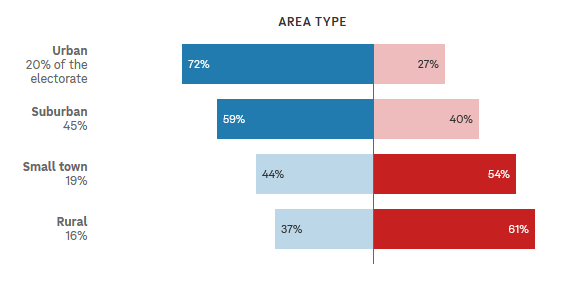
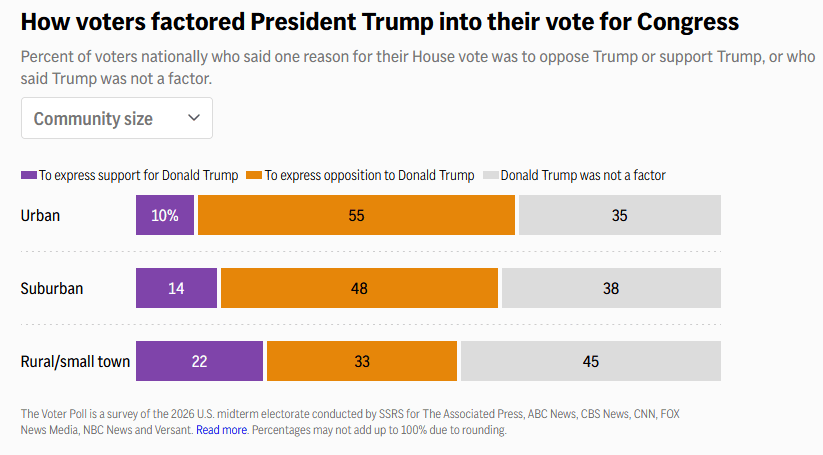
Even as urban voters are heavily Democratic and rural voters are more Republican, the suburban voters went more for Democrats. (My guess is that there is some overlap between suburban and small town here as the US urban population is around 80%.)
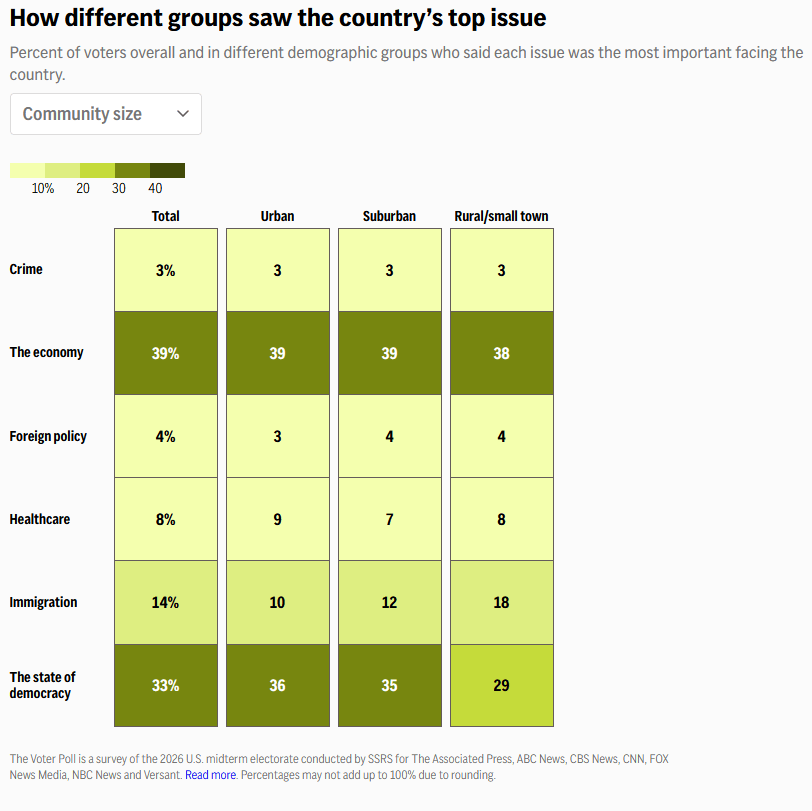
When considering the most important issues in the election, voters in urban and suburban areas were more alike (with some slight differences in rural areas and small towns regarding immigration and democracy):
Both because the suburbs contain so many potential voters and there are some suburbanites who can be swayed (see how they voted in 2024), this will be something to watch for leading up to 2028. If the economy was the leading issue in 2026, what changes would influence suburban voters one way or the other?
Most voters say the economy or the state of democracy is the top issue facing the country, with the cost of living and government corruption weighing heavily on many Americans’ minds as they cast a ballot in Tuesday’s midterm elections. The poll also signals a strong desire for Congress to take a more forceful role in checking the presidency.
Given these sentiments, what will politicians now do about housing? It is not the only expensive or costly items voters care about; see concerns about gas prices or groceries or utility bills. But it is a persistent and important concern. It is one of the biggest, if not the biggest, line item in household budgets. It is tied to all sorts of other life opportunities and outcomes. Good housing at a reasonable cost is something people (read voters) want.
Some directions we might see in the coming months:
-More statewide efforts to address local zoning issues. If individual communities can reject housing, can states allow more situations where housing can be built regardless of local concerns?
-More federal monies funneled toward helping people obtain housing. This could take different forms but it could help people purchase homes or find rentals.
-More incentives for builders and developers. What could help them provide cheaper housing? What could help them build more units?
-Resources for redeveloping spaces. If there are properties not living up to their potential (whether they are residential, commercial, or institutional), money or changed policies or something else might spur turning them into needed housing.
-More agreement that the federal government should step in or should address housing needs. Public housing may not be popular but local governments are not always open to big housing change. Who can help address the logjam of housing needs?
These are not very specific as there are multiple opinions and options.
At the same time, curbing inflation and affecting the price of everyday goods would be welcomed by many but still does not get at the fundamental issue many Americans face: how can I find decent housing at a reasonable price? People want action, not just a lot of possibilities.
Voters in at least 29 jurisdictions across the country passed bans or restrictions on data centers Tuesday, reflecting the widespread public revulsion to the facilities and adding to the growing pushback on the ambitions of the artificial intelligence industry.
Data center construction also suffered setbacks in several states that are hot spots for the projects, as Democratic candidates promising to curb the rapid proliferation of the compute warehouses won governors’ races…
A voter poll conducted on behalf of major TV networks said early on Wednesday that 56 percent of midterms voters considered AI and data centers to be a major or crucial factor in their vote. That ranked them as the least influential among five issues, far behind government corruption, the war in Iran and the cost of living…
It’s unclear whether local and state restrictions will meaningfully slow the frantic building of AI data centers around the United States. Some industry officials say that a significant portion of the roughly 600 large-scale AI data centers either planned or under construction is unlikely to become operational regardless of public reaction.
Three quick thoughts in response:
With these election results, this does not necessarily mean that data centers cannot or will not be built in some places. Does this mean places and officials open to data centers will build more within their geography? Is this an opportunity for some locations?
I’m curious to see how conversations about AI and its potential line up with conversations about people not wanting to live near them. What is the point where people say data centers are needed because AI is needed for particular uses and so they have to go somewhere near us? Is there any point that this happens if there are always options where data centers can be located elsewhere?
When I read about NIMBY responses to all sorts of land uses, I keep coming back to an idea: why not have municipalities or special government zones where these undesirable land uses could be concentrated? Use the Chicago area as an example: if many residents in the city and suburbs do not want data centers near them, is there a way to put a bunch of data centers in one municipality with no residents nearby? Out of sight and hearing, out of mind?
Records show that the pope is registered under his baptismal name, Robert Francis Prevost, to vote in the Chicago suburb of New Lenox, where his brother John lives. The Chicago-born pontiff has cast ballots in both Republican and Democratic primaries in recent years and cast a vote in the 2024 presidential election….
The pope’s ballot is expected to include votes for the senate and governor race in Illinois, along with house of representative, state and county elections.
While there is interest in comparing the Pope’s political views versus that of the current US administration, I would be interested to know how he voted regarding local candidates and issues. As noted above, this includes voting for state and local elections. Local choices could include for county boards, forest preserves, local judges, and municipal governments. It might include local referendum issues about property tax increases for school district needs or other specific local questions. Local residents might struggle to keep up with all the local issues and all the names on signs that pop up at each election cycle, let alone someone who is living elsewhere and voting from a distance.
The shorthand the media often uses for state and national issues – it is Democrats vs. Republicans, one party wins and the other loses – do not always hold up in suburban elections. Sometimes they do; elections for county boards and school boards in the Chicago suburbs can now echo national party platforms. But sometimes they do not. There are local election slates. Or particular histories and character in communities that influence local elections. A suburban community may lean more Democratic or Republican in larger political races but the local political activity can be unique.
New Lenox, Illinois is a unique suburban community southwest of Chicago. It has grown rapidly in recent years, increasing from under 3,000 residents in 1970 to over 27,000 in 2020. The suburb is largely white with the 2020 Census finding over 87% were white alone. A 2015 promotional campaign for the community emphasized that it is “home to proud Americans.” How do leaders and residents understand their community’s character, considering past, present, and future, and how does this affect their vote?
After the election concludes, there will be data regarding races – national, state, and local – that New Lenox residents voted in. It sounds like the Pope’s votes will be part of this.
Mike Rogers and Abdul El-Sayed tried to discredit each other’s fitness to serve us in the U.S. Senate by bringing up property they own outside Michigan. Rogers said El-Sayed owns a home in the United Arab Emirates. El-Sayed questioned why Rogers took the “McMansion” he owns in Florida off the market. You’ll have to decide how relevant their real estate holdings are.
To call someone’s house a McMansion is not something usually said positively. I would guess most people would not talk to their friends or family about their McMansions. To call someone’s house a McMansion typically is meant to critique their taste and lifestyle. Here, the debate reference to a McMansion seems to be about the money acquired and spent and the kind of home purchased.
This does not mean McMansions are uncommon. Whether talking Michigan or Florida, there are many McMansions built in those states in recent decades. The average voter may not live in a McMansion given their price and where they are located. At the same time, some of those McMansion residents might be suburban swing voters.
How many politicians actually live in McMansions? Does the percentage of politicians living in McMansions exceed that of the general population or do politicians live disproportionately live in others kinds of housing? Or perhaps there are at least a few major politicians who live in average or smaller housing; are there any major politicians living in single-family homes under 1,500 square feet? If housing is a reflection of one’s political values and actions (as suggested above), such answers might matter to some.