Renters now make up the majority of residents in more than 100 suburbs around the U.S., according to a new analysis of Census Bureau data from Rent Cafe. Another 57 suburbs are on their way to becoming predominately renter territory over the next five years, the apartment search website also found…
Overall, roughly a quarter of the more than 1,100 suburbs near the nation’s 50 largest metro areas are renter-dominated, according to Rent Cafe. Some 21 million people rented their homes in the suburbs as of 2019, up from 17 million a decade ago.
Millennials and members of Generation Z account for most suburban renters, Census data show. Rent Cafe notes that 55% of suburban renters are younger than 45, with median household earnings of around $50,000.
Meanwhile, the pandemic is expected to further fuel the shift away from suburban homeownership in favor of renting. Remote work opportunities have generated more interest in suburban areas within striking distance of cities.
If this is indeed the case, it would be interesting to know if these suburbs share characteristics. Do they tend to be close to the city or further out? Do they have particular hosing stocks compared to other suburbs? Are middle-class and up suburbs still devoted to residents owning single-family homes as a status marker?
My guess is that a majority of suburban residents would still say that they desire to home at some point. But, if more suburbanites are now renters, is the pathway to homeownership in their own community or other suburbs much more restrictive? This is part of the larger affordable housing conversation; people need any decent housing to live in but because many Americans aspire to own a home, having affordable ownership options is important as well.
An interesting middle path in some communities could be having significant numbers of single-family homes with long-term renters. The appearance and status of homes is maintained while renting adjusting for current conditions. On the other hand, many have argued that renters do not care for their properties or communities in the same way and communities may not like this trend.
Highlights include transitioning to clean and renewable energy, incentivizing energy efficiency, developing a plan for electric vehicle infrastructure, increasing public transportation use and recycling efforts, and focusing on the maintenance of natural resources.
Other objectives include a 4% annual reduction in waste, energy use and vehicle miles driven in conjunction with an increase in tree planting to help decrease greenhouse gases by 4% each year.
One of the recent steps taken by the city was hiring Ben Mjolsness as Naperville’s first sustainability coordinator. Mjolsness on Tuesday talked about the many options and incentives residents have with energy efficiency and recycling.
Councilman Patrick Kelly said he looked forward to showcasing Naperville as a front-runner in sustainability.
Many communities will be pursuing such plans in coming years. But, the particular context of Naperville is interesting to consider for multiple reasons:
It is a large and wealthy suburb. It has the resources to pursue this.
Naperville likes to be a leader among suburbs and this may help further this status in coming years.
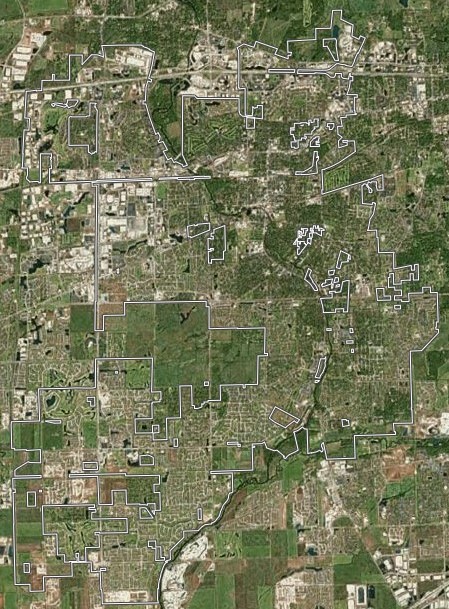
Sixty years ago or even forty years ago, Naperville was much smaller in population and had a smaller footprint in land use. Today, it has nearly 150,000 people and roughly 39 square miles of land with much of this involving single-family homes.
In one sense, the growth patterns that helped make the Naperville of today possible – explosive growth in the postwar era built around homes and driving – also make pursuing sustainability more difficult. Take the reducing the miles driven goal from above. Some residents of Naperville could do this but many are in subdivisions whose roads then feed to large arterial roads. This does not work as well for biking (and the weather in the area may not help). Additionally, the sprawl makes mass transit more difficult. In the past, Naperville has tried buses in the community but they do not get much use (even as the train stations are some of the busiest with commuters going toward Chicago). The best way for Naperville to achieve this goal may be to encourage local businesses to allow employees to work from home, thus limiting commuting needs.
Not mentioned in the news article above (it could be in the report) is the density of the community. One way to improve sustainability in the long run is to have denser housing, particularly near locations where other forms of transportation other than driving are possible. This could be in and around the downtown. It could be in different nodes around the community where there are jobs or where it would be possible to pursue transit-oriented development. As a bonus, denser housing might also provide more opportunities for affordable housing. Naperville has thought about these options in the past but they are not always popular given the single-family home character of the community.
As Naperville pursues sustainability, some actions will be relatively painless given what the community can do. Other conversations about long-term changes or how to address sprawl might take much longer for a consensus to emerge.
The number of homes in the Chicago metro area grew by 3.9% between 2010 and 2020, census data made public Thursday shows. That was a slower growth rate than the nation overall, where the number of homes grew by 6.7%.
The slow housing growth was not surprising, as the region recovered from the 2008 housing and financial crisis…
Among Cook and the collar counties, only Kendall County added homes at a higher rate than the nation: 11.6%. It added more homes than any county in the state, likely reflecting the county’s explosive growth in population over the past decade…
The Chicago area’s population growth could be good news for the housing market, inspiring investors and developers to take a deeper interest in the city, Smith said.
Presumably, builders and developers are going to be a bit hesitant to build a lot of units when the population is not growing as quickly. If new demand is limited, why build too many units and risk having lower selling prices? Add this corollary to the growth is good idea in American communities: higher rates of housing construction is a sign of a bright future and a higher status.
I do wonder what percent of homes or residential units need to be replaced each decade. Populations in metropolitan regions expand out – as noted above in Kendall County with double-digit growth – and occupy existing homes and units that may or may not meet their needs. Teardowns are one option, usually limited to wealthier communities where a new home in place of an older one can get a hefty price, but so are denser housing developments, in-fill development, or a change of use for properties (think vacant shopping malls or office parks converted to housing).
Additionally, does this small increase in homes also help address the need for affordable housing? At what price points are these new homes going for? I would guess that at least a sizable percentage of the new homes are out of reach of many in the region.
The project is one of several in Atlanta where faith leaders are investing in affordable housing for the sake of their communities. Across the country, churches with property in prime locations are turning over one block, one building, one lot at a time through movements like “Yes in God’s Backyard” in California. Atlanta-area pastor Rev. David Lewicki discusses the calling of affordable housing as a ministry.
“We are increasingly convinced that affordable housing is the foundation of beloved community,” the Presbyterian minister wrote at Faith & Leadership. “Housing is a profound and even holy good.”…
Lewicki’s church got involved in lobbying for more inclusionary zoning policies to allow for lower-priced options in their area and began to create a land trust so they could get involved in addressing the legacy of racial and economic segregation in the city…
Affordable housing and community development can seem like just business ventures—which they are—but pastors know how much these issues directly affect their congregants and stem from biblical calls for community.
Here are a few compelling reasons why suburban churches should follow this course:
Affordable housing is needed throughout metropolitan regions. For example, in the Chicago region, experts suggests there is a need for tens of thousands of units. And the need is not limited to Chicago or just specific communities; it is needed in many locations.
Welcoming people goes beyond Sunday morning and indicating to people that they are wanted in the community all week round. It is one thing to be part of a church community; it is another to be fully welcomed into all of the community.
Housing is critical in a suburban environment as it helps in access to jobs, schools, parks, and other amenities that lead to a higher quality of life. Plus, homeownership is highly valued in suburbs so if there are opportunities for congregations to provide affordable single-family homes, this helps attendees match suburban aspirations with reality.
Suburban churches have funds and local power to make this happen. It takes money to buy, develop, and maintain properties. It takes expertise and influence to work with municipalities and concerned neighbors. Congregations are often viewed as assets in communities and they often have built up goodwill over the years.
After purchasing a plot of land in the Griffin Heights neighborhood, the couple reached out to Printed Farms, a Florida startup that has access to the Danish manufacturer COBOD’s construction 3D printer, to head the innovative project.
Work began Thursday on a plot of land in northwest Tallahassee area and is expected to finish by Friday. The automated printer can lay up to two feet of wall a day.
Once initial construction on the three-bedroom, two-bathroom house wraps up, it still won’t be ready for its first owner until it has furnishings installed, which may take an additional eight to 10 weeks.
The house will cost between $175,000 and $200,000 depending on its appraisal and area median income affordability, Light said.
Once there are some completed homes, this will provide opportunities for builders and possible homeowners to consider them. I wonder how much of the devil is in the details. What is the materials and labor cost compared to traditional methods? How long will these homes last? Will the appearance and experience of the home be similar to traditional construction? How much faster could such homes be constructed? How many people would want to be among the first to try them out?
Of course, if this can help address affordable housing needs, it could be a big deal. Alongside tiny homes, ADUs, and other innovations, many communities in the United States need more quality and cheaper units.
The developers propose to build a three-story building on approximately 2.5 acres at 874-920 N. Quentin Road, on the southwest corner with Poplar Street. All of the apartments — one-, two- and three-bedrooms — would be set aside for tenants whose income is between 30% and 80% of the area’s median income.
Village staff members recommended denying the plan, and the plan commission did the same after a public hearing Tuesday night. The village council will have final say and is expected to discuss the matter Aug. 9.
Plan commissioners praised the developer’s successful record of affordable housing developments, but they didn’t like the plan for the Palatine site, saying it’s too dense. The area consists of single-family homes and townhouses, with an apartment complex further north…
Several residents spoke Tuesday against the plan, saying they are worried about traffic, noise and light pollution, and changing the character of the neighborhood.
The final word will come in a few weeks. In the meantime, this set of arguments is a common one when suburbs consider apartments or even townhomes and condos. A key issue is the density of the project. What this often means is the community prefers to have single-family homes. Denser housing is often thought of as smaller housing or cheaper housing. Here, that is clear in that it is affordable housing where, through a sizable tax credit ($15 million) from an Illinois agency, residents will not need to pay full market rate.
Additionally, people often have concerns about the aesthetics and daily experiences around apartments. Apartment buildings are taller and are bulkier compared to homes on grassy lots. Because of more residents on less land, there will be more traffic on local roads. This particular proposal is close to a busier intersection but it also would be adjacent to single-family homes. It just looks different than single-family homes. If there are too many denser developments, the impression may be that single-family homes are not valued.
In sum, this density and kind of housing is perceived as a threat to the character of single-family home communities. Municipalities will sometimes respond to such proposals by asking the developer to reduce the number of units. Or, they might reject it all together by saying that it is not a good fit. And the search for land for affordable housing continues.
Far worse than corporations taking a few thousand units off the market for owners are the governments and noisy NIMBYish residents taking millions of units off the market for owners and renters alike—by blocking construction projects in the past few decades. (California alone has an estimated shortage of 3 million housing units.) From New York to California, deep-blue cities and states have amassed a pitiful record of blocking housing construction and failing to meet rising demand with adequate supply. Many of the people tweeting about BlackRock are represented by city councils and state governments, or are surrounded by zoning laws and local ordinances that make home construction something between onerous and impossible.
One of the issues at play here is a numbers one: who exactly is acting within the US housing market and how much sway do they have. Concerns about corporations and housing can be placed in the larger context of how many housing units there are and how many are being built. Here are the numbers Thompson provides:
The U.S. has roughly 140 million housing units, a broad category that includes mansions, tiny townhouses, and apartments of all sizes. Of those 140 million units, about 80 million are stand-alone single-family homes. Of those 80 million, about 15 million are rental properties. Of those 15 million single-family rentals, institutional investors own about 300,000; most of the rest are owned by individual landlords. Of that 300,000, BlackRock—largely through its investment in the real-estate rental company Invitation Homes—owns about 80,000. (To clear up a common confusion: The investment firm Blackstone established Invitation Homes, in which BlackRock, a separate investment firm, is now an investor. Don’t yell at me; I didn’t name them.)
If I am calculating correctly, institutional investors currently own 2% of the single-family rentals. Of course, this number could grow if these firms find this to be a good investment.
Thompson settles on local actors – governments and residents – as holding back housing construction. In this numbers game, restrictions on a local level collectively are holding back the construction of single-family housing. If these restrictions were lifted or lessened, concerns about institutional investors would presumably diminish because there is a larger supply of houses to choose from.
One problem I see with this among the larger numbers: while local actors might in the aggregate have oversight over millions of units, they individually have control over relatively few units. Let’s say a particular suburb in the Bay Area (and this NIMBY argument often comes back to California) is against building new single-family homes. Depending on the size of the community and the availability of land, this might affect just a few homes to several thousand. This is not many. Zoom out to the whole region and many suburbs doing this adds up to tens of thousands of potential homes. Do this across all of California’s metro areas and the numbers add up. Similarly, you could do this across all the metro areas in the United States.
All of this does not necessarily mean Thompson is wrong. Yet, to get to the numbers of new homes constructed that would make a significant difference – whether in reducing the need many metro areas have for more affordable housing or outweighing the actions of investment firms – would require a lot of change across many communities. State or federal legislation may or may not be successful and would be unpopular in many places without a significant public groundswell of support that this is an issue that all or even most communities need to address.
Together, municipal changes regarding zoning and NIMBY could add up. But, changes would need to come across communities to make a big difference.
A sweeping affordable housing bill, recently passed by Illinois state lawmakers, has strengthened the Affordable Housing Planning and Appeal Act (AHPAA). That law requires cities, with at least 1,000 residents and with less than 10% affordable housing, to submit affordable housing plans to the state. The law also allows for affordable housing developers to appeal the decisions of municipalities who reject their affordable housing proposals. Those appeals are heard by the Illinois Housing Appeals board.
The AHPAA, originally passed in 2003, is intended to encourage affordable housing, but resistance is rampant. As of October 2020, the Illinois Housing Development Authority identified 46 municipalities that met the law’s requirements. At that time, fewer than half had submitted plans or indicated that they intended to do so. Some municipalities cited home rule as the reason why they didn’t comply. The revised law says that doesn’t matter anymore. It gives the Illinois Attorney General enforcement powers, including seeking court relief, if the municipalities continue to flout the law…
Schecter said the next hurdle is getting units built — not just submitting plans. She said deadlines are needed for when municipalities must turn in their plans and by when they must achieve the 10% affordable housing requirement.
The last paragraph quoted above suggests there is still work to be done. The recent changes suggests there are now consequences if communities do not submit plans. But, I would guess the real goal of the 2003 guidelines and the update is to lead to new affordable housing units. Even if tomorrow Illinois moved to push communities to submit plans, it would take years for the actual housing to be planned and built. According to various groups, there at least tens of thousands of affordable housing units needed in the Chicago region. If these legislative changes make a sizable dent in this number, this could help a lot of people.
The company’s resilience suggests the S.R.O. housing model never really disappeared. It was reinvented for the suburbs, where, since the mid-2000s, more poor people have been living than in cities, according to research by Elizabeth Kneebone and Alan Berube, the authors of the 2013 book “Confronting Suburban Poverty in America.” And it morphed in accord with broader economic trends — captured, above all, by two statistics: One in five adults who “wanted more work” were doing without full-time work in late 2019, according to the Federal Reserve; and 53 million people have low-wage jobs, research from the Brookings Institution shows. An expanding industry built on informal and impermanent housing is a reflection of the precariousness that increasingly defines daily life for millions of Americans.
And one company sees it as a business opportunity:
The Siegels see no end to demand and seized on the pandemic as an opportunity to expand beyond Nevada. Last July, the Siegel Group announced the purchase of two Budgetel hotels, 15 miles from downtown Birmingham, Ala.; in November, the company said it was buying a HomeTowne Studios with 130 units in Baton Rouge. The most recent purchase, announced in early May, is an Amerihome Inn & Suites in Houston, five miles north of the beltway in the city’s outer suburbs. That brought the chain to 60 sites nationwide, which now also include Toledo; Memphis; Jackson, Miss.; and Shreveport, La. As Stephen Siegel put it to me, “Our business model is great in a good and a bad economy.”
As the article notes, there are much bigger problems here masked by the opportunity or reliance on extended stay hotels: there are limited housing options for people with limited income, evictions on their record, and poor credit. Government assistance can be lacking or very slow. Landlords have their own worries. Suburban safety nets are thin or do not reach very far. Non-profits and religious groups are not as involved in housing. As sociologist Matthew Desmond showed in Evicted, the housing issue is a big one.
What suburban community would want to address this? Many suburbs want to be a higher-status community and this generally means avoiding having cheaper housing. Depending on the suburb, cheaper housing might be everything from smaller single-family homes to apartments to trailer homes. Hotels might be more acceptable because they could be used by a wide variety of people, including business visitors and potential tourists. If there are problems at such hotels, this could lead to issues.
Local buyers bid against one another as well as against investors who now comprise about a fifth of annual home sales nationally. Online platforms such as BiggerPockets and Fundrise make it easier for out-of-town investors to buy real estate in smaller cities across the U.S., said John Burns of California-based John Burns Real Estate Consulting.
Often, Mr. Burns said, “the cash flows are better in the Tulsas and Allentowns of the world” for those seeking to rent out properties. In the fourth quarter of 2020, nearly a fifth of homes sold in the Allentown area were bought by investors, according to Mr. Burns’s data.
While much attention is directed to hot real estate markets in major metro areas – with a lot of attention for the most expensive like Manhattan, San Francisco, Los Angeles, and others – this hints at a different dynamic. In smaller town, there is not a big supply of new housing. Thus, investors can purchase homes and turn them into rental properties. Without large influxes of new residences, these rental units can bring in good money as buyers look to move up within an unchanging local supply.
If there is such demand and limited supplies of new homes in places like Bethlehem, Pennsylvania, the focus of this article, one possible future is a business opportunity for local or national builders who could come in and provide new apartments or single-family homes. While the community may not be growing much in terms of population, housing stocks do need replenishing and what people desire over time changes. Could building in Bethlehem generate the kinds of profits builders are looking or are more of them chasing even better profit opportunities in hotter markets with faster-growing populations?
If investors are making a significant number of these purchases, could communities respond in ways that help retain opportunities for local residents as opposed to far-off companies? Could they form local investment funds or cooperatives that then only sell or rent the homes at reasonable rates to local residents? This could be an affordable housing issue in many communities and even if local actors generated little profit in the transactions, they could help insure a supply of human capital.









 Legally Sociable