What the losers for Amazon HQ#2 might gain

Amazon may be leading the way to more highly public location searches and there is one way this could help the communities who lose out:

All may not be lost for the 237 also-rans, though. They’ll have thick books filled with available sites, potential incentives and glossy pages touting their best attributes, and they’ve learned lessons for their next big pitch.

“A positive outcome of this could be the self-reflection of communities throughout the country,” Sessa said. “They’ve had to be very honest about where their strengths are and where their weaknesses are. Only one is going to be selected, and the other 237 will have assembled a lot of good information. If the weaknesses are addressed, the beneficiaries will be the companies who reside there now and the companies looking to move there in the future.”

This is a positive takeaway from what promises to be a disappointing outcome for numerous major cities: they will be better positioned to make the next pitch. But, I can imagine multiple ways this self-reflection and self-improvement will not work in the long run:

  1. There are not many future large-scale searches like this for cities to participate in. Amazon is a special case both because of its size as well as its desire to add jobs (rather than relocate existing facilities and employees).
  2. It is unlikely there are enough major companies for every major city to win something in the coming years. Additionally, major companies tend to want to locate near other major companies and in hot areas.
  3. The tax breaks and incentives required to attract these companies may not be worth it, particularly in an era when many communities are struggling to generate revenues.

In my mind, honest self-reflection in many communities would involve the realization that fighting for the biggest companies is not in their best interest.

Several of the large tax breaks offered by cities for Amazon’s HQ2

One reporter went digging into the proposals cities made for Amazon’s second headquarters and some of the offers are extraordinary:

Example: Chicago has offered to let Amazon pocket $1.32 billion in income taxes paid by its own workers. This is truly perverse. Called a personal income-tax diversion, the workers must still pay the full taxes, but instead of the state getting the money to use for schools, roads or whatever, Amazon would get to keep it all instead…

Most of the HQ2 bids had more traditional sweeteners. Such as Chula Vista, California, which offered to give Amazon 85 acres of land for free (value: $100 million) and to excuse any property taxes on HQ2 for 30 years ($300 million). New Jersey remains the dollar king of the subsidy sweepstakes, having offered Amazon $7 billion to build in Newark…

Boston has offered to set up an “Amazon Task Force” of city employees working on the company’s behalf. These would include a workforce coordinator, to help with Amazon’s employment needs, as well as a community- relations official to smooth over Amazon conflicts throughout Boston. (Surely Amazon can handle these things itself?)…

Fresno promises to funnel 85 percent of all taxes and fees generated by Amazon into a special fund. That money would be overseen by a board, half made up of Amazon officers, half from the city. They’re supposed to spend the money on housing, roads and parks in and around Amazon.

And he has not even been able to see a significant minority of the proposals. It is as I suggested: a tax break bidding war is underway. It would be great to hear public leaders questioned about these offers and why they are willing to give up so much. How might such offers change their communities? How much will a city really benefit from the second headquarters if they give so much away?

A side thought: what if Amazon’s call for a second headquarters is really a way to flesh out what big cities are willing to offer for a major headquarters? The project has to have enough size and prestige that cities would make big concessions. Once they fall over themselves for this, can’t other corporations ask for similar deals?

Imagine corporate highways with autonomous vehicles

Pair self-driving vehicles with highways that can coordinate their movement and corporations may be interested. More on those highways:

Amazon was awarded a patent for a network that manages a very specific aspect of the self-driving experience: How autonomous cars navigate reversible lanes…

In the patent, Amazon outlines a network that can communicate with self-driving vehicles so they can adjust to the change in traffic flow. That’s particularly important for self-driving vehicles traveling across state lines onto new roads with unfamiliar traffic laws…

The patent also indicates that the roadway management system will help “assign” lanes to autonomous vehicles depending on where the vehicle is going and what would best alleviate traffic…

The main difference is that Amazon’s proposed network would be owned and operated by Amazon, not each individual automaker. It also appears to be designed so any carmaker’s vehicles can take advantage of the technology.

We’ve seen highways funded or operated with private money. But, imagine a highway built and run by Amazon for the primary purposes of moving Amazon traffic. With the traffic management capabilities and the autonomous vehicles, you could reduce the number of required lanes, increase speeds, and cut labor costs. Roads still aren’t cheap to construct but this may be feasible monetarily in particular corridors.

Even better: an Amazon Hyperloop.

Can you plan suburban growth around an Amazon distribution center?

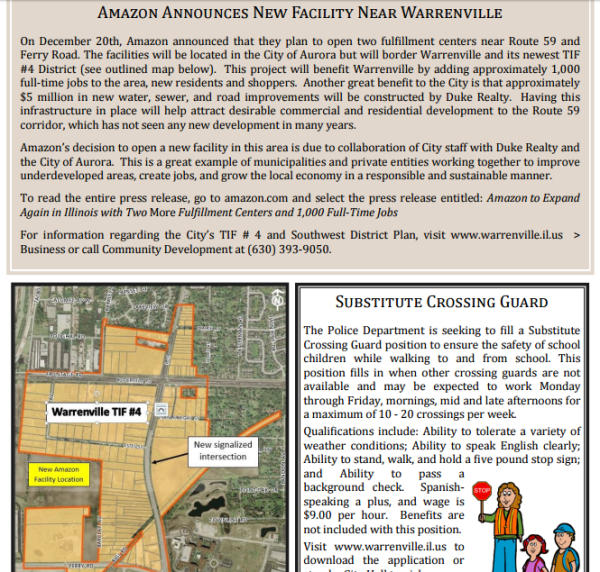
Thanks to state tax breaks, Amazon will soon begin construction on a new distribution center in northeast Aurora. The new facility is said to bring 1,000+ jobs. The latest newsletter from the City of Warrenville discusses the new facility. The facility is located near the border with Warrenville and the city thinks this will be a good for Warrenville:

warrenvilletifamazon

Can an Amazon facility be an economic boon for a suburb, particularly in a portion of the community that is underdeveloped? At the least, the 1,000+ workers will have to live somewhere. Could there be certain facilities that pop up to serve the workers – fast food places? Gas stations? Dry cleaners? Tattoo parlors (wait, Warrenville has enough of those)? Adding students to the school system?

I’m sure the city is either working on estimates of this and it would be worth sharing with the public. Connecting the dots between a warehouse/distribution facility and other community amenities is not obvious and what is Warrenville willing to do to capitalize on this opportunity?

Amazon’s future might be less about drones and more about operating its own trucks

The idea of Amazon using delivery drones attracted attention but one commentator thinks owning and operating its own trucks would be more feasible and important:

Ajay Agarwal knows Amazon. As a managing director with Bain Capital Ventures, he led a big investment in Kiva Systems, the warehouse robot company that Amazon paid $775 million for last year. Agarwal says that Amazon may be taking an ever-greater chunk out of the world’s brick-and-mortar retail sales, but physical stores still have Amazon beat in one key area. “What’s the biggest negative of Amazon? Returns,” he says. “It’s a royal pain…I feel like a daily, weekly exercise for me is breaking down boxes, doing returns, printing out return labels, etcetera, etcetera.”

But a dense network of Amazon delivery trucks could make returning unwanted items as easy as taking out the garbage. Unlike electronics or books, which most people shop for sporadically, grocery shopping takes place regularly and often. If Amazon Fresh takes off, that will mean frequent, predictable trips by Amazon trucks down residential streets. For every grocery order delivered, those trucks will have room for another return. “They take packages, and they take packages back,” Agarwal says, much like the milkman who in distant days not only delivered your milk but also picked up the empty bottles. “They control the entire infrastructure.”

That deep control has been a signature element of Amazon’s operations, from the first website visit to the moment an order leaves a warehouse. But that’s when Amazon hands off that order to a third-party carrier, typically UPS or FedEx. Such a concession must drive a control freak like Amazon CEO Jeff Bezos nuts — even if those companies have helped cement Amazon’s reputation for reliability by delivering on Amazon Prime’s promise of two-day shipping. With an army of its own trucks on city streets, Amazon cuts out the middle man. Meanwhile, returns could become as easy as handing a box back to the same Amazon driver who brought it in the first place…

But, he adds, Amazon must tread lightly. For now, the company depends intensely on UPS and FedEx to make its business work. At the moment, Amazon can’t make them angry. It’s telling that a day after Bezos revealed Amazon’s flying drone ambitions on 60 Minutes, which would also be a form of direct shipping, news leaked of UPS’ own drone plans, as if the delivery company was saying: “Don’t test us.”

Companies like Amazon like having control over the whole process for several reasons. One is that everything is then under their control. (Except the production of products which still have to be designed, made, and placed in Amazon distribution centers.) From beginning to end, they can set quality standards and track information. The other important part of this is cost and I’m a little surprised Agarwal doesn’t say anything about this. One appealing aspect of drones is that they remove the need to have people involved with the delivery of packages. In contrast, trucks require drivers and maintaining equipment. (This also doesn’t account for the need for Amazon, companies, and taxpayers to also support and pay for roads.) Could Amazon do trucking cheaper?

Maybe Amazon doesn’t care. Compared to other companies, Amazon seems relatively unconcerned about its profits. For example, see this opinion piece on “Why Amazon is a Lousy Business:”

Unfortunately, it’s not a great business.  According to Yahoo Finance, the company earned only a slim 1% operating margin during the last 2 years and a not particularly impressive 4% margin in 2010.  While there’s more to a business than just the bottom line, those are worrying numbers.

Jeff Bezos insists that he can turn on the earnings spigot any time he wants and is merely plowing money back in order to grow the business, but that seems thin to me.  Last year Amazon grew its top line 27%, very good, but not unusual for a technology company (Google, for comparison, grew 32%).

Drones, trucks, or otherwise, Amazon will have some choices about how to proceed with deliveries.

What is better for small shopping trips: Amazon’s drones versus walkable neighborhoods

Delivering in the final mile is a problem. So what is better in combatting this issue: Amazon using drones or walkable neighborhoods?

“You have the technology that can help the most difficult part of delivery: The last-mile problem. You have a lightweight package going to a single destination. You cannot aggregate packages. It’s still way too complicated and expensive. It’s very energy inefficient,” Raptopoulous sad. “UAVs or drones deal with the problem of doing this very efficiently with extremely low cost and high reliability. It’s the best answer to the problem. The ratio of your vehicle to your payload is very low.”

Part of the argument is that our current last-mile delivery system can seem kind of ridiculous, at least from an energy efficiency point of view.

As Raptopoulous put it: “In the future, we think it’s going to make more sense to have a bottle of milk delivered to your house from Whole Foods rather than get in your car and drive two tons of metal on a congested road to go get it.”

Of course, we could also build walkable neighborhoods that don’t require driving as often as we do, but walkability requires density—and even places like San Francisco sometimes balk at the sorts of buildings that entails. And we’ve got a lot of low-density infrastructure in place that isn’t going away anytime soon.

The conclusion here seems to be that building walkable neighborhoods would be a good solution but untenable in lots of places because many Americans don’t want that kind of density. I suspect New Urbanists and others would argue with that conclusion though adding density to urban and suburban neighborhoods does tend to bring out NIMBY responses.

So perhaps we could see these drones or cars as concessions to what Americans want: more privacy in their residences, more space, and to find technological solutions to get around the effect these kinds of neighborhoods produce. As the article notes, having lots of flying and landing drones could lead to problems but this might be preferable to asking people to live in different kinds of places.

Analysis suggests fake Twitter followers common among Washington political leaders

A new analysis of political leaders in Washington D.C. suggests many of them have a lot of fake or inactive Twitter followers:

Of the president’s 36.9 million Twitter followers, an astonishing 53 per cent – or 19.5 million – are fake accounts, according to a search engine at the Internet research vendor StatusPeople.com. Just 20 per cent of Obama’s Twitter buddies are real people who are active users.

Overall, the five most influential accounts linked to the Obama administration – the first lady has two – account for 23.4 million fake followers.

Biden’s nonexistent fans make up 46 per cent of his Twitter total, with 20 per cent being ‘real’ followers. The White House’s followers are 37 per cent fake and 25 per cent active; the first lady’s primary account is 36 per cent fake and 29 per cent active…

The difference between fake followers and ‘real’ ones is comprised of ‘inactive’ accounts, which may relate to real people but no longer send tweets with any regularity.

If this analysis can be trusted, this appears to be a bipartisan problem. But, it would be helpful to hear more about how inactive or fake users are determined: shouldn’t we expect that there are some people on social media platforms like Twitter and Facebook who have set up profiles but then don’t use them regularly? At least there is one infographic that helps provide more detail regarding this phenomena. Plus, you can use this app to analyze your own account.

And, once we have such numbers, we should then think through what it means: is it dishonest for politicians to have a lot of fake or inactive Twitter followers? Should the standards for having fully active followers be different for politicians as opposed to other public figures? Does having more followers really translate into a more positive public image or more votes?

UPDATE: This is not a problem just relegated to well-known figures. See this story from this morning on fines levied against companies that posted fake reviews:

The New York Attorney General has slapped 19 companies with a $350,000 fine after his office unearthed fake review writing for Google Local, Yelp, and others in a yogurt shop sting.

Eric Schneiderman revealed that a raft of search engine optimisation (SEO) companies created dummy accounts and paid writers from the Bangladesh and the Philippines $1 to $10 per review after his office set up a fake yoghurt shop in Brooklyn, New York and sought help to combat negative comments.

“Consumers rely on reviews from their peers to make daily purchasing decisions on anything from food and clothing to recreation and sightseeing,” said Schneiderman in a statement.

“This investigation into large-scale, intentional deceit across the Internet tells us that we should approach online reviews with caution.”

Plus, this is an online concern at sites like Amazon where reviews provide important information for potential buyers.

Inside Amazon’s fulfillment centers

If Walmart is where normal America gathers, then here is where much of the stuff Americans order online comes from: Amazon fulfillment centers.

For its “Amazon Unpacked” series, UK’s The Financial Times Weekend Magazine got photographer Ben Roberts a pass into the hyper-systematized environs of one of Amazon.com’s ginormous—roughly the length of nine football fields—fulfillment warehouses. The facility in Rugeley, England, is an expansive structure flooded with natural light and imbued with the sterility and efficiency of a major hospital. Here, employees can walk between seven and 15 miles a day, and they don’t meander; the warehouse gets 35 orders a second and worker productivity is measured via handheld device. Architizer calls it “a warehouse employee’s worst nightmare,” but with all the organization, light, and crisp colors, the space seems pretty ideal for a warehouse—particularly if an employee were training for a 10K or something.

When looking at these pictures, they seem like they could either represent the possibilities of our future (think of what is on all those shelves!) or represent cold, calculating buildings that are all about feeding a consumerist economy in the most efficient way. Either way, their scale alone is impressive.

Combined with my post over the weekend about subway facades, these images could be part of a larger series on the infrastructure behind the 2013 world. When people order from Amazon, they are not likely to think about all that it takes to get the product from a factory to a distribution center and then to their door/mailbox. Yet, they know it all works and like the results. Or, think about the data centers built in places like Iowa to handle all of the information flowing through the Internet. Or, the distribution centers behind Walmart or that helped Netflix quickly ship out DVDs years ago. All of this is relatively hidden in faceless warehouses away from the consumer.


Killing books with coordinated one-star reviews on Amazon

I’ve posted before about the wild world of Amazon reviews and here is another example: a group of Michael Jackson fans succeeded in burying a new book about the late pop star.

In the biggest, most overt and most successful of these campaigns, a group of Michael Jackson fans used Facebook and Twitter to solicit negative reviews of a new biography of the singer. They bombarded Amazon with dozens of one-star takedowns, succeeded in getting several favorable notices erased and even took credit for Amazon’s briefly removing the book from sale.

“Books used to die by being ignored, but now they can be killed — and perhaps unjustly killed,” said Trevor Pinch, a Cornell sociologist who has studied Amazon reviews. “In theory, a very good book could be killed by a group of people for malicious reasons.”…

The retailer, like other sites that depend on customer reviews, has been faced with the problem of so-called sock puppets, those people secretly commissioned by an author to produce favorable notices. In recent months, Amazon has made efforts to remove reviews by those it deemed too close to the author, especially relatives.

The issue of attack reviews, though, has received little attention. The historian Orlando Figes was revealed in 2010 to be using Amazon to anonymously vilify his rivals and secretly praise himself. The crime writer R. J. Ellory was exposed for doing the same thing last fall.

This is an interesting world where arguments are being made that people have the right (free speech) to provide harsh and even untrue Amazon reviews.

I don’t envy Amazon for having to deal with this issue where reviews would have to be more closely monitored. Even with close monitoring, people could provide excessively positive or negative reviews as long as they couldn’t be identified as being relatives or bragging out their actions on Facebook (as one member of the Michael Jackson fan group did). It puts Amazon in an unenviable position of having to play the heavy and try to crack down on people.

It would be interesting to see arguments of when these tactics might be supported or praised. Imagine a neo-Nazi writes a book; is it ethical or effective to shut down their book on Amazon? What about an obnoxious political figure on the other side that you can’t stand?

An argument for Amazon’s one-star reviews reveals the role of cultural critics

A professional critic praises Amazon’s one-star reviews:

About a year ago, while shopping online for holiday gifts, I became an unabashed connoisseur of the one-star amateur Amazon review. Here I found the barbed, unvarnished, angry and uncomfortably personal hatchet job very much alive. Indeed, I became so enamored of Amazon’s user-generated reviews of books, films and music that my interest expanded to the one-star notices on Goodreads, Yelp and Netflix, where, for instance, a “Moneyball” review notes the movie “did not make you feel warm and fuzzy at the end as a good sports film should.” How true! A rare opinion on a critical darling!…

But there is a visceral thrill to reading amateur reviewers on Amazon who, unlike professional critics, do not claim to be informed or even knowledgeable, who do not consider context or history or ambition, who do not claim any pretense at all. Their reviews, particularly of classics, often read as though these works had dropped out of space into their laps, and they were first to experience it. About “Moby-Dick,” one critic writes: “Essentially, they rip off the plot to ‘Jaws.'” About “Ulysses,” another critic writes: “I honestly cannot figure out the point, other than cleverness for cleverness’ sake.”

Likewise, to seriously dismiss “The Great Gatsby” as “‘Twilight’ without the vampires,” as an Amazon reviewer did, may be glib and reductive, but it’s also brilliantly spot on, the kind of comparison a more mannered critic might not dare. “Whoever made that ‘Twilight’ comparison, whether they know it, is showing their education, that they can connect new media with old works and draw fresh conclusions,” said David Raskin, chair of the art history, theory and criticism department at the School of the Art Institute of Chicago…

Speaking of honesty: It should be pointed out here that, in general, online amateur reviews are not mean but usually as forgiving as the professional sort. Bing Liu, a data-mining expert at the University of Illinois at Chicago who has studied online reviews — “partly because I was curious if they were real or just someone gaming the system” — told me that 60 percent of Amazon reviews are five-star reviews and another 20 percent are four-star. The information research firm Gartner released a study in September predicting that, within a couple of years, between 10 and 15 percent of online reviews will be paid for by companies — rigged.

It sounds like the argument is this: you can find the average American in the one-star Amazon reviews. Instead of getting the filtered, sophisticated review typically found in media sources, these reviewers give the unvarnished pop culture take. Discussed in this argument is the idea of social class and education. An approved reviewer or critic, the typical gatekeeper, is able to put a work in its context. The educated critic is trying to make the work understandable for others. The educated critic often has experience and education backing their opinions. In contrast, the Internet opens up spaces for individuals to post their own reactions and through aggregation, such as the Amazon five-star review system, have some say about how products and cultural works are perceived.

This new reality doesn’t render cultural gatekeepers completely irrelevant but it does do several things. One, it dilutes their influence or at least makes it possible for more critics to get involved. Second, it also makes more visible the opinions of average citizens. Instead of just theorizing about mass culture or pop culture, we can all see what the masses are thinking at the moment they are thinking it. (Think of the possibilities on Twitter!) Third, it provides space like in this article for reviewers to admit they don’t always want to write erudite pieces but want to have a “normal person reaction.”

Just one problem with this piece: the critic says he doesn’t really read the one-star Amazon reviews for information. Instead, he appreciates the “visceral thrill.” He quotes an academic who says such reviews reveal cultural gaps. Thus, celebrating the one-star reviews may be just another way to assert the traditional reviewer’s cultural capital. Read the one-star reviews for entertainment but continue to go back to the educated reviewer for the context and more valued perspective.