Musician raised in the suburbs “grateful for the thousands of hours of sitting in my room playing guitar”

How might being raised in a quiet suburban community affect a musician’s career?

Photo by billy Lopez on Pexels.com

You grew up in Wheaton. What was that like?

Quiet. It’s a nice suburb, I enjoyed it. I was homeschooled, so I had a very different experience than probably a lot of people did. My mom kept our world very big — we traveled a lot. Wheaton is where I fell in love with music. I’m grateful for the thousands of hours of sitting in my room playing guitar.

Practice is required to become skilled at many tasks. Having the time, space, and skills to practice well is helpful.

Suburban bedrooms are a private space in the American suburban home. It is a place to get away from the world. One can be alone with their thoughts. In the case of practicing music, playing guitar in a bedroom isolates the activity and noise from the rest of the house. The practicing goes unobserved.

Add to this that suburbs are sometimes portrayed as being creative wastelands. Suburbs are said to be conformist, conservative, cookie-cutter. Many narratives suggest there is a suburban facade of success and attainment – happy families, polite interactions – but just below the surface are problems and divisions.

Can suburban bedrooms produce artistic talent and creativity? The majority of Americans live in the suburbs and multiple generations have grown up in the suburbs. Presumably at least a few artists, novelists, filmmakers, playwrights, and musicians have honed their craft in the suburbs, and perhaps even in their bedrooms.
When I enter an American hotel room, I think I am supposed to watch TV

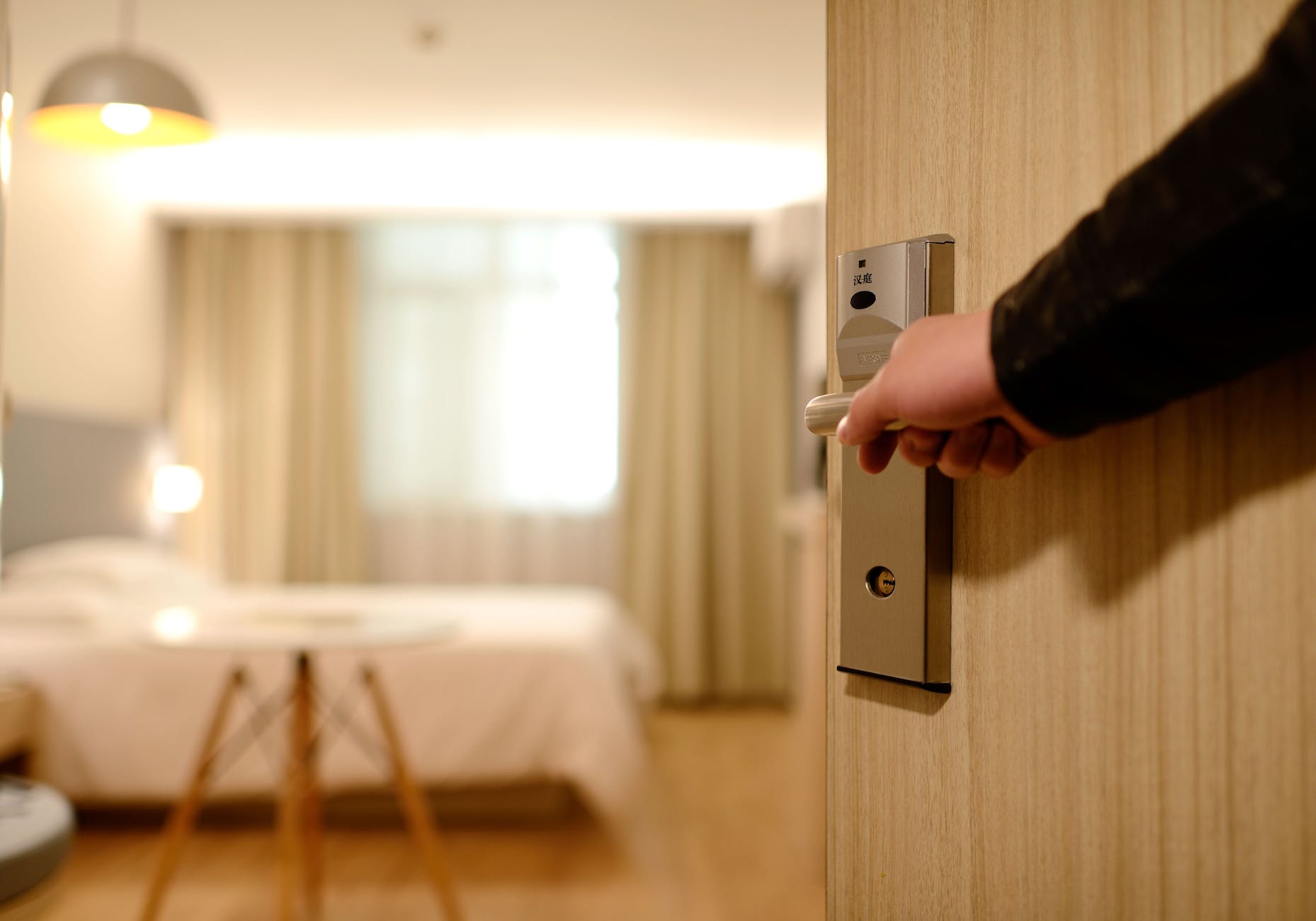
Hotel rooms in the United States can look different across brands and locations. However, one feature I have noticed through recent years is consistent: there is a large television mounted in a prominent location in the room.

Photo by Pixabay on Pexels.com

The primary purpose of a hotel room is sleep. It is a place to stay when away from home. It is a bedroom. The bed or beds are usually the biggest pieces of furniture of the room and take up the most square footage.

Yet, it is hard to miss how big the TV often is in hotel rooms. There is a lot of entertainment available through this TV. When I was a kid, I remember lots of hotels advertising that they had cable or particular cable channels or particular premium movie channels. This is not the case now and you can often log into your own streaming accounts through these TVs.

The design of hotel rooms suggest Americans want to continue to do what they do plenty of at home: watch TV. Perhaps this reflects what Americans have done for decades: watch hours of TV a day. Even with ubiquitous smartphones, tablets, and laptops, Americans keep watching TV whether home or away.

(Other ways to get at this topic: what percent of Americans have a television in their bedroom and how many TVs, particularly big ones, are in Airbnbs.)

Here is what Americans gained in interior features with larger and larger new homes

An analysis of data involving American homes from 1970 to 2022 shows several important changes:

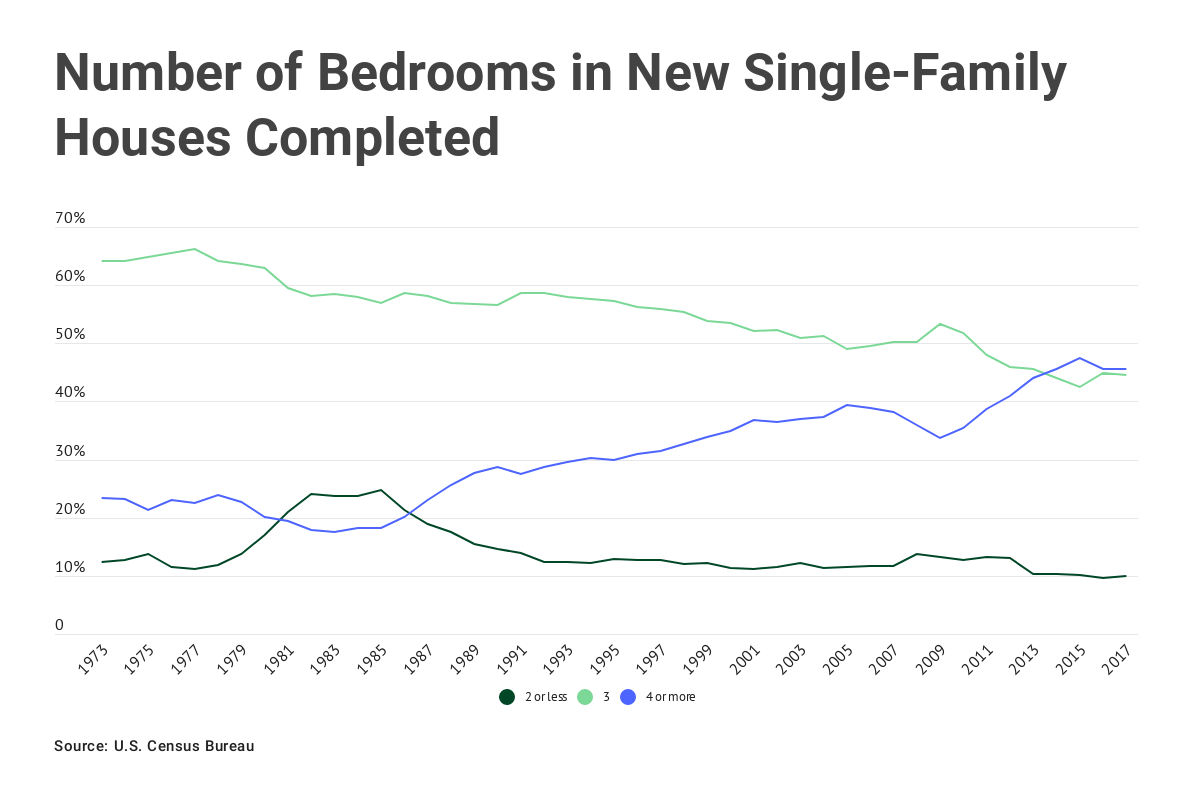
Since the 1980s, the percentage of homes being constructed with four bedrooms has on the whole grown, while the percentage of two-bedroom homes have fallen. In 2022, nearly half of all homes constructed had four bedrooms, compared to two-bedroom homes at 9%.

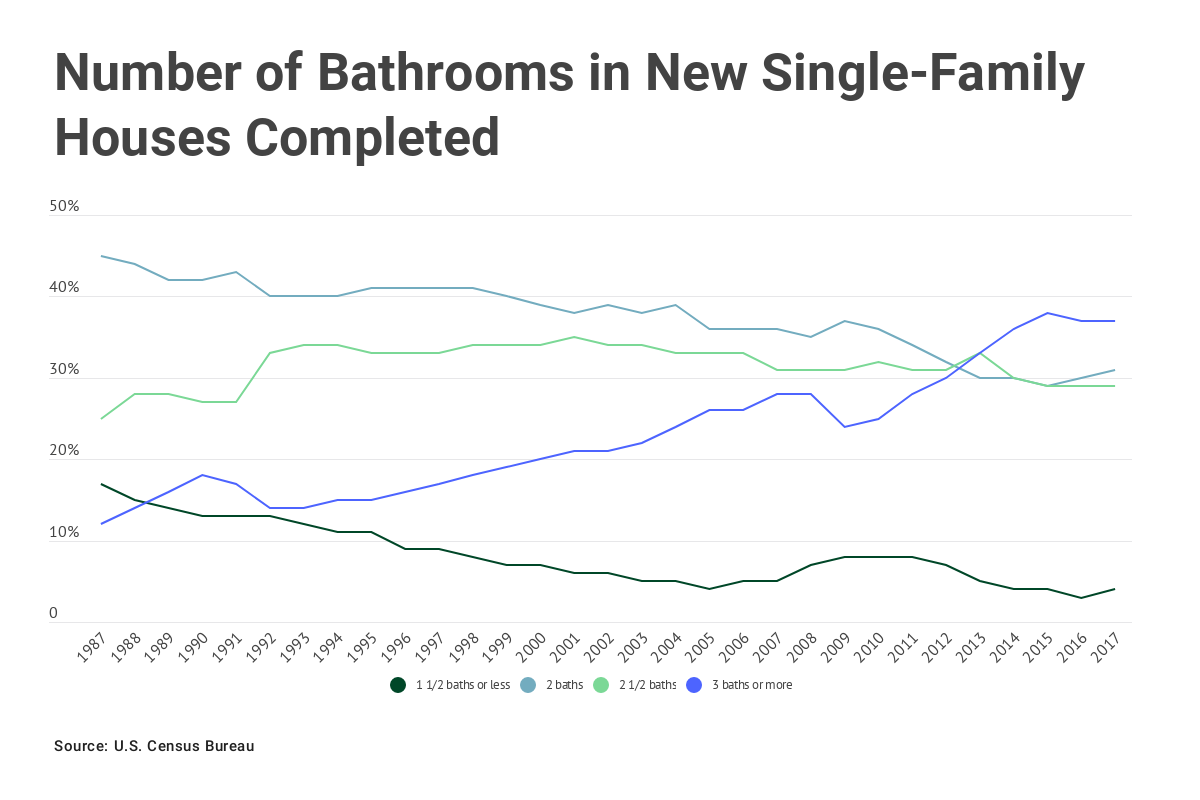
This trend of larger homes is also shown through the number of bathrooms in new houses, with over a third having three or more baths, slightly more than the percentage of homes with two baths.

If you have more square footage, people might want more of these kinds of rooms. Who wants to share a bathroom? Can’t additional bedrooms be repurposed for other uses like an office or workout space? Haven’t all the shows on HGTV convinced viewers that more bedrooms and bathrooms increase the resale value of a home? Too bad we do not have a measure of the number of open concept living areas. Or, how many square feet are allocated to the kitchen, the space where Americans spend a lot of their time?

One more interesting chart regarding basements:

Basements have also become much less popular over the last five decades— the percentage of new homes with a full or partial basement in 1974 was 45%, compared to just 21% in 2022. Slab and other types of foundations have become the sweeping majority for new homes.

I wonder if this has more to do with more new homes constructed in places, like the South, where basements are less common as opposed to a declining interest in basements. This also suggests newer homes have less space underground and have more of their space above ground.

Are these changes due solely to the spread of McMansions? The headline may invoke McMansions but they were not the only style of larger home constructed in recent decades. As many new homes added square feet, their features shifted. McMansions may have had plenty of bedrooms and bathrooms but so did other new homes.

“Americans demand more bedrooms, baths”

I argued a few days ago that the American system is set up to encourage people to purchase bigger homes. Look, the system is working! Americans continue to build and buy bigger homes.

The latest numbers from the U.S. Census Bureau show newly-constructed homes in 2017 are 4 percent larger on average than a decade ago. And they come with a larger price tag — the average price of a new home jumped 23 percent from $313,600 in 2007 to $384,900 last year. Meanwhile, the average family size in the U.S. continues to shrink, from 3.33 persons in 1960, to 2.54 in 2017…

Below are some takeaways from the Survey of Construction data released in June. Based on the most common features, the most popular home built in 2017 was a two-story, two-garage home with more than four bedrooms and three bathrooms.

Several graphs highlight the proliferation of bedrooms and bathrooms in recent years:

Chart: Number of bedrooms in new single-family houses completed

Chart: Number of bathrooms in new single-family houses completed

Even with plenty of critics, American builders and buyers still seem to want larger homes. Perhaps the market is primarily open these days to wealthier buyers and builders may not be interested in constructing starter homes but this is not an isolated blip in the data: for decades, Americans have sought larger homes.


WSJ declares 2014 the “year of the McMansion”

The “Characteristics of New Housing” 2014 report shows more new homes had McMansion features:

Meanwhile, 2014 will go into the history books as the year of the McMansion. The percentage of homes built with four or more bedrooms last year was 12 percentage points higher than at the housing market’s recent nadir in 2009. The same goes for the percentage built last year with three or more bathrooms. Those built with three-car garages was up seven percentage points from its trough in 2010…

The annual Characteristics of New Housing report found that 46% of single-family homes constructed last year had four or more bedrooms, up from 44% in 2013 and from 34% in 2009. Thirty-six percent of the homes built last year had three or more bathrooms, up from 33% in 2013. Meanwhile, two-car garages remain the norm, but they’re receding in popularity – to 62% of homes built last year from 64% in 2013 — while three-car garages increased to 23% from 21%.

The latest numbers are a reflection of a multiyear run-up in median new-home sizes, fueled by builders’ focus on better-heeled buyers with better credit while entry-level and first-time buyers largely remained sidelined in the recovery.

This evidence fits with a narrative of the return of McMansions (though perhaps it is a blip): new homes were larger and they had more bedrooms, bathrooms, and garages. At the same time, these homes aren’t necessarily McMansions just because of these features. Other criteria for being a McMansion includes:

1. The proportions of the new home next to homes nearby. Are these homes primarily suburban/exurban builds or are they teardowns (which are on the rise) in established neighborhoods?

2. What is the quality of these homes? McMansions are often said to be poor construction or have bad layouts.

3. Are these homes primarily for wealthier residents or people trying to show off their status?

Having a larger house may be the beginning of defining a home as a McMansion but it is not the end.

Get rid of the bedroom and add a fancy Murphy bed

All the new micro-apartments would benefit from sleek and comfortable Murphy beds:

And a growing number of these projects are installing upscale wall beds that turn back into a sofa (or a dining table, or a desk, or a bookshelf, or a wall-storage unit) by day, giving the small-space dweller the equivalent of a secret room. The design leader of cleverly engineered, high-end, top quality transformable furniture is Clei, the family-owned, Brianza, Italy–based company that celebrated its 50th anniversary last year and is available in the U.S. via Resource Furniture…

“The Murphy bed is a key part of the design,” Hill said. “But there are so many that are cheesy and low-quality, and look like crap. We’re trying to create something really compelling and sophisticated, that doesn’t feel like you’re sacrificing anything. These don’t feel gimmicky or cheap but like a great bed, and a great piece of machinery.”…

Clei beds are the closest thing I have ever seen to furniture performance art. Thanks to sophisticated engineering, they can be opened and closed in seconds with almost no effort, a huge part of their appeal…

The beds are made from quality materials and offer ultra-sleek contemporary Italian design. Much of the hardware is hidden and the units housing beds are only 12 inches deep. One detail they are working on is finding a way to hide the buckled straps that hold the mattress in place while the bed is being opened and stowed.

And the end of the article starts an interesting discussion about whether bedrooms are necessary. Of course, when space is very limited, furniture that is movable or that can serve multiple uses is very helpful. Some of these micro-apartments are very clever about storage, fold-down furniture, and even moving walls.

One feature not mentioned about the high-end Murphy bed: is it comfortable? Can you get a good night’s sleep? It may not matter if the bet design is here if the bed isn’t comfortable…

Another thought about micro-apartments: while they can be good for providing affordable housing and also encouraging people to live with less, could they fall prey to becoming status symbols all about the latest design? Given the price of some of the features needed to live comfortably with only a few hundred square feet, it may not be too cheap to have a comfortable apartment with only a few hundred square feet. For example, the IKEA store models of small apartments don’t have terribly expensive things but they aren’t necessarily trying to be trendy.

“The U.S. is now a country where many people live alone in a land of 3-bedroom houses”

Putting together recent data on household type and housing supply in the United States, Emily Badger comes to this conclusion:

As we’ve written before, American households have been getting smaller as our houses, conversely, have actually been getting bigger. But the disconnect between those two trends may be felt the most strongly by people who live alone, whether they’re 22-year-old women who aren’t yet married, or 70-year-old retired widows. As more Americans are opting to live alone than ever before, that now seems like an entirely unremarkable choice. But for years we’ve been building houses for that big nuclear family that’s now less common. And housing data released earlier this summer by the Census Bureau, illustrated at right, suggests that the U.S. is now a country where many people live alone in a land of 3-bedroom houses.

Interesting claim but without knowing exactly if the single-person households are living in the three bedroom homes, it is difficult to support.

A thought: I wonder if household types/family life can change much more quickly than the housing stock. That housing supply data includes a lot of homes built in past decades, both in eras when homes were smaller with larger families (pre-1960s) and when homes have been larger (the last few decades). It will take a long time for the housing market to fully adjust to more people living alone. Micro-apartments may be catching on in a few big cities but smaller housing for solo households is still limited.

But, it would also be interesting to ask single-person households how many bedrooms they would prefer to have if they could. Three bedrooms allows for space for guests as well as other kinds of rooms (used as storage/closets, hobby rooms, etc.). Two bedrooms does the same thing but with less space and four bedrooms probably provides too much space.

Assessing “The Return of McMansions” in the NYT

Following up on the same data behind the CNN story on the McMansion comeback, the NYT looks more closely at the characteristics of new houses in 2012. Here is my summary:

-Housing starts were still down in 2012. Looking at the graph with housing start data since 1973 shows that the last few years have been quite different.

-The homes built in 2012 were bigger: the highest median square footage ever of 2,306 square feet, 41% of the houses were four or more bedrooms (a new record), and 30% of new houses had 3 or more bathrooms (also a new record).

My thoughts on this data:

1. This is not a big surprise. While housing starts are way down, wealthier Americans and others have still been able to buy large new homes. Again, Toll Brothers is doing just fine. On the other hand, the lower ends of the housing market are not doing well.

2. It is interesting again for people to pick up on the highest-ever median square footage for new houses. For years, journalists and others have looked at the average square footage which is bit down from its high several years ago. Perhaps the median is now alluring because it is at its highest point and therefore can be linked to McMansions and American excess?

3. More houses have more bedrooms and yet the average family size in the United States has decreased in recent decades and more Americans are now living alone. So what are these bedrooms being used for?


Australian architect argues banks are pushing him to design McMansions

One Australian architect argues that he doesn’t want to build McMansions but banks are pushing him to do so:

CANBERRA’S appetite for McMansions may have lessened but architects are complaining that it is now the banks – not the clients – who are pushing them for extra more bricks and mortar.

President of the ACT chapter of the Australian Institute of Architects Tony Trobe said he had been effectively forced to change designs to give clients extra bedrooms they did not want or need, just so they could get finance from their banks for the build.

”The banks are saying ‘no’ because they think it’s not as easy to sell a stylish two bedroom house as is to sell a three bedroom house with a garage,” he said…

Australian Bankers’ Association chief executive officer Steven Munchenberg said there was no hard and fast rule about needing at least three bedrooms.

”Nobody in the industry is saying ‘no more two bedrooms’ but the banks will take into account the re-salability of the home,” he said.

This sounds like an interesting conundrum: the architect wants a certain design but the bank wants to make sure the home can be sold down the road. Having three bedrooms makes the home more attractive to families and others who might extra space (a guest room, an office, etc.). Could the banks simply be hedging their bets here, meaning they want to ensure they aren’t stuck with an underwater mortgage or foreclosure down the road?

I do have one question: having three bedrooms in a home automatically makes it a McMansion? Having three bedrooms sounds pretty normal to me…