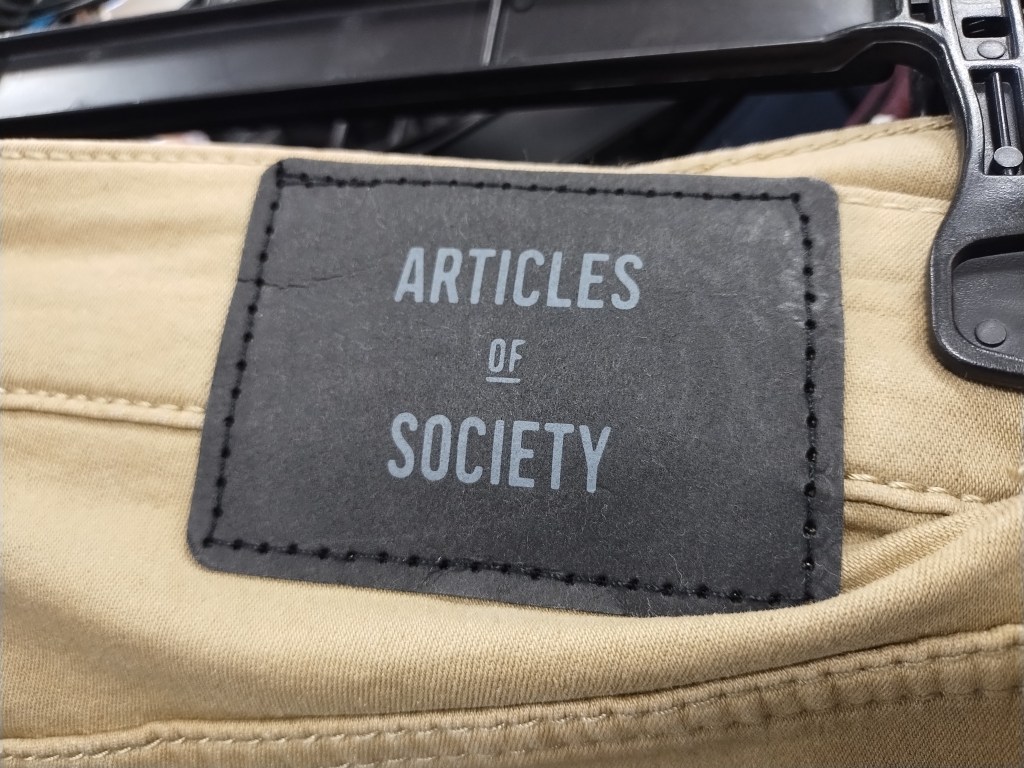
The brand “Articles of Society”

On a recent shopping trip, I found a brand name I did not know. It sounds sociological. Apparently they make clothes.

From their Instagram page:

Live life in Articles inspired by you, created with the earth in mind• #articlesofsociety

Is this a play on the phrase “articles of clothing”? If so, where does society fit in? Is it a reference to how fashion is a negotiation between the individual and the society around them? Or is it meant to be more biting, referencing how we all are just a part of society?

Maybe I am missing the point. One goal of developing a brand is to stand out from other options. A consumer has lots of choices for clothes ranging across design, price, and availability. The brand name caught my attention so perhaps that is the point? I did not purchase the clothing but I did snap a picture and the brand name will live on in my head.

When a neighborhood doesn’t want a budget version of Whole Foods

Whole Foods has selected a LA neighborhood for its first Whole Foods 365 and residents are not happy:

Let’s take a quick trip to Los Angeles’ bourgeois-hip Silver Lake neighborhood, where more than a few residents are up in arms over Whole Foods’ recent decision to not go through with a planned full-service Whole Foods but rather to build the first store in the chain’s new line of budget outlets aimed at millennials, 365 by Whole Foods Market. “Whole Foods! We want the REAL thing,” reads a Care2 petition recently posted by neighborhood resident and music executive Dawn White. “People in this neighborhood are desperate for a local high end market with the best quality foods, which are often not the 365 brand,” White wrote. Online, commenters began to call the proposed store “Half Foods.”

What is behind this reaction?

Silver Lake is not the first nor likely the last enclave where residents are literally begging for a Whole Foods. Online petitions asking for stores frequently read like crosses between market research reports, sales pitches, and letters from spurned would-be lovers. “Between the families, the young professionals, long-time residents and university students in the neighborhood, we have more than enough demand to satisfy Whole Foods,” went one 2013 plea out of Washington, D.C. As for White, her missive told the organic superstore that it was “wholly wrong” about who lived in the neighborhood. “Residents of this neighborhood can afford this,” she added.

In a world where all too many people define themselves by what they can afford to purchase and do actually buy, Whole Foods gives the sort of person David Brooks so memorably labeled bobos, short for bourgeois bohemians, validation, not to mention a bit of convenience in a busy life. It endorses that decision to drop more than $800,000 on a tiny two-bedroom Spanish or craftsman bungalow with a Viking stove or a Brooklyn brownstone that’s located near a Superfund site. A local Whole Foods is a stamp of approval from the United States’ greater corporate culture, but one that at the same time allows the people who crave it to still believe they remain just a bit outside the mainstream.

Up and coming or hip or gentrifying neighborhoods are interesting places. On one hand, they want to live on the edge with lots of cultural opportunities and relatively cheap housing. They don’t want to be conventional, typically associated with higher incomes and less nightlife. They want to be authentic, gritty, and real. On the other hand, they often want to have some markers of their success as well as amenities. This could come in the form of Starbucks, rising housing values, or even grocery stores. The presence of these upscale places or items hints at the wealth in the neighborhood and suggests it is a place worth investing in.

But, these two competing forces are difficult to reconcile. Is having a Whole Foods hip? What kind of people shop there as opposed to those who shop at budget grocery stores? Do national retail chains hint at rising land values, eventually putting pressure on lower-income residents to move? There are likely more neighborhood discussions to come as residents try to exert their influence in the direction they would like their community to go.

When the store with a cult following comes to town

I recently ran into an article about “16 Brands That Have Fanatical Cult Followings.” This got me thinking about how people want certain stores to move near them. Take this example from this article as several people expressed how much they wanted a Wegmans.

On its website, Wegmans writes that in 2003, almost 5,800 loyal customers wrote “love letters” to the company, with almost half of the letters including pleas to build supermarkets in their communities. One letter included rewritten lyrics to “Yesterday” by the Beatles:

Yesterday,
A Wegmans store, it seemed so far away.
But a new one opened in Dulles today.
Now I will drive
Towards Wegmans’ way.

Wegmans mania reached a new high when a group of musical theatre students in Massachusetts created an entire musical based on the brand. They rewrote popular Broadway songs in praise of the store.

That’s some devotion. And yet, this sort of interest isn’t uncommon. I’ll briefly mention some of the stores that prompt reactions from loyal residents and communities:

-Trader Joe’s is on this list. Multiple friends have told me how much they like this store and one mentioned how while on trips he was prone to finding the Trader Joe’s before leaving to grab things for home.

-I’ve heard similar things about Ikea.

-The article has an interesting conclusion: do some of the bigger brands count as cult favorites?

The infamous Cult of Mac spans far and wide, with a deep obsession with anything and everything Apple. Starbucks blankets America, driving endless droves of coffee-lovers to its baristas. Whole Foods fans swear by the huge supermarket chain’s pesticide free cantaloupes.

Are these followers still a cult if the companies they fawn over have grown into some of the world’s biggest and most successful multinational corporations?

I say yes. Even though these may be big brands, having one of these stores indicates that the community is on the map. This is a bit of strange logic – corporate America wants to be near us! – but it suggests some prestige. Plenty of communities around the United States would have to have a Starbucks. Now only would it bring in revenue and people, having a Starbucks indicates a community has a certain kind of customers (i.e., people with money to spend on coffee) and can also help attract other businesses. Second, I saw that several Facebook friends were very excited about Whole Foods moving to Mishawaka, Indiana. This is a classic case of a cult brand moving in: the South Bend/Mishawaka area is more blue-collar, middle America but having a Whole Foods suggests it has some more sophistication and wealthy residents. Third, Apple stores are less common so perhaps more meaningful: the Apple store in downtown Naperville suggests the place is akin to an upscale shopping mall or thriving big city.

Granted, there is some breaking point to this. Not every place is thrilled to have a Starbucks and some might argue that there are too many already (the company itself suggested this in recent years). In comparison, fewer people are thrilled about a Walmart moving in. There must be some threshold when too many chains are viewed negatively and start impinging on local culture. This threshold likely differs by type of place: places that hope to be “up and coming” likely welcome such stores while wealthier communities with some tradition and enough prestige resist such chains, no matter how cult friendly.

This discussion of cult brands also gets at the heart of Naomi Klein’s arguments in No Logo. Do we want to live in a world where people regularly select and interact with cult brands? Does this kind of devotion detract from more authentic civic life?

Brand favorites by political party

AdvertisingAge reports on the favorite brands of Republicans and Democrats. There are some differences between supporters of the two parties:

The Republican Top 10: Fox News Channel, History Channel, Craftsman, Discovery Channel, Johnson & Johnson, UPS, Fox, FedEx, Lowe’s, Cheerios.

The Democrat Top 10: Google, Sony, Discovery Channel, UPS, Craftsman, Johnson & Johnson, Cheerios, History Channel, FedEx, Amazon.

Some interesting differences, particularly the presence of Google and Fox News Channel. Do these company’s political contributions match up with their favored status among each party?