Companies like Reframe are trying to solve a conundrum scholars call the construction crisis. Although most sectors of the economy have gotten more efficient over time, construction has moved in the opposite direction—construction sites are less productive today than they were 50 years ago. It’s a genuine mystery, and everyone has their own pet theory about what’s to blame.
Efficiency is the answer to numerous perceived social issues in the United States. Make government more efficient. Make the distribution of resources or services more efficient. Get things done faster and at lower cost. And in the business world, who would be opposed to more efficiency?
I also recall some of the concerns expressed by critics about efficient home building operations. Take the Levitts mentioned in this article. Amid the various concerns expressed by many was a concern about the quality and character of homes that were mass produced. Would such homes stand for a long time? What does it do to community life when there are so few models available?
The example given in the article of efficient housing is modular housing. Part of this involves logistics; can it be produced at particular quantities and price points that makes it viable. But there will also be architectural and community questions. Will neighbors want to live next to it? Do early residents find it comparable to housing built by other methods? How does it stand up over time?
It would be interesting to ask Americans if they want “an efficient house.” Is the opposite of this “an inefficient house”? I’m not sure many think about in terms of efficiency when thinking about their residence.
The company had averaged more than two hundred houses per year at a time when just six firms nationwide were constructing as many as twenty-five homes annually in Levitt’s price range. Eighty-six percent of pre-war builders put up two or fewer houses a year, and 60 percent built only one. In 1947, the editors of Fortune magazine called homebuilding “The Industry Capitalism Forgot.” (17)
This is an important feature of postwar suburbia: the construction of single-family homes happened at a scale unknown in previous eras. Before then, many builders built few homes. It took time to put together a block. Neighborhoods and communities grew more slowly. After the war, subdivisions and communities with thousands of residents could emerge within a few years. Fields or woods could be turned into flat land for building quickly. Housing frames went up, the trades came through and did their parts, people moved into completed homes.
The scale and efficiency is hard to compare between these two eras. It is like two completely different processes. The Levitt company argued the new approach allowed them to get needed homes into the hands of people, particularly veterans (but not Black residents), at an affordable price point. Critics said the process led to conformity and a lack of true community. Either way, new communities quickly developed and the processes were adopted by other builders and developers.
A golden run for homebuilders is drawing to a close. When rising mortgage rates trapped many would-be sellers in their homes two years ago, builders turned out to be the big winners — if you wanted to buy a home, your best bet was probably new construction. One economist told me last year that builders were “the only game in town” in some areas. Builders not only offered a welcome alternative to the frozen resale market but could cut deals to make their homes even more appealing to the average buyer: Mortgage-rate buydowns, in which the builder pays the lender up front in exchange for lowering the buyer’s loan rate, can save a new homeowner hundreds of dollars each month.
Now, even with the freebies, builders are selling homes at a slower-than-expected pace as buyers grapple with worsening affordability, sharp swings in mortgage rates, and general uncertainty — people would rather sit on the fence than leap into a market with so many unknowns. With slower sales across the board, the number of homes on the market has climbed. There were 108,000 finished homes for sale at the end of September, some 48% more than at the same point a year ago. There were 258,000 homes under construction but not yet sold, another sizable figure — at the same point in 2019, there were about 194,000. Builders surveyed by John Burns Research and Consulting said they had an average of about 2.5 unsold homes in each of their communities in October, representing a 47% increase from a year ago. In October 2021, they reported only 0.4 unsold homes per community. Some of this increase is by design. Companies are building more homes “on spec,” or before they have a buyer, to shorten timelines and compete directly with the resale market. But there’s no question that builders have hit a snag.
The answer might seem obvious: Cut prices! But builders will “try a lot of other things first,” says Keith Hughes, an executive at the housing research firm Zonda. “And we’re not seeing drastic price drops virtually anywhere.” Buyers may not be flooding the market, but there are fewer homes out there, too. The number of available homes for sale at the end of October, according to Realtor.com, was about 21% lower than in the same month in 2019. Builders looking to move their product lean heavily on incentives — Lennar, one of the largest homebuilders in the country, said that the average sales incentives per home amounted to $48,100 from June through August, compared with $36,400 a year earlier. Builders are also completing smaller floor plans to match the needs of cost-conscious consumers.
Builders have another fallback: the rental market. Over the past decade, homebuilders have forged relationships with companies that purchase thousands of single-family homes and manage them as rentals — if a builder were looking to move a portfolio of homes, they might find a willing buyer in a company like Pretium, which owns nearly 100,000 homes, or Invitation Homes, which manages a portfolio of more than 85,000 homes. Builders have also started developing entire communities of single-family homes to be rented out rather than sold, a strategy known as build-for-rent. The idea is to meet the demand of renters who want their piece of the American dream — a home with a yard in a safe neighborhood with good schools — but either can’t make a purchase or don’t want to. Builders can sell to a guaranteed buyer willing to purchase in bulk or hold on to the homes and enjoy the steady returns of rental income.
How about another option (and this does not change the houses that have already been built): build cheaper units in the first place. With the decline of starter homes, is it time for more builders to construct homes that meet these criteria?
Or how about channeling more effort into multi-family housing? There will continue to be a market for single-family homes in a country that idealizes them but there is also demand for more housing in numerous places and multi-family housing provides more units in the same amounts of space.
I would also be interested to hear how builder revenues and profits are affected by these changes. If builders have found ways to limit the costs by renting, are they losing money or are they making less money than they would like?
Robert I. Toll, L’66, a former University Trustee, an emeritus member of the Carey Law School Board of Advisors, and the co-founder of transformative home construction company Toll Brothers, died on October 7 at home in Manhattan. He was 81.
Mr. Toll was born in Philadelphia suburb Elkins Park, Pennsylvania, to a father who was involved in Philadelphia real estate and who had successfully rebuilt his career after the Great Depression. Mr. Toll graduated from Cornell University in 1963 with a bachelor’s degree in political science, then graduated from Penn’s Law School three years later. He briefly worked at the Philadelphia law firm Wolf, Block, Schorr, and Solis-Cohen, but then founded Toll Brothers with his younger brother Bruce in 1967. To start out, “we built two homes,” Mr. Toll recalled. “Instead of selling them, we used them as samples for the lots we owned down the street.” These sample homes landed the brothers contracts to build 20 more homes, which each sold for $17,500. Robert, Bruce, and Alan Toll were among the first postwar housing developers to recognize how trends in highway construction would allow access to swaths of farmland for housing and shopping developments.
Over the next five decades, under Robert Toll’s leadership of the company as chair and CEO, Toll Brothers rapidly grew to become, as the company’s slogan boasts today, “America’s luxury home builder.” The company recognized shifting demographics in the U.S. during the 1970s and targeted baby boomers looking to trade upward. The Toll Brothers blueprint included targeted land purchases, appeals for quick zoning approval, and predesigned houses that allow room for personalized changes by buyers. Boosted by the proliferation of McMansions and the implementation by zoning boards of two-acre lot sizes in many American suburbs, Toll Brothers became a force in the American housing market. Today, over 150,000 American families in 24 states live in a Toll Brothers-built home. Toll Brothers appeared on the Fortune 500 list, and Robert Toll spearheaded several philanthropic initiatives, including Seeds of Peace, a summer camp in Maine for children from global conflict. His many professional honors included recognition as one of the world’s top 30 CEOs by Barron’s magazine in 2005 and as best CEO in the Homebuilders and Building Products Industry by Institutional Investor magazine in 2008 and 2009. The Wall Street Journal once called Mr. Toll “the best CEO in the housing business.”
Did Toll Brothers take advantage of an opportunity to sell luxury homes to a growing market or help create and establish a growing market? Would they call their luxury homes McMansions or is that a term applied by others?
No matter how these questions are answered, it is clear Toll Brothers contributed to the trend of larger and more expensive homes in the United States. Over 150,000 homes is a sizable number of dwellings. The shift to large-scale builders in the mid-twentieth century is an important factor in suburbanization and housing more broadly.
Additionally, what will happen to all of these luxury homes? Will they be updated and renovated for decades? I assume a good number are situated in neighborhoods and communities where they will not be near any cheaper or denser housing. Will some become teardowns? Will at least a few be preserved? There is still more of the Toll Brothers story to tell.
The affordable end of the market has been squeezed from every side. Land costs have risen steeply in booming parts of the country. Construction materials and government fees have become more expensive. And communities nationwide are far more prescriptive today than decades ago about what housing should look like and how big it must be. Some ban vinyl siding. Others require two-car garages. Nearly all make it difficult to build the kind of home that could sell for $200,000 today…
Nationwide, the small detached house has all but vanished from new construction. Only about 8 percent of new single-family homes today are 1,400 square feet or less. In the 1940s, according to CoreLogic, nearly 70 percent of new houses were that small…
But the economics of the housing market — and the local rules that shape it — have dictated today that many small homes are replaced by McMansions, or that their moderate-income residents are replaced by wealthier ones. (A little 1948 Levittown house on Long Island, the prototypical postwar suburban starter home, now goes with a few updates for $550,000.)…
The costs – financial, regulatory – are too high for the construction of lots of starter homes. The proposed solution is to try to reduce those costs by placing multiple residents on one lot and/or increasing density in communities and developments.
I wonder if the best path forward is for certain communities to pursue starter homes successfully and show that it is possible. Of course, one danger is that even if it works well in some communities, other communities might leave the burden of such housing to a small number of communities. However, if starter homes can be constructed in such a way that they are perceived as an asset to the community and not a threat to property values, they might catch on. Are there several communities that would fit the bill?
Nearly 836,000 multifamily units are under construction, the most since 1973, according to Jay Parsons, chief economist at RealPage. But most new construction targets higher-income tenants and not the lower end, where supply shortages are most extreme, he said.
I have written about the dearth of starter homes and I would suspect a similar dynamic is at play here. Builders and developers can make more money on multifamily units with higher prices. If someone is going to go to all the effort for development and construction – and this can be quite a bit of effort in certain places – they would prefer to gain more financially in the end. The number of places that require the construction of affordable housing alongside market rate housing or seriously pursue cheaper housing are limited.
If these higher-income units come on line, it will add to a bifurcated housing market where those with enough resources have plenty of choices and those with fewer resources have limited and possibly unpleasant options.
Daryl Fairweather: We are not building enough housing for everybody who needs a place to live. We built fewer homes in the 2010s than in any decade going back to the 1960s, and at the same time millennials are the biggest generation and they’re entering into home-buying age. Millennials aren’t living in their parents’ basement any more or shacking up with roommates, they want a place of their own, and we didn’t build any housing for them in the last decade because we are still so traumatized by the last housing crisis. We didn’t put any investment into housing…
Daryl Fairweather: The government has estimated that we are short about 4 million homes in this country, and that number is likely growing, especially since the pandemic.
In my opinion, the emphasis in the rest of the segment on institutional buyers is a weird way to go given the numbers cited above. If we need over 4 million housing units, it seems like more of this falls on developers, builders, and communities to open up opportunities for new housing for millennials and others who really want it.
I wonder how much of this now works like it seems to in the auto industry. Auto makers have shifted to making trucks and SUVs because there is demand and a higher profit margin. These vehicles are not greener but there is a lot of money to be made. Is the same true of starter homes? Smaller units simply do not bring in as much money as a larger house with more amenities. And, if builders and developers have to go through a significant process to purchase land, get approval, and go through construction, wouldn’t they want more money at the end?
I think we should ask about the civic responsibility of those who can approve homes and/or build homes. Don’t we need more housing? Shouldn’t this be a shared responsibility across actors? Why are so many Americans willing to get into their particular housing unit and then shut the door to those who want a similar opportunity?
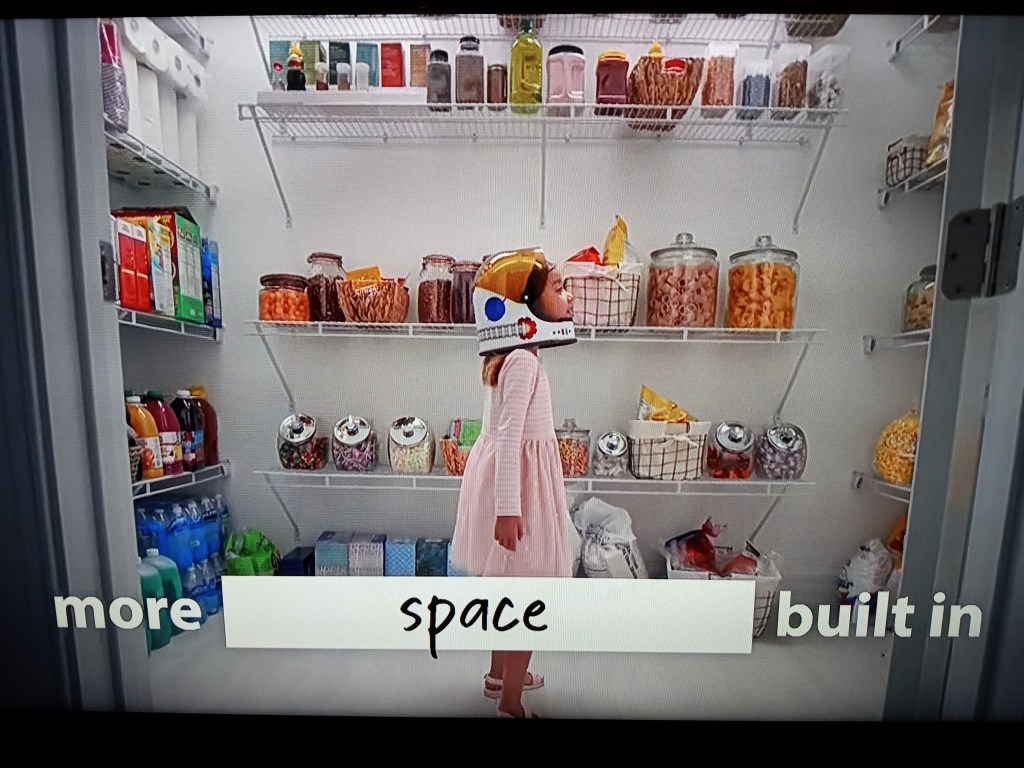
A commercial from Pulte Homes touts unique features in the houses they build. For example, they have large pantries:
The pantry is large, the stuff on the shelves is well-organized, and the shelves themselves are…mediocre. Builder-grade. Why show off such a large pantry with basic shelves?
Perhaps this accurately reflects the shelves Pulte includes in its homes. This kind of shelves might be found in closets throughout many new homes in the United States. They are usable shelves, after all. If the first homeowner wants something more complicated, they have plenty of options ranging from Ikea designs to those who can custom-fit shelves and all sort of options.
Or, perhaps I am only supposed to notice the space in the pantry. The girl has so much room to move. There are so many shelves. The Costco shopper has somewhere to put all of their bulk purchases.
Even with these explanations, I find it a strange image. I see the space…and the shelves.
With houses selling for so much, you’d think there would be a big incentive for developers to throw up new units, which they can do quite quickly. I still remember driving around New Jersey during the McMansion boom and being amazed at how quickly houses went up. Why aren’t the developers rushing in now?
In correspondence, my old M.I.T. classmate and economist Charles Steindel pointed me to the likely answer: It’s the supply chain, stupid.
This makes sense given current conditions: an increased cost in materials plus difficulty acquiring materials might translate into fewer profits in building McMansions.
I do wonder if there are additional factors at work. A few quick ideas:
McMansions have an established reputation. There are still plenty of people who will buy one but there is also a clear connotation about the home when this specific term is used. Hence, “luxury homes” instead.
There is more money to be made in even larger houses. Why build McMansions when there are enough customers for even larger and/or more opulent homes? Perhaps the money in McMansions comes at a sizable building scale while the per lot/house profits on even more expensive homes is preferred.
McMansions are not going away as they are an established part of the American housing stock. But, it will be worth watching how many new ones are constructed, where, and by whom.
Earlier this year, Realtor.com estimated the gap between the number of homes needed and the number of homes available at 5.24 million. That estimate in June represented an increase of 1.4 million above the estimated 3.84 million gap in 2019, primarily because residential construction hasn’t kept up with household formations.
From January 2012 to June 2021, 12.3 million new American households were formed, but just 7 million new single-family houses were built, according to Realtor.com.
The housing shortage is particularly acute in the more-affordable range. Newly built houses with a median sales price of $300,000 represented just 32 percent of builder sales in the first half of 2021, compared with 43 percent during the first half of 2018, according to Realtor.com. To close the gap between demand and supply, builders would need to double their pace of construction for five or six years, Realtor.com economists estimate.
I have been trying to keep track of this for several years now: where are the new cheaper homes? If home builders are interested in selling homes, why not also create products for this part of the market?
There could be lots of reasons for this present state. But, this is not just a problem of 2021; this has been going on for at least a few years. Who can or will act to address this? Is this a pressing social concern that requires attention or just something to note every so often?
Imagine a time in the near future after this trend of the last ten years or so has truly piled up. How will younger adults pursue homeownership, a goal many Americans still say is desirable? Will a lower end of the housing market simply disappear to be overshadowed by more expensive, larger homes that truly generate profits?
If this continues, I would not be surprised to see more calls for housing interventions beyond the market.




 Legally Sociable