Between 1925 and 1990, the rate of suburbanization differed by Protestant denomination. Some denominations were already more likely to be in the suburbs (their suburban presence predated mass suburbanization), some moved to the suburbs in increasing numbers, and some hardly moved at all. The general pattern among these groups was an increasing percentage of their churches in suburban locations, a process that was underway by the 1930s and 1940s and continued after World War II…
In this study, churches were influenced by settlement patterns in the Chicago region and the presence of numerous churches already existing in suburban communities. In addition, the racial and ethnic identity of some denominations helped dictate their choices for new suburban locations.
This article built on important work by multiple scholars about white flight in the Chicago area. Mark Mulder in Shades of White Flightlooked at how The Christian Reformed Church and The Reformed Church in America churches, both Dutch Reformed denominations, moved to the suburbs. Irving Cutler in The Jews of Chicago examined how Jews moved to suburban communities. Eileen McMahon in What Parish Are You From?analyzed how one Catholic parish responded to changing neighborhood populations, including moving to the suburbs.
As the story is told of American suburbanization, particularly after World War Two, the story should include the role religious institutions and adherents played in supporting white flight. I say more about the ways this played out with evangelicals in Sanctifying Suburbia.
Pope Leo XIV grew up in Dolton, Illinois, a suburb just south of the city of Chicago. Is this a story not just of the first American pope but a pope who grew up in the changing American suburbs? Over the years, what happened in his suburban community that had its first white settlers in the 1830s? First from the Encyclopedia of Chicago:
The mixture of railroads and the Little Calumet River proved to be a good site for industry. Dolton grew as a center for truck farming and manufacturing. It has produced bakery equipment, brass castings, shipping containers, cement, furniture, agricultural equipment, steel tanks, and chemicals. This diverse activity attracted an ethnically varied workforce. In the 1960s the Calumet Expressway (now the Bishop Ford Freeway) improved automobile and truck access to Chicago by two interchanges serving Dolton. In recent years large numbers of African Americans have moved to Dolton. The 2000 census reported a population of 25,614 with 14 percent white, 82 percent black, and 3 percent Hispanic.
According to a table on this page, Dolton was 99.9% white in 1960, 58.1% white in 1990, and 14.3% white in 2000. According to the Census Bureau, Dolton is now 4.9% white.
This is the story of how one small town became trapped in a downward spiral that poverty experts say follows a well-worn pattern of deindustrialization that leads to a disenfranchised economic class. Communities of color inherit a legacy of decline and then lack the resources, both financial and political, needed to turn things around.
The focus is Dolton, but it just as easily could be Riverdale, Harvey, Dixmoor, Posen, Calumet City or other nearby suburbs that once were powered by steel and other industry but over time slowly coalesced into a broad swath of economic distress. In other parts of Illinois, such as North Chicago to the north or Maywood to the west, the details change but the problems are often much the same.
It was no one single thing, but a cascade of events that changed the fortunes of Dolton and its neighbors. The decline of manufacturing led to a loss of job and pay opportunities, which in turn fed a wave of white flight as longtime residents left and were replaced by African-American city dwellers lured by better, yet not too expensive, housing.
But luring new investment to now majority black communities proved a challenge and housing values began to fall, taking down with them the tax revenues needed to keep up public services. Next came widespread foreclosures and an invasion of real estate scavengers who bought houses on the cheap, transforming a community of homeowners with a deep financial stake in their town into one of renters with looser bonds.
All the while, the political fabric vital to turning things around continued to fray. Government stumbled amid patronage and gridlock, rendering even more challenging the task of drawing needed new investment.
His parents had been living in a 1,200-square-foot brick house on East 141st Place in Dolton. They bought it new in 1949, paying a $42 monthly mortgage.
His father Louis Prevost was superintendent of the south suburban schools in District 169. News clippings from 1945 show he served as a Navy lieutenant in the Mediterranean in WWII. He had graduated from the old Central Y.M.C.A. College in 1943 while living in Hyde Park.
The new pope’s mother, Mildred Martinez Prevost, studied library science at DePaul University. Her death notice, in 1990, said she and her husband started the St. Mary’s library in the basement of the old school building and mentions jobs she had in the libraries at Holy Name Cathedral, Von Steuben High School on the North Side and at Mendel from 1969 to 1975.
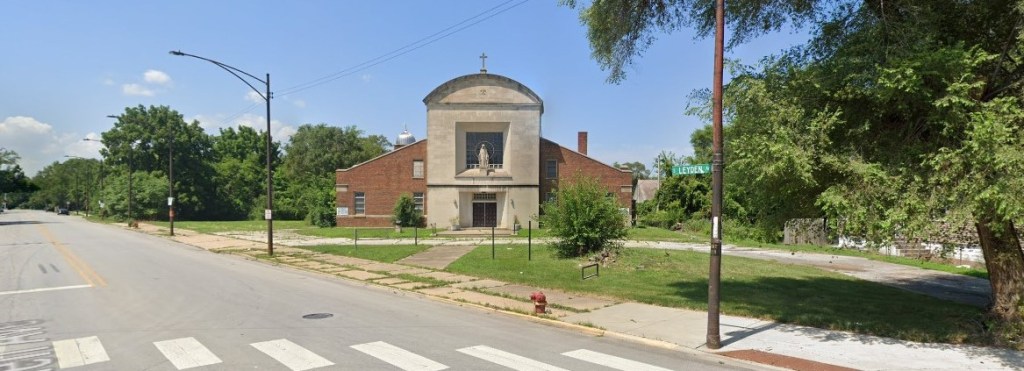
The Prevosts attended a Catholic parish – St. Mary of the Assumption – just inside the southern borders of Chicago and next to the suburbs of Dolton and Riverdale. Here is what the property looked like as of July 2024:
Like St. Mary’s, other Catholic institutions that helped shape the future cardinal are long gone, closed over the past several decades as the Catholic population around where he grew up and elsewhere plummeted. Among those bygone institutions:
• Mendel College Prep High School, where Prevost and his mother worked.
• St. Augustine Seminary High School in Michigan.
• Tolentine College in Olympia Fields, the suburb where he briefly lived.
• Mount Carmel Elementary School in Chicago Heights, where his father was principal.
Several of these communities mentioned – Olympia Fields, Chicago Heights – experienced racial change similar to that of Dolton.
If white Catholic residents indeed left Dolton and other communities on the South Side of Chicago and its southern suburbs and American suburbia became more complex, where did they move to? How did this shape the ministry of Pope Leo XIV?
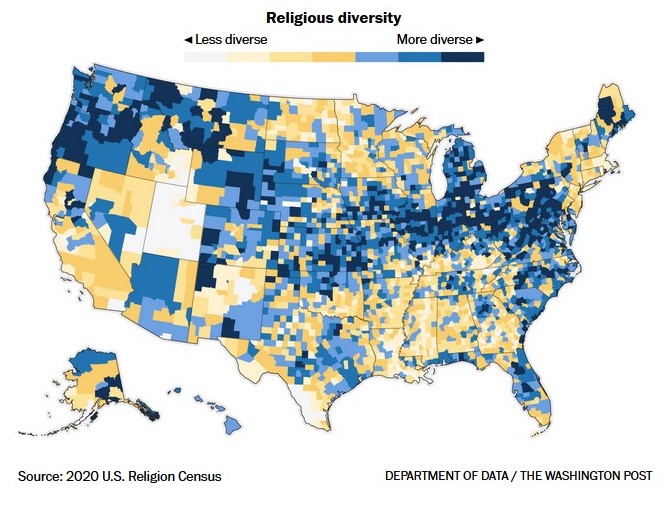
There is a good amount of diversity across counties with this measure. The Chicago area is in the middle, leaning toward less diversity by this measure.
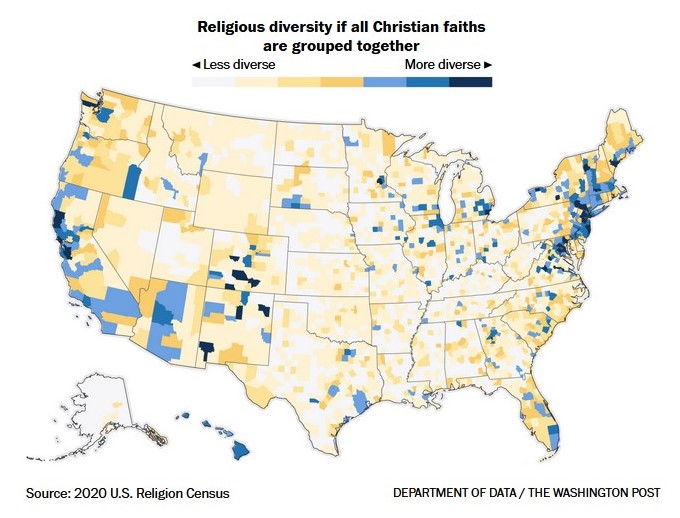
Second, putting together all of the Christian traditions under one umbrella leads to a different map of diversity:
The Chicago region is now more diverse with the metropolitan counties generally on the side of more diversity.
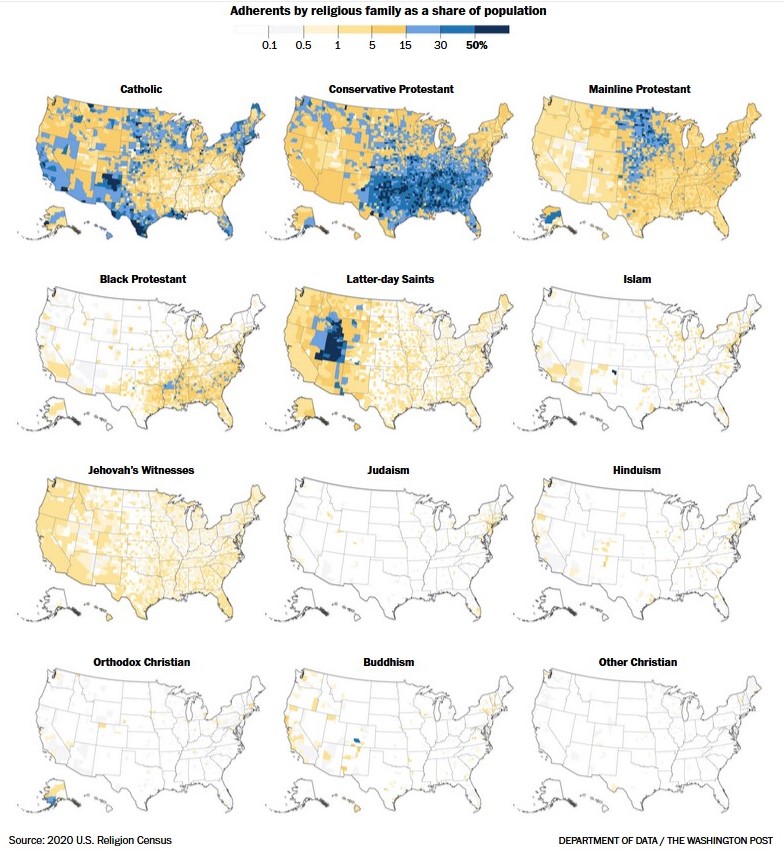
Third, a map of different religious traditions:
This helps show the ways the Chicago region is diverse with a number of religious traditions present. Find county by county findings here.
The article has a summary of the larger patterns across the United States:
But if we regard Christianity as a single monolith — lumping all the Catholics, Presbyterians, Methodists, Lutherans and whatnot in one big sacramental wine jug — we find that the most religiously diverse places in America are generally the big cities. The urban Northeast leads the pack.
That’s because if America has a Quran Belt, a Torah Belt or a Bhagavad Gita belt, greater New York City forms its buckle. Almost half of America’s Jews, by synagogue adherence, live in either New York or New Jersey — which also happen to be the second and third most Islamic states, after Illinois. And they’re in the top three for Hindu Americans (along with Delaware). The Buddhists stick to the West Coast (and D.C.).
In other words, religious diversity varies quite a bit by county in the United States with metropolitan regions tending to be more diverse. The Chicago region is in the middle and has a large presence of Catholics.
Urban areas attract the unaffiliated; the religiously unaffiliated are among the top three religious groups in every metro area polled.
Catholics also love cities; Catholicism is among the top three religious groups for nearly every metro area—only Nashville, Charlotte, Indianapolis, Kansas City, and Atlanta don’t have Catholics among the top three.
Atlanta is the only metro area that doesn’t have Catholics, the religiously unaffiliated, or white evangelical Protestants in the number one slot; that prize goes to black Protestants.
Nashville has the largest percentage of one singular religious group: nearly four in ten (38 percent) residents identify as white evangelical Protestant.
Related to these takeaways, two things stuck out most to me looking at this data:
The relative evenness of major religious traditions (and unaffiliated) in major cities. Few large regions have one religious tradition that comprises of more than 33% of the population. This suggests a lot of pluralism at the metropolitan region level.
The pattern does not hold in every case but the leading cities for having the percent of different religious traditions tend to fall into certain regions: Catholics in the Northeast and Midwest, unaffiliated in the West, white evangelical Protestant in the Bible Belt and Midwest.
Put these two factors together and it would be fascinating to consider how the experience of religiosity differs across metropolitan regions. For example, a comparison across traditions such as between Nashville (dominated by white evangelicals) and Portland (dominated by the unaffiliated) could be interesting as would regional differences within the same leading tradition such as between Miami and Milwaukee. If metropolitan regions could be considered fields of religious activity, how might they differ in significant ways?
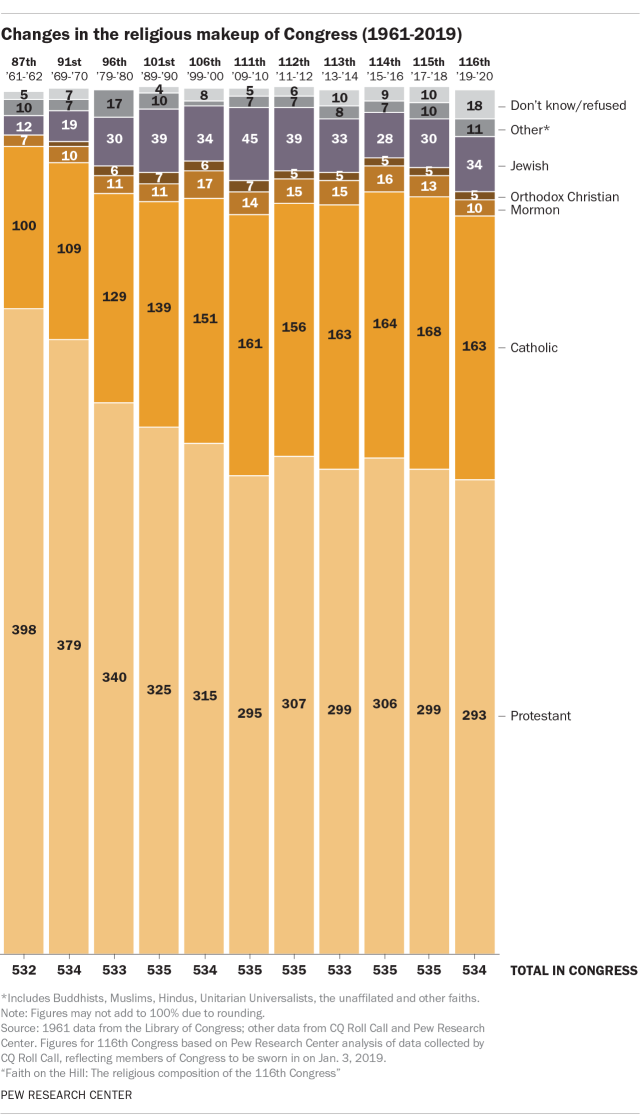
The number of Protestants has dropped dramatically – roughly a loss of 100 from sixty years ago – even as the percent of Protestants in Congress (54%) continues to be higher than the percent of Protestants in the U.S. population (48%).
The number of Catholics in Congress increased from the 1960s into the late 1970s and early 1980s and then has stayed relatively stable. There are more Catholics in Congress (30%) than in the U.S. population as a whole (21%).
The number of religious others is still low and hasn’t changed much over time.
As noted in the summary of the findings:
But by far the largest difference between the U.S. public and Congress is in the share who are unaffiliated with a religious group. In the general public, 23% say they are atheist, agnostic or “nothing in particular.” In Congress, just one person – Sen. Kyrsten Sinema, D-Ariz., who was recently elected to the Senate after three terms in the House – says she is religiously unaffiliated, making the share of “nones” in Congress 0.2%.
When asked about their religious affiliation, a growing number of members of Congress decline to specify (categorized as “don’t know/refused”). This group – all Democrats – numbers 18, or 3% of Congress, up from 10 members (2%) in the 115th Congress. Their reasons for this decision may vary. But one member in this category, Rep. Jared Huffman, D-Calif., announced in 2017 that he identifies as a humanist and says he is not sure God exists. Huffman remains categorized as “don’t know/refused” because he declined to state his religious identity in the CQ Roll Call questionnaire used to collect data for this report.3
In summary, Congress is overwhelmingly religious and Christian. While America as a whole is still solidly majority religious and Christian, Congress is even more so. This seems to suggest Americans still like to elect people who have a faith affiliation even if there is less information on the actual beliefs and practices of the Representatives and Senators (this data “does not attempt to measure their religious beliefs or practices. “).
“The new findings … lay bare the dramatic and growing gap in racial attitudes and experiences in America,” writes David Briggs in releasing the second wave of results from the Portraits of American Life Study (led by Michael Emerson of Rice University and David Sikkink of Notre Dame) via the Association of Religion Data Archives. “We do not live in a post-racial nation, the [new 2012 results] suggests, but in a land of two Americas divided by race, and less willing than ever to find a common ground of understanding.”…
1) More evangelicals and Catholics have come to believe that “one of the most effective ways to improve race relations is to stop talking about race.” In 2012, 64 percent of evangelicals and 59 percent of Catholics agreed with this statement, up from 48 percent and 44 percent respectively in 2006…
2) More evangelicals now agree that “it is okay for the races to be separate, as long as they have equal opportunity.” In 2012, 30 percent of all evangelicals agreed, up from 19 percent who said the same in 2006…
In 2006, more than 4 in 10 white non-evangelical Protestants agreed that the government should do more, versus only 3 in 10 white evangelicals and white Catholics. But in 2012, researchers found that “the religion effect disappeared” thanks to “substantial declining support” among white mainline Protestants (dropping from 42 percent to 21 percent) and white “other” Protestants (42 percent to 20 percent). Thus, “regardless of religious affiliation, whites were statistically identical to each other” by 2012.
5) More Americans now say they have been “treated unfairly” because of their race. And moreover, the increase from 2006 to 2012 was statistically significant for all groups: blacks (36% to 46%); Hispanics (17% to 36%); Asians (16% to 31%); whites (8% to 14%); as well as all Americans (13% to 21%).
Looks like more evidence for continuing to assign Divided By Faith to my Introduction to Sociology classes…
The plate tectonics of social mobility also figure into the Santorum surprise, note scholars like the political scientist John C. Green of the University of Akron. In the post-World War II years, many Catholics moved out of insular urban neighborhoods while many evangelicals left their rural and small-town homes for the suburbs and exurbs. In subdivisions, in office parks, in colleges, the young people of the two religions began to encounter one another as benign acquaintances rather than alien enemies.
It is no coincidence, then, that a Santorum voter like Carissa Wilson has grown up in the suburban sprawl between two cities with strong Catholic heritages, Dayton and Cincinnati. Like the Michigan autoworkers in 1980 who made a break with Democratic tradition to vote for Ronald Reagan, Miss Wilson just may be the embodiment of a new wave.
In other words, evangelicals and Catholics met and learned to like each other in the suburbs. United by suburban values and perhaps a dislike for both cities and rural areas, these two groups settled into the land of single-family homes and found that they could find common ground on some social and theological issues.
This brings several questions to mind:
1. Are Catholics and evangelicals more interested in preserving suburban values than finding common theological ground? Perhaps this is crassly put but the way the argument is written in the article, it suggests that the suburbs came first before the social and theological common ground.
2. How do race and class play into the process? In other words, while both groups came from different places to the suburbs, they were probably mostly white and the educational status of both groups was rising. Does this mean that the older city/rural divide was transcended by common status interests based on race and class?
More than 1,000 Mexicans left the Catholic Church every day over the last decade, adding up to some 4 million fallen-away Catholics between 2000 and 2010, sociologist and historian Roberto Blancarte told Efe.
Put this way (and a headline built around this daily figure), this statistic seems noteworthy as it looks like a lot of people are making this decision every day. But later in the article, we get a broader perspective:
In 1950, 98.21 percent of Mexicans said they were Catholic, in 1960 the percentage dropped to 96.47 percent, in 1970 to 96.17 percent, in 1980 to 92.62 percent, in 1990 the percentage dropped to 89.69 percent, in 2000 the country was only 88 percent Catholic, and now that percentage is lower still at 83.9 percent.
This signifies that the last decade has seen a drop of more than 4 percentage points, equivalent to almost 4 million people or an average of 1,300 people a day leaving the Catholic Church.
From this decade-by-decade perspective, there is a clear decline from 98.21 percent to 83.9 percent in 2010, a drop of just over 14 percent over 60 years. But this longer-term perspective also helps show that the daily average isn’t really that helpful: are there really 1,300 people each day that make a conscious decision to leave the church? Is this how it works among individual citizens? In this case, it might be better to look at the percentage change each decade and see that the 4.1 percent drop in the 2000s is the largest since 1950.
Additionally, can the average person easily envision what exactly 1,300 people means? This is a large room of people, bigger than even a decent size college classroom but not quite enough to fill a decent sized theater. The Metro in Chicago holds about 1,150 so this is a close approximation.
At least we didn’t get down to another type of common statistic: this data from Mexico breaks down to about 1 Catholic leaving the church every 1.11 minutes.
Sociologist James Davidson, professor emeritus at Purdue University, said young Catholics “distinguish between the Catholic faith, which they identify with and respect, and the Catholic Church, which they are less attached to.”
Quoting a wide body of research, including his own, Davidson said eight of 10 young Catholics believe there are many ways to interpret Catholicism and they grant more authority to their individual experience than they do to the magisterium.
“They stress the importance of thinking for themselves more than obeying church leaders,” he said. “Instead of simply embracing church traditions and teachings, they tinker with them. They distinguish between abstract beliefs and principles that they think are at the core of the Catholic faith, and more concrete norms and codes of conduct that they consider optional or peripheral.”
In essence, Davidson said, “they believe that doctrines such as the Trinity, the Incarnation, Mary as the mother of God, Christ’s real presence in the Eucharist and the need to be concerned about the poor are more important than teachings such as the need to limit the priesthood to men, the need for priestly celibacy, the church’s opposition to artificial birth control and its opposition to the death penalty.”
Catholic young adults are not immune to the complex encounter between the church and popular culture, said participants in a panel discussion on “Sex and the City of God.”…
There is some more interesting stuff here. These discussions sound very similar to the findings of Soul Searchingand Souls in Transition: emerging adults are less interested in organized religion but are still spiritual even as this spirituality looks more like “moral therapeutic deism” and they question traditional (or conservative) stances of the church toward social issues.
On Wednesday, a new comprehensive report on Chicago Catholics will be released. The report is based on data from “524 Catholics in Cook and Lake counties” and the project was headed up by sociologist Andrew Greeley. Here are a few of the findings:
In addition, 78 percent of the respondents said Catholicism is either “extremely important” or “very important” in their lives.
Greeley wrote that the survey suggests “two separate Catholic identities — an imaginative, story-telling identity and a rules identity,” commonly referred to as “Cafeteria Catholics.” Those Catholics revere the sacraments and run in primarily Catholic circles, but they make their own choices on moral, religious and political issues.
“The only safe prediction seems to be that … there will be, whether the leadership likes it or not, varied forms of affiliation with a Church most of them still love,” Greeley wrote. “Not Cafeteria Catholics so much as Smorgasbord Catholics, a rich and diverse collection of ways to affirm one’s Catholicism.”
These findings about Catholics don’t seem too different than findings from other studies of American religion that show people of faith don’t follow all of the doctrines or practices of their faith traditions. Overall, people have some basic Christian beliefs or notions about spirituality but then a wide range of opinions on moral and practical issues.
A few questions about the methodology: 524 as a total N seems a little small plus I wonder why they went for Catholics in Cook and Lake Counties and not some of the other collar counties. This reminds me that on maps that show the religious plurality in each American county, DuPage County is coded Catholic. I’d also be curious to know whether Latino Catholics, of which there are a large number in the Chicago region, have different views than other Catholics.




 Legally Sociable