But to get around metropolitan areas in the United States almost requires using highways. Driving is required in most places and people might be able to avoid faster roads for specific destinations or shorter trips. However, completing a lot of trips – whether suburb to suburb or in and out of major population centers – will involve highway travel.
There are already numerous efforts to make highway driving safer. Vehicle features. Signs. Public service announcements. Traffic enforcement. Are there other methods to try or is this more of a question of public will – are people willing to change driving habits and our public infrastructure in order to reduce the number of deaths?
The U.S. census reported that the number of suburban jobs rose after 1850 and accelerated after 1880, so that, in the second half of the nineteenth century, suburban employment constituted one-third of all manufacturing employment in America. Ignoring those jobs beyond the central business district means ignoning blue-collar workers and ignoring one of the leading forces for suburbanization in America. (75)
A large part of the American Dream of suburbia involves single-family homes. But the story of suburbia also includes industry and jobs. In this book, historian Elaine Lewinnek highlights the move of industry to suburban areas outside of what was then the Chicago city limits and how working people followed those jobs. They often ended up in small, single-family homes close to new factories and meatpacking facilities.
Why did industry move to the suburbs? Land was cheaper. They could build large facilities. The downsides of industry – noise, smells, pollution – affected fewer people and the land uses faced fewer regulations in suburban areas.
The one statistic that jumped out at me in the paragraph above was that “one-third of all manufacturing employment” was in the suburbs. Some of those suburban areas became part of the city, as they did in Chicago. But industrial suburbs continued, such as in places like Gary, Indiana, as did suburban employment. When the most common commuting trip in the United States today is suburb to suburb, this is part of that legacy of suburban industry and work.
Some suburbs are indeed bedroom communities with limited or no commercial and industrial land uses but the suburbs as a whole have lots of business activity.
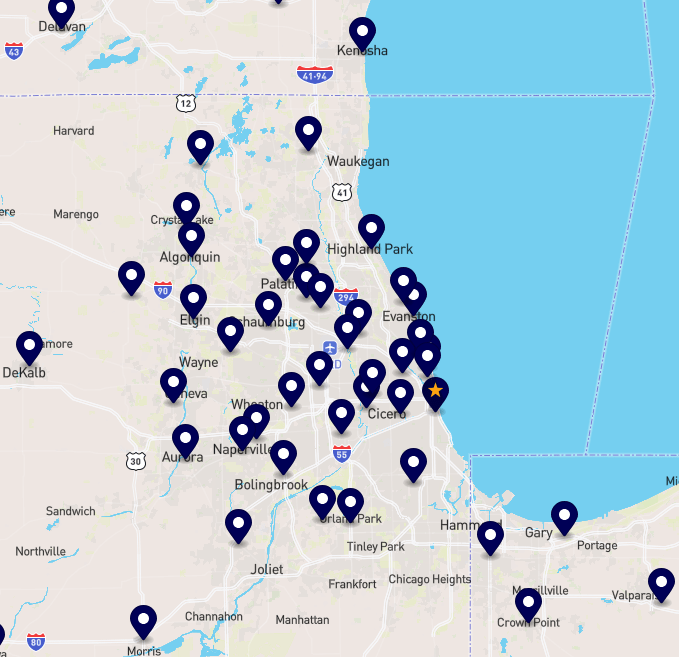
In the last decade or so, protests in the United States do not just take place in big cities. For example, the No Kings website listed over 30 gatherings in the suburbs of Chicago:
The website listed 7 sites in Chicago itself, including the primary site in the Loop which drew over 100,000 people. But people in the region had plenty of options where they could join others. Some of these locations are close to the city while others are on the edges of the metropolitan region. From what I can see on the map, most residents were with 10-15 miles of a protest site and many could access multiple options.
Three related thoughts:
The portrayals of suburbia in the postwar era tended to emphasize its conservative or Republican bent. This may have been true in numerous places but is harder to sustain these days with suburbs closer to cities often leaning Democratic and suburbs on the suburban edges often leaning Republican.
It would be interesting to look more closely at these suburban protest sites. Where can people gather in the suburbs for political purposes? Suburban downtowns or city halls? Shopping areas or busy streets? Public parks and public spaces? Which places helped increase the solidarity among those gathered and which ones helped them reach others who did not come?
The suburbs are built around driving. How many protesters around the Chicago region drove, parked, and then protested? Protests tend to happen on foot but people have to be able to get there and options are limited in some suburban settings.
Trump told mourners that one of the last things the slain conservative activist and Illinois native said to him was, “Please, sir. Save Chicago.” Trump then launched into a familiar refrain, saying, “We’re going to save Chicago from horrible crime.”
One of the Trump administration’s actions regarding Chicago includes recent ICE activity. While all the details are hard to come by, it appears however that this activity has not just affected people living in Chicago; there has been ICE activity in numerous suburbs. An ICE facility in Broadview. ICE agents approaching people in numerous suburbs, as far as 40 miles out from the city.
These actions hint at the complexity of the Chicago region and suburbs across the United States. Even as some Americans have long associated cities with racial and ethnic diversity, this diversity has increased in suburbs in recent decades. The American suburbs are full of people of different racial and ethnic groups as well as large numbers of recent immigrants to the United States.
So when Trump says Chicago has problems, does he mean just the city or is the whole region in question?Again, from the Kirk service:
Trump later took aim at Gov. JB Pritzker, declaring, “You have an incompetent governor who thinks it’s OK when 11 people get murdered over the weekend. … He says he’s got crime [under control]. No, they don’t have it under control, but we’ll have it under control very quickly.”
Both the city of Chicago and its suburbs have the same governor. Only one of the Chicago collar counties in Illinois voted for Trump in 2024: McHenry County. (There are portions of the greater Chicago area in southeastern Wisconsin and northwestern Indiana but they may not be part of the same conversation.) Are the problems some see in Chicago also ones they see present in suburbs?
The Suburban Mayors Coalition for Fair Transit criticizes new taxes proposed in a bill approved by the state Senate to avert a $771 million shortfall facing Metra, Pace and the CTA in 2026.
A $1.50 delivery fee on online orders, excluding groceries and medications, dubbed the “pizza tax” is “regressive, (and) disproportionately burdens low- to moderate-income families,” officials said.
Mayors also panned expanding a real estate transfer tax from Chicago to the suburbs, and allowing the new Northern Illinois Transit Authority to acquire or develop land near train stations for projects such as condos with retail space.
That concept would strip away power over zoning and parking from municipalities and give it to an nonelected board, they argued.
Three major issues seem to be at stake for suburban officials:
Taxes and funding. Will more funds be raised from the suburbs? Will that tax money then be sent in ways that benefit suburban communities and residents?
A loss of local control. More taxes affecting local residents imposed by other government bodies. Not having complete control over local land.
Representation on the board that would oversee a new regional transit agency. How many suburban officials should be there? Should it be evenly balanced between suburban and Chicago interests?
All of this gets at a major reason suburbanites like the suburbs: they like local control. They generally do not like the big city dictating what will happen. They want what they think is best for their suburban community.
Perhaps this is elsewhere in the letter but it strikes me what is missing is a sense of how regional mass transit could be used by suburbanites and improve suburban life. Take the issue of suburban traffic: single communities cannot often address these issues as suburban residents commute from suburb to suburb. Could mass transit help? Or could mass transit help provide suburban residents access to more jobs and housing opportunities?
If the funding and representation issues were worked out, would a majority of suburban communities then want a regional mass transit agency? How many would be interested in more mass transit present in their communities?
Metro Chicago’s Asian population is growing faster than any other racial or ethnic group, Census Bureau estimates show. Of the estimated 9.4 million people in the Chicago metropolitan statistical area in 2024, roughly 764,000 are Asian — almost 80,000 more than in 2020, data show. During that span, the Hispanic population also grew from about 2.22 million to more than 2.32 million. Meanwhile, the metro area’s white and Black populations both declined. White population fell from 4.83 million to 4.64 million, and the Black population declined from about 1.56 million to 1.50 million.
If these patterns continue, what significant changes could come to communities and the region? How does this affect residential segregation in the region (thinking back to the high levels of white-Black segregation documented in American Apartheid)? Or political representation and policies? Or day to day lives of residents? Looking at the regional level could obscure important differences at other levels.
I am also reminded how the city of Chicago has had roughly similar sized populations of white, Black, and Latino residents in recent years. Do the patterns above suggest that the city might be headed toward four groups being roughly evenly sized at some point?
Illinois has a shortage of about 142,000 housing units and must build 227,000 in the next five years to keep pace with demand, a number that would require recent annual production rates to double, according to a new economic study.
The joint study published Tuesday by the Illinois Economic Policy Institute and the Project for Middle Class Renewal at the University of Illinois Urbana-Champaign found that although the rental and for-sale housing markets in Chicago and Illinois as a whole remain more affordable than many coastal cities, such as New York and Los Angeles, and some other states, Illinois still faces a severe housing shortage that is escalating affordability challenges.
National housing shortage estimates are wide-ranging, with Freddie Mac citing 3.7 million and the National Association of Realtors reporting 5.5 million.
And the recommendations for how to do this?
The authors suggest a variety of solutions, some of which Chicago officials and other state leaders are already working on, including easing zoning restrictions, quickening permitting processes, offering tax incentives to convert commercial buildings to residential units and increasing surtaxes on short-term rentals such as Airbnb. Aldermen recently took a step toward giving themselves the power to ban Airbnb and other short-term rentals from opening in their wards, a move that could potentially lead to an increase in housing supply.
This is not a new issue. And even drastic changes right now would not lead to 227,000 new units in five years. This is a long-term project that needs to be addressed.
One thought: this is an opportunity for Illinois to do something that could help lead the way in the United States. Here is why. It is a blue state and Chicago and its region dominates politics and perceptions. (This is not to ignore those living outside the Chicago area; there are just fewer of them.) It has more affordable costs compared to numerous other important cities. Chicago is still an important, world-class city. If Illinois could make a serious dent in providing affordable housing across the state, it could become a model for numerous other places. What works in Illinois might not work at all in New York City or Seattle or San Francisco or other super-heated housing markets. But it might work in Cleveland, Nashville, Denver, and other American metropolitan regions. Figure it out and Illinois and lots of areas could benefit.
For numerous reasons, it seems like politicians and business leaders in American cities and regions are hesitant to truly tackle affordable housing. But those who get out ahead of it can (1) help people living there and (2) provide models and tools for others to learn from and use.
The suburb of Naperville, Illinois is marked by several characteristics: rapid growth from the 1960s onward, particularly between 1980 and 2000, and lots of land annexation; wealthier suburban residents and numerous white-collar jobs; and a lively downtown with national retailers, local stores, plenty of restaurants, and a nice Riverwalk. Will any Chicago area suburb trace a similar path in the future?
Here is why I would guess no:
Limited population growth in the Chicago suburbs. The whole region is not growing much. Population growth in the suburbs could still be uneven; some places are perceived as more desirable or are more affordable and they could grow faster will others stagnate or even shrink. But explosive population growth in the Chicago area looks like it is done.
At multiple points in Naperville’s history, leaders and residents discussed possible development and regulatory options. They tended to choose growth and in particular forms. These sets of decisions helped give rise to the particular traits of Naperville today. Even if another suburb tried to pursue the same path, not all the pieces might fall together in the same way.
When Naperville grew from 1960 onwards, it was closer to the edge of the metropolitan region. Land was cheap and available. The city could annex land without running into other communities. That growth has since moved out further beyond Naperville’s ring, out to places like Aurora and Plainfield and Oswego. Any future Naperville will be 10-30 miles out from Naperville.
Naperville itself – and other older suburbs – will likely change in the future. If Naperville wants to continue to grow in population, it will need to grow denser and taller. Infill development on small parcels could add lots of townhouses, condos, and/or apartments. Redevelopment in desirable areas and around mass transit options could lead to taller or denser buildings. This all could happen in numerous Chicago suburbs but this will move them away from homes dominated by single-family homes and lifestyles.
The suburban coyote populations are growing rapidly which means there will likely be more interaction with people but both Erickson and Ramono say it’s not really the coyotes’ faults.
“We invited them when we built all these suburbs,” Erickson said. “We said, ‘Hey, there’s more food here. There’s more habitat here.’ We invited these animals in here.”
They say when we experience mild winters three to four years in a row, the population can increase 18 to 27 percent. The old and sick and late-littered animals survive, animals that would normally would die off.
In five years, the population could double.
They also say rural coyotes may only live two years because there are pressure on them. In suburban areas, we have coyotes live to 13-years-old because of the all of food and the lack of pressure.
I have seen coyotes running across busy four-lane suburban roads and through suburban backyards. I have heard them howl at night in an open field next to a neighborhood. I have read plenty of online claims regarding the threat of coyotes to local pets. Coyotes are now fixtures in suburban Chicagoland.
They are evidence that some species can thrive in suburbia. As noted above, suburban areas provide food and places to live while limiting pressure (competition for food? predators?). The typical suburbanite may not like their presence but coyotes are here to stay for now.
At what point would communities take action against coyotes? When I have read online claims of the threats to pets, I could imagine that an uptick in coyote/pet interactions could move people to act given the love Americans have for their pets. Or perhaps signs of coyotes taking out other wildlife that suburbanites like or are used to.
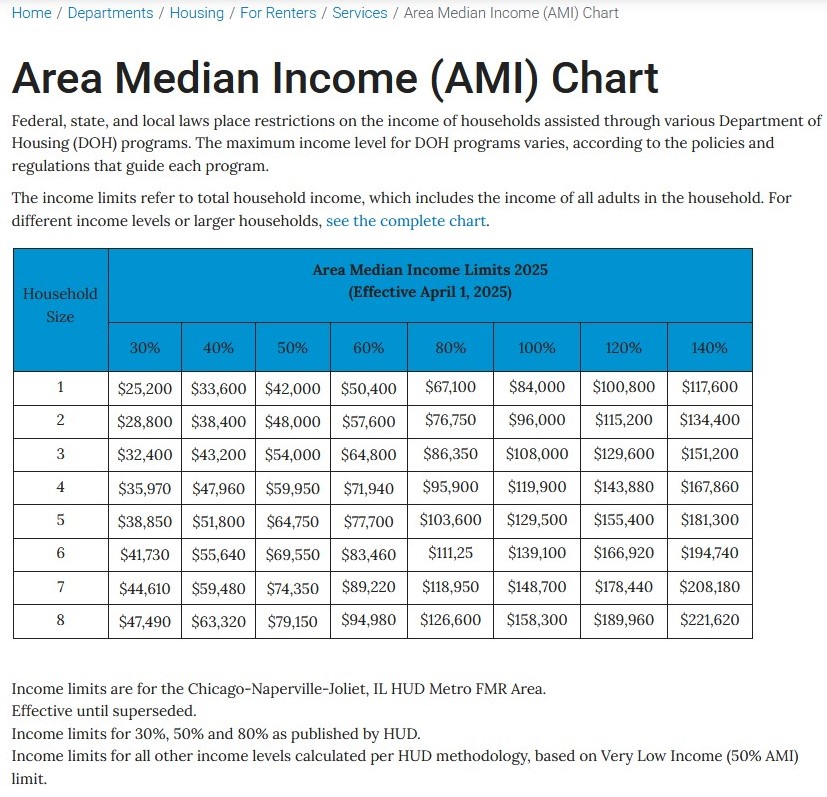
According to a memo, The Residences at River Point would set aside one-quarter of the apartments for households making 30% or less of the area median income. Roughly half would be earmarked for households making 60% or less of the AMI, and the rest would be for those making 80% or less of the AMI.
According to the federal Housing and Urban Development Department, the AMI for the Chicago metropolitan area, which includes Kane County, is $50,976 for a four-person household.
The AMI is set by HUD who has a chart of the various cutoff points for the AMI for the entire region. From the City of Chicago:
For those who have not run into these figures before, several things from this chart might stand out:
The AMI depends on household size. Discussions of housing and affordability can often focus on median household incomes but HUD adjusts for the total number of people in the household. This fits with housing with more space and bedrooms generally being more expensive.
The AMI figures are for an entire region. The Chicago region includes more than 9 million residents and hundreds of municipalities. While the AMI limits for Chicago might differ quite a bit from other regions, there can be quite a bit of variation within the region as well regarding incomes and housing prices.
These income guidelines apply to a number of programs but are not the only metrics that might be used regarding housing affordability.