Evidence from the past and future that suggests religious revival is not happening in the United States

I appreciate this part of Ryan Burge’s approach to examining whether a religious resurgence is happening in the US: he looks at past patterns and he considers possible changes in the future.
Photo by Arina Krasnikova on Pexels.com

First, the present data:

The General Social Survey, for instance, reported a steady rise in the “nones” between the early 1990s and 2020. In 2018, the figure was 23%, rising to 28% in 2021. The two most recent estimates are slightly lower — 27% in 2022 and 25% in 2024. Similarly, the “headline finding” from Pew’s Religious Landscape Survey was that both the decline of Christianity and the rise of the unaffiliated have paused in recent years.

As Burge and others have noted, recent data seems to show a stopping/slowing/plateauing of two trends: fewer people affiliating with Christian traditions and more Americans identified as “religious nones.”

But these patterns are also related to aging and whose activity researchers can examine. Burge next turns to the future:

When you compare generations, the pattern is obvious. The youngest members of the Silent Generation were born in the early 1940s, and just 7% report no religious affiliation. In less than a decade, they — and a growing share of Baby Boomers (18% unaffiliated) — will disappear from survey samples.

Meanwhile, millennials are moving solidly into middle age, and 36% of them say they have no religion. Generation Z, all of whom will soon be adults, are even less religious: 43% are nones. That’s 25 points higher than the Boomers they’re replacing. So if the overall share of nones sits around 28% now, it will inevitably rise as generational turnover continues.

Could millennials and Gen Z find God in the years ahead? Possibly — but it would require a transformation unlike anything seen in modern times. Roughly 10 million millennials would have to reaffiliate with religion, followed by another 18 million Gen Zers. There’s no sign of that happening in any dataset.

In other words, for the percent of people in the United States to identify as Christian in the future at the same rates as now would require more young people to become Christian. For the percentage of Christians to grow, even more religious change would need to take place.

By looking at past, present, and future possibilities, Burge concludes: “I can say without equivocation that there’s no clear or compelling evidence that younger Americans are more religious than their parents or grandparents.”

When trying to understand what is happening in a social group or society, one data point or set of evidence is often not enough to fully understand what is happening. Patterns can change over time or the way we understand the world can change over time but a compelling case needs to be made. Seizing on new evidence that does not fit what we know about something might hint at significant change – or it could be a sampling outlier. Good steady research can help reveal these patterns even if there are multiple actors wishing that we could have identifiable patterns more quickly.

Crosses on churches vs. the popularity of cross necklaces

I found crosses on church buildings and online profiles are somewhat common but why bother with building architecture when cross necklaces are trending?

Photo by Tima Miroshnichenko on Pexels.com

As a millenniums-old symbol of Christian faith, the cross would seem somewhat immune to trendiness. But cross necklaces and pendants have been in vogue before and may be again as some feel more comfortable embracing their faith and seek community with others.

On red carpets, on social media, at protests by high-ranking Democrats and in the White House, necklaces with cross pendants are appearing with renewed prevalence. Chappell Roan wore an oversize one to the MTV Video Music Awards in September, and one dangled from Sabrina Carpenter’s neck in the music video for her single “Please Please Please.” The trendy online store Ssense sells them in nearly 50 variations, and mainstream jewelers like Kendra Scott and Zales carry numerous designs.

Lately, the cross necklaces flash across cable news screens several times a week, suspended between the collarbones of Karoline Leavitt, the White House press secretary, and Attorney General Pam Bondi…

Over centuries, the cross evolved as a signpost of the moral compass one shares with fellow Christians and a kind of talisman with deeply personal significance. “They have an official meaning but people bring their own meaning, which is where symbols really get their power,” said Mr. Covolo, 58, who in 2020 published a book about the link between Christianity and fashion.

The article suggests two primary reasons for more worn crosses: (1) strengthening/expressing one’s own faith and (2) identifying with religious communities. This speaks to two important elements of religious faith: knowing and living out one’s one faith and participating in community with others.

At the same time, this seems like it is part of the larger pattern of individualizing or privatizing faith in the United States. The individual makes choices regarding their faith and practice. They choose to display it or not. They pick a level of involvement that works for them and their stage in life. A necklace or pendant can be added and taken off. (This might be contrasted to religious tattoos, for example, that are more permanent.)

This all makes sense in a religious marketplace where the consumer is the key actor. Crosses on church buildings or online profiles could function in similar ways: religious communities have to brand themselves as a cross is a known marker of the Christian brand.

Would cross necklaces and pendants be something different in societies with other settings?

Divine Programming and the last two seasons of a critically acclaimed TV show that takes religion seriously

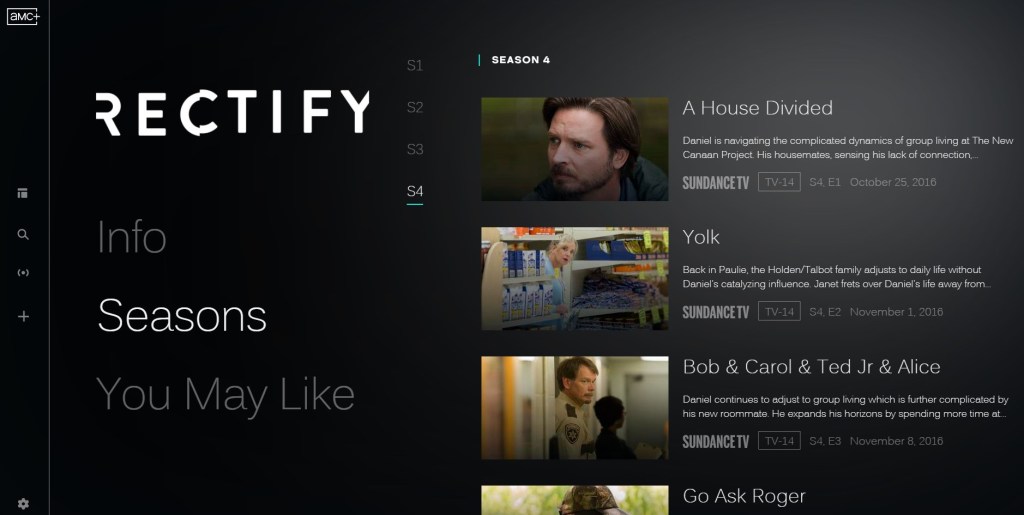
In September, I wrote about reading the academic study Divine Programming and watching seasons one and two of the TV show Rectify. I have now watched the final two seasons of the show, seasons three and four, and was interested to see the role religion played. Here are some thoughts.

  1. Religion is certainly not as important to the plot as it was in the first season. The number of times it is mentioned decreases. There is no presence of organized or institutional religion; it is all personal or individual.
  2. The primary religious character has a return to their faith in the final season. This does not mean everything turns out correctly for them or religion helps solve big issues. It appears that their privatized faith emerges again after going through some personal trials.
  3. The final episodes interact with the themes of hope and disappointment. Arguably, these themes run throughout the entire series; when Daniel is released from prison at the beginning, this does not necessarily lead to long-term consequences for the characters as they engage with what happened in the past and their current circumstances. These are themes that certainly fit with a religious theme. Why do bad things happen? Why are we disappointed? What gives us hope? In the end, the themes of hope and disappointment are left more to the individual characters and immediate family to address, not to religion.

Considering the full show, religion did matter in the narrative arc of the show but it was not a primary force, one that even a majority of the characters engaged with, and did not provide hope or disappointment in the end. Other forces and actors were more influential and the show, like many American narratives, puts a lot of hope in individuals and close relationships among family.

Divine Programming and watching two seasons of a critically acclaimed TV show that treats religion seriously

This summer I read the book Divine Programming: Negotiating Christianity in American Dramatic Television Production 1996-2016. Charlotte Howell argues that television often utilizes two techniques when portraying Christian faith: keeping it at a critical distance or depicting it a cultural feature of Southern life. However, not all television shows do this. One critically-acclaimed show Howell highlighted, Rectify, sounded interesting.

Photo by Nicola Barts on Pexels.com

I have now watched the first two seasons of the show. And it is indeed interesting to see how religion in incorporated as part of the plot. The main character in the drama, a man who has been released from death row even as law enforcement and legal actors are interested in putting him back in prison, finds religion in the middle of the opening season. He has a conversion and a baptism. He is attracted to this faith through the example of his sister-in-law who attends church regularly, encourages her husband to be more faithful, attends a small group, and has a gentle spirit.

Yet, at least through two seasons, the reassurances faith provides have difficulty matching up the problems the characters face. The released prisoner finds that his conversion is perhaps less important to his thriving than interacting with his sister-in-law. The sister-in-law confronts new problems and her faith no longer provides all the answers. The other main characters do not seem to interact with faith much at all and their own self-interest and hurt drives their decisions. Outside of several individual characters engaging religion (a common approach in American religiosity) , it is not present for the other characters or the community.

The faith of this show is not simple or does not always provide an answer or does not even matter to many of them. The characters have religious highs and lows and wrestle with how faith matters in real situations. The faith on the show is not front and center in the way it is in Seventh Heaven (also a case study in Howell’s book) nor is it derided or just a cultural artifact.

At the same time, it is clear that faith or religion is not driving the plot: human desires are. I will keep watching and see whether this is ultimately commentary about the ability or inability for religious faith to intercede in human affairs.

Materialism and religion in the clothes pastors wear

An Instagram account highlights the expensive wear of ministers:

On his feed, Kirby has showcased Seattle pastor Judah Smith’s $3,600 Gucci jacket, Dallas pastor T.D. Jakes’s $1,250 Louboutin fanny pack and Miami pastor Guillermo Maldonado’s $2,541 Ricci crocodile belt. And he considers Paula White, former president Donald Trump’s most trusted pastoral adviser who is often photographed in designer items, a PreachersNSneakers “content goldmine,” posting a photo of her wearing $785 Stella McCartney sneakers.

As the Instagram account grew, Kirby started asking more serious questions about wealth, class and consumerism, including whether it’s appropriate to generate massive revenue from selling the gospel of Jesus.

“I began asking, how much is too much?” Kirby said. “Is it okay to get rich off of preaching about Jesus? Is it okay to be making twice as much as the median income of your congregation?”

This is a long-standing issue within Christianity, let alone in American Christianity where money and status have existed alongside religious fervor and practices for a long time. In a society that emphasizes consumption, even conspicuous consumption, plus celebrity, is it a surprise that ministers would want to wear expensive items?

Counterfactuals to these observations might help. Two come to mind:

  1. Are there mainstream religious groups or leaders who actively shun or downplay status? I can think of famous pastors who are not as well dressed. But, are they necessarily poorly dressed? How much does presentation of self matter compared to other noteworthy factors like particular religious doctrines or practices? I assume there is some limit where a pastoral presentation has to fit some parameter or the lack of style or flashiness will be a negative. Is the nature of American religion with its religious economy of competition inextricably tied to status and presentation?
  2. Some evangelicals have raised questions about materialism and consumption for decades. Historian David Swartz’s book Moral Minority highlights how evangelicals in the early 1970s questioned the consumption patterns of Americans. If you want to go back further, Max Weber argued in The Protestant Ethic and the Spirit of Capitalism that a particular ascetic approach to spending wealth on oneself helped spur on capitalism. How far did this critique go? By the 1980s, evangelicals largely became associated with conservative economic policies and reside in suburbs where appearances and keeping up with the Joneses matter to some degree. At the same time, evangelicals often claim they do not want to be too flashy or that they are middle-class even if they have the resources to be above that.

Religiosity of 116th Congress both does and does not reflect changes in American religion

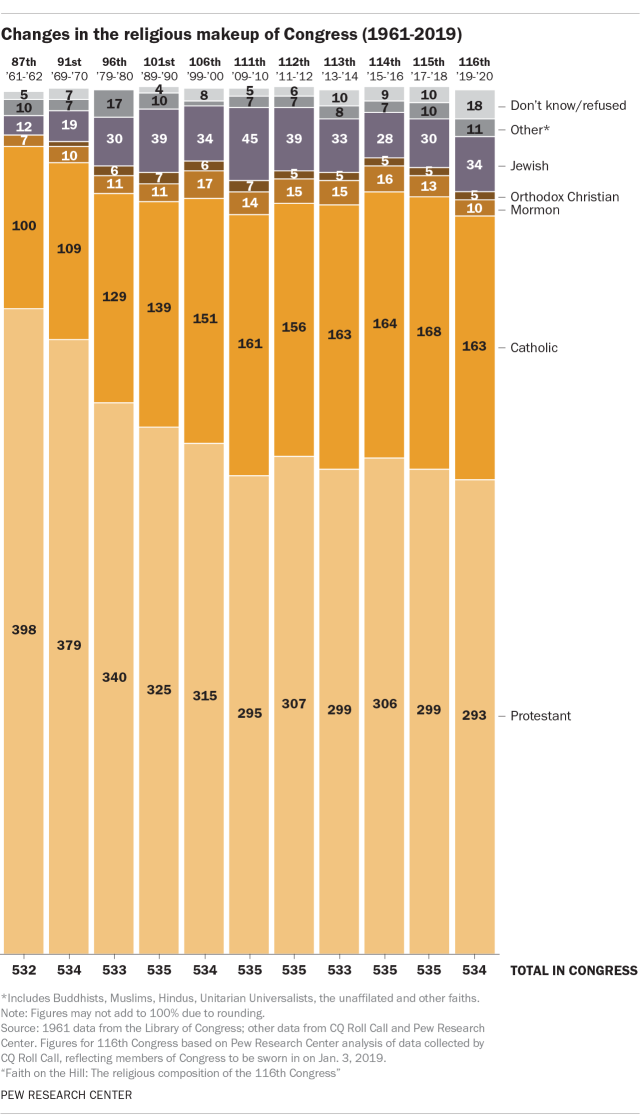
Comparing the religious makeup of the newest Congress to previous Congresses shows several interesting patterns:

http://www.pewforum.org/2019/01/03/faith-on-the-hill-116/

A few patterns to note:

  1. The number of Protestants has dropped dramatically – roughly a loss of 100 from sixty years ago – even as the percent of Protestants in Congress (54%) continues to be higher than the percent of Protestants in the U.S. population (48%).
  2. The number of Catholics in Congress increased from the 1960s into the late 1970s and early 1980s and then has stayed relatively stable. There are more Catholics in Congress (30%) than in the U.S. population as a whole (21%).
  3. The number of religious others is still low and hasn’t changed much over time.
  4. As noted in the summary of the findings:

But by far the largest difference between the U.S. public and Congress is in the share who are unaffiliated with a religious group. In the general public, 23% say they are atheist, agnostic or “nothing in particular.” In Congress, just one person – Sen. Kyrsten Sinema, D-Ariz., who was recently elected to the Senate after three terms in the House – says she is religiously unaffiliated, making the share of “nones” in Congress 0.2%.

When asked about their religious affiliation, a growing number of members of Congress decline to specify (categorized as “don’t know/refused”). This group – all Democrats – numbers 18, or 3% of Congress, up from 10 members (2%) in the 115th Congress. Their reasons for this decision may vary. But one member in this category, Rep. Jared Huffman, D-Calif., announced in 2017 that he identifies as a humanist and says he is not sure God exists. Huffman remains categorized as “don’t know/refused” because he declined to state his religious identity in the CQ Roll Call questionnaire used to collect data for this report.3

In summary, Congress is overwhelmingly religious and Christian. While America as a whole is still solidly majority religious and Christian, Congress is even more so. This seems to suggest Americans still like to elect people who have a faith affiliation even if there is less information on the actual beliefs and practices of the Representatives and Senators (this data “does not attempt to measure their religious beliefs or practices. “).

A need to better understand why more education doesn’t lead to less religiosity among American Christians

A new Pew report looks at the relationship between education and religiosity:

On one hand, among U.S. adults overall, higher levels of education are linked with lower levels of religious commitment by some measures, such as belief in God, how often people pray and how important they say religion is to them. On the other
hand, Americans with college degrees report attending religious services as often as Americans with less education.
Moreover, the majority of American adults (71%) identify as Christians. And among Christians, those with higher levels of education appear to be just as religious as those with less schooling, on average. In fact, highly educated Christians are more likely than less-educated Christians to say they are weekly churchgoers.
There is a two part process with this data. First, it has to be collected, analyzed, and reported. On the face, it seems to contradict some long-held ideas within sociology and other fields that increasing levels of education would reduce religiosity. Second, however, is perhaps the tougher task of interpretation. Why is this the case among Christians and not other groups? What about the differences between Christian traditions? How exactly is religion linked to education – does the education reinforce religiosity or are they separate spheres for Christians (among other possibilities)? Data is indeed helpful but proper explanation can often take much longer.

Can Americans elect a non-Christian president?

On President’s Day, Pew Research highlighted the religious faith of America’s presidents:

With the exception of Democrat Bernie Sanders (who is Jewish), all of the presidential hopefuls are Christians and most are Protestants.

In addition, all of the current presidential candidates have spoken openly about the importance of faith in their lives (again, with the exception of Sanders, who describes himself as “not particularly religious”). Our recent survey shows that many Americans care about their leaders’ faith. For instance, half of all American adults say that it’s important for a president to share their religious beliefs. And more people now say there is “too little” religious discussion by their political leaders (40%) than say there is “too much” (27%).

Historically, about a quarter of the presidents – including some of the nation’s most famous leaders, like George Washington, James Madison and Franklin Roosevelt – were members of the Episcopal Church, the American successor to the Church of England.

The next largest group of presidents were affiliated with the Presbyterian Church, which has roots in Scotland. Andrew Jackson, Woodrow Wilson and Ronald Reagan, all of whom had Scots-Irish ancestry, were among the commanders in chief who belonged to the denomination.

Protestants have dominated the office yet just two denominations – Episcopalians and Presbyterians – have supplied nearly half (19 out of 43) of the presidents. Arguably, Americans might not care exactly what denomination or particular doctrinal beliefs a president has as long as they identify as a Christian. This may be part of American civil religion where particularities are not encouraged but a general Christian faith is helpful.

In a continuing trend, a sizable number of Americans say they are unwilling to vote for atheists for president though more younger voters are open to it:

As the 2016 presidential election field takes shape, more than nine in 10 Americans say they would vote for a qualified presidential candidate who is Catholic, a woman, black, Hispanic or Jewish. Less than half of Americans would vote for a candidate who is a socialist…

Among religious identities, while the large majority of Americans would vote for a Catholic or Jewish presidential candidate, smaller majorities say they would vote for a candidate who is Mormon (81%), an evangelical Christian (73%), Muslim (60%) or an atheist (58%)…

At least two-thirds of adults younger than 30 say they are willing to vote for a candidate with any of the characteristics included in the survey.

How this influences the 2016 election remains to be seen.

Religious change: Americans identifying as Christian drops to 70.6%

New data from Pew Research shows a drop in how many American adults identify as Christians:

The Christian share of the U.S. population is declining, while the number of U.S. adults who do not identify with any organized religion is growing, according to an extensive new survey by the Pew Research Center. Moreover, these changes are taking place across the religious landscape, affecting all regions of the country and many demographic groups. While the drop in Christian affiliation is particularly pronounced among young adults, it is occurring among Americans of all ages. The same trends are seen among whites, blacks and Latinos; among both college graduates and adults with only a high school education; and among women as well as men.

To be sure, the United States remains home to more Christians than any other country in the world, and a large majority of Americans – roughly seven-in-ten – continue to identify with some branch of the Christian faith.1 But the major new survey of more than 35,000 Americans by the Pew Research Center finds that the percentage of adults (ages 18 and older) who describe themselves as Christians has dropped by nearly eight percentage points in just seven years, from 78.4% in an equally massive Pew Research survey in 2007 to 70.6% in 2014. Over the same period, the percentage of Americans who are religiously unaffiliated – describing themselves as atheist, agnostic or “nothing in particular” – has jumped more than six points, from 16.1% to 22.8%. And the share of Americans who identify with non-Christian faiths also has inched up, rising 1.2 percentage points, from 4.7% in 2007 to 5.9% in 2014. Growth has been especially great among Muslims and Hindus, albeit from a very low base.

Changing U.S. Religious Landscape


While the drop in religious affiliation will get a lot of attention, this report has other interesting information: American Christians have become more non-white; religious intermarriage is up; Black Protestants have been stable while Evangelical Christians are growing whereas Catholics and Mainline Protestants have lost large numbers; and non-Christian groups have grown but are still quite small.

Sociologist: China to have the most Christians in the world by 2030

In another indicator of the shift of Christianity from the West, one sociologist predicts China will be home to the largest number of Christians by 2030:

“By my calculations China is destined to become the largest Christian country in the world very soon,” said Fenggang Yang, a professor of sociology at Purdue University and author of Religion in China: Survival and Revival under Communist Rule…China’s Protestant community, which had just one million members in 1949, has already overtaken those of countries more commonly associated with an evangelical boom. In 2010 there were more than 58 million Protestants in China compared to 40 million in Brazil and 36 million in South Africa, according to the Pew Research Centre’s Forum on Religion and Public Life.

Prof Yang, a leading expert on religion in China, believes that number will swell to around 160 million by 2025. That would likely put China ahead even of the United States, which had around 159 million Protestants in 2010 but whose congregations are in decline.

By 2030, China’s total Christian population, including Catholics, would exceed 247 million, placing it above Mexico, Brazil and the United States as the largest Christian congregation in the world, he predicted.

This could lead to a lot of change in China – and change in the United States where many Christians see China as a less-than-Christian country as well as consider their own country to be a (the?) leading Christian nation. Of course, there is some time before this prediction can be assessed and a lot could happen between now and then…