Peak urban millennial reached?

A new study suggests millennials are now less interested in settling in big cities:

Millennials have been singled out as the stuff cities are made of, but Dowell Myers, a professor at the University of Southern California’s Price School of Public Policy, says the real estate industry should be bracing for a shift back to suburbs…

In a study published in late April in the journal Housing Policy Debate, Myers examined Realtor surveys and various sources of federal data…

Myers, however, found that circumstance was the likely driver of urban living: Three cycles — one demographic, one economic and one housing-based — converged in the 2000s to drive millennials into downtowns.

All three have reversed their effects, he said.

If this holds up, two possible consequences:

  1. Cities have worked hard in recent decades to appeal to young, educated adults – the Creative Class, in particular. If this group doesn’t move to cities in as large of number, who will cities try to attract? They may still go for wealthier empty nesters and retirees who can purchase housing and contribute to the tax base. But, they don’t quite have the same benefits as vibrant, motivated young people.
  2. If they aren’t going to the big cities, suburbs and suburban developers will increasingly look for ways to attract this demographic. Denser, more vibrant suburban areas could be appealing as they offer “city-lite” living. This could lead to more smaller yet having-all-the-features suburban housing.

Comparing aliens, asteroids, and ghosts destroying cities

Mass destruction of cities is a common feature of action films but what creatures bring about the most destruction?

Anyway, this all got us wondering why aliens hate Earth architecture so much, and then we realized that it’s not just aliens—Earth architecture is also hated by asteroids and ghosts. Let us review the evidence…

Verdict: Asteroids

It’s got to be asteroids. Asteroids are such jerks.

Not exactly a scientific review of the available evidence (how hard would it be to analyze all the movies with such urban destruction) but still an interesting question to ponder. Nature, in the form of asteroids, does not care about what exactly is destroyed. Asteroids of large size rarely hit earth and what are the odds that they would regularly hit major cities as opposed to falling in the ocean. At the same time, asteroids are faceless villains whereas you can fight or negotiate with aliens and ghosts.

We could also ask whether it is best for other worldly villains to take out key architectural landmarks versus other strategic targets. The first has symbolic value but key infrastructure would be much more crippling. Perhaps this is the equivalent of the bad guys always having bad aim as they try to shoot; these villains always go for visible targets, giving responders time to come up with a plan.

Charlotte mayor: rural areas of states hold back big cities

Charlotte mayor Jennifer Roberts discusses the relationship between state legislators and big cities:

ROBERTS: Remember, this is Charlotte. There’s always a way out of the impasse. This is absolutely not something that just Charlotte is facing. I talk to mayors: In Seattle, they have rural areas that often don’t understand what they’re doing—Phoenix, Atlanta, so many other cities have this challenge. And this is a critical issue in America because we have many states that are still controlled largely by rural legislators. And there are different needs. We’re not a one-size-fits-all country. So if you are in a rural area, you’re thinking about things differently. If you’re in a densely developed, urban center that’s dynamic, where change happens every day, you’re looking at things differently than if you’re in a town or rural community where things haven’t changed in decades. And so, my worry for America is that we have states that are holding our cities back.

We have read that cities are the center of innovation. They are laboratories for how we face the 21st century, how we solve the energy crisis, how we work on climate change, how we make sure people are included, how we work on public safety in an increasingly diverse universe of people who are moving, are transient, are mingling, and are living close together. And how do we solve all those issues if we have a rural mentality where things are static? We don’t have the tools. This is a great challenge in America: How do we convey that it’s okay to be different? I love our rural areas. I spend time in the mountains, in small cities, and small towns. We have wonderful people in North Carolina. But, how do we show them that we’re not competing with them in our cities, that it’s not diminishing them? That we are actually providing sales tax for them? Just let Charlotte be Charlotte. Let Charlotte work.

On the one hand, this could be a very real issue: leaders in Charlotte likely want very different things from leaders in small towns and rural counties. This urban-rural dynamic happens in many states, including Illinois where it is Chicago vs. downstate.

On the other hand, I’m guessing states also provide some benefits for cities. Does Charlotte receive a lot of state funding? Are there certain programs or initiatives that it would be hard even for a large city to put together themselves? Think of things like entitlement programs or the DMV or state roads.

I imagine relationships between city and rural leaders could be more beneficial to both in numerous states if they sought to maximize each other’s advantages…but this is unlikely to happen. The urban-rural divide has a long history in the United States going back to an urban North and agrarian South as well as competing visions of idyllic small town life versus the bustling, innovative metropolis.

The geography of minority majority counties

New data on demographic change in the United States highlights counties with minority-majority populations:

In 370 counties across 36 states and the District of Columbia, non-Hispanic whites accounted for less than half the population as of July 2015. That includes 31 additional counties since 2010, such as those encompassing Fort Worth and Austin in Texas; Charlotte, N.C.; Savannah, Ga.; and parts of suburban Atlanta and Sacramento, Calif.

Of the nation’s 3,142 counties, the so-called minority majority ones—12% of the total—represent an outsize chunk of the U.S. population since they are home to almost one-third of Americans…

In Texas, Latinos are the main group driving the shift, primarily because they are younger and have more children than whites, said Texas State Demographer Lloyd Potter. Whites are also moving out of the urban cores of Fort Worth and Austin.

A notable uptick in Asian immigrants is also diversifying these cities, Mr. Potter said. Immigration from Mexico has slowed so much that the percentage of immigrants coming to Texas from Asia is almost as high as the share coming from Latin America. “That’s a very dramatic shift in a relatively short period of time,” he said.

In other words, there are two processes going on:

  1. The spread of minorities – particularly new groups since the 1965 Immigration Act – throughout all parts of the United States, including rural areas.
  2. Continued concentration of non-whites in large urban centers.

There is enough demographic change taking place across the country that many communities have new populations even as minority majority counties are still limited. All of this probably contributes to some of the geographic divides of today such as competing interests between urban, suburban, and rural groups as well as Democrats having city votes, Republicans having rural votes, and the parties fighting over suburban votes.

Claim: liberals love cities due to “snobbery, graft, and politics”

Glenn Reynolds argues liberals like cities for self-serving reasons:

The snobbery comes from the fact that most media are headquartered in big cities and the people who work there are the kind of people who like big cities — often people who, as one of Taylor Swift’s songs has it, move to a “big ole city” in part as revenge on the places they come from. As Kotkin notes, the writers, pundits and academic types who write on the subject of cities tend to live in big cities; suburban and rural people are treated as losers, or just ignored, despite the fact that most people don’t live in big cities. And there’s a class thing going on, too. As Robert Bruegmann noted in his book, Sprawl: A Compact History, nobody minds when rich people build houses in the country. It’s when the middle class does it that we get complaints.

The graft is probably more important still: Big developments mean lots of permissions, many regulatory interactions and, of course, big budgets — all of which lend themselves to facilitating the transfer of money from developers to politicians. Frequently they’re government subsidized, which allows that money to come, ultimately but almost invisibly, from the pockets of taxpayers…

Finally, there’s politics. Politicians like to pursue policies that encourage their political enemies to leave, while encouraging those who remain to vote for them. (This is known as “the Curley effect” after James Michael Curley, a former mayor of Boston.)  People who have children, or plan to, tend to be more conservative, or at least more bourgeois, than those who do not. By encouraging high density and mass transit, urban politicians (who are almost always on the left) encourage people who might oppose them to “vote with their feet” and move to the suburbs.

This isn’t necessarily good for the cities they rule. Curley’s approach, which involved “wasteful redistribution to his poor Irish constituents and incendiary rhetoric to encourage richer citizens to emigrate from Boston,” as David Henderson wrote on the EconLog, shaped the electorate to his benefit. Result: “Boston as a consequence stagnated, but Curley kept winning elections.”

A quick response to each of these claims:

  1. I think there is indeed some urban snobbery among academics. Comparatively, there is little attention paid to suburbs even though a majority of Americans live there. Yes, it is convenient to study cities as many research schools are in large cities but to look down on other areas – usually viewed as conservative, backward, and less cosmopolitan – is not good.
  2. Cities do indeed have a lot of regulations. This is almost inevitable given their complexity. Think of cities with power laws rather than linear relationships; doubling the population doesn’t simply create twice the complexity but rather four times. As conservatives have pointed out recently, pretty much all major American cities are run by Democrats and there corruption scandals keep emerging. Yet, conservatives are not immune to such city scandals – see the example of Big Bill Thompson in Chicago. How about a different explanation: big government invites opportunities for malfeasance for all (and Democrats happen to be in charge of most big cities today)?
  3. This is an interesting argument as much as has been made in recent decades about the negative effects of white flight as well as efforts by many cities to attract younger, wealthier residents. Did big city mayors really try to keep conservatives out of cities? Take Chicago again as an example. The mayors and residents did as much as they could to stem the movement of non-whites into certain parts of the city and were fairly successful for decades. But, when their tools disappeared and demographics changed, many left. Did Mayor Richard J. Daley want this? At the same time, Daley made deals with black South Side politicians to have a reliable voting bloc. Perhaps this isn’t exactly the argument; cities really don’t want suburbanites or suburban living. Yet, David Rusk has argued for years that elastic cities – those that have been able to capture suburban growth (mostly in the South and West) – are more successful ones. So, are cities spiting themselves simply to keep a party in power?

Of course, these three reasons ignore other reasons for liking cities: economic opportunities (which both cities and suburbs can benefit from), diverse neighborhoods and public spaces, people watching, and physical and social features not found elsewhere (from skyscrapers to symphony orchestras). Even though suburbia may be more self-sustaining that many give it credit for, imagining a world of suburbs where Americans can live free without having any major cities is very difficult to imagine.

Exploring underground cities

Curbed takes a quick look at a number of underground cities around the world. I’ve highlighted a few – the ones that were not constructed for defense purposes:

SubTropolis (Kansas City, Missouri)

Hardly hidden—the development has its own logo—this huge warren of business parks carved into ancient bluffs that line the Missouri River claims to be the world’s largest underground storage facility and business park. Since opening in 1964, this constantly expanding operation, carved into former limestone mines and expanding at roughly 3.2 acres a year, has become a massive commercial success, attracting tenants such as Postal Service, the EPA, a cloud computing company, a food processing plant, and even a special firm that stores old film reels. Turns out giving up sunlight has plenty of business advantages; underground living means a constant temperature, virtually eliminating heating and cooling bills...

Underground City (Montreal, Canada)

Recently renamed RÉSO, a play off the French word reseau (network), this huge tunnel complex spread out underneath Quebec’s biggest city is a lot more utopian than many of the other entries on the list. The city, which now counts 20 miles of tunnels and more than 120 surface entry points, began in 1962 as passageways around and through the Place Ville-Marie, a shopping mall designed by I.M. Pei that helped hide an unsightly former rail depot. Decades later, it has expanded into a massive shopping a recreation district, including a hotel and hockey rink, and stands as one of the city’s busiest neighborhoods, most popular tourist attractions, and an escape from winter weather...

Helsinki Underground City (Helsinki, Finland)

In a bid to develop within its limited footprint, this Finnish city decided to build underground a few years ago, linking shopping centers and a metro station. Currently, a swimming pool, hockey rink, and church can all be found below the surface. Construction stretches nearly 100 feet below the surface, and the city has a master plan for roughly 200 new underground projects in the works, hoping to connect the region and expand space for industrial facilities, leaving the surface free for more aesthetically pleasing development.

These are quite different from abandoned facilities; these are locations that intentionally have sought out underground space for social activity. At the least, these take advantage of space that otherwise would not be used. Land is expensive in many cities so finding new space – same location, just underground rather than building up – can be quite advantageous. Additionally, such spaces can block out weather and utilize natural cooling and heating. I also imagine the underground status gives them some extra measure of cool. Contrast “do you want to go to the mall” with “do you want to go to the underground mall,” particularly for tourists or teenagers. However, if every city has some underground area (just like if every one has an elevated park like the High Line), they all may become less interesting.

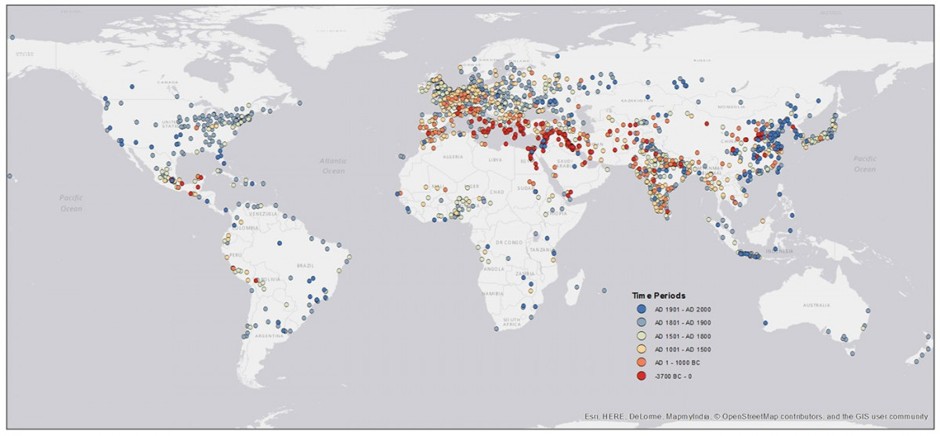
First project mapping cities of the last 6,000 years

Since their rise thousands of years ago, cities have transformed social life and societies. Here they are in map form:

A new paper published in Scientific Data takes a stab at mapping the information Chandler and Modelski gathered. Yale University researcher Meredith Reba and her colleagues digitized, transcribed, and geocoded over 6,000 years of urban data. She and her colleagues write in their paper about the significance of their effort:

Whether it is for timely response to catastrophes, the delivery of disaster relief, assessing human impacts on the environment, or estimating populations vulnerable to hazards, it is essential to know where people and cities are geographically distributed. Additionally, the ability to geolocate the size and location of human populations over time helps us understand the evolving characteristics of the human species, especially human interactions with the environment.

Their map, pictured below, plots the first recorded populations for all urban settlements between 3700 B.C. and 2000 A.D. The earliest records available are in the warmest colors, and are clustered around Ancient Mesopotamia. The latest ones on record are in blue. (To be clear, the map shows when the populations of cities started being documented, not when and where these cities were actually “born.”):

This has been oft-studied – the cradles of civilization and all – but it is still helpful to see the spread from these areas to other centers. It is remarkable how many newer cities there are on this map, particularly in the Americas and east Asia. In other words, some parts of the world have had cities for millennia longer than other areas. At the same time, the recent rise of megacities is a relatively recent phenomenon since the Industrial Revolution and many of these cities are in places where cities are relatively new.

The biggest urban problem is that all the major American cities are run by Democrats?

American cities face a host of problems but one common claim from conservatives is that the biggest issue is that all of them are run by Democrats:

The rapid growth of urban areas, increased population density, and a massive influx of immigrants—accompanying the explosion of manufacturing and commerce during the Gilded Age—hastened the rise of municipal political machines (such as Tammany Hall in New York City), official corruption, labor unrest, and the demographic diversity that continues to this day. Even though Americans’ standard of living generally improved during industrialization (people moved to the cities for a reason), the Progressive movement was in significant part a response to America’s nascent urban problems.

Progressivism is a legacy that endures, as we know, and for good or ill, urbanization has profoundly affected the American experience. Members of ethnic minorities disproportionately reside in U.S. cities, and their local governments are disproportionately (in fact more or less exclusively) in the hands of the Democratic Party. Cities expend substantial taxpayer resources to try to address poverty, crime, air pollution, congestion, substandard housing, homelessness, and the education of non-English speaking students, all of which are not as prevalent in suburban and rural areas.

Cities tend to have large numbers of unionized public employees, high (and rising) taxes and debt (including unfunded pension liabilities), and intrusive regulations. For a variety of reasons, urban residents favor liberal policies—and elect liberals to office—to a greater degree than suburban and rural voters. Some major American cities, such as Detroit, have become dysfunctional fiefdoms, forced into bankruptcy…

Cities present different challenges than they did a century ago, but the current problems are no less dire. Costly and ineffective public education systems, massively under-funded public employee pension plans, law-enforcement failures, high taxes, and uncontrolled spending imperil the security and solvency of America’s cities. Unless these problems are promptly addressed by responsible state reforms, more urban residents will face the tragic plight of Detroit, Chicago, Baltimore, and San Bernardino.

Two quick thoughts:

  1. It would be interesting to see a recent example where more conservative policies helped a large city. Perhaps it is simply hard to find a case from today with most big cities having Democrat mayors. Is the historical record kinder? I recently read about “Big Bill” Thompson who was the last Republican mayor of Chicago, leaving office in 1931. He had all sorts of problems and Wikipedia sums up: “He ranks among the most unethical mayors in American history.” Maybe we could look to Rudy Giuliani in New York City who is often credited for helping reduce crime in the city (due to applying broken windows theory) and for strong leadership after the September 11th attacks. But, some of his legacy has been questioned as crime rates dropped in numerous other major cities and such policies may have come at a cost. All together, it is easy for one party to blame the other but why not have a discussion of exactly how Republicans have actually helped cities in recent years?
  2. Cities are complex places which is why they started drawing so much attention from social scientists and others in the 1800s. Having a change in political party of leadership won’t automatically solve issues: how do we tackle neighborhoods that have now been poor for several generations? How about income inequality? Development and economic opportunities throughout big cities and not just in wealthy areas? The presence and activity of gangs? Providing affordable housing? Avoiding police brutality? Maintaining and upgrading critical infrastructure? Again, it is easy to blame one party but these are not easy issues to address – there is a level of complexity that would prove difficult for a mayor of any party.

Quick Review: Evicted

I recently read Matthew Desmond’s much discussed work Evicted: Poverty and Profit in the American City. Here are my thoughts on the ethnographic work.

  1. The book is certainly readable as he tells the stories of a number of tenants and landlords in the Milwaukee area. The plight of the tenants is striking and the landlords are also an interesting group (particularly Sherrena who wanted to tell her story). Of course, such readability may not impress some sociologists who prefer more scientific prose (and who complain about the work of Venkatesh or Goffman) but this should reach a broader public. The narratives have some summary data and causal explanations sprinkled in but the emphasis is on the stories.
  2. One of the more impressive features of this work is the quantitative data that it also draws on. This information is buried in the footnotes but Desmond also developed several quantitative datasets that helped (1) suggest his stories are not unusual and (2) provide the broader patterns for an issue that is not studied much in sociology.
  3. The biggest takeaway for me: the number of evictions that take place on a regular basis.
  4. The subject area – evictions – certainly needs more attention. I’ve read my share of work on affordable housing in the last decade but rarely did I see this issue mentioned. As Desmond notes, big cities have a sizable population of people who consistently have to move around due to evictions. Even if there were more housing units – and big cities are often tens of thousands of units short of affordable units – evictions make it difficult to establish roots and settle kids into schools. The final chapter – where Desmond discusses the broader issue and possible solutions – leads off nicely with this idea of a good physical home as the centerpiece of a thriving society.
  5. That said, how common is this issue in suburban areas? As poverty moves to the suburbs as do increasing numbers of minorities, I would expect that evictions are not limited just to larger cities.
  6. One area that gets less attention in this ethnography that may also prove worthwhile to explore further is the legal apparatus. Desmond follows one of the eviction squads and provides some insights into the court process but it would be interesting to hear more from judges (who from the book seem to work against the tenants – though they may just be following the law) as well as local officials (how do public officials respond to these situations).
  7. A second area is thinking about the intersections of race and class. Desmond hints at the influence of race: comparing the experiences of blacks on the North Side of Milwaukee versus whites on the South Side, comments from black and white tenants about the possibilities for living in the other’s neighborhoods, briefly discussing the race of landlords. However, there is a lot more here to unpack, especially given Desmond’s other work on race. Take the two main landlords in the book: one is white, the other black. The first has a more stand-offish approach (working through intermediaries) while the second is more directly involved with tenants. Both are in it for the money and seem to be doing well. How much does their race matter?

An enjoyable read and a work I could imagine using with undergraduates who often have little to no experience with housing issues. I look forward to looking at Desmond’s journal articles that also build on this ethnographic and quantitative data.

Middle class declines in the majority of US metropolitan areas

A new study from Pew shows that the middle class did not do well in many metro areas between 2000 and 2014:

The report by Pew Research Center found that the share of the middle class fell in 203 of the 229 U.S. metropolitan areas examined from 2000 to 2014, including major cities such as New York, Los Angeles and Chicago, which saw a relatively sharp drop in its middle class.

For many areas, a big culprit in the declining middle was the falloff in manufacturing jobs during that 14-year period, when factories shed about 5 million workers from their payrolls nationally…

The news was not all downcast, especially for metro areas in coastal and border regions that have benefited from the boom in technology, trade and resources…

Among the 229 metro areas, which constitute about 76% of the U.S. population in 2014, there were slightly more areas that saw a bigger increase in the share of upper-income population than lower-income adults. Still, Pew’s Kochhar did not view that as a big win for the American economy. The median incomes of the lower, middle and upper tiers all shrank between 2000 and 2014, he said.

Three quick thoughts:

  1. The continued effect of losing manufacturing jobs cannot be overstated: this has hurt numerous cities for decades. It is not easy for any large city to transition from such jobs to opportunities in new sectors.
  2. Looking at this data at the level of a metropolitan region is helpful because it hints at broad patterns within regions that are often segregated by social class and race. The phenomenon of the rich and poor living right next to each other as well as trendy and wealthy communities getting a lot of attention is not exclusive to cities; similar patterns can be found in suburban areas.
  3. Connected to the second point is that solutions to income issues could come at the level of the entire region rather than within individual communities. How might entire regions help the middle class? Why don’t more large cities and surrounding suburbs work together on these issues? (I know why they don’t but that doesn’t mean that it wouldn’t benefit many local residents.)