Zillow, realtors, and who can be a “neighborhood savant”

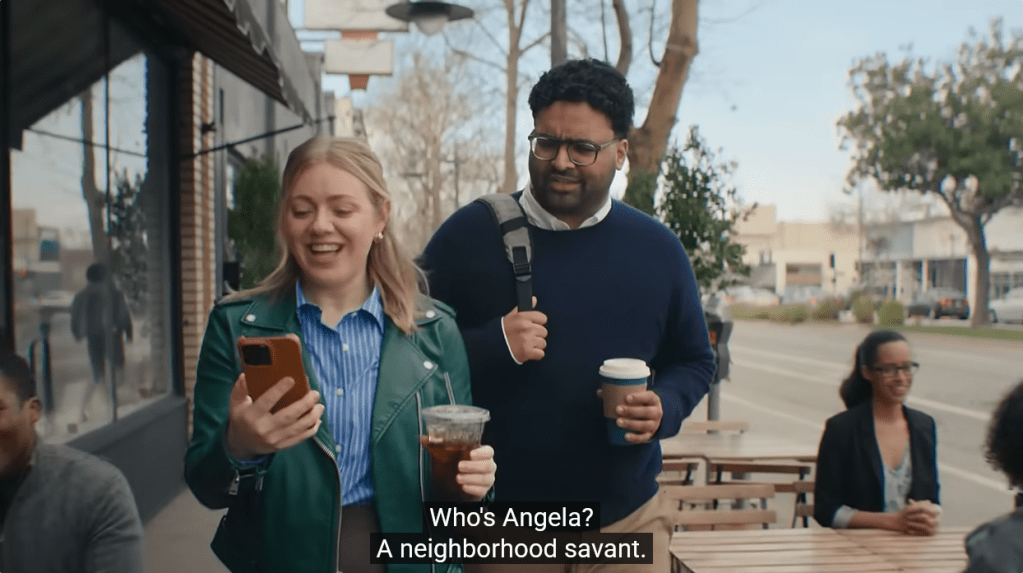
A Zillow commercial refers to their agents as a “neighborhood savant.” Are Zillow agents or realtors the best people to claim this title?
A real estate agent might know a lot about neighborhoods or communities. Looking at the local marketing realtors do, I see that they claim to know about different suburbs. In particular, they have knowledge about the local housing market through what has sold and what has not. They can also talk about other aspects of the community, such as schools and nearby amenities.

If I go to websites like Zillow or Realtors.com, they offer neighborhood information with each property listing. This includes a map, walkability scores, ratings of local schools, other nearby listings and recent sales, and more.

But what does it take to know about a neighborhood? Who can accurately describe what it is like to live there or how the character of a place plays out? Does anyone offer insights from local residents? Do real estate agents live in the communities they sell in or have secondhand information from local residents and organizations?

This reminds me of two posts I put together years ago on how to learn about a suburb. There are lots of sources of information about communities and some of it is available online. But some of it is not. Talking to people or walking through a community or reading local histories can provide some insights that are harder to intuit online.

Who else might be a “neighborhood savant”? A local journalist, where they are still available. A local political official or a longstanding member of a community institution. A local historian. Residents who take an interest in and actively participate in their neighborhood.


Studying both individual communities and patterns across communities

In considering places in the United States, is it better to study a community in-depth and get at its uniqueness? Or, is it better to look for patterns across places, focusing more on what joins types of communities compared to other types?

Photo by Nataliya Vaitkevich on Pexels.com

The last two posts have introduced this question through an unusual place in western Pennsylvania and all the histories communities across the United States have. And this is a common issue in urban sociology and among others who study cities and places: should we seek to adopt model places that help us understand sets of places – think of the odd quote that “There are only three great cities in the US and everywhere else is just Cleveland” – or focus on all of the particularities of a particular place or region?

I have tried in my own work to do some of both when studying places and buildings. Two examples come to mind. In 2013, I published an article titled “Not All Suburbs are the Same: The Role of Character in in Shaping Growth and Development in Three Chicago Suburbs.” I built off in-depth research on three suburbs to compare how internal understandings of character affected how they responded differently to changes in the Chicago region and changes to suburbs more broadly. On one hand, these suburbs that shared important similarities have different character and on the other hand they still fit within the category of suburbs that sets them apart from different kinds of places.

As a second example, take the book Building Faith I co-authored with Robert Brenneman. We provide case studies of particular religious congregations as they navigate constructing and altering buildings as those physical structures shape their worship and community. These case studies among different religious traditions and in different locations highlight unique patterns in these congregations and places. Yet, we also look across places, considering patterns of religious buildings in suburbs, in Guatemala, and a few other places.

In both works, knowing the particulars and examining the broader patterns are helpful. Different researchers might go other routes; why not investigate even further in these particular cases? What else is there in archives, interviews, ethnographic observation, etc. that could reveal even more details? Or, go the other direction: look at patterns in hundreds or thousands of places to find commonalities and differences across more settings.

But, I find that the particularities of a certain place make more sense in light of broader patterns and those broader patterns make more sense knowing some local or micro patterns. Having a sufficient number of cases or a varied enough set of cases to make these links can be tricky. Yet, I enjoy approaching places this way: digging into both the histories of particular communities and seeking broader patterns that hold across communities.

How many communities in the United States have histories we should know?

After seeing SNPJ, Pennsylvania on the map and recently reading Radical Suburbs by Amanda Kolson Hurley (recommended), I thought about this question: how many more histories of communities in the United States should we know? SNPJ appears to have a unique background and purpose and Hurley considers multiple suburbs with different visions of what a suburban community could be. But, there are thousands of communities in the United States – are they all unique enough to pay attention to?

Photo by Engin Akyurt on Pexels.com

One way to consider this is to think about patterns in we might pay attention to some communities and not others. In the United States, population size and growth is often emphasized. Bigger places often receive more attention and their unique histories and features are more known. At the same time, it takes efforts by numerous actors for history to become known and narrated over time. Discrimination, a lack of power, and limited resources mean some histories are not as known.

There is certainly value for people living in a community to know their own local history. I have written about seven steps for knowing your suburb and how to take additional steps. This local knowledge can help longstanding members of a community, new residents, and visitors. It can take some digging to hear multiple voices, see what is told and not told, and think about how a community came to be.

In the next post, I will explain why I see value in both larger categories – such as examining suburbs as distinct places compared to cities and rural areas – and looking at specific histories and characters of communities. In my own work, I found linking these two levels can provide further insights into places and experiences within them.

Seeing the community SNPJ on a map

On drives from the Midwest to locations further east, we often pass a community with an interesting name: SNPJ, Pennsylvania. This is an unusual name. No vowels. An acronym? A misprint? Wikipedia suggests this is an unusual place with just 15 residents:

Photo by Pixabay on Pexels.com

S.N.P.J. stands for “Slovenska Narodna Podporna Jednota” (Slovene National Benefit Society), a fraternal society and financial co-operative based in North Fayette, Pennsylvania. The society applied to have their 500-acre (200 ha) recreation center in western Pennsylvania designated as a separate municipality in 1977. The S.N.P.J. borough was created so that the society could, among other things, get its own liquor license. North Beaver Township, the municipality in which the center was originally located, restricted the sale of alcohol on Sundays (blue law)…

It is more of a recreation complex than a community, and has 60 rental cabins, 115 mobile home slots, and an artificial lake. It is open to the public as a summertime resort and facility for bingo, weddings, and dances. Members of the society get a discount on the events.

Wikipedia offers few additional details but there is enough here to hint at an interesting history: a fraternal group for a white ethnic group, efforts to bypass liquor laws, providing recreational opportunities, and very few permanent residents.

This leads to the post for tomorrow: how many communities across the United States have unique histories worth knowing? How many communities are like SNPJ and does it matter if there are just a few or a lot?

Amazon was opening a warehouse every 24 hours…but not now

Amazon was building warehouses at a rapid pace during COVID-19:

Photo by James Anthony on Pexels.com

When homebound shoppers stampeded online during the pandemic, Amazon responded by doubling the size of its logistics network over a two-year period, a rapid buildout that exceeded that of rivals and partners like Walmart Inc., United Parcel Service Inc. and FedEx Corp. For a time, Amazon was opening a new warehouse somewhere in the U.S. roughly every 24 hours. Jassy told Bloomberg in June that the company had decided in early 2021 to build toward the high end of its forecasts for shopper demand, erring on the side of having too much warehouse space rather than too little. 

But, now the opposite is happening:

MWPVL International Inc., which tracks Amazon’s real-estate footprint, estimates the company has either shuttered or killed plans to open 42 facilities totaling almost 25 million square feet of usable space. The company has delayed opening an additional 21 locations, totaling nearly 28 million square feet, according to MWPVL. The e-commerce giant also has canceled a handful of European projects, mostly in Spain, the firm said.

The scale of this is worth marking: a new warehouse every day.

Companies act in such ways given economic conditions. Yet, these are not just business decisions; they affect communities. As Amazon rapidly expanded, many communities sought out such a facility and/or offered tax breaks and incentives. This happened in the Chicago region. If Amazon contracts, this affects local decisions and revenues.

As conditions change, will communities operate differently toward Amazon or will they reassess their approach to attracting businesses, jobs, and revenues? Many communities would still probably prefer to have an Amazon facility in the long run but they may be harder to entice or the competition might be stiffer. Or, if Amazon facilities come and go, they might be inclined to look toward other firms or industries.

Ghost towns of the Midwest, sand dunes edition

While Americans might associate ghost towns with the West, communities elsewhere across the United States have also disappeared. Here is the case of one such community on the eastern shore of Lake Michigan:

Silver Lake, Michigan

A small town once stood on the riverbank, where the river bends before ending its journey at the lake. For several decades in the mid-1800s, the village of Singapore was a humming lumber and shipbuilding hub. Residents and sawmill workers processed the plentiful white pine trees of western Michigan, then loaded them onto schooners for Chicago and Milwaukee.

The founders of Singapore had big dreams. They envisioned their town, then located north of present-day Saugatuck on the southwestern Michigan shore, as the next important Midwestern city, rivaling the growing metropolises in Illinois and Wisconsin…

After the lumber trade waned and a series of fires roared through the area, leading to the destruction of many of Singapore’s houses, the town was abandoned. By 1875, according to Eric Gollannek, executive director of the Saugatuck-Douglas Historical Society, the lumber boom was over, the mills were dismantled and moved to St. Ignace, Michigan, jobs dried up and the village slowly disappeared.

Eventually, what was left of Singapore was buried beneath the sand.

The sand dunes of Lake Michigan are an underrated natural feature. Since I have seen them on top of a house or two at Silver Lake (see the image above), it is not surprising that they cover the remains of a town.

I would guess that the early decades of Midwest settlement is a ripe time for finding ghost towns or abandoned communities. Many early settlers had dreams that their town would prosper in the future. But, time, outside social forces, and internal decisions helped seal the fate of some places while others thrived.

The possible forces at work are numerous. Perhaps it was the changing of transportation technology; the coming of the railroad, the slowdown or rise in traffic along a road, shifting harbors and waterways. Perhaps it was the consolidation of residents or trading activity in one community as opposed to another. Perhaps it was the presence of a particular industry or the the decline of an industry. Ecological conditions can change as well, ranging from droughts to major storms to fires to human activity that changes the landscape in significant ways.

Today, it is hard to imagine that established communities of a particular size could disappear. Yet, history suggests this has happened before. It may not take sand dunes or cutting down many trees (something that happened all around Lake Michigan) but the communities of today are not guaranteed to be the communities of the future.

Designing your own Peytonville, Part 1

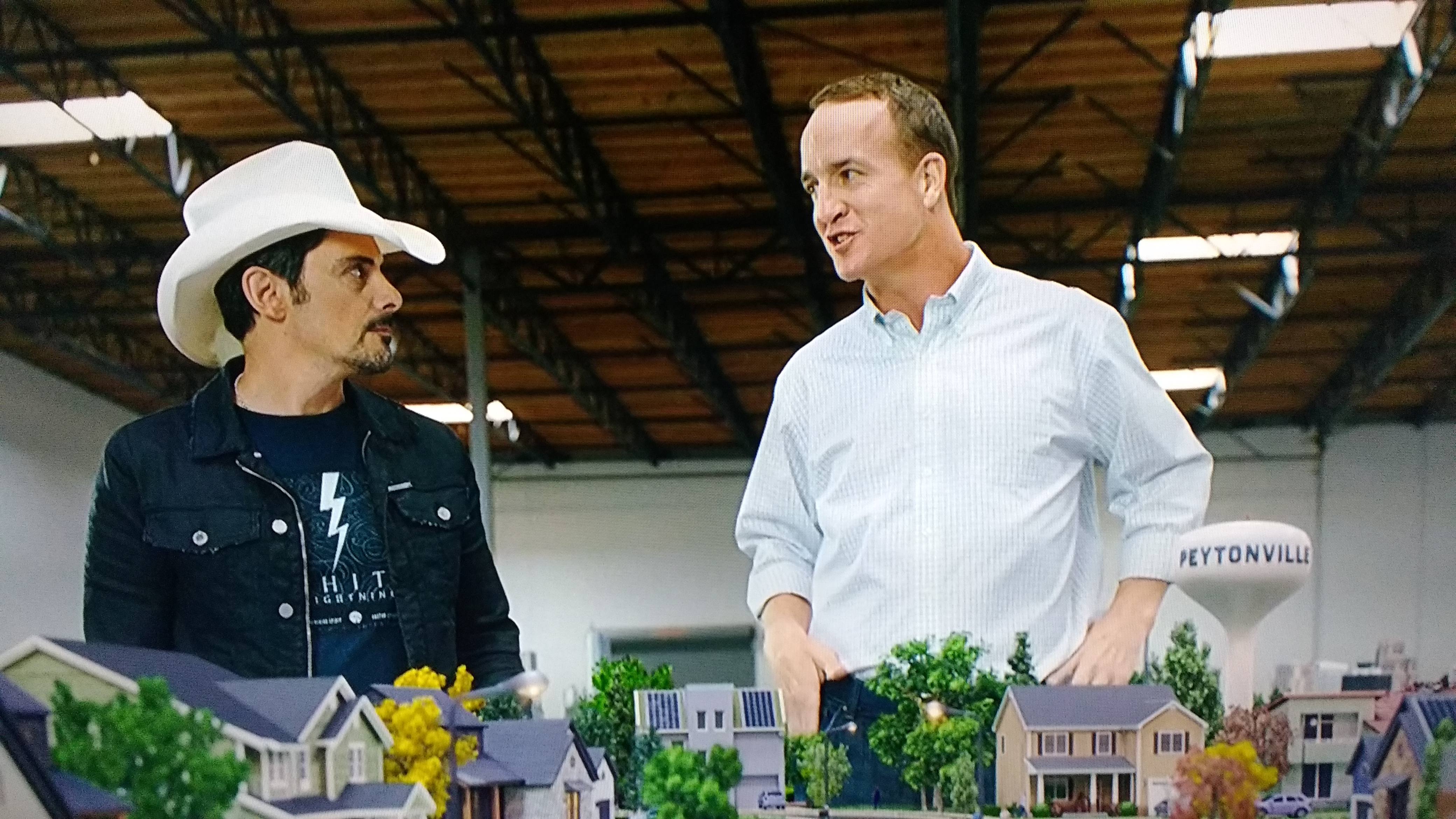
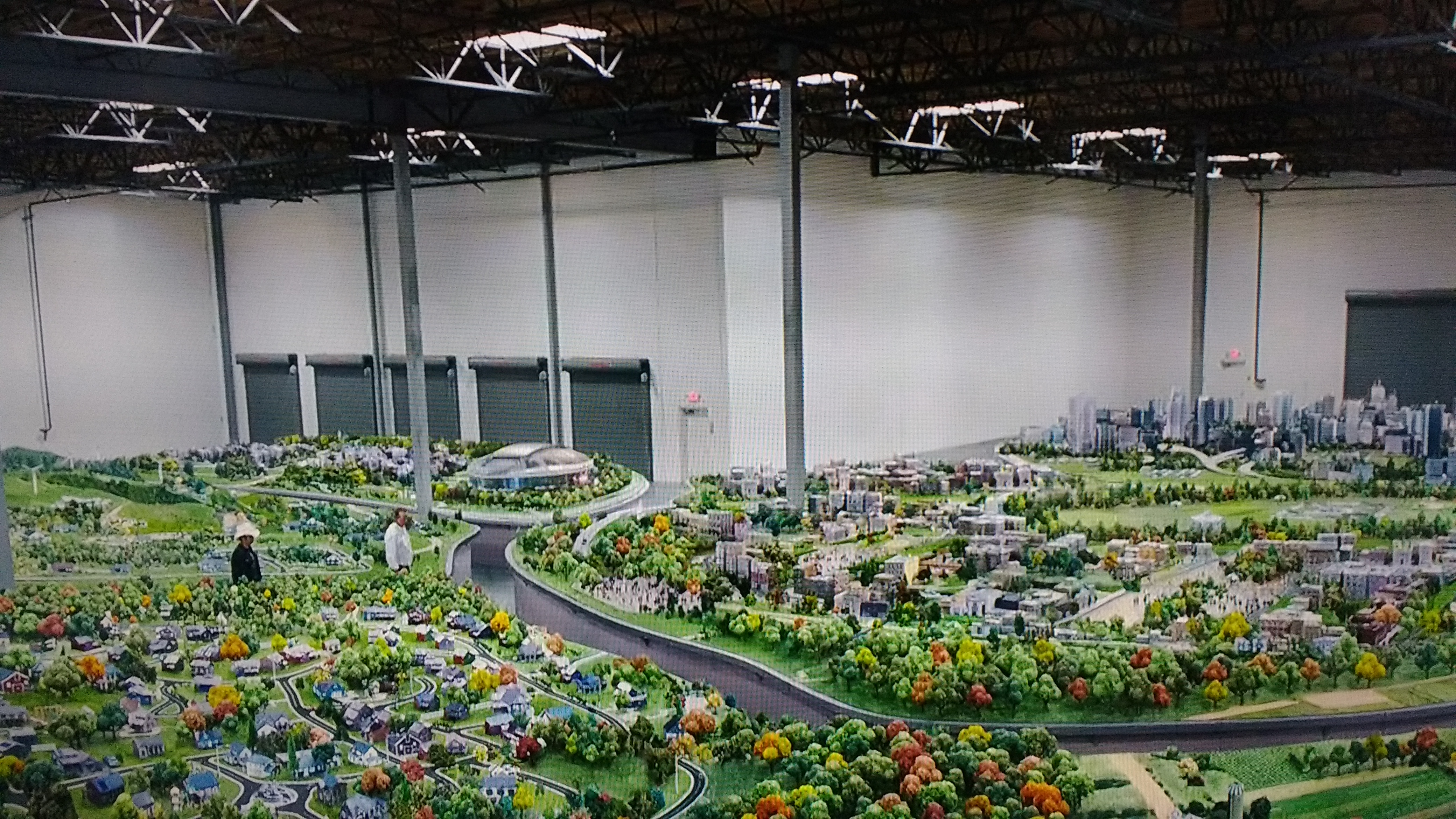
A recent Nationwide commercial has former NFL star Peyton Manning walking within Peytonville, a town set up on a large layout in a warehouse:

Peytonville2

What makes attending such layouts attractive to people? Three quick guesses:

  1. The ability to craft and build an entire community. In real life, no one person could do this on their own. Even a fabulously wealthy person would likely have to rely on a lot of help – think construction workers and others – to put a community together. This sort of layout is possible with a lot of time, materials, and skill (particularly given the size of it all).
  2. The birds-eye/God-like view (and control in #1) possible with such a layout. It is one thing to walk within an interesting place; it is another to consider it from above.
  3. The chance to attach one’s name to a community. This is an honor often given to a founder or a prominent early member of the community. If you control the construction and have a birds-eye view, you can add your own name to it all. The community in the commercial is Peytonville but it could be Peytonton, Peyton Corner, Peyton Park, and other variations.

Peytonville1

It would take a long time to put this together but it could be very fun to maintain, play with, and show off to others.

Why the study of social media and the study of suburbs goes together

Two days ago, I presented a talk titled “Screens, Social Media, and Spirituality: Technology and Religiosity Among Emerging Adults.” In this particular talk, I drew upon my work work with co-authors analyzing social media. While this is one of my research areas of interest, I am also a scholar of suburbs. How do these two areas go together?

To start, the sociological study of the Internet and social media has connections to the study of communities and places. Barry Wellman is a good example of a scholar who studied communities and then the Internet. Both social spheres have logics that connect people: communities tend to rely on geographic proximity while Internet and social media networks rely more on choosing connections and common interests. (There are other lenses sociologists could use to join the two topics: materiality – think smartphones and single-family homes; narratives about science and progress; consumption.)

Both social media and suburban areas rely on narratives of choice made by users or residents while both ave deeper forces pushing people toward those choices. In social media, people do not pick platforms at random nor are the platform’s development and popularity random. What people users connect to is not random; existing social ties matter as do factors like fame, influence, and power. Similarly, Americans may often argue they made it to the suburbs through their own efforts but decades of government policy as well as cultural ideology has privileged the suburban way of life.

One might argue that social media is relatively placeless. Users can communicate with any connected friend or follower from any place and at any time. Compared to social interaction bounded by proximity, technology offers unprecedented access without a need for a tie to a place (outside of a need for some sort of Internet connection). But, this placelessness is also a critique regularly leveled at American suburbs where the regularly repeating of features can make it appear all to be similar. See an example of this argument. (I tend to disagree as suburban communities can have very different characters, just as different social media platforms and interactions can feel different even if they all all fall into the same broad categories of social life.)

Finally, the profound implications for communities and broader society by both phenomena – particularly mass suburbanization after World War II and social media after the founding of Facebook plus the quick popularity of smartphones – are hard to ignore. It isn’t just that more Americans moved to suburbs; this had ripple effects on many places (including every major city), industries (think cars, fast food, big box stores, etc.), and government policy. It isn’t just that people now spend some time on social media; the shift to different kinds of relationships means we have to think afresh about how community works.

Communities, inertia, and change from a sociological point of view

After recently reading Market Cities, People Cities and hearing a talk by one of the authors plus having several conversations with people about how sociologists think about how communities and organizations develop and change, I wanted to outline how cities and suburbs change over time. Here is how I would describe it:

  1. A community or organization is founded. Relatively small in size at the start, it takes on characteristics and activities of its founder(s). These initial traits can have effects down the road but are not necessarily deterministic of where the community will end up. Inertia and founding energy carry the social collective along.
  2. Two major categories of social phenomena can lead to change. One option is outside social forces or pressure. Examples for communities could include broader shifts (such as new residents moving there from elsewhere, changes in government policies or funding, large-scale economic shifts, or changing cultural norms in the broader society) as well as more local changes (such as requests for new development, budget issues, a critical mass of new residents in the community, changes brought by local elections). A second option is internal decisions made to go a different direction (or reaffirm the existing inertia/path). These decisions are often a reaction to outside forces but they can also spring up from internal discussions and thinking. Examples of this could include requests for new developments, budget issues, and a critical mass of new residents.
  3. A period of inertia then follows until another major period of decision/reaction to outside forces takes place.
  4. The community or organization then goes on until it doesn’t.

To sum up: communities tend to follow a particular path of development and community life until something happens externally and/or internally that often allows space to have a discussion about a different vision. This “something happens” could be the result of external forces or internal forces or decisions. Emerson and Smiley rely more on steps toward developing a social movement while my own suburban work suggested “character moments” could lead to new paths. This collection of founding characteristics plus key moments then comprises the unique character of a community or organization that can differentiate it from an organization of community of the same broader kind.

Facebook’s goal: build community, help people find purpose

This story tracks Mark Zuckerberg’s language about community and the purpose of Facebook. There has been a recent change:

But when 2017 arrived, Zuckerberg immediately began talking about Facebook “building community.” In February, he wrote a massive post detailing his vision to “develop the social infrastructure to give people the power to build a global community that works for all of us.”

We now know that sometime in late 2016, Mark Zuckerberg directed some new questions at his employees. The company had noticed that there was a special subset of Facebook users, about 100 million of them. These were people who had joined “meaningful communities” on the service, which he defined as groups that “quickly become the most important part of your social-network experience and an integral part of your real-world support structure.”..

This marks the first mention of “meaningful communities” from Mark Zuckerberg. In the past, he’d talked about “our” community, “safe” community, and the “global” community, of course. But this was different. Meaning is not as easy to measure as what people click on (or at least most people don’t think it is)…

But the route to a “sense of purpose for everyone is by building community.” This community would be global because “the great arc of human history bends toward people coming together in ever greater numbers—from tribes to cities to nations—to achieve things we couldn’t on our own.”

I could imagine several possible reactions to this new message:

  1. Cynicism. How can Facebook be trusted if they are a company and their primary goal is to make money? Community sounds good but but perhaps that is what is customers want right now.
  2. Hope. Facebook began in the minds of college students and now has billions of users. This has all happened very quickly and alongside a number of social media options. While traditional institutions (particularly those related to the nation state) seem to struggle in uniting people, Facebook and other options offer new opportunities.
  3. Indifference. Many will just continue to use Facebook without much thought of what the company is really doing or trying to figure out what they can really get out of Facebook and other platforms. They just like having connections that they did not used to have.

Given that the messages on connecting people and community has changed in the past, it will be interesting to see how they evolve in the future. In particular, if Zuckerberg wants to get more involved in politics, how will these ideas change?