Adaptations to Walmart leaving communities

Joel Kotkin considers the fate of smaller communities where Walmart has decided to close stores:

None of this suggests that the retreat of big boxes from smaller towns and some urban areas will be painless. Yet those who see this trend as the harbinger of the end of malls or Main Streets may be in for a surprise. Rather than die off, bricks-and-mortar shopping will change, adding new elements and moving from ever greater uniformity to more variety and differentiation, which are critical to independent business’s survival. Much of this change will take place in small towns, but also in suburban areas, which have long been the happy hunting ground of big boxes.

Why not in the big cities? One of the chief ironies of our times is that chains and their attendant sameness now define much of our most sophisticated urban core—Starbucks on every corner, global brands and restaurants serving the same trendy cuisine. The recovery of large cities, suggests New York researcher Sharon Zukin, has also made them more alike by “bringing in the same development ideas—and the same conspicuous textual allusions and iconic corporate logos inevitably affixed to downtown architectural trophies—to cities across the globe.” Efforts to make the city “safer and less strange to outsiders’ eyes”—tourists, expatriates, media producers, and affluent consumers—are making one global city barely indistinguishable from another…

Some small towns—and suburbs even more so—will be transformed by immigrants and millennials, who may want to set up their own unique shops along the very Main Streets once targeted by firms like Walmart. In wealthier communities, this may mean more boutiques and high-end restaurants. But among less affluent areas, other institutions, such as cooperatives—300 already nationwide and another 250 on the way, as well as farmers markets—could provide some of the products that many once found at Walmart…

As the retail world become more digitally focused, and less big-box-dominated, there is a golden opportunity to restore the geographic and local diversity that has seemed doomed for nearly a half-century, but now may enjoy a new burst of life.

There is little doubt that the retail industry will continue to change. Walmart and other large corporations may seem inevitable today but they didn’t exist decades ago and may not have much presence in the future. Yet, Kotkin seems pretty optimistic about online retail which requires its own set of adjustments as well as infrastructure that could be threatened in the future.

For small towns and many suburbs, do these future changes leave much space for residents themselves to create and experience local differences? On one hand, online retail offers customization yet relies on large companies located elsewhere and on the other hand, local diversity in things like restaurants and small stores draws upon local entrepreneurs. Is the secret to promote an experienced based consumption – local culture and food – as opposed to decades of goods based consumption?
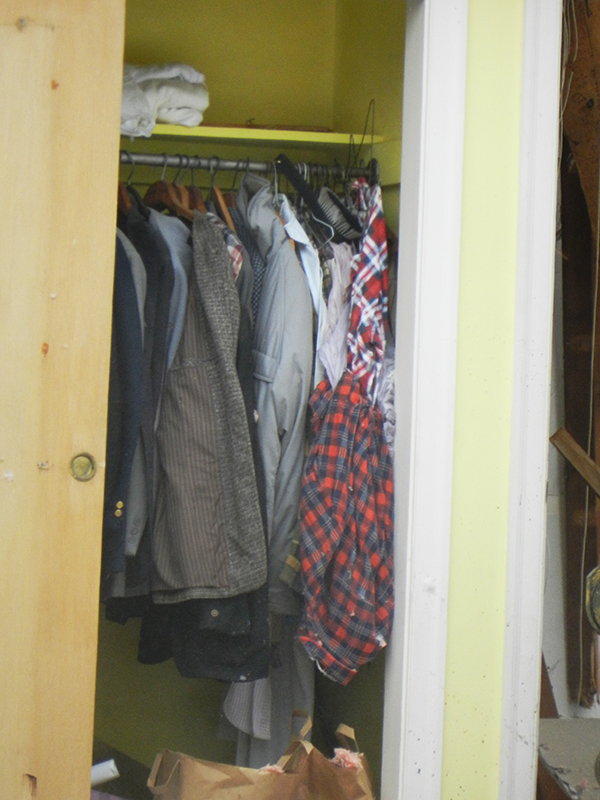
Demolition for a teardown, clothes in the closet and all

Many neighbors don’t like teardowns and one residents highlight that the new property owners didn’t even empty the old home:

This house is two houses away from us. The lady who lived in this house passed away a few months ago. A builder bought the house for $660,000 and a mortgage was taken out for $1,178,000 on it. So what this means is it’s probably going to be sold for a minimum of $1.5 million dollars…

The builder didn’t even empty the closet.

On one hand, if the whole house is going, why not simply trash everything inside rather than spend the time sorting it all out? On the other hand, displaying such a picture highlights several features:

  1. It increases the tragedy factor many claim are inherent in teardowns. These aren’t just houses; these places where people have lived for decades and threatening the character (and social life) of the neighborhood is not a trivial matter.
  2. Americans have so much stuff through our consumption patterns that it simply doesn’t make sense to try to salvage any of these items. It often may not be worth it to even donate the items as it is too easy to throw it out and/or obtain more.

Now that I think about, there are numerous photographers and artists in recent decades who highlight ruins in big cities – like Detroit or New York City. Where is the major project that documents the sadness of teardowns? It may not quite have the noir allure of the city but there is long history of suburban critiques to draw upon: the mass produced raised ranch of the post-war era is even more desolate in the snow and shadow of the wrecking ball.

Yes, Thoreau would have disliked McMansions

One writer describes how Thoreau helped her move on from her McMansion:

“The cost of a thing is the amount of what
I will call life which is required to be exchanged for it,
immediately or in the long run.”
Henry David Thoreau, Walden

These words hit me hard at the age of 29. It was 2008, and depending on the hour, I was watching my marriage unravel, witnessing the collapse of the financial markets from the office of my first-year financial planning business, or determining whether I was even or underwater on a 2,500-square-foot McMansion. Collectively, my husband and I were $275,000 in debt…

One day I picked up the book and read it all the way through. I looked around my home and finally understood: I was drowning in debt, and my lifestyle was making me miserable. I exhausted hours every Sunday dusting, vacuuming, and mopping. I spent the majority of my time either working to pay for things like furniture or electronic gadgets or fearfully maintaining them by obsessively dusting and scrubbing. I could see my future, and it looked bleak…

Seven years have gone by since I left that lifestyle, and so much has changed. I now make about half the annual income I once did, teaching yoga, writing about health and wellness, and waitressing part time. I have good days and bad days, but I no longer feel controlled by debt. I take 12–16 weeks off each year and one winter spent four months on the Big Island of Hawaii, eating homemade dinners on the beach and listening to the trumpets of humpback whales. In moments like those, when the magic and wonder of the world offer themselves so vividly, I experience so much gratitude for simply being alive.

It is interesting to note that the anti-consumption narrative of today – avoid the McMansions and big debt, simplify your life, pay more attention to things you love – is not exactly new. It could appeal to more people today after the spread of consumerism throughout much of American society with the prosperity of the 20th century. McMansions make easy targets since they require a large financial outlay (not only is it costly but it requires payments for a significant portion of adult life), require maintenance (whether because of cleaning, repairs, or making use of all that space), and critics argue they are meant to impress other people.

In the end, I wonder if Thoreau would find such efforts as described above enough to truly get away from modern life. Are vast resources now required to get away from it all?

Are McMansions bad for children?

I recently read how one family wanted to help their kids avoid McMansions:

No McMansions: Andrew Porter said that his family was drawn to Maywood by the idea of raising his two preschool-age daughters in a community full of homes that felt plucked from a bygone era.

“The historical designation really helps preserve the character of the neighborhood,” said Porter, a lawyer in his mid-30s who lives on 23rd Road. “You don’t have to deal with people tearing down the original structures and replacing them with huge McMansions on tiny lots.”

So here is one argument for how McMansions could be bad for kids: they get to experience older homes in a historic neighborhood. What might be other reasons?

  1. McMansions encourage consumption. They are big houses with room for lots of stuff.
  2. McMansions teach bad things about proper architecture and design.
  3. McMansions are often constructed in suburban neighborhoods where kids become dependent on cars, limiting their opportunities to explore, and have limited interactions with neighbors.
  4. McMansions are poorly constructed (not built to last, cheaper materials) and this could hurt kids in the long run.
  5. Fires work differently in McMansions.
  6. If the oft-criticized teardown McMansion is located on a small lot, there is little room for kids to play.

I imagine some McMansion critics could add to this list. Of course, the owners of such homes might argue McMansion could also be positive for kids – how many parents would move into a home that could hurt their children? I’m actually a little surprised neither side makes this case more strongly; claiming that their actions are best for their children or future generations is a common tactic of opinionated people in the United States.

Sociologist Schor on less materialistic American dream

Given the pessimism of Americans toward upward mobility, what evidence does sociologist Juliet Schor see for more Americans moving away from a materialistic American dream?

There’s a more sober attitude to consuming since the crash. A lot of people don’t feel as comfortable. I’m not talking about the 1 percent or the folks, who you know, just ordinary people are kind of less comfortable with showiness and excess at a time when so many people are suffering economically. There’s a kind of solidarity, or at least a sentimental solidarity, that comes up.

What I think we’re seeing is you have groups of highly educated, predominantly white young people living really different kinds of lifestyles. I’ve called it an “eco-habitus” using Pierre Bourdieu’s idea of habitus—your sort of underlying sensibility toward things. This is the rise of things like CSAs and farmers’ markets. These are not necessarily low-cost lifestyles, some of them are. It’s a different sensibility. Again, that rejection of mass consumption, which has been there for a while, but rejection of materialism, advertising, people who are saying how do I raise my children in a way that’s not having them just sucked into this dominant consumer culture. That’s really mainstreaming and it used to be pretty niche.

We’re also seeing a validation of some of that kind of attitude among, not so much among the white working class, or the white poor, but more among inner city communities of color who are also engaged in alternative ways of provisioning around food or some of the more community-based approaches to provisioning. There are a lot of parallels with what’s going on with more affluent, highly educated consumers.

I do think there is a movement to transform the way we live to make it more ecological, more economically secure, less unequal, and more economically fair. And out of necessity you’re seeing this in some of the most depressed cities, like Cleveland and Detroit, where you just have a flowering of alternatives.

As noted in this article, Schor has a section on downshifting in The Overspent AmericanBut, it is difficult to get national data on this trend and Schor tends to use case studies or ethnographic work to make her case. (A related topic: if owning big homes is a big marker of a materialistic culture, why can’t we get better statistics on the number of tiny houses?) How many Americans are giving up materialism because they can’t spend as opposed to really are making significant life changes that they will continue for decades? And what exactly are they replacing their old materialistic ways with?

At this point, perhaps Schor’s reference to habitus is most appropriate. It will be within families and smaller groups dedicated to less materialistic lifestyles where these values are passed down and continued. Expanding this habitus to encompass more people is a more difficult task.

Selling Bibles is big business

The market for the Bible is still strong:

No official sales projections are publicly available, but if history provides a guide, the “NIV Zondervan Study Bible” could easily sell 100,000 copies by the end of the year — probably a lot more. The new study Bible by Zondervan, a Christian publishing house in Grand Rapids, Mich., owned by HarperCollins, could follow earlier blockbuster sales. The last NIV study Bible, published by Zondervan in 1985, sold more than 9 million copies.

The Bible business is booming. There are annual sales of 40 million Bibles — from study Bibles to family Bibles to pocket Bibles. That’s not even counting foreign markets. As journalist Daniel Radosh observed, “The familiar observation that the Bible is the best-selling book of all time obscures a more startling fact: The Bible is the best-selling book of the year, every year.”…

The “ESV Study Bible” is actually only one of 19 Bibles that have sold more 1 million copies in the past decade. The editors behind Zondervan’s new offering are undoubtedly looking for the same sort of sales, and there’s reason to believe they will get them…

The anxiety over kinds of Bibles — aggravated by the market — creates a demand for new, more authoritative works. Some of the most popular study Bibles are designed to reassure readers of the text’s accuracy and authority, while at the same time promising to be easy to read.

I worked for two summers in the warehouse of Tyndale House Publishers where we shipped a good number of Bibles (among other items, such as plenty of Left Behind books). We had all sorts of Bibles: different translations, ones for different people groups (teenagers, women, seekers, those with the education to make use of the original language and the translation side by side), and in all sorts of packaging from software to metal cases to real leather. I remember noting the two forces at work: the impulse to make the Bible available alongside the motivation to make money.

This is an area where Christianity and materialism come head to head and yet I’m not sure it gets discussed much. How useful are all those Bibles? How much do people need new and improved versions? Where does all that money go? Americans love to consume things…are the sales of Bible more of an indication of consumption than of religious fervor?

McKinsey predicts drop in car ownership (after 2040) due to self-driving cars

McKinsey suggests one side effect of self-driving cars will be less need for owning one:

But it’s in Phase 3, after 2040, that the fun begins. This is the point where autonomous cars become our primary means of transport, and all the rules are up for debate. Just as car design will fundamentally change once things like forward-facing seats, mirrors, and pedals are no longer necessary, the way we structure physical space could evolve: McKinsey predicts that by 2050, we might need just 75 percent of the space we now reserve for parking our cars. Because this is America, that means we get back 5.7 billion square meters of space—enough to hold the Grand Canyon and then some. That’s because autonomous cars can pack themselves together tightly (no need to allow space for human to exit).

More than that though, our entire idea of car ownership could change. Currently, cars sit unused about 95 percent of the time. That leaves a lot of room for improvement in terms of how we allocate resources.

We won’t stop buying cars altogether—people will still want the option to “independently drive and use the vehicle, and have fun doing so,” says Kaas— but we will buy fewer cars. Without the need for a human at the helm, one autonomous vehicle could take the place of two conventional vehicles: If Joan is going golfing and Joe needs to go shopping, a single car could drop Joan off at the club, swing back to the house to take Joe to the supermarket and back, then return to the club and get Joan. Kaas also predicts you could see the rise of private commuting services, shuttling customers around for a fee.

The recurring theme in the McKinsey report is that the consumer wins. Yes, cars crammed full of high-end technology will likely cost several thousand dollars more than they do today. But “drivers” will save money in the form of regained time (spend your commute working instead of driving!) and many fewer accidents: McKinsey pegs the savings on repair and health care bills alone at $180 billion in the US, predicting a 90 percent drop in crashes.

Cars are expensive so this could theoretically save money (as long as the new autonomous cars have reasonable price tags) and offer more convenience. Yet, it could take a lot to overcome the American love of cars. They aren’t simply about convenience or getting from Point A to Point B (and Americans would always choose mass transit if it were more convenient and effective). It is about other ideas in the American Dream, about freedom and independence and having a status symbol and being mobile. Perhaps by 2040, these things won’t matter as much as we all adjust to autonomous vehicles (and perhaps legislation that makes them the norm for safety’s sake). But, this isn’t just a technological change; this requires some big cultural changes as well.

“Are Americans falling out of love with the shopping mall?”

The shopping mall era may be slowly ebbing away:

While high-end malls thrive, many others have been unable to keep up with changing shopping demands of American consumers, leading to obituaries in the US press with headlines such as “A dying breed – the American shopping mall” and “shopping malls in crisis”.

About 80 per cent of the country’s 1,200 malls are considered healthy, which means store vacancy rates of 10 per cent or less, according to CoStar Group data published in The New York Times.

That is down from 94 per cent in 2006, and there is even a website dedicated to documenting what some are calling the death of the shopping centre, deadmalls.com, keeping tabs on the latest closures across the country. Ms Dorsey remembers the old-style mall with nostalgia. “The first time my mum allowed me to go out by myself, it was in a mall,” says Ms Dorsey, a saleswoman at a natural products shop in Fairfax, outside the US capital. “I do have fond memories.”

Most of America’s malls were built in the 1950s and 1960s, as a growing network of highways connected suburban homes to futuristic urban shopping centres…

“It’s not that consumption is going down – consumption is going up, but we’re consuming differently in different places,” says the sociologist George Ritzer, the author of a book on consumption, Enchanting a Disenchanted World. “They are becoming more entertainment complexes.”

There are some competing trends contributing to this:

1. The rise of the suburbs helped lead to this as centralized locations for shopping became more important than communities where needs could be met within walking or mass transit distances (like in cities). But, that decentralization can now be moved increasingly online.

2. Suburbs didn’t have as many public places – and if they did, they were more difficult to access since they often required driving. Malls filled this void, particularly for teenagers who became a prominent social group right around this time (and their collective life was encouraged in the suburbs which was largely centered around child-rearing).

3. Americans still like consuming. See the fate of higher-end shopping experiences. However, shoppers now have more options including big box stores and online retailers. Additionally, the shift in malls toward experiences rather than consumer goods is still consumption. In fact, prioritizing experiences might even increase consumption because people can have a variety of experiences.

While malls won’t disappear anytime soon, perhaps they will be seen at some point as the result of a particular historical and social convergence.

Reminder of how much we can cheaply consume today

Megan McArdle discusses living standards in earlier period of American life and suggests we can consume a lot more now:

In 1901, the average “urban wage earner” spent about 46 percent of their household budget on food and another 15 percent on apparel — that’s 61 percent of their annual income just to feed and clothe the family. That does not include shelter, or fuel to heat your home and cook your food. By 1987, that same household spent less than 20 percent on food and a little over 5 percent of their budget on apparel. Since then, these numbers have fallen even further: Today, families with incomes of less than $5,000 a year still spend only 16 percent of the family budget on food and 3.5 percent on apparel. And that’s not because we’re eating less and wearing fewer clothes; in fact, it’s the reverse.

The average working-class family of 1901 had a few changes of clothes and a diet heavy on beans and grain, light on meat and fresh produce — which simply wasn’t available for much of the year, even if they’d had the money to afford it. Even growing up in the 1950s, in a comfortably middle-class home, my mother’s wardrobe consisted of a week’s worth of school clothes, a church dress and a couple of play outfits. Her counterparts today can barely fit all their clothes in their closets, even though today’s houses are much bigger than they used to be; putting a family of five in a 900-square-foot house with a single bathroom was an aspirational goal for the generation that settled Levittown, but in an era when new homes average more than 2,500 square feet, it sounds like poverty.

At that, even the people living in the last decades of the 19th century were richer than those who had gone before them. I remember coming across a Mauve Decade newspaper clipping that contained a description of my great-grandmother “going visiting” in some nearby town during the 1890s. On the other side of the clipping was a letter to the editor from a woman in her 90s, complaining that these giddy young things didn’t know how good they had it compared to the old days — why, they even bought their saleratus  from a store instead of making it from corncobs like they did back when times were simpler and thrifty housewives knew the value of a dollar.

As McArdle notes at the end, it is difficult to remember these conditions of the past when we have so much today. Part of the story here is just how much we have but it is worth thinking about why we have a hard time remembering these conditions that were not really that long ago.

We have certain social values that may make us more ahistorical than others. For example, Americans value progress. We’re always talking about novelty and developing solutions. We consistently suggest our kids should have better lives than we did and we expect it to happen. The American Dream is about getting ahead so why would we want to spend much time thinking about the poverty of the past? Not only do we have a lot, we like the acquisition process. Shopping is a popular activity and we spend a lot of time looking at various consumer objects (clothes, cars, smartphones, etc.). Capitalism is good, consumption is a necessary part of the economy, it is just part of everyday life. Some might point to the role of technology in making the past even further away or more fragmented from our everyday reality. When many things come so quickly today, how can truths about the early 1900s be communicated in a way that resonates? (It is interesting that McArdle uses the example of reading Little House on the Prairie books. Do we expect the children of today to be reading those or similar books about that time period?)

Academics summing up the evils of suburbia

In looking at the new book Global Suburbs: Urban Sprawl from the Rio Grande to Rio de Janeiro, I was struck by the opening statement by the series editor, sociologist Sharon Zukin. Here is her opening (page ix):

In Global Suburbs: From the Rio Grande to Rio de Janeiro, Lawrence Herzog exposes the dystopian underside of the suburban American dream. A house of one’s own, on a little plot of land, is no longer a place of domestic comfort, spiritual renewal, and communion with the green space and clear air of nature. Instead, the mass suburban habitat that Americans pioneered features oversized McMansions stuffed with giant TVs and electronic gadgets, to which their owners commute in gas-guzzling SUVs, enduring stressful journeys on traffic-clogged roads, leaving neither space nor time for pleasure.

This human habitat, Herzog warns, is neither a happy nor a healthy place. It is, instead, a treadmill of over-consumption that burdens our bodies, our spirits, and the natural environment. Obesity, anxiety, toxic air: how can we think this is a good life?

Most important, the suburban dream that Herzog describes now spreads throughout North and South America…Every metropolitan area in the Western hemisphere bears a tragic cost: Overbuilding reduces the water supply, destroys the trees and insects on which all life depends, and creates an eco-disaster.

Naming these issues can be important as many suburban residents don’t consider the implications of consumption, their impact on the surrounding ecology (particularly if the rest of the world consumed at similar levels), and whether such a suburban life truly offers the be-all-end-all of existence. Yet, this description tends toward the over-the-top suburban critique that has been leveled for decades. Here we have another citing of McMansions and SUVs together – key symbols of excessive consumption – even though many suburbanites have neither. How anxious and stressed are these suburbanites – if the milieu is so toxic, why did they keep moving there for decades? (They are either dupes tricked by someone or have misplaced priorities.) Was there once a golden age of suburbs that wasn’t about over-consumption and truly was about “domestic comfort, spiritual renewal, and communion with the green space and clear air of nature”? (There is evidence of this but it tended to be limited to the wealthy, provided limited opportunities for women, and also had a view of a certain kind of nature.)

On to the rest of the book…