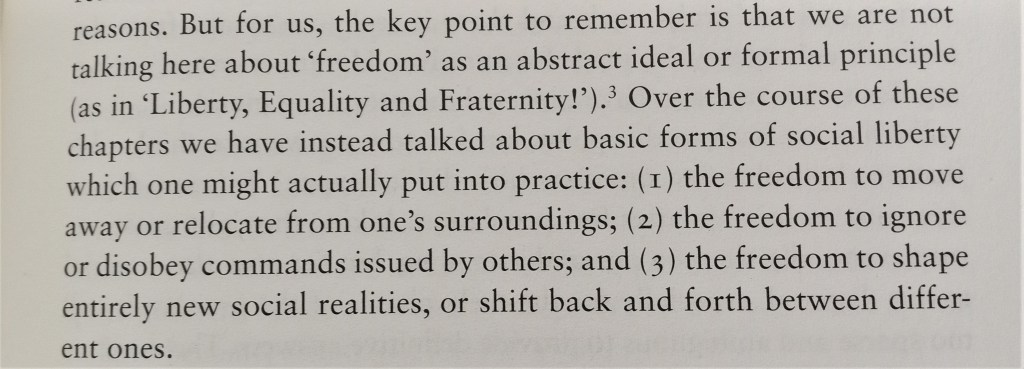
I recently finished reading The Dawn of Everything: A New History of Humanityby anthropologists David Graeber and David Wengrow. I highly recommend the book for its argument about how evidence from recent decades disrupts the common idea that people moved from hunter-gatherers to agriculture and cities and “civilization.” The reason I put civilization in quotes has to do with the argument they make regarding the freedoms humans used to have:
If we do not have these freedoms today what went wrong? The argument and the evidence is worth considering.
Rather, changes in home price growth, the supply of homes for sale and upticks in rock-bottom interest rates are more likely to stabilize the market after an unpredictable 2021, they said. That likely won’t mean an end to competition or high prices — and it doesn’t bode well for first-time homebuyers — but the market could ease up compared with 2021…
In the nine-county Chicago metro area, the median home sale price from January to November was $300,000, up nearly 12% over the same months in 2020, according to the Illinois Association of Realtors…
Prices are likely to rise next year, but won’t continue the exponential growth of 2021, said Daniel McMillen, head of the Stuart Handler Department of Real Estate at the University of Illinois at Chicago. Without an influx of new residents to the area or big increases in incomes, that growth will become unsustainable, he said…
Homebuyers are continuing to look for amenities like home offices and workout areas, Melbourne said. Kitchens are a priority. Condo-buyers are looking for bigger units, rather than one-bedrooms.
The pressure from COVID-19 moves will hopefully subside. Then, the more regular patterns in Chicago area real estate might take over again. There are at least several interrelated factors:
Uneven development within the region where some neighborhoods and suburbs will be popular and others not. Prices will go up in desirable places.
Construction of new residences has been down. What kind of units will be built? If recent trends hold, it will be housing aimed more at wealthier residents. Additionally, these units will be constructed in some locations and not others.
In October, Tokens.com, a blockchain technology company focused on NFTs and metaverse real estate, acquired 50 percent of Metaverse Group, one of the world’s first virtual real estate companies, for about $1.7 million. Metaverse Group is based in Toronto but has virtual headquarters in a world called Decentraland in Crypto Valley, which is the metaverse’s answer to Silicon Valley. Decentraland also has districts for gambling, shopping, fashion and the arts.
“Rather than try to create a universe like Facebook, I said, ‘Why don’t we go in and buy the parcels of land in these metaverses, and then we can become the landlords?” said Andrew Kiguel, a co-founder and the chief executive of Tokens.com…
For those wondering why a company would want to invest in a virtual office in the metaverse, Michael Gord, a co-founder of the Metaverse Group, said that skeptics should look at the trends catalyzed by the pandemic…
The Metaverse Group has a real estate investment trust and it plans to build a portfolio of properties in Decentraland as well as other realms including Somnium Space, Sandbox and Upland. The internet may be infinite, but virtual real estate is not — Decentraland, for example, is 90,000 parcels of land, each roughly 50 feet by 50 feet. Among investors, there’s a sense that there’s gold in those pixelated hills, Mr. Gord said.
Let the artificially-induced-scarcity-fueled-boom begin!
Seriously though, this offers an opportunity to acquire real estate that otherwise might be very difficult to find online or offline. In the offline world, how often do significant new parcels of land or developments come available? If they can be bought, they are not cheap, they probably attract a lot of interest, and there might be restrictions based on what is already there or what is possible on the site. In the online world, it could be difficult to predict where users might show up, how long it could take for sites to develop, and what it all might be worth?
In the meantime, investors and speculators will wait and see what happens. The bet could pay off massively: if the metaverse is successful with a few years or even a decade or two, those who got in early in prime locations with the right offerings could gain a lot. And if the metaverse does not develop in this way or other factors go awry, the money lost will be in a long line of those who hoped for the best with property and nothing materialized.
Overall, the city’s population increased by about 50,000 during that decade. But aside from those top 10 communities — which are found mostly on the North Side or near downtown — the rest of the city actually declined in population by more than 40,000 people.
WBEZ conducted an analysis of growth in Chicago community areas within the past decade, examining growth in population, new construction permits, jobs, and licenses issued to new businesses. The analysis showed that majority-white communities, collectively, experienced high growth in all areas: population, jobs, new construction and new businesses. The same was true for areas experiencing significant growth in white population, like the Near West Side and the Near South Side…
When compared with majority-Black and majority-Latino communities, and communities with no majority racial or ethnic group, majority-white communities also had higher rates of job growth, new construction and new businesses…
“Race is a big factor in the growth and development and revitalization in Chicago communities,” said Saunders, who studies Rust Belt cities and urban dynamics. “It’s a big factor that many people do not want to acknowledge.”
Such disparities across Chicago neighborhoods and the role of race are not new. The 77 community areas and how many neighborhoods have had different reputations and resources available. For decades, Chicagoans have celebrated how these different communities can have a common identity while knowing that this did not mean they were treated the same.
And this is not an issue limited to Chicago or just big cities. Uneven or unequal development is a prominent feature of communities in our current system. Within metropolitan regions, some suburbs are wealthy and continue to accrue residents and businesses (see the example of Arlington Heights in the Chicago news) while others struggle. These patterns often follow race-based settlement patterns and residential segregation.
This could be a critically important issue for the twenty-first century: how to encourage development and growth within places that historically have not attracted residents or capital. Without significant interventions, these patterns do not easily change.
Construction of the East-West Tollway and widening of Illinois Route 53 changed the Arboretum landscape, resulting in new lakes, roads, and a staffed gatehouse.
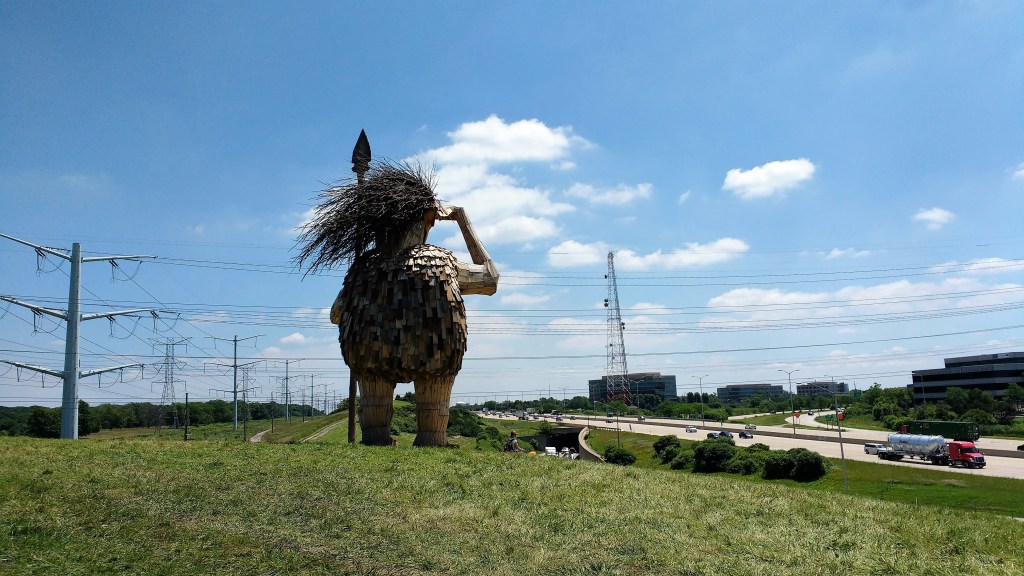
In a recent popular exhibit, the Arboretum even leaned into the nearby development with one installment looming over the highway:
Note the large power lines, the evidence of two major highways nearby (I-88 and I-355), and office buildings.
Recently, I drove around the east side of the property. This land has had a number of office and warehouse properties for years. This makes sense: the properties have access to multiple highways and there are plenty of residents/workers nearby.
However, I have noticed a more recent addition to this set of land uses: there is a parking lot just for Amazon trucks and vehicles. As far as I could see, there was no building next to the lot; just many spaces for vans and trucks. Looking at Google Maps, there is indeed a parking lot there among some other development and some undeveloped land. There is an Amazon facility nearby – one of many in the Chicago region – but it is not directly connected to the parking lot so drivers would have to exit to the main road and then turn back into the Amazon facility.
It is hard to completely escape development when in the Arboretum. Traffic noise can be heard, airplanes fly overhead, and houses and other signs of suburbia are visible from different vantage points. Yet, the presence of an Amazon parking lot reminded me of what nature is in the suburbs: present but often in-between roads, homes, and other buildings that speak to the ways that humans have and continue to transform natural features to their own particular suburban goals.
This was not always the case. The urbanization of the United States was quite rapid and gave rise to numerous big cities by the mid-twentieth century. In the early 1900s, the United States was less than 30% urban and less than one hundred years later was 80% urban. See this table from a 2002 US Census publication:
Before this, certain cities boomed. Chicago went from a small community in the 1830s to the second largest city in the United States in 1890. Numerous Sunbelt cities exploded in population, whether Atlanta or Phoenix or Las Vegas.
But, the United States now has relatively few new big cities. For decades, numerous small suburbs have truly expanded. One of the most noteworthy, thank to journalist Joel Garreau’s work Edge Cities, is Tysons Corner, Virginia. Once a rural intersection, the construction of a shopping mall and the arrival of thousands of square feet or retail and office space created a new kind of suburban community: one dominated by business rather than residents. While Tysons Corner has plans for additional residential units, it is a convergence of business and office activity at the intersections of several major roads outside Washington, D.C. Instead of new big cities, Americans get office parks and retail in the suburbs that rivals that of smaller big cities.
More broadly, where other places around the world have focused some development attention and resources on new cities, the United States has continued to fund and pursue suburbs. There are multiple reasons Americans love suburbs – I highlight the top seven – but this is still an interesting choice given how new cities might have non-linear benefits in certain areas that could help people and the country meet new challenges.
So this spring, Oakley, about an hour’s drive east of Salt Lake City, imposed a construction moratorium on new homes that would connect to the town’s water system. It is one of the first towns in the United States to purposely stall growth for want of water in a new era of megadroughts. But it could be a harbinger of things to come in a hotter, drier West…
Yet cheap housing is even scarcer than water in much of Utah, whose population swelled by 18 percent from 2010 to 2020, making it the fastest-growing state. Cities across the West worry that cutting off development to conserve water will only worsen an affordability crisis that stretches from Colorado to California…
Developers in a dry stretch of desert sprawl between Phoenix and Tucson must prove they have access to 100 years’ of water to get approvals to build new homes. But extensive groundwater pumping — mostly for agriculture — has left the area with little water for future development.
Many developers see a need to find new sources of water. “Water will be and should be — as it relates to our arid Southwest — the limiting factor on growth,” said Spencer Kamps, the vice president of legislative affairs for the Home Builders Association of Central Arizona. “If you can’t secure water supply, obviously development shouldn’t happen.”
Critics of sprawl have discussed this for decades: new subdivisions and development in arid areas taps already precious water supplies. It is not just about drinking water; it includes the water used for lawns, agriculture, parks, and other uses that come with expanding populations.
But, simply having more people and business might be the problem. If drought conditions continue, it will be worth watching how development – often assumed to be necessary for a good community – is treated.
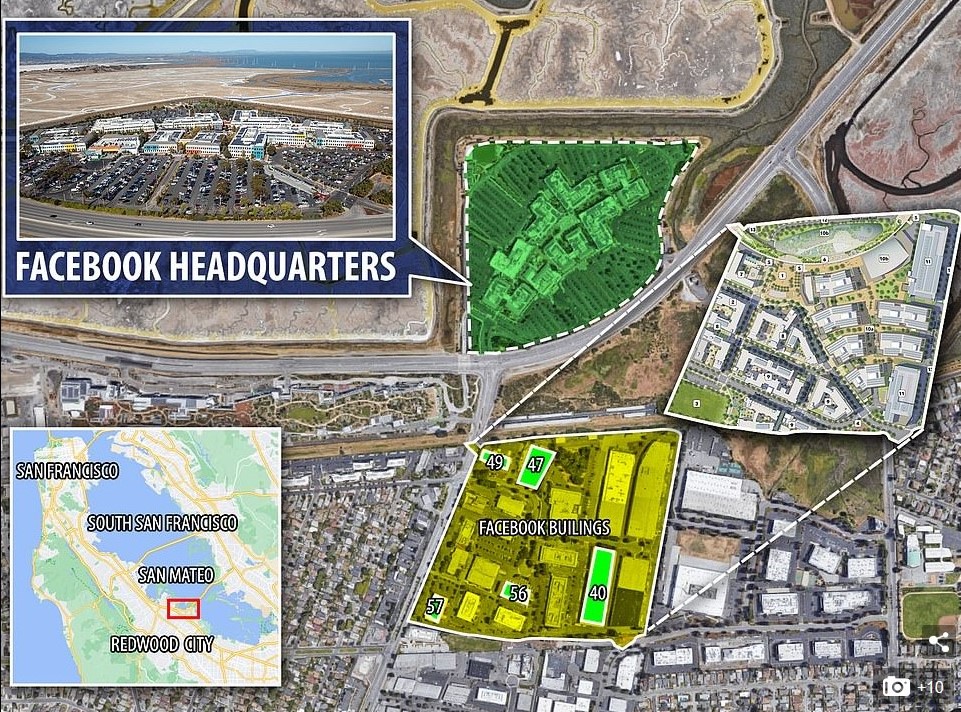
The most recent plans, which were updated in May, show the development will be built where a single-use industrial and warehouse complex currently stands…
It will feature 1,729 apartments, including about 320 that will be affordable housing and up to 120 units designated for senior housing…
The plans for the new city also feature a supermarket, pharmacy, cafes and restaurants and a 193-room hotel.
The 200,000 square feet of planned retail space will be built around a 1.5-acre town square.
Separate to the town square will be a four-acre public park, a two-acre elevated park similar to New York City’s High Line and other public open spaces.
In addition to the housing and retail spaces, Facebook also plans to have 1.25 million square feet of new office, meeting and conference room space for the social media company.
There are multiple interesting elements of this proposal:
This has numerous benefits for Facebook. It will have new office space built to its specifications. It will have some housing space for workers. It worked with the municipality to make changes.
All of this happening in the aftermath of COVID-19 where it is not entirely clear how many workers will return to the office. Adding this amount of office space suggests Facebook thinks it – or some other firm – can use the space.
This kind of mixed-use development is popular in many places. For example, New Urbanists promote such developments for their numerous advantages. Is Facebook explicitly building on this line of reasoning or does it have other reasons for this kind of development?
Once the land is developed in this way, what role will Facebook play moving forward in overseeing the space? This will be an ongoing tension between the company, residents, and the municipality.
This is an expensive area in which to develop land. Facebook has the resources to pull this off when others could not. In the long run, will this viewed as a net gain for the larger community or is it best for the company?
Since the project is under review by Menlo Park, it will be interesting to see how this continues to play out.
Councilman Patrick Kelly, the lone dissenting vote, objected to the lack of affordable housing in the 227-unit development, a “missed opportunity” that could have helped efforts to diversify the city’s housing stock.
State law requires 10% of a town’s housing supply to qualify as affordable. Naperville falls shorts at an estimated 7.5%…
The townhouses will be priced from the $300,000s. While the project doesn’t provide, by definition, affordable housing, Councilwoman Judith Brodhead said it “does fit the category of attainable housing.”
“Certainly, there’s not new construction, anything that you can find in north Naperville, in that kind of price range,” Whitaker said.
Much of the opposition to the proposal for an empty piece of land has centered on the possible environmental impacts. The property in question backs up to a Forest Preserve and there are bird and animal habitats nearby.
But, the affordable housing question is an interesting one. In wealthier suburbs, affordable housing does not necessarily mean housing for poorer residents. Such communities could not like affordable reasons for a number of reasons including who might live there and how smaller and/or cheaper homes might affect other homes in the community.
And there are ways to push off affordable housing. For example, zoning in particular ways can limit the number of residences that are cheaper. Another way is to recast what affordable housing is. Remarks, like the one above in the quoted section, are not unknown in Naperville. See this example from last July. Naperville is a desirable community: it is wealthy, has good schools, has an exciting suburban downtown, has lots of parks. Even as a large suburb, it has a lofty status. According to 2019 Census estimates, the median home value is over $416,000.
With all of this, a townhouse at $300,000 is a lower price. Units on this kind of land in a community like Naperville could go for a lot more. Yet, is $300,000 attainable for all the people who want to live in Naperville? Or, the people who work in Naperville? It is cheaper – but is it affordable?
There are limited ways to force suburbs like Naperville to construct housing that is affordable. President Biden wants to offer more carrots in this area. Public pressure from residents and organizations could push Naperville leaders to address this more fully. Naperville has served as a center of suburban protests before. But, there will always be questions of how such units would fit with the character of the existing community, what it means for existing units and residents, and who might live in such housing.
Chicago, like many American cities, asks developers of particular projects to include a portion of the space for affordable housing. But, developers argue this may make an entire project not worth their while. Here is a recent example from proposed developments on Chicago’s North Side:
But those fees and the sites’ location within a pilot area where there are higher affordable-housing requirements – 20%, all on-site – have made some projects difficult to finance. The 700 W. Chicago project also has been made more difficult by the COVID-19 pandemic, which leaves a record level of vacant office space in downtown Chicago…
Omni Group appears to have been able to overcome financing challenges in part because it negotiated a lower purchase price for the site – $38 million, down from an initial $50 million deal with Greyhound – in response to the affordable-unit requirements
The firm is also known for keeping apartment buildings it develops, rather than selling them after they’re built and filled with renters. The decades-long investment strategy may help offset the 500-plus affordable units, which typically lose money for developers because of high construction costs.
The affordable housing requirements are not the only factor at work here but they are a regular part of proposals in many locations. The goal is to have some of the benefits of a new development in a desirable urban location – a valuable asset – address the important issue of affordable housing. If developers have no or little interest in constructing affordable housing on its own, the construction of desirable projects can still help lead to affordable housing.
What would be very interesting to know is how exactly the money, including financing, costs, and profits, works out with the requirements for affordable housing. Can the developers here not make any money or does it reduce their profits below acceptable levels? It is one thing if money will be lost but another if the affordable housing requirements limit the profit. How much return do they expect on a large project like this? Is the goodwill of participating in providing affordable housing worth anything (status, money down the road, favorable approaches to future projects, etc.)? While this is likely firm-specific proprietary information, I imagine some money still could be made.