The brand “Articles of Society”

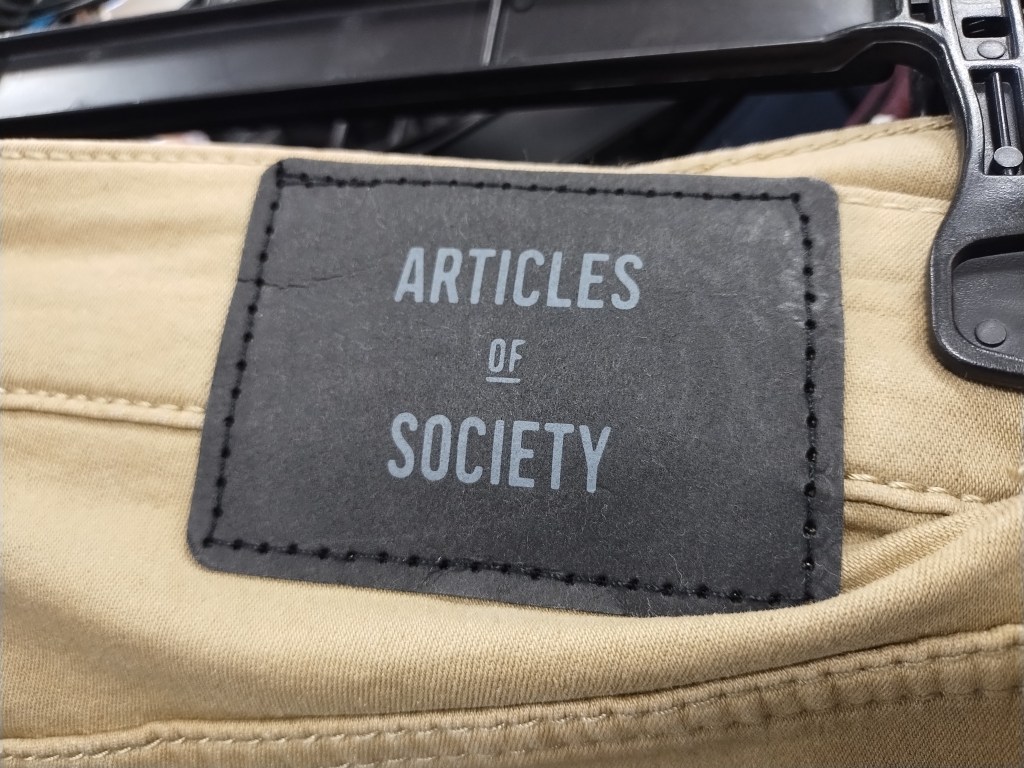
On a recent shopping trip, I found a brand name I did not know. It sounds sociological. Apparently they make clothes.

From their Instagram page:

Live life in Articles inspired by you, created with the earth in mind• #articlesofsociety

Is this a play on the phrase “articles of clothing”? If so, where does society fit in? Is it a reference to how fashion is a negotiation between the individual and the society around them? Or is it meant to be more biting, referencing how we all are just a part of society?

Maybe I am missing the point. One goal of developing a brand is to stand out from other options. A consumer has lots of choices for clothes ranging across design, price, and availability. The brand name caught my attention so perhaps that is the point? I did not purchase the clothing but I did snap a picture and the brand name will live on in my head.

When choosing to wear a house on your head

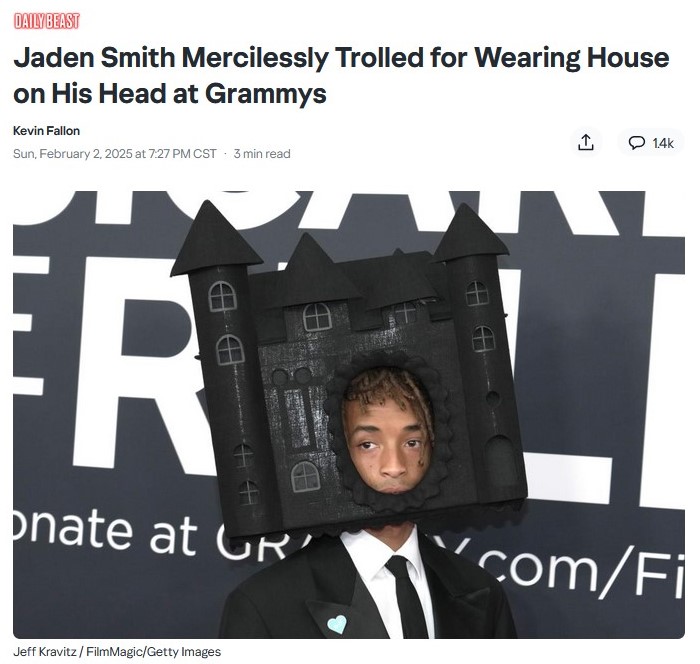
One person showed up to the Grammys this past weekend wearing a building:

Jaden Smith, the son of Will and Jada Pinkett-Smith, turned heads when he walked the red carpet ahead of 2025’s Grammy Awards—even if he could barely turn his own.

The younger Smith arrived with a diorama of a castle enveloping his head, with his face poking out of a circular hole. The headpiece was created by designer ABODI, which is apparently called “Vampire Castle.” (Vanity Fair pointed me to ADOBI’s site, which lists the so-called “wearable” piece for €4,500, which amounts to roughly $4,602.80. A bargain!)

On its Instagram account, the brand wrote, “The artistic headpiece combines the mysterious elegance of ABODI Transylvania with a bold, modern design inspired by Transylvanian history and the vampire legends of the Bathori.”

This is a unique fashion choice in at least two ways. First, the decision to wear a building on one’s head. Second, by the choice of building to wear.

The only time I have seen something close to this is at a few graduations where a few students put buildings on top of their mortarboard graduation cap. Some of these students were architecture students and this provided a platform for them to display a particular structure.

If people had to wear a building, what would they choose? How about a basic ranch house or a McMansion? Perhaps certain landmarks would be popular, like the Eiffel Tower or the Burj Khalifa. I do not see the trend catching on soon but one might want to be prepared to have an answer.

Are the suburbs connected to the popularity of 1950s housewife fashion?

If the style of the 1950s is back, what does this mean about how people see the suburbs?

Photo by Wendy Wei on Pexels.com

A new generation of women is discovering the midcentury look, albeit for wildly varying reasons. Perhaps most divisively, there’s the “trad wife” movement, an online community of traditional women whose retro fashion reflects their religious, conservative and even sometimes far-right values. Then there are women who profess “vintage style, not vintage values,” combining hourglass silhouettes with a progressive worldview. And then there are those women and designers who just happen to appreciate the bygone charm of a swirly skirt…

The contemporary interpretations of 1950s fashion run the gamut from a sprinkle of yesteryear—winged eyeliner, a Grace Kelly headscarf, cat-eye sunglasses—to full-on June Cleaver dress-up. Fans of the look share makeup tutorials and life philosophies on TikTok. On

Pinterest, the somewhat disturbing tag “Stepford wife” includes images of Nicole Kidman in the spooky 2004 remake alongside black-and-white photos of women vacuuming. On Etsy, a gateway to the style, vintage hounds source period pieces, as well as replicas from purveyors like “Hearts and Found” and “Son de Flor.”

The 1950s housewife look isn’t limited to online rabbit roles and vintage shops. It’s also bleeding into high-end runway fashion. Prada has long made ladylike pieces like full skirts, capri pants and fitted sweaters cornerstones of its line, and Dior’s fall 2023 collection played up the house’s heritage of hourglass shapes.

Missing from this discussion is any explicit mention of the suburbs. The suburban lifestyle of the 1950s was a particular one. Even as it suggested middle-class success, it was not home to all nor offered equality. The country was relatively prosperous. The examples of fashion images from the era hint at the suburbs, whether it is Leave it to Beaver or I Love Lucy (two shows part of a study I published on TV shows set in the suburbs) or The Stepford Wives or Barbie (who has a dreamhouse).

Is this fashion trend connected to a feeling of nostalgia about or wrestling with the suburbs? The suburbs are not typically thought of as incubators of high fashion or culture yet, given their important part in American history and as the most common place where Americans live, there may be some connections here. I remember a political poll in 2016 getting at this longing among supports of Donald Trump. There are plenty of American narratives about a golden era of suburbia and also numerous critiques of those narratives.

The suburbs have an ongoing legacy that plays out in all sorts of contemporary issues and conversations. That it should be part of fashion should not be a surprise, even if it may not appear obvious to start.

Fashion in roof colors vs. what is best for cooling

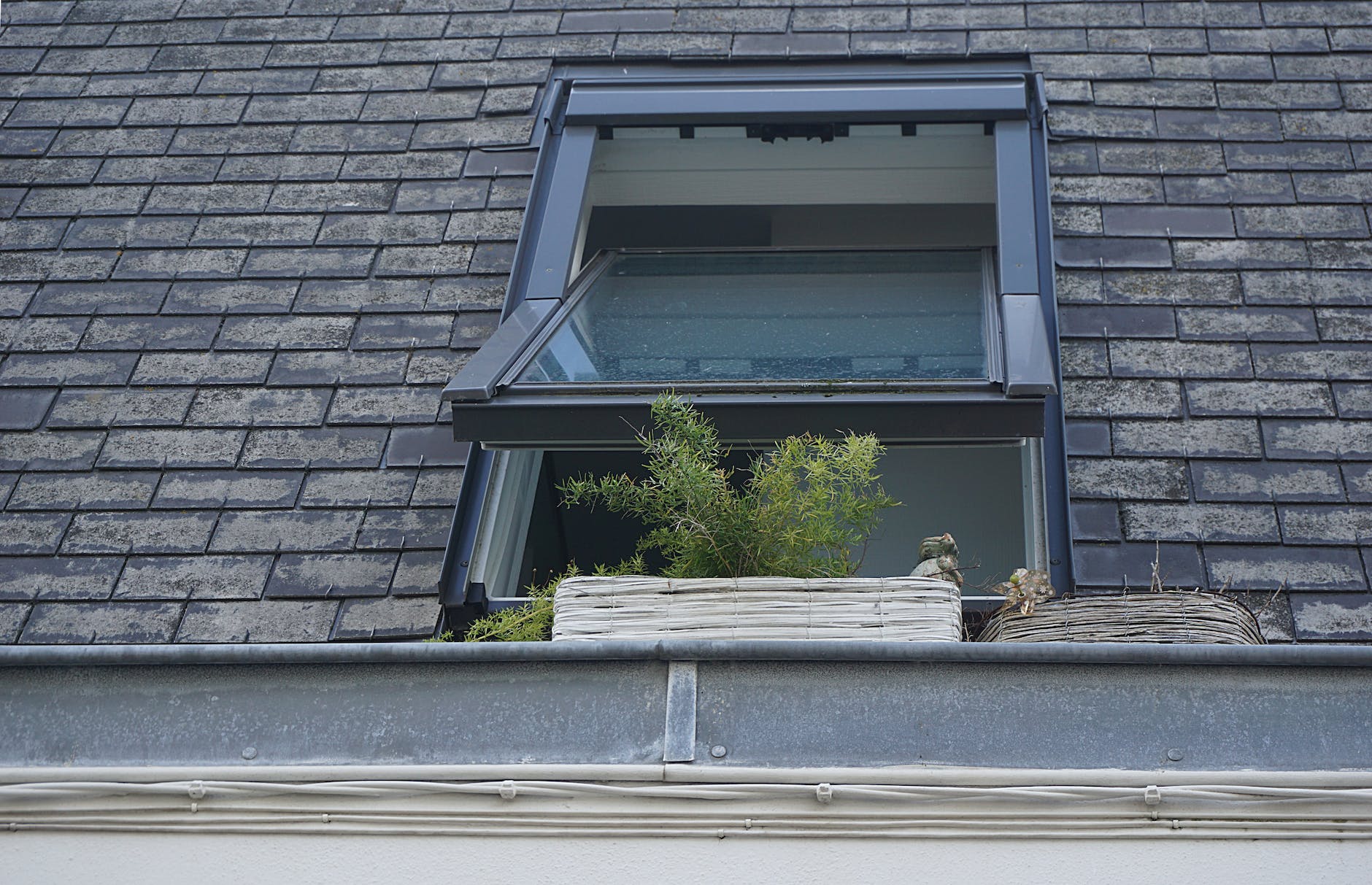
Here is an update on fashion in residential roofs:

Photo by hermaion on Pexels.com

Hagen sees a persistent “undertow of people wanting contrast, a dark roof with light siding”—the prevailing fashion. I suspect we can blame anxiety over property values; call it Zillow syndrome. With inflated home prices composing larger shares of owners’ net worth, who wants to take a chance? This is the sort of thinking that has supported water-sucking green lawns in places like Arizona, not to mention racist exclusionary covenants across the country.

The roofing industry itself encourages it. The website of Apple Roofing, which has offices from Florida to South Dakota, credited dark shades with “significantly improving curb appeal.” (Sometime after I spoke with an executive there, this reference was removed.) Its blog argues that the choice between dark and light shingles “should really be about your color preference and curb-appeal over cooling costs … You can rest easy knowing proper ventilation and insulation will ensure the color has no effect on heating costs!” For roofers and manufacturers, such reassurances represent the path of least resistance—or, less graciously, pandering to consumers. And, because light shingles generally cost more to produce (the rock granules embedded in the asphalt base need an extra kiln-fired coating), dark shingles let companies charge higher margins or offer customers lower prices.

But, this prevailing fashion comes with downsides:

All this despite the fact that light shingles tend to last longer than dark ones; they stretch, contract, and crack less in the heat. Factor in energy costs and they’re a bargain: A study by Lawrence Berkeley National Laboratory found that white roofs cost considerably less over their lifetime than both black and sustainability-flaunting grassy “green roofs,” which have other environmental benefits but cost more to install and, contrary to popular belief, don’t do much to counter global warming. Researchers at Australia’s University of New South Wales, another hotbed of cool-roof research, determined that such roofs reduced indoor temperatures by up to 7 degrees Fahrenheit.

This can save lives as well as pocketbooks: Researchers found that living on the top floor under a black roof was “a major risk factor in mortality” in Chicago’s July 1995 heat wave. Cooler roofs and whiter walls may explain why fewer people die in heat waves in Greece and North Africa than in France, Russia, and other countries to the north; all that whitewash isn’t just for scenic effect.

Where are the home roofing influencers who can tilt roofing fashion in a different direction? I say this partly in jest, but the piece goes on to briefly discuss the limited involvement of governments in regulating cool roofs for residences.

The fashion for roofs will probably change at some point; home styles come and go based on a variety of factors. If it can be tilted in a direction that helps limit energy bills, limits indoor overheating, and generally is positive for the environment, this could be helpful.

The trick here might be to link cooling roofing to property values. Homeowners are very interested in increasing their property values. Having the correct style helps but style is not everything. Do cooler roofing options provide a better return on investment in the long-run? Wouldn’t not replacing a roof as often be a good thing? When do green options for homes become a very important factor in deciding property values?

Linking “newness” in a home with particular materials, styles

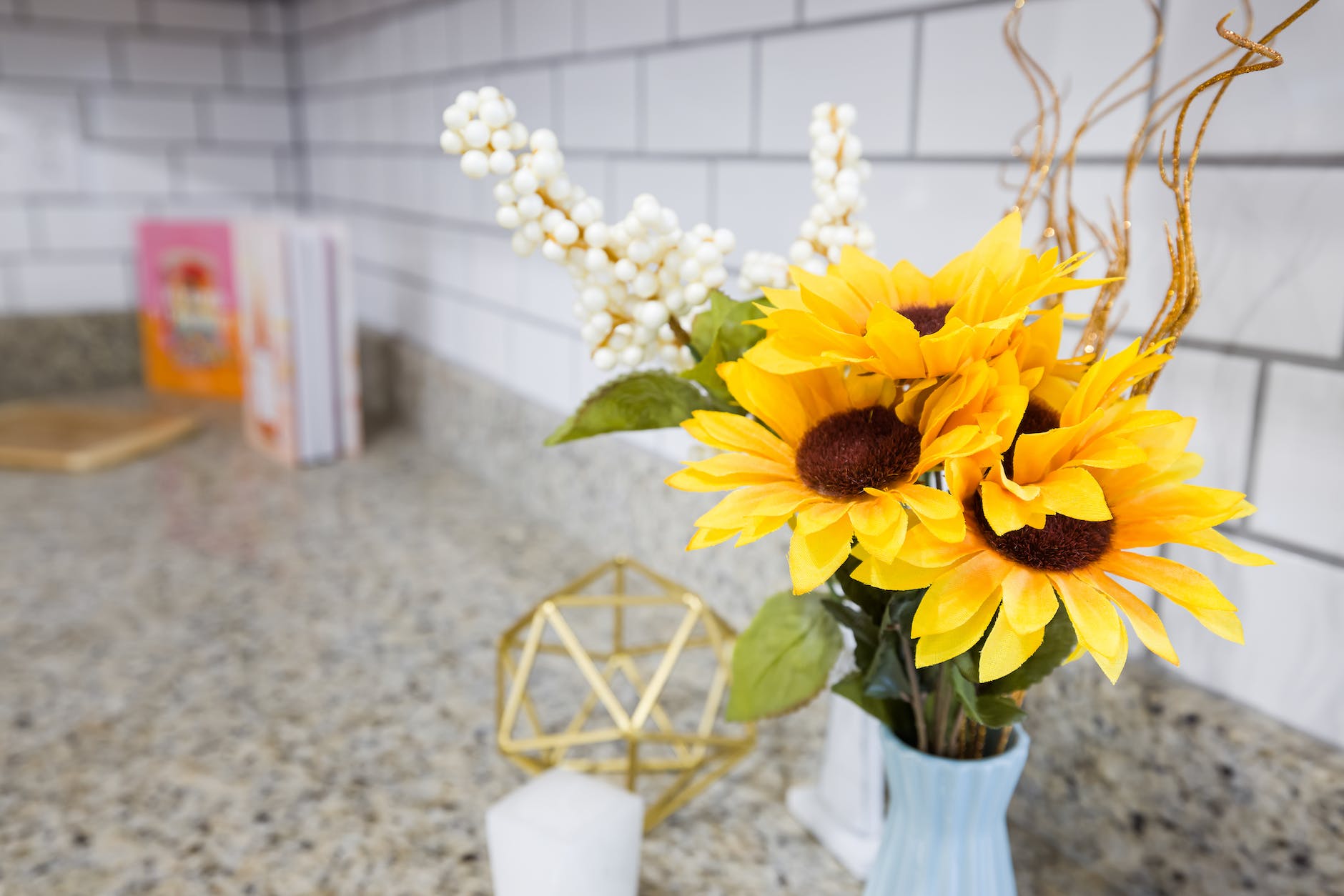
The impression of “newness” in a home is connected to particular updates and items:

Photo by Curtis Adams on Pexels.com

But not simply any new floors and counters will create the desired effect. The feeling of newness is largely relative, and the only real key to creating it is banishing the things that people expect to see in a dwelling built decades ago—“landlord beige” walls, all-white appliances, dingy carpet, laminate counters, wood so warm-toned it’s practically orange. Gray floors and all of their comorbid design phenomena are cool and crisp and modern by comparison, even if they’re also crushingly boring and totally character-free and really limit a space’s potential capacity to feel warm and alive and like a home.

And the purpose of these changes is to sell properties:

In theory, the things that make up the interior of your home should be either beautiful or useful; if you’re lucky, they’ll be both. And surely some people do lose their mind for gray laminate or subway tile or barn doors, and not just because there’s no accounting for taste. Once a particular design element becomes a shorthand for newness and freshness and successful domesticity, people come around to it precisely because they want their home to reflect those qualities. But that’s a different phenomenon than appreciation for the thing itself—for how nice it is to look at, or how much more functional it makes a space. In the hands of flippers and landlords, these choices are generally made not by people who want to fill the world with the best, safest, most comfortable homes possible but by those looking for a return on the bets they’ve made on the place where you’ll start your family or play with your future grandkids. They’ve chosen these things just as much for what they aren’t as for what they are—inoffensive, inexpensive, innocuous. These houses aren’t necessarily designed to be lived in. They’re designed to go into contract.

I wonder if this process mirrors that of the fashion industry and other culture industries. The production, sale, and popularity of created works and objects moves in waves and trends. Not too long ago, homes featured granite countertops and stainless steel appliances; now it is subway tile and grey floors; shortly it will be something else. Or, formal living rooms were a thing to open concept to providing smaller spaces to enable working from home. The key for those who want to make and sell properties is to appear on trend or close to it.

A related argument: homeowners and sellers exhibit their investment, emotional and economically, in a property by updating it to more recent trends. They show that they care about the home fitting in a new era rather than being left behind. It can suit a new family just as well as it did its original occupants.

Would it be possible to signal newness in different ways? A particular smell? How the occupants use the space? Altered infrastructure (ranging from new furnaces or electrical systems to greener options)? Integrating the Internet, screens, and sounds?

Uniqlo, don’t lose your edge by appealing to the suburban market like Gap did

An overview of Uniqlo suggests it would do well to avoid becoming the wear of suburban families:

Uniqlo isn’t in the business of chasing trends. Its staples—versatile black pants, reliable oxfords, crisp cotton socks—are available month after month, year after year. A more apt analogue would be the Gap. In its 1990s heyday, the Gap revolutionized American retailing by making basics cool. But the company eventually became a victim of its own success. “When [the Gap] tried to go from having a certain cachet to being in every single mall in every single town in America, the brand lost its edge,” Steve Rowen, a managing partner at Retail Systems Research, told me. Gap clothing became the uniform of suburban moms and dads. Despite the company’s efforts to make its khakis less baggy and its shirts slimmer, no one wants to fall into the Gap anymore—especially when you can get cheaper basics with cleaner lines at Uniqlo…

That could be an opportunity to make a good first impression. But as Uniqlo learned when it arrived on American shores, first impressions can be hard to manage. The three original U.S. stores were in New Jersey malls, where the company soon encountered several hurdles, including fit. (American customers, on average, are taller and fleshier than Japanese shoppers.) It closed the stores within a year.

Uniqlo has continued to struggle in suburban markets. Rowen, of Retail Systems Research, said he thinks the company should hew closely to cities, where it has found its greatest success, because that’s where its core customers are. This would also help it avoid the fate of the Gap, which traded its sense of self for growth.

This could be a simply story of a company being cautioned to avoid the mass market because doing so would lessen is cool factor. But, it is interesting that this is cast primarily in suburban/urban terms. The dilemma appears to be choosing between these two points:

  1. The majority of Americans live in suburbs. If a company wants to hit it big, the American people are in the suburbs. Furthermore, there is a lot of money to tap in the suburbs as well as future generations of loyal brand adherents in the form of suburban children.
  2. Being associated with the suburbs – shopping malls, parents, the mass market – will change the brand and eventually render it obsolete.

It is also worth considering numerous other brands that have appealed to suburbanites and survived. Is the clothing market that different than the smartphone and tech industry? In other words, does Apple suffer because so many suburbanites have an iPhone or are they the rare example of a company that has kept its cool factor even while becoming ubiquitous?

If this were an American company, I might guess that they would eventually go for the suburbs with all its money and potential buyers.

Americans dress more casually…because they can

A historian explain how and why American clothing styles have changed toward the casual:

It wasn’t always this way. For much of the 20th century, Americans didn’t dress casually all the time. There were dress codes and customs. Men wore suits and hats, women wore dresses. Jeans and t-shirts were for laborers, not professionals.

“Casual is the sweet spot between looking like every middle class American and being an individual in the massive wash of options,” Clemente told the Post.

She says we now find meaning in the way we dress, in a way we didn’t in the early 20th century, when people dressed more aspirationally. They wanted to look as though they had higher social status than they actually did.

As it turns out, historians can point to two major periods in the 20th century that changed the way we dress today: the 1920s, when women started breaking away from dresses and fewer men attending college wore full suits; and World War II, when women cared more about their work in the factories and the victory gardens than what they were wearing on the particular day.

While the goals of choosing certain clothes have changed (from projecting a higher social standing which is now viewed as gauche since we are all middle class to individualization), clothing is still intended to present a message to others. Arguably, that individualization is still about status but a different kind. Instead of pointing to traditional markers of class such as money and wealth, individualization points to creative status and taste. Perhaps we have shifted the symbolic boundaries of clothing from socioeconomic boundaries to cultural boundaries (to use the terms laid out by sociologist of culture Michele Lamont) where the aesthetic choices we make now matter more.

Selecting “The Most Overexposed Chicago Design Trends”

Curbed Chicago identified six Chicago-specific design trends that they think are now passé.

Stylized Chicago neighborhood maps [I have a t-shirt version but not a poster]

Reclaimed wood Chicago flags [Odd – no]

Stolen ‘L’ maps [A version of the stolen street sign…don’t have one]

Chicago World’s Fair prints [No – but have one of the better South Shore Line posters]

Generic Chicago skyline poster [Sort of – a real matted photograph but a similar image]

The nothing-but-a-black-leather-sofa-and-flat-screen-TV look [No]

I want to know whether these are real patterns or not: how many Chicago area residents have these features? How does this compare to residents of other cities? Someone could create a bot to scan real estate listing photos or the list could have emerged from a set of in-the-know interior designers. Alas, we have no idea what methodology Curbed Chicago employed which perhaps indicates that it wasn’t very rigorous.

All of this hints that decor trends are driven more by “feel” than hard data. What’s “in” these days could be tracked in a variety of ways yet it often seems that a class of gatekeepers – professionals, the media, corporations – gets to dictate when these trends begin and end. For example, are we past the era of stainless steel appliances and granite countertops? The average resident or seller is looking to others to signal the latest trend.

Zara devotes its full marketing budget to leasing expensive retail space near high-status brands

Here is a way retailers can take advantage of space: locate near high-status stores.

How about advertising? Basically, Zara doesn’t do it. There is no ad budget. Instead, the company spends ungodly amounts of money buying storefronts next to luxury brands to own the label of affordable luxury:

“The high street is really divided according to brand value,” says [Masoud Golsorkhi, the editor of Tank, a London magazine about culture and fashion], who is also a consultant for fashion brands. “Prada wants to be next to Gucci, Gucci wants to be next to Prada. The retail strategy for luxury brands is to try to keep as far away from the likes of Zara. Zara’s strategy is to get as close to them as possible.”…

Zara stores cozy up to the most famous brands in the world to sing their luxury ambitions even as they profit off a brilliant, cheap, short supply chain that delivers similar fashion at a much lower price.

In this case, proximity matters. By being located near prestigious brands, Zara is pulled up more to their level. Additionally, shoppers willing to wander into the really high-status stores might then also wander into Zara. This seems to be the strategy of the shopping mall as well: utilize several important anchor stores (or anchor facilities/restaurants in “lifestyle centers“) to help bring in more customers who will then also visit other stores along the way.

I wonder: are there any streets or malls where retailers have found ways to expressly disallow stores like Zara? Imagine a high-end outlet mall where there are only high-end retailers and no middle-brow stores or aspiring stores are allowed. Leasing prices is one way to do this but this article makes it sound like firms like Zara can do an end run by paying those big sums and then not spend money on traditional marketing.

The changing standards in dress for NBA players and its impact on social norms

One writer suggests that the current clothing styles of NBA stars is related to social norms for black men:

When David Stern imposed the league’s reductive dress code six years ago, all this role-playing, reinvention, and experimentation didn’t seem a likely outcome. We all feared Today’s Man. But the players — and the stylists — were being challenged to think creatively about dismantling Stern’s black-male stereotyping. The upside of all this intentionality is that these guys are trying stuff out to see what works. Which can be exciting. No sport has undergone such a radical shift of self-expression and self-understanding, wearing the clothes of both the boys it once mocked and the men it desires to be.

It’s not a complete transformation. Being Carlton wasn’t just code for nerd, it was code for gay, and the homophobia these clothes provoked still persists, even from their wearers. Once last year, Dwight Howard, of the Orlando Magic, wore a blue-and-black cardigan over a whitish tie and pink shirt to a press conference. When a male reporter told him it was a good color on him, instead of asking the reporter “Which color?,” Howard spent many seconds performing disgusted disbelief: Whoa, whoa. A moment like that demonstrated how hopelessly superficial all this style can be. The sport can change its clothes, but, even with Dan Savage looking over its shoulder, will it ever change its attitude? If Howard thinks compliments about his cardigan are gay, he probably shouldn’t wear one.

Still, something’s changed in a sport that used to be afraid of any deviations from normal. That fear allowed Dennis Rodman to thrive. Now Rodman just seems like a severe side effect of the league’s black-male monoculture. The Los Angeles Lakers officially recognize the man who was involved in one of the most notorious fights in sports history as “Metta World Peace.” Baron Davis, of the Cleveland Cavaliers, spent the summer in a lockout beard that made him look like a Fort Greene lumberjack. And Kevin Durant wears a safety-strapped backpack. If Stern was hoping to restore a sense of normalcy to the NBA, he only exploded it. There no longer is a normal.

Summary of the argument: in a big shift, it is now acceptable, and perhaps even cool, to be a wealthy black athlete who dresses like a nerd.

I could imagine several interpretations of this trend (and these would likely come from different groups of people):

1. A Marxist approach. David Stern has succeeded in pushing black stars to dress like preppy whites in order to further the economic interests of the NBA. This isn’t about allowing these stars to express themselves; it is about making them palatable to a white audience that buys tickets, corporate sponsorships, and drives TV ratings.

2. The clothes may have changed but there is not exactly overwhelming support for gay athletes or perhaps even for having more “feminine” traits.

3. There is a broader “star culture” or “celebrity culture” that transcends basketball and unites the broader entertainment industry. Star athletes today are not just physically unique; they are cultural celebrities and need to dress the part to fit in with their reference group.

4. Athletes today care too much about things like clothes and not enough about winning.

5. Black male culture was never that homogeneous. Using “The Fresh Prince” as the primary cultural example in this article is a limited perspective. The media and society might have one image but it is not necessarily accurate.

6. Is examining how stars dress like nerds continuing a negative stereotype about nerds and the importance of education? Does the way LeBron James dresses change the culture’s views of nerds or does his celebrity still push a macho image tied to basketball competition and physical prowess or perhaps a stylish, sophisticated, and wealthy image?

In the end, the intersections here between athletes, race, gender, and fashion are fascinating to consider.