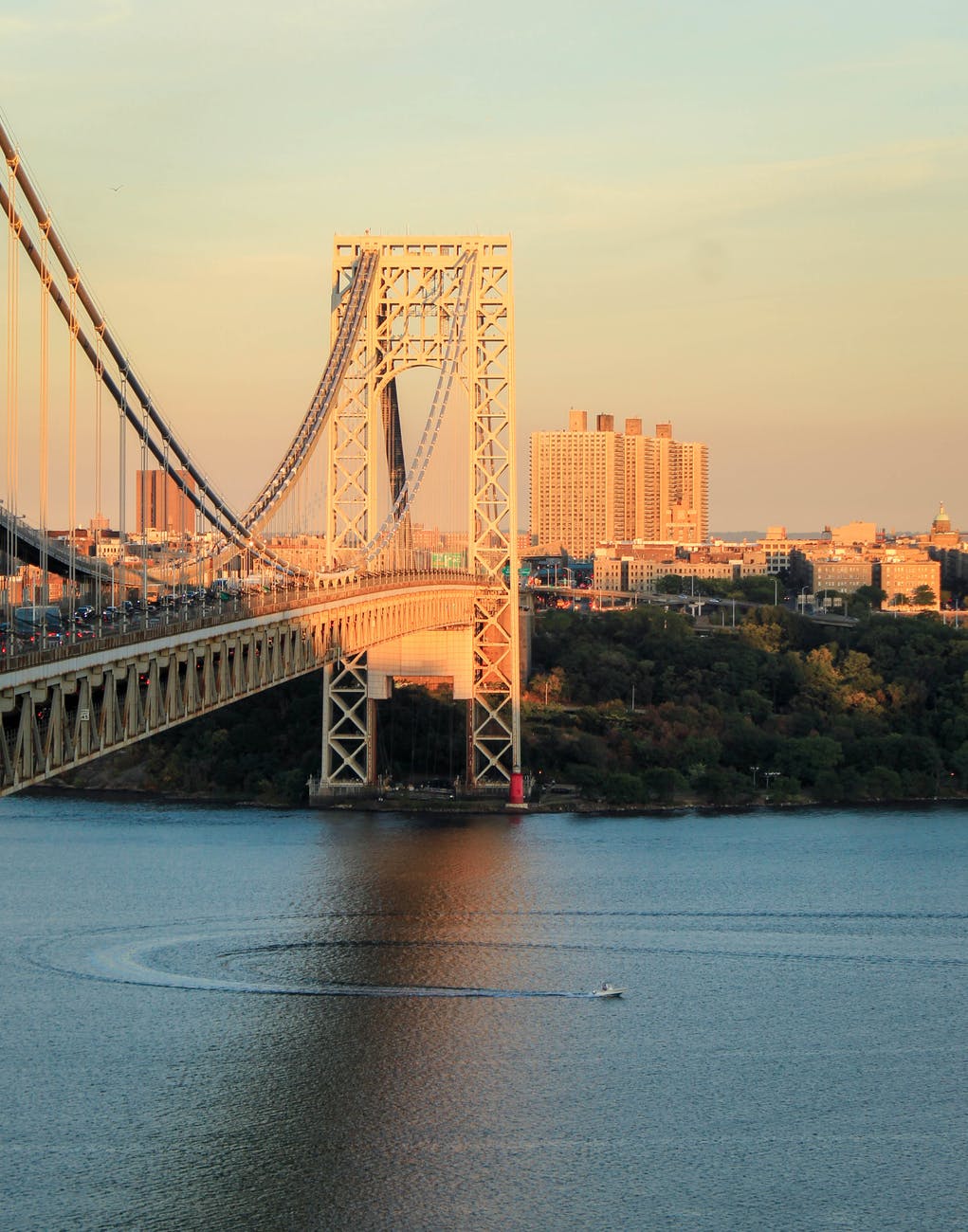
Trying to portray early 1920s New York City accurately

A discussion of The Great Gatsby includes portions about trying to accurately show life in New York City:
Photo by Ramil Ugot on Pexels.com

Between Manhattan and West Egg, where Jay Gatsby and Nick Carraway live, spreads the “valley of ashes,” “a fantastic farm where ashes grow like wheat into ridges and hills and grotesque gardens; where ashes take the forms of houses and chimneys and rising smoke and, finally, with a transcendent effort, of men who move dimly and already crumbling through the powdery air”. Fitzgerald’s valley of ashes tips its hat to TS Eliot’s The Waste Land, but it was also a feature of New York at the time. The Ash Dumps were mountainous piles of ash up to 90ft high, a malodorous stretch of swampland in which coal ash, cinders, garbage, and human waste had been dumped. Lone figures wandered the desolate heaps searching for treasure or anything they could sell – a perfect image of a nation squandering its promise in search of a buck.

Most of the novel’s memorable details function in the same way, as realistic features of New York in 1922, and as symbols that fuse social satire with the novel’s metaphysical meanings. Gatsby is peppered with familiar symbols: the valley of ashes, the green light, the eyes of Dr Eckleburg that are mistaken for the eyes of God. It’s a novel that understands how signs can expand our capacity for thought. Gatsby’s green light has become one of the most famous images in literature, standing for Gatsby’s envy of the Buchanans’ world and his desire to attain it. It suggests his and his nation’s aspirationalism, their faith in renewal, in the fresh hope of starting over – and their drive for the colour of American money…

Hollywood routinely helps itself to any details from the 1920s that let it gesture toward the jazz age. Baz Luhrmann’s 2013 film adaptation of Gatsby features Prada dresses in silhouettes that were not worn until around 1928. This may sound like pedantic quibbling – what’s six years in Hollywood time? But, socially and culturally, the 1920s ended in a very different place from where they began: the styles of 1922 were far closer to those of 1919 than to those of 1929.

Luhrmann’s Broadway is thronged with yellow taxis – but New York taxis were not uniformly yellow in the early 1920s. There were also red taxis, blue taxis, checkered taxis, and by the summer of 1923, lavender taxis, like the one Myrtle Wilson selects after letting four others pass by. Lavender taxis were known for being expensive and could seem pretentious, an impression heightened by their violent colour scheme: “cerise and lavender taxis with red and green checkers”. A night out in Prohibition New York, it was said, “begins in a bierstube [beer hall] and ends in a purple taxi”. Myrtle Wilson, with her violent affectations and social climbing, would naturally choose a lavender taxi.

These deadening clichés distort our view of Gatsby in important ways. They keep us from registering how rich and strange and alien its world is: the New York of Gatsby lures us in because it is a surreal and surprising city, without a trite yellow cab in sight – but a lavender one is waiting for those who care to notice. All these carefully chosen details also suggest a world beyond the merely mimetic – what John Updike once called the ability of language to be “worked into a supernatural, supermimetic bliss”. The reason everyone who reads Gatsby wants to join the fun has far less to do with our ideas of what a jazz-age party looked like than with the vital strangeness of Fitzgerald’s writing. The lavender taxi is hyper-realistic, but it is also surrealistic, capturing the phantasmagorical qualities of Gatsby’s New York.

Trying to remember the past of familiar places can be difficult. Images and narratives about New York City are so widespread and pervasive that they can be hard to counter. Was Times Square always that way? What about Harlem or Brooklyn?

Cultural works that try to do this can add to the difficulty. Did they portray things correctly? What sources are they drawing on? How many people engaged with that cultural work (whether it was accurate or not)?

Are there sites devoted to pointing people to correct depictions of places in the past and telling them which ones to avoid? For example, this article points out that Fitzgerald captures some unique features of early 1920s New York while the 2013 film does not. If I wanted to know more about New York as it was, should I watch the Godfather or find other sources?

Setting The Matrix in Chicago – sort of

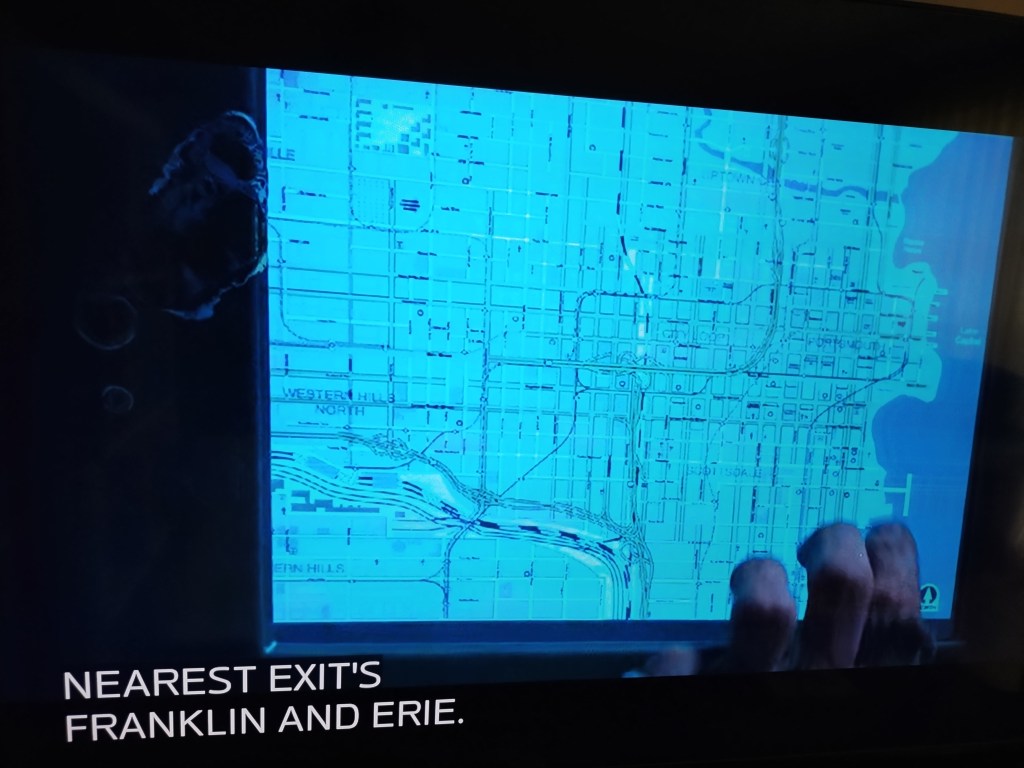
While recently rewatching The Matrix, I noticed multiple references to Chicago streets. And then there is a map in the second half of the film:

Looking closely, this is not exactly Chicago. But, the waterfront kind of looks like Chicago, there is a neighborhood on the map marked “City Loop,” the city has a river, and things do appear to converge in the district next to the waterfront.

Why the resemblance? One source suggests this is deliberate in the depiction of Mega City:

Early drafts of the screenplay identified the city as Chicago, and most of the street and landmark names referenced in the films are from Chicago,[4] such as Wabash and Lake, Franklin and Erie, State Street, Balbo Drive, Cumberland Ave, the Adams Street Bridge and the Loop Train.[5] Some street names, such as Paterson Pass and Wu Ping Ave., are derived from names of production staff.

In a brief screenshot of the first movie, wherein Tank zooms in a map on the screen to give Cypher directions to the telephone, the map of the city shows a coastline similar to that of Chicago’s Lake Michigan Coastline.

The creators have connections to Chicago:

Sure, most of the trilogy’s urban scenes were shot in Sydney, and close watchers of the first movie can spot several Sydney landmark buildings. But creators Larry and Andy Wachowski were raised in Chicago and drop at least five references in the first script…

The Wachowskis attended Whitney Young High School and spent two years in small liberal arts colleges before they each dropped out and started a construction business. Then the quirky film resume began to take shape.

This is not unusual in today’s filming of movies and shows: creators are from certain places, scenes may be shot in a variety of places, and the name of the place in the film or show may or may not align with the places that are depicted on screen. In The Matrix, a combination of modern cities produce a soulless but recognizable setting.

Tax breaks and Chicago suburban locations standing in for other locations in films and TV shows

The state of Illinois offers tax breaks for filming in the state. This means the Chicago suburbs can stand in for numerous other locations:

Photo by Stephan Mu00fcller on Pexels.com

The state’s film production tax credit allows qualified productions to receive a 30% transferable tax break on most production costs and certain salaries. Producers can also receive 15% more for hiring workers living in “economically disadvantaged areas.” In return, these productions generate jobs and draw business from outside the region.

According to a new report commissioned by Dudley’s group, the state’s film incentive is the biggest box office draw for Hollywood. A survey of producers included in the report indicates more than 90% of the productions shot in Illinois would not have occurred without the incentive…

Producers of the television series “Fargo” used Elgin and other suburban locales as a stand-in for Kansas City a few years ago. Acclaimed director David Fincher turned downtown St. Charles into upstate New York for his recent Netflix film, “The Killer.” And parts of Warrenville and Lockport are used as substitutes for Manhattan, Kansas, in the HBO series “Somebody, Somewhere.”…

This commonly happens in movies and television shows: a filming location stands in for another place. This could include filming on a backlot or in another city or community.

Yet, it still is a strange experience to see a location you recognize on-screen that is supposed to be somewhere else. Imagine you live in a suburb listed above. These communities have their own history roughly 30-40 miles outside of Chicago. They exist alongside dozens of other suburbs. But, you could be watching what is supposed to be Kansas City and you recognize this suburb. Or, Manhattan, Kansas is on-screen and it happens to look like Lockport. Do these geographic switches make the on-screen presentation less real? How many people notice the disconnects?

The article also emphasizes the role of finances: tax breaks help drive where filming takes place. I assume there are also efforts to try to make sure the stand-in location looks similar to what is supposed to be depicted. Do certain suburbs make good stand-ins for all suburbs or are particular metropolitan regions good to offering the variety of locations studios might want?

Do Christmas movies avoid McMansions?

What kinds of homes are featured in Christmas movies? One article suggests McMansions are rarely featured:

Photo by Kristina Paukshtite on Pexels.com

Have you noticed that holiday movies are already streaming? And have you noticed the homes? They’re built for families who enjoy being together.

Rarely opulent “McMansions,” the homes featured in holiday family movies run the gamut from the family cabin in the woods to a stately family home that has been passed down through the generations.

The suggestion here is that the features of McMansions are not well-suited for these films. Here are some traits that might not work. Lots of square footage means family members are not around each other regularly. Unusual architectural features or interior designs do not look like traditional homes. A giant house on a small lot or looming over other homes does not appear friendly.

In contrast, a “good” home for a Christmas movie will be cozy, traditional in architecture and design, and present a particular appearance from the outside. The home might be tied to particular styles from the Victorian era through the mid-twentieth century when many Christian traditions and themes emerged in the Anglo-American sphere.

Given the way McMansions are treated in artistic endeavors, perhaps a McMansions could serve as the setting for a dystopian or black comedy Christmas film.

Filming a wealthy home exterior, McMansion interior

A film production designer describes the problem of finding a home for filming:

Photo by Mark McCammon on Pexels.com

We were looking for the Voze mansion and having trouble finding an exterior and interior to match, as most wealthy estate-type people heavily renovate their interiors and look more McMansion inside. The exterior was a house in Pasadena.

I think this is saying that they had a problem finding a home fit for wealthy characters because the homes with the gravitas-invoking exterior did not necessarily have the same kind of interior. Having lots of money can be associated with a particular aesthetic. Describing a portion of the home as having a McMansion look is not usually a good thing. It is a negative term. I imagine a McMansion interior could involve the latest trends, having large spaces, and going for shock and awe rather than refined details.

Through the magic of filming and editing, a different exterior and interior can be put together without too much evidence otherwise. Of course, it is also fun to watch for situations where they do not exactly match.

When the music swells…

I recently encountered two examples where an increase in volume of music portends something important is happening:

Photo by Pixabay on Pexels.com

-In watching The Truman Show for the umpteenth time, I noticed at one point director Cristof points to the live pianist to increase the music. The musician obliges and the melancholy music swells. (Bonus: you can see composer Phillip Glass playing piano in this scene as Truman sleeps.)

-In a chapel service, the organist played a quiet piece underneath a prayer, but as soon as the prayer ended, the volume and activity increased as the congregation moved to singing together.

This musical signaling is common in live events, religious services, television and film, and elsewhere. When the music increases in volume and/or activity, something important is happening. It is a cue to the events unfolding in front of the participant or the viewer.

Is it emotional manipulation? Can we be pushed in directions we may not even be aware of just by the musical vibrations around us? Perhaps. Yet, humans have done this for centuries and millennium as music has a long and rich history not just as an individual activity but a collective tissue and performance where tone, volume, timbre, and more contribute to life together.

A positive on-screen depiction of New Jersey

In contrast to the typical depiction of New Jersey on TV and movies, one writer suggests a new show portrays a positive vision of the state:

Photo by Noriely Fernandez on Pexels.com

I don’t want this attention. Jersey’s bad reputation for being America’s garbage dump has done a great job of keeping people out and our blocks relatively affordable. For years, Jersey City was protected by a forcefield of bad representation. Jersey is by far America’s favorite punchline of a state. Futurama imagined America’s founding fathers dubbing New Jersey “our nation’s official joke state.” Movie after movie refers to Jersey as “the armpit of America.” Even in Marvel’s What If…?, Harold “Happy” Hogan laments the only escape from a zombie apocalypse: “Just when you thought things couldn’t get any worse, we gotta go to Jersey.” MTV’s Jersey Shore continues to do a fantastic job of finding the best cast to represent the state and all it has to offer folks on the outside. Snookie and J-Wow knew exactly how to lay out the red carpet. The Sopranos also knew exactly how to showcase Jersey’s finest hospitality. Come for the bar fights, stay for the gabagool.

I would argue few places are depicted well on television or in films where the emphasis is usually on character and plots rather than on places, neighborhoods, and communities.

At the same time, certain locations can acquire a particular character through the way they are depicted over the years. Viewers might see only a particular perspective on or a portion of a place.

What would the average American think New Jersey is like based on what they have seen on screen?

Constructing a New Urbanist movie town outside of Atlanta

Going up around a one-stop movie filming and production facility outside of Atlanta is a New Urbanist community named Trilith.

Google Maps

When the British film studio company Pinewood opened a production facility outside Atlanta in 2014, it framed the venture as a one-stop-shop alternative to the mature but spatially fragmented system in Hollywood. With a high-tech media center, soundstages, offices, prop houses, and set builders all colocated, Pinewood Atlanta was a turnkey space for filming. An early relationship with Marvel Studios led to a steady stream of big-budget superhero movies such as Ant Man and Captain America: Civil War, and Pinewood Atlanta quickly became a contender in the film business.

But some of its local investors wanted it to be more than just a production facility. They wanted the entire business to have a place at the studios, with development of new shows happening where they’d eventually be filmed, and local workers able to easily commute to jobs on the site, about 20 miles south of Atlanta. So they decided to build a town…

Pinewood recently left the project, amiably, and the studio and town are now fully in the hands of local founders, who have accelerated Trilith’s development, which broke ground two years ago. Planned with New Urbanist design principles, Trilith is a dense, pedestrian-oriented, mixed-use village, with a commercial town center, more than half of its area dedicated to green space and forest, and room for an eventual population of 5,000. About 500 people are currently living in the town, which is planned to have a total of 1,400 townhomes, apartments, cohousing units, and 500-square-foot “microhomes.” Housing is available to rent or buy, and Trilith’s developers say it’s luring residents from within the film industry as well as people from other walks of life…

Parker says the town was inspired by Seaside, a New Urbanist community in Florida famous for its use as the setting of The Truman Show. Trilith was designed by the Atlanta-based planning firm Lew Oliver, with homes designed and built by companies such as 1023 Construction and Brightwater Homes. Parker says the design was intended to appeal to young creatives, with an emphasis on wellness and access to the outdoors, but with the kinds of amenities people want in a town. The first of the town’s restaurants recently opened, and 11 more are in the works. A 60,000-square-foot fitness studio was recently completed, and a K-12 school is already open.

Three quick thoughts:

  1. It will be interesting to see how the relationship between the film industry and the town continues. On one hand, it could create a regular level of business and residents. On the other hand, not everyone in the community will be involved and interests could collide. Will this be like other suburbs and communities that rely heavily on one industry or sector (with both the advantages and disadvantages that come with this)?
  2. Later portions of the article discuss the diversity of residents in the community. Seaside looks good on film but has been more of a wealthy community than one that lives up to its New Urbanist principles of having mixed-income housing and residents. Will the desirability of such a community drive up housing costs? Will the connection to the film industry make it more difficult to others to move in?
  3. Does this provide a new model for numerous industries? For example, prior to COVID-19 big tech firms had constructed large, all-encompassing headquarters intended in part to help keep workers close. Or, large office buildings in central areas help consolidate workers and multiple sectors. But, perhaps this New Urbanist vision provides an alternative: more space in the suburbs, film facilities, other opportunities in the town outside of film.

Comparing aliens, asteroids, and ghosts destroying cities

Mass destruction of cities is a common feature of action films but what creatures bring about the most destruction?

Anyway, this all got us wondering why aliens hate Earth architecture so much, and then we realized that it’s not just aliens—Earth architecture is also hated by asteroids and ghosts. Let us review the evidence…

Verdict: Asteroids

It’s got to be asteroids. Asteroids are such jerks.

Not exactly a scientific review of the available evidence (how hard would it be to analyze all the movies with such urban destruction) but still an interesting question to ponder. Nature, in the form of asteroids, does not care about what exactly is destroyed. Asteroids of large size rarely hit earth and what are the odds that they would regularly hit major cities as opposed to falling in the ocean. At the same time, asteroids are faceless villains whereas you can fight or negotiate with aliens and ghosts.

We could also ask whether it is best for other worldly villains to take out key architectural landmarks versus other strategic targets. The first has symbolic value but key infrastructure would be much more crippling. Perhaps this is the equivalent of the bad guys always having bad aim as they try to shoot; these villains always go for visible targets, giving responders time to come up with a plan.

Selecting the right McMansion for Gone Girl

Following up on a post from two days ago, here is how the production designer described finding Nick and Amy’s McMansion in Gone Girl:

HOW DID YOU FIND NICK AND AMY’S HOUSE? WHY WAS THAT ONE PERFECT?
It’s hard to explain without being insulting (laughs). Those neighborhoods, with that style of housing— and without finding any other better way of describing it, sort of that “mcmansion” — they aren’t very attractive. You go, oh geeze do we have to really film this, you know? We found this simple one, and it had all the attributes of that type of house without being too obscene. It felt like it could be traditional, but it was a modern take on traditional. Just the fact that it was on the corner, it gave us good angles for a lot of the scenes with the driving and the staging of the news vans.

DID YOU SHOOT THE INTERIOR SHOTS AT THAT HOUSE, TOO?
We built the entire interior on a stage in Los Angeles. We took the floor plan of the house that we shot on location, and we started adjusting it for our own story and our own camera angles. It was important for me, especially, not to do something where you’d look at the exterior and then you go inside and you’re like wait a second, how could this interior even fit with that exterior? I didn’t want to do that. David [Fincher, the director] and I had long conversations about it. We cheated a few things, we stretched the interior.

HOW WOULD YOU DESCRIBE THE INTERIOR YOU CREATED FOR NICK AND AMY’S MISSOURI HOUSE?
You know those homes are they’re done with traditional elements but in a modern style? They have the built-in cabinets and they have the wooden molding, but there’s something askew about it. The way the moldings are done, they are made out of mdf instead of real wood. It’s that modern construction where they use traditional, classical elements— they put medallions on the ceilings and they have recessed lighting in drywall ceilings instead of real plaster. The spiral staircase isn’t really spiral. It’s curved, and it looks elegant but when you stand there and take it in, you realize there’s something skewed about it.

WHY WAS THAT PERFECT FOR THIS STORY?
It works in the sense that Nick is trying to give Amy the perfect home in the perfect place. It’s sort of like, why wouldn’t you like this? Why wouldn’t you feel comfortable in this large house? There’s remnants of the New York feel, but it’s a little bit offbeat from that.

A few thoughts, question by question:

1. The dislike for McMansions is clear. But, then he notes that the house wasn’t too bad in its attempt to replicate a traditional style. What then marks it as a McMansion? Subdivision. Multiple gables. Square footage. Tall entryway.

2. Even with a home that is already large, they stretched the interior. Does this mean that the home scorned for its size was depicted as even larger on the screen?

3. Commentary on the quality of construction. The style may fit from a distance but someone who knows the older style can spot the problems quickly.

4. Conjecture about what such homes are supposed to symbolize: the perfect house. Looks new, nice landscaping, quiet neighborhood…how did all that violence and coldness end up there again?

Even with all that explaining about the negatives of such homes, it is amusing to see the comments below the story from people who want to replicate the look.