AI generating a new history through pictures?

AI platforms can create images that might look they are historical photos. This could be a problem:

Photo by Nikhil Manan on Pexels.com

Widely shared on social media, the atmospheric black and white shots — a mother and her child starving in the Great Depression; an exhausted soldier in the Vietnam war — may look at first like real historic documents.

But they were created by artificial intelligence, and researchers fear they are muddying the waters of real history…

For now, Amaral and Teeuwissen believe they can still tell fake historical images from real ones just by looking at them.

AI-generated photos often have tell-tale glitches: too many fingers on a hand, missing details — such as the lack of a propeller on the Wright brothers’ plane — or, on the other hand, compositions that are too perfect.

“AI-generated pictures can recreate the look, but they miss the human element, the intent, the reason behind the photographer’s choices,” said Amaral.

With AI text and images, history could be all redone. What is available online, often the first or primary source for many, could provide different historical accounts and evidence.

Of course, history to some degree is always in flux as different actors and different contexts affect how we understand what happened in the past. There are things that happened and then perceptions and interpretations of those happenings that often take time to develop and solidify. AI joins an already existing process.

Do AI images then pose a unique threat to historical knowledge and narratives? If history is primarily created and understood through images online, perhaps. Will others find ways to demonstrate that certain images are truly from the past?

How many communities in the United States have histories we should know?

After seeing SNPJ, Pennsylvania on the map and recently reading Radical Suburbs by Amanda Kolson Hurley (recommended), I thought about this question: how many more histories of communities in the United States should we know? SNPJ appears to have a unique background and purpose and Hurley considers multiple suburbs with different visions of what a suburban community could be. But, there are thousands of communities in the United States – are they all unique enough to pay attention to?

Photo by Engin Akyurt on Pexels.com

One way to consider this is to think about patterns in we might pay attention to some communities and not others. In the United States, population size and growth is often emphasized. Bigger places often receive more attention and their unique histories and features are more known. At the same time, it takes efforts by numerous actors for history to become known and narrated over time. Discrimination, a lack of power, and limited resources mean some histories are not as known.

There is certainly value for people living in a community to know their own local history. I have written about seven steps for knowing your suburb and how to take additional steps. This local knowledge can help longstanding members of a community, new residents, and visitors. It can take some digging to hear multiple voices, see what is told and not told, and think about how a community came to be.

In the next post, I will explain why I see value in both larger categories – such as examining suburbs as distinct places compared to cities and rural areas – and looking at specific histories and characters of communities. In my own work, I found linking these two levels can provide further insights into places and experiences within them.

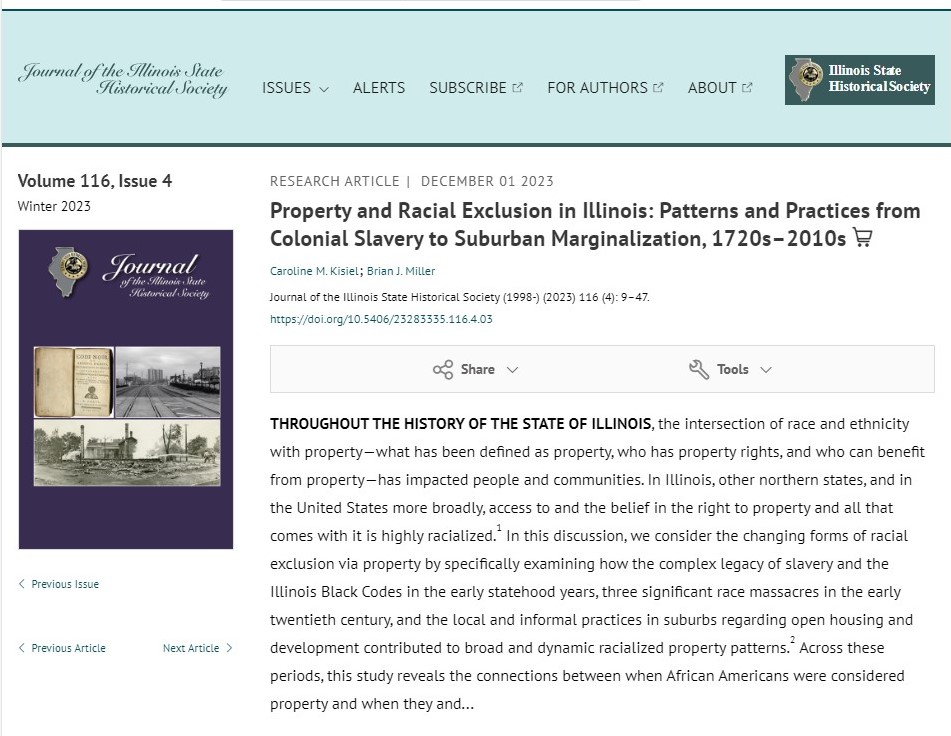
Kisiel and Miller new publication – “Property and Racial Exclusion in Illinois: Patterns and Practices from Colonial Slavery to Suburban Marginalization, 1720-2010s”

Caroline Kisiel and I have a new publication in the Journal of the Illinois State Historical Society. Here is a link to the article/journal issue:

This paper has been several years in the making and the helpful feedback we received along the way made it better.

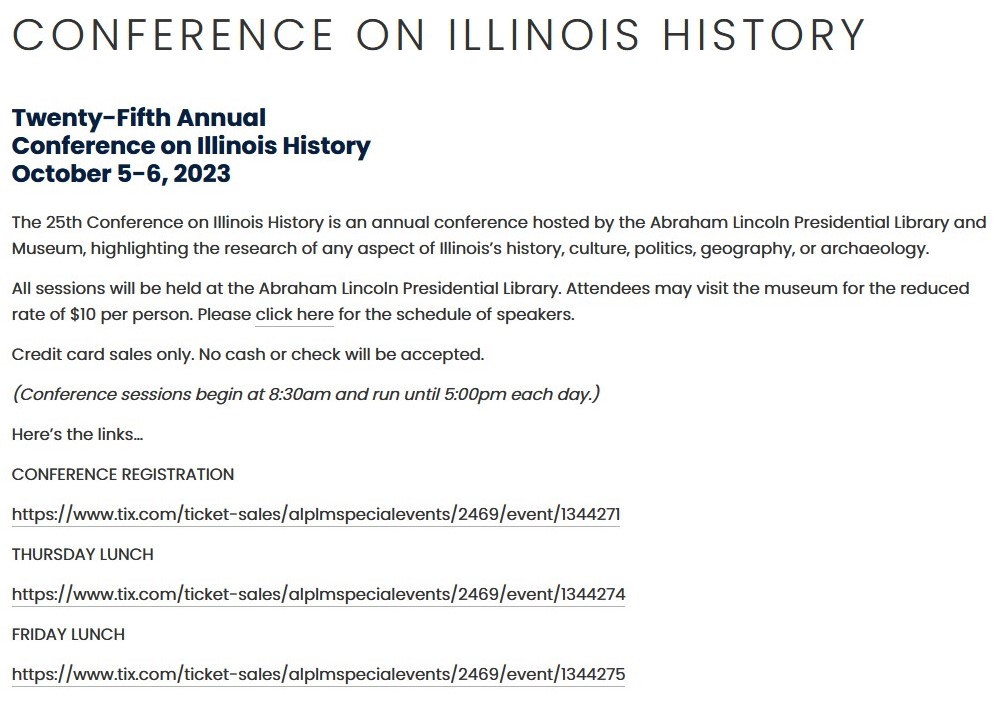
Presenting at the Conference on Illinois History and crossing disciplinary boundaries in research

Later this morning, I will present at the Conference on Illinois History. The title of my talk is “Racial Exclusion, Public Housing, and Affordable Housing: The Cases of Chicago and Naperville” and I present in a session with my collaborator Caroline Kisiel of DePaul University.

This talk builds on previous research I did involving Cabrini-Green in Chicago and in my dissertation on the development and trajectories of three Chicago suburbs. The work is sociological but also historical. The larger scope of research involved weeks in archives looking at primary and secondary sources, reading through newspaper accounts, reading academic histories, and conducting interviews with leaders. I published portions of this work in several outlets, including the Journal of Urban History (Cabrini-Green, the surprising growth of Naperville) and Urban Affairs Review (key character moments in suburban development). Additionally, I have published work in what might be considered media studies. For example, looking at the McMansion on The Sopranos (Journal of Popular Film and Television). Or, examining the architecture and design of teardowns (Journal of Urban Design).

I have done this all with professional training in sociology. Some sociologists do more historical-comparative work and I did have some training in this during my sociology Ph.D. program. I would consider all of this work to be sociological in nature, even if conventions regarding writing, evidence, and making strong arguments differs across academic fields. I have learned much by engaging with work in other fields and it has pushed me to develop my own thinking and writing.

I am grateful for conferences, colleagues, and journals that have been gracious with a sociologist stepping into these fields.

Google Maps can show you the locations of some Chicago area ghost towns

A journalist details some of the ghost towns in the south suburbs of Chicago that pop up on Google Maps:

Photo by John-Mark Smith on Pexels.com

Perhaps kept alive by the unrealized optimism of their founders, places such as East Orland, Rexford, Alpine Heights and Goeselville are long gone, but still show up as potential destinations on internet atlases such as Google Maps…

But Google “Alpine, Illinois” and the algorithm will pinpoint the long-forgotten downtown area of Alpine Heights at 167th Street and 108th Avenue…

“It amuses me that Goeselville still shows up on maps,” Bettenhausen said. “I can’t explain why this happens, because it really was not much more than a post office.”

I assumed Google Maps and other online mapping options are drawing on modern cartographic information. Does this mean this information includes older communities that have not officially existed for decades or that Google Maps draws on historical information as well?

I could imagine an improved Google Maps that is able to show places as they existed in the past. There is a small version of this available right now with Google Street View. If you walk along a street, you can often pull up a previous version of the same view. This only goes back less than two decades but you can still observe changes.

Imagine Google Maps with pictures of former buildings, how roadways used to appear, and older names. You might be able to peel back the layers and look at a place in the 1990s or the 1950s or the 1910s. It would take a lot of work to find and put together all of these images but the ability to see how places are transformed would be fascinating.

Take these suburban ghost towns. Imagine being able to see an old post office or train station. You might then compare what is there today. To do this today, this might require searching for older images online or going to a local historical society to find images.

Radio interview on Illinois history, race, and property on “The 21st Show” on Illinois Public Media yesterday

On Monday, March 27, I contributed to a conversation on “The 21st Show” titled “Illinois’ history with slavery and its links to the present.” You can listen here and I first talk at the 39:55 mark.

Photo by Jean Balzan on Pexels.com

Some of the conversation is based on a co-authored research article in progress with Caroline Kisiel of DePaul University. We discuss the working out and legacy of race and property over 300 years of Illinois history. My previous work in looking at the development of several suburbs in western DuPage County – earlier work published here, here, and here – adds to the latter portion of this history as race and ethnicity influenced decisions about development, zoning, and who was welcome in different communities.

Is American unity only possible when confronting a common threat? Thoughts on reading about the Revolutionary War

After completing the second of two long academic books on the Revolutionary War period and teaching about groups, organizations, and social networks recently in Introduction to Sociology, I had a thought about what can bring residents of the United States together: a common outside threat or enemy. For many groups, knowing what or who they are against is helpful in forging their own identity and connections.

Photo by Sawyer Sutton on Pexels.com

Before, during, and after the American War of Independence, the colonists on the Eastern seaboard of the United States banded together to register complaints, revolt, fight, and then form a new country. This was no easy task; different groups had immigrated to the United States, ties to particular colonies were often stronger than any sense of common cause, and regional differences mattered. During the war, not all residents in the United States supported the colonial side and a good number fought for the British. After the war, it took significant effort to develop a centralized government that could tie all of the colonies together. Ultimately, the war against Britain led to enough collective effort to form a new nation.

Arguably, these patterns have continued throughout American history. There are moments when Americans are united. After Pearl Harbor, the country was devoted to the war effort. The quest to take over the frontier from the Appalachians westward required the efforts of many. The Cold War was fairly all-encompassing. For a short period after 9/11, Americans came together.

But, the opposite tendency is also very present as well. The long presence of slavery that culminated in a bloody Civil War and insufficient efforts to address the ongoing issues afterward. Acrimonious political divides. Different actors looking out more for their own interests rather than the common good. The polarization and outrage of today.

If today the United States is in a period marked by more disunity than unity, is there a common threat that could again bring people together? Hopefully, a war is not required. There might be no shortage of suggestions from different sides about what should be unifying: fighting racism and inequality, climate change, individual freedom, reproductive rights, a commitment to capitalism, to welcome immigrants or not, religious liberty, fighting diseases, the surveillance state, and so on. Such unity has happened before and it could happen again in ways that might be difficult to foresee in the moment.

(Related earlier post: the relatively few things 90% of Americans agree on.)

9/11 occurred during a different era

As the United States marks the 20th anniversary of the attacks on September 11, 2001, it also provides a reminder that the events happened a while ago. American society and the world were different then. Here are a few scattered thoughts on how this passage of time influences how Americans view that day.

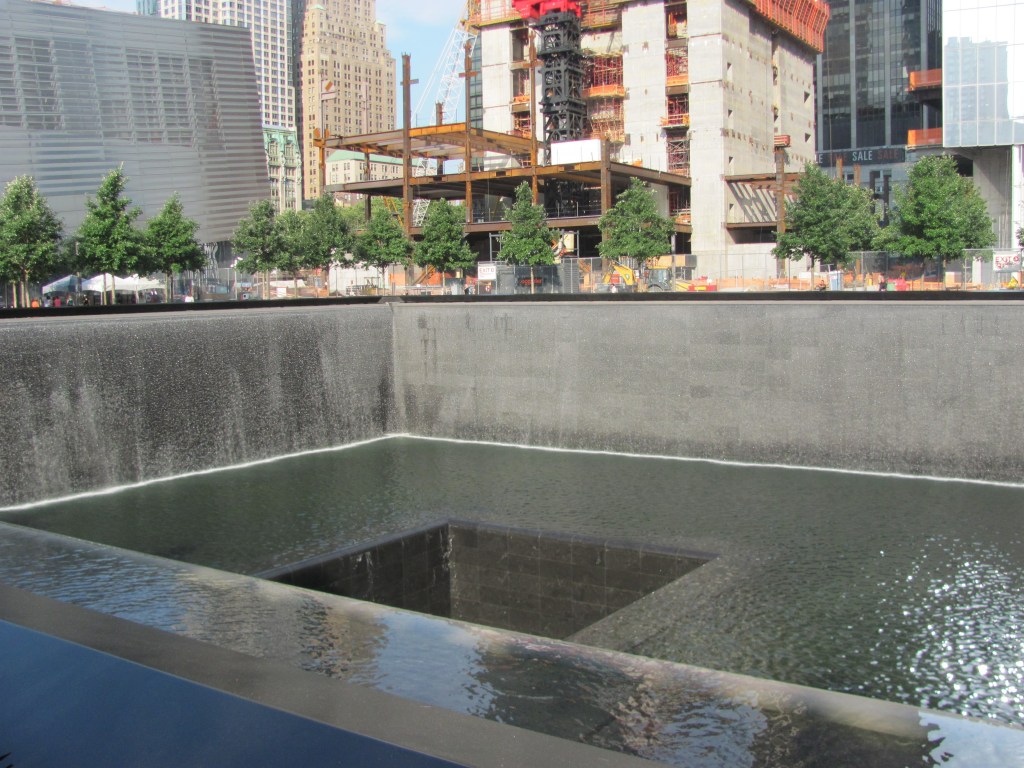
The Ground Zero Memorial in July 2012

-I saw a statistic that roughly 1/4 of Americans alive today were not alive on September 11, 2001. I have been aware of this for at least a few years as the college students I teach were either very young or not yet alive then. To a significant number of Americans, 9/11 is history.

-So much has happened since then that makes it all seem like a different era. The response to the attacks kicked off the War on Terror and the consequences are still being felt (see recent events in Afghanistan). Political polarization increased. The housing bubble burst and more economic instability seems present. Two presidents served their time in office and did so in very different ways.

-The commemorations often stress the quick coming together for rescue and cleanup efforts alongside the expressions of unity among members of Congress and Americans. This did not last long.

-We now have official memorials in numerous locations, including at the sites of the attacks and in communities around the country. Will these be altered or viewed differently as years go by?

Future commemorations will face these issues even more. The United States is not new to such change – how D-Day and Pearl Harbor are marked differs with the increasing age of those alive at the time and World War II might seem like eons ago, the memory of the Civil War has been a conflict for over a century – but subsequent decisions and events could solidify or change 9/11 narratives in ways that might be hard to predict.

Why I would choose to read a 700+ page book versus an 11 page summary on an important historical period

I recently read two histories of a similar time period and both texts addressed the North American aspects of the Seven Years’ War. However, the texts had very different lengths. One book was over 700 pages and included many details. The other book included a summary of the same war in 11 pages. Which was the better read?

Photo by Polina Zimmerman on Pexels.com

Much of this answer depends on what I hoped to accomplish in my reading. Months ago, I had stumbled onto the Wikipedia page for the Seven Years’ War and realized I knew relatively little about it. The North American branch of this conflict involved relatively few troops yet had very important implications for the subsequent history of the United States. I searched out some recommendations on notable academic histories that addressed this period and received a few books from my library. I wanted to know more and now I had options.

I enjoyed reading the 700+ page book. Did I need all the details in my life? Probably not, but much of what I read was fascinating and provided insights that shorter summaries could not. I am glad that I read all of this so that at least at one point in life I could say I tried to take in all of this knowledge.

The 11 page summary was also interesting and well-written. It also took much less time. I recognized the high points of the conflict from the much longer narrative. These high points made a lot more sense given all the details I had read not too long before.

In the academic world, we run into these sorts of issues all the time: how much knowledge do I need to proceed? Would a one page summary be sufficient or should I devote years to studying this? We publish different length materials, ranging from encyclopedia entries and shorter notes to longer articles and books. One cannot read and study everything so we must be judicious in what we spend our time on. Yet, the joys of diving deeply into material is one of the best parts of study and research.

Having read both texts, I am still in favor of reading the much longer text. I may go years before reading anything on the Seven Years’ War and the longer text gave me plenty to consider. I had the time to spend on it and I may not make the same decision regarding another subject area given different circumstances. But, for two weeks this summer, reading a lot about the Seven Years’ War was a good decision.

When television shows help interpret history

What responsibility do television shows have to accurately depicting history? Take the case of The Crown:

Photo by John-Mark Smith on Pexels.com

Historical dramas might similarly warp our attitude toward history, encouraging us to expect that cause and effect are obvious, or that world events hinge on single decisions by identifiable individuals. Academics have been trying to demolish the great-man theory of history for more than a century; television dramas put it back together, brick by brick.

What matters here is that we are having the right arguments about these ethical and dramatic decisions, not lobbing grenades at each other from opposing trenches of the culture war. Reasonable people can disagree over artistic license and the writer’s duty of care to her or his subjects. And none of this would be an issue if so many people didn’t love The Crown. Dowden is right to argue that the show is so popular that its interpretation of history will become the definitive one for millions of viewers.

That is something Netflix could mitigate, if it wanted to. Not with a pointless disclaimer, but with an accompanying documentary, rounding out the stories told in the drama. (There is a Crown podcast, featuring Morgan, but I mean something packaged more obviously alongside the main series.) There is certainly an appetite for one: Three unrelated Diana documentaries now clog up my Netflix home screen, and newspapers have published multiple articles separating fact from fiction.

Ultimately, it is not illegitimate to create narratives out of real lives. In fact, a good historical drama has to do so. But when we talk about the monarchy, modern Britain, and the legacy of divisive politicians like Thatcher, The Crown should be the start of a conversation, not the last word.

Television, and mass media more broadly, has the potential to shape how people udnerstand the world. This is not only because people find it a compelling window to the world; the sheer amount of time Americans spend watching TV on a daily basis means that television depictions have at least some influence.

Given this, it is interesting to consider whether Netflix and other producers and distributors of television should do more to depict history accurately. How possible is this? Here are a few problems that might arise:

  1. Balancing a historical drama with an accompanying documentary might help. But, documentaries are also told from particular points of view. And how many viewers will watch all of both?
  2. History is an ongoing narrative. The Crown comes from a particular point of view in a particular time that may or may not with other depictions before and after. Imagine some time passes after Queen Elizabeth dies and another director with a different vision comes along – how different is the story in facts and tone?
  3. Other mediums could present different realities in different ways. History often requires working with a variety of sources, not just visuals. How about at least giving viewers additional resources to consult?
  4. How much should TV viewers know or be expected to know about particular phenomena they observe?

Public understandings of history, academic understandings of history, and other interpretations of history have the potential to interact with and shape each other. How exactly The Crown helps shape the ongoing conversation about the monarchy, Queen Elizabeth, and all the involved actors remains to be seen – and studied.