Finances, ideal lifestyles, and the push and pull away from cities experienced by young adults

Looking back at residential patterns after the late 2000s economic crisis and the COVID-19 pandemic, what motivated younger adults to leave cities and move to suburban or rural communities?

Photo by Kelly on Pexels.com

Later waves that arrived just after the Great Recession, however, had a different type of migrant identity. As luxury housing continued to be built in New York City and affordable areas disappeared, some residents found the big city “inhospitable to their desired urban lifestyle and identity”: “Many of today’s newcomers to Newburgh use the term ‘priced out’…though few actually left in direct response to their rents rising or their landlord pressuring them to move out,” Ocejo writes. “But cost still played an important role in their decision to relocate…. They felt displaced from their own potential and opportunities to thrive as middle-class urbanites living a specific city lifestyle in the metropolis.”

Herein lies the tension between getting “pushed” from a city versus “pulled.” Some contemporary migrants are pushed from a particular lifestyle and pulled by a promise that it can be built elsewhere. Unlike midcentury white flight—which was highly dependent on the construction of suburban housing, racism, and statecraft—middle-class millennials (especially those facing mounting city prices and remote work) find that smaller cities and towns cater to a broader vision for life, one that provides opportunities to buy a house, build a business, or comfortably raise a family…

“When people move from one community to another…they leave behind their old job, connections, identity, and seek out new ones. They force themselves to go meet their neighbors, or to show up at a new church on Sunday, despite the awkwardness,” Appelbaum writes. What this might mean for rural or metro areas is yet to be seen. But for people moving out of large cities, it’s redefining what upward mobility might look like. Building wealth through housing may be unattainable, but it’s being replaced by a search for a new American dream: self-actualization.

What I read in this description is an intertwining of financial matters and what lifestyle people see themselves having. Costs and resources matter; housing is a sizable portion of many budgets. Housing has become more expensive in many American metropolitan areas. But cultural narratives and individual aspirations also matter; what life does someone want to live? What do they see as a good life?

On this first factor, it helps to have more financial resources. The stories told in this article seem to involve people who had enough resources that they had options of where to live. They could make a major move, perhaps by selling a residence in one place to go to another. Or they had careers and job skills that enabled them to live in multiple places.

On this second factor, Americans have developed a lot of narratives over time about desirable lives. They want a single-family home in the suburbs. They want to be individuals who pursue their own path (the self-actualization suggested above). They want to engage community life. And so on.

Perhaps then it would be helpful to think about a two-pole line that demonstrates how people make decisions about where to live and what to pursue. On one side of the line is finances and what is possible in terms of money and resources. On the other side of the line is an image of the life they want to live and what that entails on a day-to-day and long-term basis. Depending on the current situation personally and in society, they might slide a marker more toward one pole than the other.

(Does this describe how young adults make these decisions or is this limited to a certain subset with particular resources and goals?)

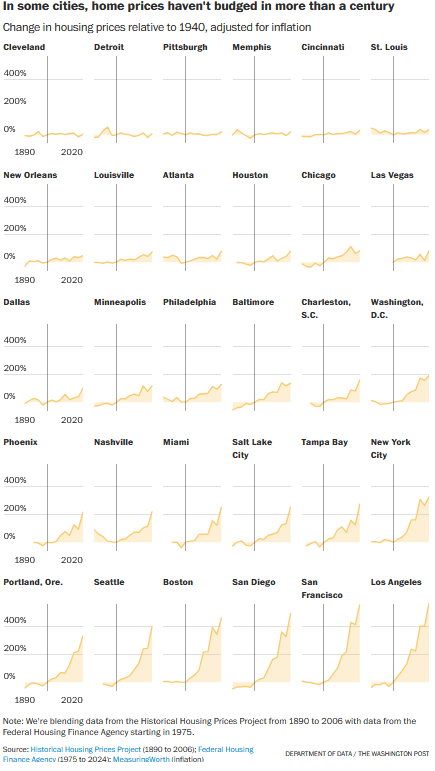
Some American cities have seen no gain in housing values for decades, others with large gains

Looking at long-term data regarding housing values in different American cities shows large differences across places:

What drives these differences?

When we stopped to think about that, we couldn’t get it out of our heads. So many of us have internalized the lesson that homes are speculative, flippable investment vehicles, yet in much of the country — Cleveland, Memphis, Detroit, we could keep going — housing has been a truly quotidian commodity. There, home prices simply keep pace with inflation over the long run, no different from spaghetti or sprockets…

Consider that Dallas, Houston, Seattle and Portland, Oregon, all had what the researchers would classify as high demand for housing. But prices in Dallas and Houston have only roughly doubled in price since 1890, compared with a more than sixfold jump in Portland, or almost fivefold in Seattle…

“If prices go up,” Lyons asked us rhetorically, “does supply come on stream to follow? Do people look to build homes?”

Since 1970, the metros where housing stock grew the least relative to population growth — think Los Angeles, San Francisco, San Diego or Seattle — saw the some of the fastest home price growth. While metros that built enough housing — such as Atlanta, Phoenix and Charleston, South Carolina, saw home prices rise much less rapidly, even as their populations soared.

Does this suggest that Americans have come to view houses as investments when some places in the country have not experienced large increases in housing values over time?

For the cities with big increases over time, how do local leaders and residents see the jump in property values? It clearly leads to issues with affordable housing: rising housing values prices some people out of the market, particularly compared to what that market was and what residents had previously experienced. But rising housing costs can be viewed positively: people can sell their properties for more money and rising values can be associated with success.

This might be another reason why it is difficult to address housing issues at a national level. Housing is a very local issue and the cities in the top row of the graphic above have very different conditions compared to the cities in the bottom row.

Housing issues are incredibly local – and they follow patterns across places

The issues of housing in the Chicago region are very local. How Chicago selected public housing sites and later handled the demolition of public housing high-rises. The discussions of affordable housing go in suburbs and the protection of single-family homes from perceived threats. Municipalities get to set their zoning maps, local officials make decisions regarding development, and residents weigh in.

Photo by Dmytro Koplyk on Pexels.com

But at the same time, these are not just local issues. There are patterns across places. What happened with public housing in Chicago may not have been exactly the same as what happened in other major cities but the effects of federal legislation and monies and public perceptions about public housing influenced numerous cities. Suburbs have unique characters but types of suburbs – say edge cities or inner-ring suburbs – can have similar experiences and trajectories. The ways zoning is used to privilege single-family homes and exclude people and undesirable uses is common. National ideologies regarding desirable and undesirable housing influences leaders and residents.

Figuring out how to link these two realms regarding housing – national and state-level policies and meanings and local action and sentiment – is very important to addressing any large-scale housing issues. Abandoning larger-scale efforts because all housing is local is not helpful. Focusing efforts only at the state or national level can ignore complexities within communities and regions.

Harris: “We will end America’s housing shortage.”

Presidential candidate Kamala Harris said this about housing in her speech at the Democratic National Convention this past week:

Photo by Palo Cech on Pexels.com

That’s why we will create what I call an opportunity economy. An opportunity economy where everyone has a chance to compete and a chance to succeed. Whether you live in a rural area, small town, or big city. As President, I will bring together: Labor and workers, Small business owners and entrepreneurs, And American companies. To create jobs. Grow our economy. And lower the cost of everyday needs. Like
health care. Housing. And groceries. We will: Provide access to capital for small business owners, entrepreneurs, and founders. We will end America’s housing shortage. And protect Social Security
and Medicare.

I am interested in hearing more about this plan for housing for two reasons:

  1. I think many Americans perceive this as a need. People need more housing, particularly cheaper good housing. They want the opportunity to invest in a residence and a community. They want the opportunity for that ownership to be an asset down the road. They do not want housing to take up too much of their budget.
  2. I have tried to keep track of this issue during recent presidential elections and it does not appear to an issue that candidates lead with. There could be multiple reasons for this: it is difficult to addressing housing at a national level when it is often a local issue and it may not be a “winning” issue with voters compared to other topics. However, I have often thought that a candidate that could promote a reasonable and doable strategy that could help people would do well to do so.

Could the two candidates offer more about housing in the coming weeks?

Can pro-housing movements be bipartisan in a polarized era?

Jerusalem Demsas tackles an interesting question: how can housing advocates navigate a society marked by political polarization?

Photo by Simon Rizzi on Pexels.com

One thing that helps bind an ideologically diverse pro-housing movement is that everyone in a community suffers when housing prices soar. Checking Zillow is a nonpartisan activity. The other thing keeping the coalition together is that, well, it’s barely a coalition at all. YIMBYs work in the context of their own states and cities. No national group dictates the bills they support or the messages they send.

On the other hand:

That doesn’t mean the bill will become law. Hobbs told reporters she’s still considering whether or not to sign the Arizona Starter Homes Act, noting that she prefers legislation with support from local jurisdictions, and this bill has been opposed by the local-government lobby. Either way, the political price is low. In a state as divided as Arizona, where the last gubernatorial election was between Hobbs and the right-wing firebrand Kari Lake, no one’s switching their votes over zoning policy.

Not even die-hard YIMBYs. “I’m a Democrat; I voted for the governor,” Solorio told me. “And if she ended up being the biggest NIMBY in our state, I’d still vote for her reelection because zoning, even though I’m one of the biggest zoning-reform advocates in the state … still doesn’t rise high enough for me to flip my vote.”

I have argued before that housing is a local issue. Theoretically, Americans are less partisan at the local government level as they focus more on addressing community needs. Or, perhaps they are just less partisan here compared to the state or national levels.

If the YIMBY movement is able to be less partisan, is this partly because such movements are still rare or not that popular? It takes a lot of work to convince American property owners that more housing should be added near them. It is one thing to support housing in the abstract and another to support it nearby.

Might another path forward be to have third-party candidates that only promote more housing? This means they would not get entangled in other issues and could focus on one issue.

Oppose housing most effectively with environmental lawsuits

A story about battles over housing plans in Minneapolis highlight one effective strategy to stall housing:

Photo by Sora Shimazaki on Pexels.com

But the legal avenue available to opponents was through environmental law because, across this country, if you want to stop the government from doing something—such as building a border wall or just allowing new housing—an environmental lawsuit is the clearest way to challenge it.

The lawsuits may not win but they serve their purpose by providing significant delays. The lawsuits also require resources and provide time for the public to think further about the sides. Delays can drive up costs and plans for communities and developers can change in the mean time.

The basis of the article about Minneapolis is the premise that the city and region need more housing, particularly with growing populations. But, building housing and changing regulations about housing is contentious and time-consuming. People disagree, even among those who might appear to be on the same side (environmentalists, pro-housing, etc.). Are lawsuits the way decisions about development and the environment should be made? Environmental lawsuits can help check problematic plans but they can also be less helpful. Are there better systems for working out differences of opinions about development?

“There are no known organized efforts in the suburbs for residents to take in asylum-seekers.”

As municipalities in the Chicago region develop regulations to limit migrants from staying in their communities, one local leader wonders if residents would house migrants in their homes:

Photo by khairul nizam on Pexels.com

McBroom said Naperville has provided migrants safe passage to Chicago without spending taxpayer dollars to house or aid them.

But with more migrants arriving in the area, McBroom says the city should look into whether any residents or organizations are willing to help.

“My idea would be let’s find out … let’s find out who’s willing to help,” he said, adding that Naperville is an affluent community with many large homes. “If there are people who would do that, God bless them.”

There are no known organized efforts in the suburbs for residents to take in asylum-seekers…

Meanwhile, McBroom acknowledges there are many unanswered questions about his idea to have Naperville residents voluntarily house migrants. Some of those include the impact the proposal may have on local schools and what role the city would play in managing a list of volunteer hosts.

Thus far, few communities have indicated much interest in helping migrants find opportunities in the suburbs. I have only seen efforts in this direction from Oak Park. Most communities in the news have been developing regulations so that migrants do not stay and/or they are making sure migrants dropped at suburban train stations make their way to Chicago.

This idea has the potential to bypass community-level initiatives and instead coordinate efforts of residents and property owners. How much space might be available in homes and buildings in a suburb with nearly 150,000 residents? How many people would volunteer?

I could only imagine what might happen among (1) neighbors of people who are willing to house migrants and (2) if names and addresses of individual hosts became known to the public.

We will see where this goes, but I imagine it would not go too far if there is the possibility of state money available to communities in the near future.

What the White House alone can do to help homebuyers

Given the high cost of purchasing a home at the current moment in the United States, what can the President and the Executive Branch do on their own? In addition to supporting legislation for a new tax credit, the Biden White House has ideas about its own actions:

Photo by Aaron Kittredge on Pexels.com

Brainard suggested that President Joe Biden will not wait for Congress. The administration, for example, said that it was advocating for zoning reforms that will help unlock the construction of affordable homes.

“Our Department of Transportation is making billions of dollars in low-cost loans available for developing housing near transportation,” Brainard said.

The administration has also been trying to help first-time buyers who have struggled to gain a foothold into homeownership. Home prices were nearly 6 times the median potential first-time homebuyer income in the third quarter, according to NerdWallet’s recent analysis.

The White House pointed out that it was trying to reduce costs for first-time buyers through the the Federal Housing Administration program. The effort, it said, helped reduce mortgage insurance premiums by 0.3 percent.

Many presidents from the early 20th century onward have promoted homeownership in rhetoric and policy. These proposed actions would continue this pattern. Could a president even if elected if they did not support homeownership for the masses? See great quotes in homeownership.

Of course, the President and the Executive Branch can only do so much in this area. Yet, a number of important changes to housing policy have come through this branch. Will Biden make a significant change or is this about temporary salves? All of these proposals do not alter the fundamental economic realities that make current homes so expensive. They offer incentives or help around the edges. Addressing zoning from a federal level could prove interesting as it is such a local matter.

Americans largely in favor of policies that would lead to more housing – but how many want that housing near them?

New data from Pew shows large majorities of Americans are in favor of more housing:

Photo by Maria Orlova on Pexels.com

The findings from one of the largest surveys done on these issues shows significant but varying support for 10 policy initiatives to encourage more housing. At the high end, nearly 9 in 10 (86%) say they would back efforts to expedite permitting processes, while at the lower end, about half (49%) support the concept of allowing smaller lots, and homes to be built closer together…

Support for most of the housing policies transcended the usual fault lines of political party, region, race, income, and gender. The eight most popular proposals received clear majority support from Republicans, Democrats, and independents. In addition, 9 of the 10 tested measures received majority support from both renters and homeowners. All of these policies have either already been shown to work in improving housing affordability in American cities and towns or have recently been enacted by state or city policymakers hoping to do so.

Some approaches that stood out as especially popular—earning support from more than 70% of respondents—are similar to state laws that have passed in recent years (although the survey questions themselves were not modeled on any particular laws). For example, in 2023, California, Montana, Texas, and Washington took steps to simplify permitting for new housing. In recent years, California, Massachusetts, Montana, and Utah have passed laws to enable more housing near commerce or transit. And Maine, Montana, Oregon, Utah, and Vermont, among others, have enacted legislation to allow houses to have an accessory apartment or dwelling unit, as have many cities…

Respondents also broadly supported the reasons behind efforts to create more housing, with 65% to 82% seeing each reason as excellent or good. (See Figures 3 and 4.) However, in some cases, Republicans and Democrats prioritized different reasons. For example, somewhat more Republicans (68%) than Democrats (62%) identified freedom for property owners as an excellent or good reason, while more Democrats (81%) than Republicans (49%) chose reducing racial segregation as an excellent or good reason. But large majorities of Democrats, Republicans, and independents see improving housing affordability and allowing more people to live near their preferred jobs and schools as excellent or good reasons to change housing rules to allow more homes to be built in cities and suburbs. Successful state-level efforts to allow more housing have consistently received bipartisan support, and the survey results indicate that people with different political views can come together to support policies to end the housing shortage and affordability crisis for different reasons. 

Americans like the idea of owning housing. Add this to the current state of housing where both owning and renting is expensive and Americans broadly like more housing.

Here is my question: how many want this new housing near them? Even if Americans like more housing in the abstract, they may display much more resistance when this becomes a local issue. This is part of the reason housing is such a difficult issue to address in the United States: it is often a local issue where local governments and residents who want to control their surroundings. Housing is a good thing but people often move to a neighborhood and community and want to limit who else can live there.

Thus, the expression of this majority for housing is difficult to put into practice. Even state laws are often fraught as it can run against local desires. Take the efforts in Illinois to promote affordable housing at the state level: the initial legislation had limited enforcement and more would need to be done for state-level policy to provide more housing.

As noted above, one of the routes forward that could gather more local support involves policies that provide more opportunities for current property owners. Adding ADUs, for example, provides a choice for current property owners to generate more income or provide housing for family. Other policies might be viewed as funneling money to outside developers or providing housing for people who would not be as welcome in the community. If policies can add housing units and enrich/protect homeowners, they might find more support.

Pilot ADU program in New York City

New York City has started a small program that could help address the need for housing in the city:

Photo by Centosfotos on Pexels.com

New York City just unveiled its newest effort, which will hand 15 homeowners up to $395,000 to build an additional apartment. This could mean an extra unit in a garage, basement, or attic, or a tiny home in the backyard. The idea is to boost housing density in a city in desperate need of new housing.

New Yorkers can apply online for the funding, but high-income residents aren’t eligible — the income limit for a family of four is $232,980, the New York Times reported. And the ADUs that are built will have a limit on rent: a one-bedroom can’t be rented for more than $2,600.

The city’s department of housing preservation and development on Tuesday unveiled the “Plus One ADU” pilot program, similar to a state-wide initiative with the same name that has doled out tens of millions of dollars to help homeowners across New York State build ADUs in their backyards…

The effort is part of the city’s sweeping new housing reform proposal, which seeks to pave the way for 100,000 new homes in the city by encouraging conversions of commercial buildings into residential, boosting density near mass transit, and reducing space devoted to parking. The proposal also aims to legalize ADU construction across much more of the city.

Adding 100,000 units would be helpful as the city, like many major cities, needs lots and lots of units to provide more housing options and address housing costs. But, how quickly can these units be added and how much can they ease the housing issues? It would be worth looking at the math on this; at what point do the government funds lead to long-term savings? Hopefully, this is part of a comprehensive strategy that tries to add housing units in multiple ways.

Not all New York City is as dense as Manhattan but it is a pretty dense American city. How dense are city residents willing to go? Like many cities, there are different clusters of housing units in different neighborhoods. Adding a housing in basements or backyards can only happen in certain places and these changes would add residents. ADUs might be less visible than other means of providing more housing units – for example, high-rises would not be welcome in many residential neighborhoods – but Is there a point where residents feel there are enough ADUs?