Some of my published work involves examining the actions of local governments. Thus, I was interested to read some published numbers about the size of local government:
The United States has nearly 90,000 local governments, with hundreds of thousands of elected officials. Indeed, the vast majority of elected officials serve at the local level. Moreover, local governments employ over ten million workers and collect nearly a quarter of the nation’s total tax revenues (Trounstine 2009, 2010).
Americans tend to like local government as it reduces the distance between voter and representative and can also address local interests more directly. But, put all of those local government units together – and they are not evenly spread out depending on location, Illinois has more, and population – and many people and lots of resources are involved. Additionally, the interaction between local government and other layers and levels of government also requires a lot.
Housing activists and lawyers filed a complaint over aldermanic prerogative with HUD in 2018, alleging that allowing aldermen de facto veto power over most development proposals in their wards promotes housing discrimination by keeping low-income minorities from moving into affluent white neighborhoods.
The complaint against the city alleges that “aldermanic prerogative” helps residents who fear racial change pressure aldermen to block affordable housing projects by publicly raising concerns over school overcrowding, declining property values and other “camouflaged racial expressions.”
HUD officials continue investigating the matter and sent a letter to aldermen Dec. 1 asking them a series of questions about aldermanic prerogative, including how they define the term.
This reminded me of how aldermen helped shape the locations of public housing projects after World War Two. From the Encyclopedia of Chicago:
When Congress passed the Housing Act of 1949, which provided substantial funding for public housing, CHA was ready with a map of proposed sites for projects to be built on open land throughout the city, but the city council rejected this map altogether. White aldermen rejected plans for public housing in their wards. CHA’s policy thereafter was to build family housing only in black residential areas or adjacent to existing projects. This rejection explains the concentration of public housing in the city center on the South and West Sides.
In a city marked by residential segregation, numerous methods for keeping Black residents out of white neighborhoods, and white flight away from the city, the protection of certain areas has been a major emphasis. Affordable housing and public housing are typically viewed as unattractive land uses in whiter and wealthier communities with residents and leaders expressing concerns about property values, safety, and other matters with a sometimes stated and sometimes not underlying factor of race and ethnicity.
A large crowd in the city council chamber erupted in applause when the vote was completed. Each council member and Chirico expressed gratitude for the work put in by all parties throughout the process that played out over nine months in the city’s planning and zoning commission with 500 speakers in 15 meetings.
“We all know it was painful,” Chirico said. “There were times where I was entertained. There were times where I was angry. There were times where I was throwing my shoe at the TV. Every emotion it seemed like it went through.”
Even as life will now continue with the different actors involved, acknowledging the difficult process is noteworthy. In my study of such proposals, the religious groups do not always reach the outcome they desire nor do communities and residents always get what they want. Here, describing the process as “painful” could refer to a number of things – the time it took, figuring out the particulars, working with all of the interested parties, etc. – and very involved may have attained exactly what they wanted at the beginning.
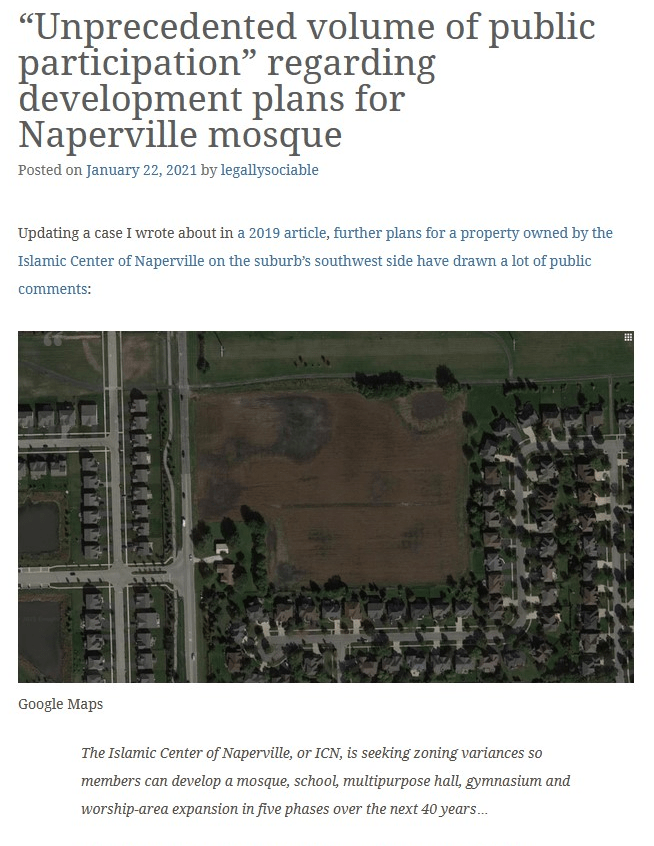
It is also worth noting that the same group and site may be up for conversation again in the future. In order to help the proposal succeed, the Islamic Center of Naperville agreed to submit future changes for the building and property for review:
The final step pushing the proposal over the finishing line was a concession by the Islamic Center to submit its third, fourth and fifth phase to additional city council review when the time comes. A group representing the nearby subdivisions of Ashwood Pointe, Pencross Knoll and Tall Grass agreed to accept the proposal with those conditions.
Will the process at that point be less painful? The group has made two proposals and both times has encountered numerous questions from neighbors and community members. Some of the particular actors involved in those two discussions may be gone but the underlying questions may not.
The modern U.S. is thus a decentralized nation, where despite an urban revival in recent years the periphery has kept growing faster than the center. Rural areas aren’t growing; most American counties actually lost population in the 2010s. But low-density suburban counties attached to large metropolitan areas grew faster than either high-density suburbs or urban counties, economist Jed Kolko calculated recently, while the fastest-growing major metro areas (Austin, Orlando, Raleigh, Nashville) aren’t among the largest.
This is a little hard to square with claims that large cities continue to wield great political clout. If it weren’t for the Electoral College, according to one oft-heard argument, voters in New York, Los Angeles and/or Chicago would choose every president. How they would manage to do this with only 4.7% of the nation’s population is a bit of a mystery. True, the three cities’ metro-area populations added up to 13% of the U.S. total in 2020, but that was down from 13.3% in 2010 and traditionally suburbs and cities largely canceled each other out politically — although that has been changing lately.
There’s a stronger argument to be made that economic power and cultural clout remain concentrated in a few places. Gross domestic product grew more slowly in the 10 largest metro areas than the country as a whole from 2010 to 2019 (2020 data aren’t out yet), but per-capita personal income grew faster. New York still dominates finance and the news media, Washington dominates government, Los Angeles rules entertainment and San Jose and San Francisco technology.
Census data suggests that the majority of the American population lives in suburbs. But, population alone cannot explain the importance and persistence of big cities. They will continue to remain powerful and important for multiple reasons. They help anchor broader metropolitan regions. They are centers of finance, innovation, real estate, cultural opportunities, key transportation infrastructure, and other essential activity. They occupy some of the most important and strategic locations. They have long histories.
At the same time, a decentralized landscape means (1) no single city or set of cities may dominate activity and/or (2) residents of the United States may not feel the importance of cities. For example, even with data showing the importance of cities and their regions for economic activity, Americans consistently discuss small businesses and farmers. Or, Manhattan and Washington, D.C. may dominate headlines but many Americans will be more invested in their local regions or communities.
More broadly, it may be safe to describe all of American society as more decentralized than other developed countries. I am thinking of Frank Dobbin’s book Forging Industrial Policy where France is the example of a more centralized state, both in terms of government structure – more power at the state level – and geography – all roads/rails lead to Paris. The United States has had from the beginning a system with distributed powers at the federal, state, and local levels as well as a broad landscape with many kinds of settlements.
Itasca’s plan commission on Wednesday unanimously agreed to recommend the village board deny Haymarket’s proposal. The Chicago-based nonprofit group is seeking permission to convert a former hotel along Irving Park Road into a 240-bed facility for adult patients with drug and alcohol use disorders.
The final decision rests with the village board. But trustees don’t want to rush their decision.
On Thursday, Mayor Jeff Pruyn said the village board plans to have at least two special meetings beginning in the middle of October. The first would allow public comment about the proposal. Haymarket representatives would make their case before the village board during the second.
As a result, the village board will not vote on the proposal until late October or early November.
Making a hasty decision may be in no one’s best interest. Particularly given the controversy surrounding the proposal, making sure everyone has a chance to voice their opinion and the board has all the time to make up their mind seems reasonable.
At the same time, what would change between now and then that would have a big effect on how the board members are viewing the situation? The proposal has been under discussion from some time and community members have made their voices heard.
This is not an easy decision for a smaller community to make. There could be consequences for life in the community and future development. Either way, some people will be upset. The village board decision will either agree with the plan commission or go the other direction (and the board is able to choose either option).
Yet, a decision needs to be made. I will be interested to see what happens: how will Itasca respond? Will Haymarket look for another suburban location? More broadly, what suburban communities might welcome land uses like these that are needed in metropolitan regions?
Come 1970, there was broad support for a portentous shift: Los Angeles would abandon the top-down planning that prevailed during a quarter century of postwar growth in favor of an ostensibly democratized approach. The city was divided into 35 community areas, each represented by a citizen advisory committee that would draw up a plan to guide its future. In theory, this would empower Angelenos from Brentwood to Boyle Heights to Watts.
In practice, it enabled what the Los Angeles land-use expert Greg Morrow calls “the homeowner revolution.” In his doctoral dissertation, he argued that a faction of wealthy, mostly white homeowners seized control of citizen advisory committees, especially on the Westside, to dominate land-use policy across the city. These homeowners contorted zoning rules in their neighborhoods to favor single-family houses, even though hardly more than a third of households in Los Angeles are owner-occupied, while nearly two-thirds are rented. By forming or joining nongovernmental homeowners’ associations that counted land-use rules as their biggest priority, these homeowners managed to wield disproportionate influence. Groups that favored more construction and lower rents, including Republicans in the L.A. Area Chamber of Commerce and Democrats in the Urban League, failed to grasp the stakes.
The Federation of Hillside and Canyon Associations, a coalition of about 50 homeowners’ groups, was one of the most powerful anti-growth forces in California, Morrow’s research showed. It began innocently in the 1950s, when residents living below newly developed hillsides sought stricter rules to prevent landslides. Morrow found little explicit evidence that these groups were motivated by racism, but even if all the members of this coalition had been willing to welcome neighbors of color in ensuing decades, their vehement opposition to the construction of denser housing and apartments served to keep their neighborhoods largely segregated. Many in the coalition had an earnestly held, quasi-romantic belief that a low-density city of single-family homes was the most wholesome, elevating environment and agreed that their preferred way of life was under threat. Conservatives worried that the government would destroy their neighborhoods with public-housing projects. Anti-capitalists railed against profit-driven developers. Environmentalists warned that only zero population growth would stave off mass starvation.
Much like the Reaganites who believed that “starving the beast” with tax cuts would shrink government, the anti-growth coalition embraced the theory that preventing the construction of housing would induce locals to have fewer kids and keep others from moving in. The initial wave of community plans, around 1970, “dramatically rolled back density,” Morrow wrote, “from a planned population of 10 million people down to roughly 4.1 million.” Overnight, the city of Los Angeles planned for a future with 6 million fewer residents. When Angelenos kept having children and outsiders kept moving into the city anyway, the housing deficit exploded and rents began their stratospheric rise.
Local school boards around the country are increasingly becoming cauldrons of anger and political division, boiling with disputes over such issues as COVID-19 mask rules, the treatment of transgender students and how to teach the history of racism and slavery in America.
Meetings that were once orderly, even boring, have turned ugly. School board elections that were once uncontested have drawn slates of candidates galvanized by one issue or another…
School boards are typically composed of former educators and parents whose job, at least until recently, mostly consisted of ironing out budgets, discussing the lunch menu or hiring superintendents.
But online meetings during the pandemic made it easier for parents to tune in. And the crisis gave new gravity to school board decisions. Parents worried their children were falling behind because of remote learning or clashed over how serious the health risks were.
This preference for local input and control is not just limited to suburbs: from the beginning, Americans have generally liked the idea of decentralized power. In the realm of education, there is input from the federal government, state government, and local bodies and districts. Local citizens retain some ability to provide their opinion on local education and to serve on local governments that control budgets and other aspects of local education.
Because of this system, people can work through different channels to address issues they are concerned about. Perhaps they can pressure the national Department of Education. They might seek to influence state boards. They can run for local boards and show up at meetings to voice their opinions. All could be useful in terms of promoting particular educational paths or policies. At the same time, I would guess there is an immediate satisfaction at showing up at local meetings, seeing real people in your community that shape schools, and advocating for change. These are not distant bureaucrats grinding out policy decisions; these are local elected residents who meet at regular times.
In the current moment, decisions made by local school boards help to differentiate different communities from each other. One district might be open to teaching something where another says no. Money may be allocated one way in a particular community while it is not a budget line in another. Board members may claim to represent one part of a community and not others. Local schools are not just about education; they symbolize local priorities and concerns. They help address or reinforce racial, ethnic, class, and gender boundaries in and across communities. Schools are both a part of the status of a community and contribute to that status.
In this article, it sounds like many of the school board battles are proxy fights over national issues. Whether this serves individual communities and their residents well remains to be seen.
The first rung on the homeownership ladder has long been an affordable “starter home.” These houses, with their smaller footprints and selling prices, allowed young homeowners to build wealth and upsize as they started their families…
Supply of “entry-level housing”—which Freddie Mac defines as homes under 1,400 square feet—is at a five-decade low.
Surging prices and stiff competition mean there aren’t enough smaller, more affordable starter homes to go around in many regions. The pandemic and subsequent recession, along with the student debt crisis and delayed family formation, contributed to frustration and despair among younger house hunters…
Lately, data from the National Association of Home Builders shows new construction is again giving priority to higher square footage for single-family homes, a trend likely spurred by the widespread shift to working from home and house hunters’ need for more space.
I wonder about the role of local governments. How many urban neighborhoods and suburban communities allow for or encourage the construction of smaller homes. It might take some extra work for a community to work with a developer who is willing to construct smaller and cheaper homes. At the same time, some of the existing members of the community might not be happy about the change as smaller homes are often interpreted as dragging down values and the character of the community. At the least, wealthier communities are unlikely to encourage such homes unless they are at a higher price point – and then it is no longer a starter home.
Such a post-mortem would likely reveal that the party’s disinterest in holding onto the suburbs prevents the rise of new Pattersonian Republicans with their own identities separate from Trumpism and that this will have long-term historical consequences.
“There are dozens, if not hundreds of these local or regional-level political power brokers who shape the outcomes of how our cities and regions function in ways that just aren’t visible to most people,” says Delmont, the Dartmouth historian. “We spend so much time talking about who’s in the White House or even who’s in Congress. But it might be the L. Brooks Pattersons of the world who actually determine, like: Do we have affordable housing? Do we have segregated cities? Do we have police forces that are militarized? The people who actually operate the levers of power are probably much more positioned like a Brooks Patterson than a President Trump or President Biden.”
National politics are indeed often built on smaller units of government. While a lot of attention goes to presidential elections (and this article also focuses on Donald Trump and how this connects to local politics), there is a lot of work that happens at the Congressional, state, and other levels that undergird the larger outcomes. A candidate or political party is going to struggle without grassroots, lower-level support.
This reminds me of my blog post Thursday about addressing housing issues municipality by municipality. We often look at particular issues at a national level. How to provide affordable housing? How to explain the rise and fall of Donald Trump? There are multiple levels of analysis possible and needed. In this post and on Thursday, the reminder is that the local level matters. Does Oakland County and all the local machinations about county seats and redestricting determine who will be president or which political party will control Congress? No, but add up a lot of counties in important areas – particularly with suburban voters who can be swayed election to election – and this can start to matter.
The Federal Highway Administration released a draft of proposed changes late last year. The last time the manual got an update, a few thousand people, mostly transportation professionals, submitted comments. This year, 26,000 comments poured in from all over the country.
Some arrived from big companies, including the ride-hail and mobility companyLyft, the Ford-owned scooter-share company Spin, and the Alphabet company Sidewalk Labs. Each asked for a major rewrite that would, as Sidewalk Labs put it, “more closely align with the equity, safety, and sustainability goals of American cities, as well as those of the Biden administration.”
Others came from individuals. “There’s a broader set of people who see that these streets don’t work, that there are too many people getting killed, that they’re too unpleasant. It’s not consistent with what a place or a community should be,” says Mike McGinn, a former mayor of Seattle and executive director of the group America Walks. He credits those everyday activists with the new interest in the design document—and his own group, which urged thousands of people to submit comments to the federal agency…
The last time the manual got an update, the process took more than a year; with the volume of comments this year, it may take longer. A spokesperson for the Federal Highway Administration says the agency “needs to carefully consider all comments before determining next steps and the timetable for updating the manual.” Given the interest, that might take a while.
One of the reasons Americans like local government is that it is easier to interact with the officials who are making the decisions. For example, in a small town to a moderately sized suburb, a resident who has feedback on a municipal decision can probably even convey this face-to-face or in a public meeting. As the size of the municipality grows, it becomes harder to meet with local officials.
At the federal level, some might feel that decisions are made by an abstract group of people in a place far away. This idea has been expressed regularly in recent years: Washington D.C. is out of touch with the rest of the country.
However, this process of public comment described above offers an opportunity for people around the United States to comment on federal guidelines for roads. In the age of the Internet and social media, this is even easier to do: people can hear about it through email or social media feeds and submit comments online.
How exactly the federal agencies in charge here work through all of these public comments would be interesting to examine. Assuming they are all read or analyzed, do they look for the most common themes? Or, are some comments weighted more than others? This sounds like an important qualitative research process in order to find the patterns in all of the comments, discuss, and then incorporate (or not) into a revised manual.