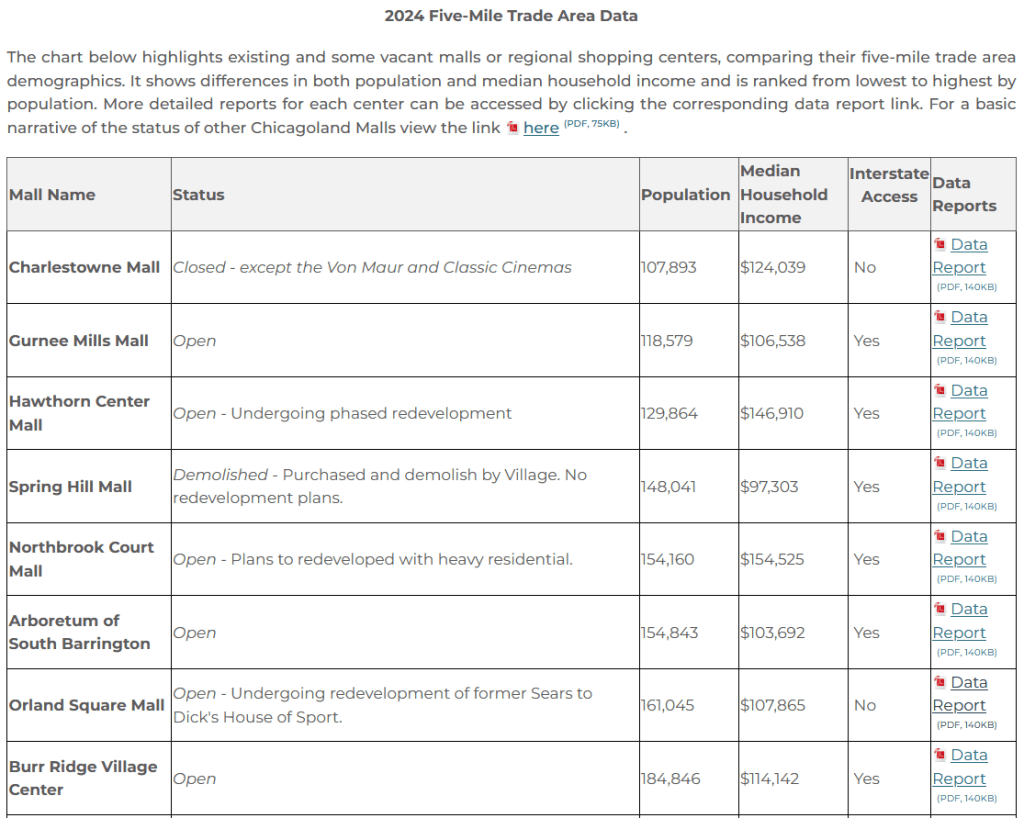
Commercial businesses such as retail stores, restaurants, and entertainment venues depend on a strong local population to generate steady sales and foot traffic. The more households that surround a shopping center, the greater the built-in customer base to support those businesses and the more attractive the redevelopment is for a developer. For Charlestowne Mall, the surrounding area has relatively low population density compared to other successful shopping corridors in the region. With fewer nearby residents, there is less day-to-day demand to sustain large-scale retail, making it harder to attract and retain major tenants. The graphic below provides the basic demographic and market data within a five-mile radius of the Charlestowne Mall site. Developers and businesses rely on this data to evaluate the market feasibility of proposed commercial uses and to understand the strength of the local customer base.
From this analysis (which continues for about 10 more malls in addition to the chart above), several features of Charlestowne stand out: the nearby population is relatively small and the mall has no interstate access. It does have a higher median household income than some malls, including the two others on the list that were demolished (but had more residents nearby with one having interstate access and another not).
So is the real story about this property about mall overdevelopment? As the number of shopping malls expanded in the growing suburbs of the end of the twentieth century, how many were doomed from the beginning? Or perhaps developers and communities were too optimistic about how many people malls might draw or projected more nearby residents than ended up living nearby. Did anyone foresee the rise of online shopping or the shifts in consumption habits?
The trend in recent years is to try to save malls with new features that will continue to pull people to the property. But the malls that are already closed – such as Charlestowne – can struggle to replace them with something local residents and leaders want. This property still has fewer people nearby and no interstate. Even if the mall building is closed, it is hard to lose the dream of the mall and all that went with it including local revenue and a local gathering spot.
The series was filmed largely in Toronto, though the sets bear a striking resemblance to Chicago’s suburban sprawls in the 1970s. Macmanus works with a private researcher, Patrick Murphy, on most projects; Murphy scoured local reports from the Chicago Sun-Times and the Chicago Tribune, as well as news footage, and produced a “great bible of photos” that was passed off to the production team to scout and replicate.
And they needed the scenes to look like a particular Chicago neighborhood (Norwood Park):
“I didn’t realize how close he was to O’Hare. That was just shocking, in the sense that he truly was hiding in plain sight. The house wasn’t in some remote area, it was a suburban street like so many other suburban streets, with houses right next to each other, right next to the airport,” Chernus said in a recent chat over Zoom.
Will the average viewer be able to tell that the filmed scenes are in Toronto and not actually in Chicago? Probably not. If the production team found similar settings and then adds a combination of establishing shots and internal sets (that could be located anywhere), it may be hard even for people with lots of Chicago experience to spot differences.
I have heard people suggest Toronto and Chicago are similar in character (and population). How much harder would it be to make it look like Chicago if it were filmed in Vancouver (a common Canadian setting for American production) or Atlanta (still in the same country but different landscape) or another American city with bigger tax breaks?
Is there any evidence that filming in the actual location improves the final product? If filming elsewhere is about saving money, what could be gained by filming on location in Chicago? Are there particular producers or networks that prioritize filming in the actual location?
Completed in 2011, the Angelo Drive estate is accessed by a long, steep driveway flanked by landscaped hedges, according to documents filed with the city. Surrounding a central courtyard, the main house has a large, high-ceilinged atrium lighted by a skylight. Fronted by a fence up to 8 feet high in places, the estate also has a tennis court, guesthouse, staff quarters and a detached recreation room and home theater.
The property has at least 12 to 15 bedrooms, said local real-estate agent Rayni Williams, who has attended events at the Pritzker estate. Its view is one of the best in Los Angeles. “You feel like you’re floating in the view,” she said. The vista is especially remarkable given the home’s massive size, she said. Most houses of comparable square footage are located in flatter areas rather than in the hills.
From this description, several traits of the home stand out:
It has particular features, including a large atrium, additional buildings, and lots of bedrooms.
It is large. It has at least 12 bedrooms and it is “massive.”
It has a special setting, particularly compared to other big houses, with a long driveway and an impressive view.
These strike me as pretty standard descriptors of homes. What features does it have? How big is it (measured by some standard traits like square footage and number of bedrooms and bathrooms)? What is its location (because it is all about location, location, location)? Real estate listings tend to have a particular format and this description fits with those.
This description does give me some sense of what the home is like. But I wonder if a different approach is needed for such a uniquely large home. A few other possible options:
What is it like to walk through a home and property this big? It has at least 12 bedrooms; what is it like to visit them all? What does it feel like to walk up to a house this size and walk around it? This helps fill out the experience of a home this size beyond certain measurements.
What is the view comparable to? What can I see from the house that I cannot see elsewhere? Roughly how many other homes have a similar view? This helps describe the location of the home.
Are these features found in other places or is this a unique combination or is there a particular sense of style with all of these features? What makes these features stand out from other large homes? This helps get at what helps the house stand apart from others.
All of these involve an experience of the home that goes beyond what can be ascertained by plans and pictures. Without this experiential information, it is just a big house and hard to imagine.
In October, Tokens.com, a blockchain technology company focused on NFTs and metaverse real estate, acquired 50 percent of Metaverse Group, one of the world’s first virtual real estate companies, for about $1.7 million. Metaverse Group is based in Toronto but has virtual headquarters in a world called Decentraland in Crypto Valley, which is the metaverse’s answer to Silicon Valley. Decentraland also has districts for gambling, shopping, fashion and the arts.
“Rather than try to create a universe like Facebook, I said, ‘Why don’t we go in and buy the parcels of land in these metaverses, and then we can become the landlords?” said Andrew Kiguel, a co-founder and the chief executive of Tokens.com…
For those wondering why a company would want to invest in a virtual office in the metaverse, Michael Gord, a co-founder of the Metaverse Group, said that skeptics should look at the trends catalyzed by the pandemic…
The Metaverse Group has a real estate investment trust and it plans to build a portfolio of properties in Decentraland as well as other realms including Somnium Space, Sandbox and Upland. The internet may be infinite, but virtual real estate is not — Decentraland, for example, is 90,000 parcels of land, each roughly 50 feet by 50 feet. Among investors, there’s a sense that there’s gold in those pixelated hills, Mr. Gord said.
Let the artificially-induced-scarcity-fueled-boom begin!
Seriously though, this offers an opportunity to acquire real estate that otherwise might be very difficult to find online or offline. In the offline world, how often do significant new parcels of land or developments come available? If they can be bought, they are not cheap, they probably attract a lot of interest, and there might be restrictions based on what is already there or what is possible on the site. In the online world, it could be difficult to predict where users might show up, how long it could take for sites to develop, and what it all might be worth?
In the meantime, investors and speculators will wait and see what happens. The bet could pay off massively: if the metaverse is successful with a few years or even a decade or two, those who got in early in prime locations with the right offerings could gain a lot. And if the metaverse does not develop in this way or other factors go awry, the money lost will be in a long line of those who hoped for the best with property and nothing materialized.
At least 75 companies receive anonymous, precise location data from apps whose users enable location services to get local news and weather or other information, The Times found. The database reviewed by The Times — a sample of information gathered in 2017 and held by one company — reveals people’s travels in startling detail, accurate to within a few yards and in some cases updated more than 14,000 times a day.
These companies sell, use or analyze the data to cater to advertisers, retail outlets and even hedge funds. It is a hot market, with sales of location-targeted advertising reaching an estimated $21 billion this year. IBM has gotten into the industry, with its purchase of the Weather Channel’s apps…
To evaluate location-sharing practices, The Times tested 20 apps, most of which had been flagged by researchers and industry insiders as potentially sharing the data. Together, 17 of the apps sent exact latitude and longitude to about 70 businesses. Precise location data from one app, WeatherBug on iOS, was received by 40 companies. When contacted by The Times, some of the companies that received that data described it as “unsolicited” or “inappropriate.”…
Apps form the backbone of this new location data economy. The app developers can make money by directly selling their data, or by sharing it for location-based ads, which command a premium. Location data companies pay half a cent to 2 cents per user per month, according to offer letters to app makers reviewed by The Times.
Sure, this could all be monetized for advertising purposes. But, it’s longer-lasting influence could come in helping us better understand location patterns across people. There are many different ways to understand places, the sets of human activity and meaning associated with particular spatial arrangements. The location data from apps could reveal all sorts of interesting things: commuter patterns and responses to traffic/delays, how far people travel from home or work for certain activities, where leisure time is spent, and how locations differ across various demographics (race/ethnicity, social class, gender, age, etc.).
What are the odds that this data will be made available to researchers? Very slim. But, I hope someone is able to get access to it and find some intriguing patterns in urban and suburban life.
I would argue this is not just true of “the new American aristocracy“; where people live has a significant impact on their lives.
Zip code is who we are. It defines our style, announces our values, establishes our status, preserves our wealth, and allows us to pass it along to our children.
On an everyday basis, living in a certain location could affect these aspects of life:
social networks and local relationships with different groups of people (race/ethnicity, social class, similar interests)
schools
access to jobs
other local amenities such as community services, recreation, shopping
health
Now, the upper class may use their zip code in unique ways. The full paragraph that includes the excerpt at the beginning of the post suggests the zip code becomes a way to keep others out:
Zip code is who we are. It defines our style, announces our values, establishes our status, preserves our wealth, and allows us to pass it along to our children. It’s also slowly strangling our economy and killing our democracy. It is the brick-and-mortar version of the Gatsby Curve. The traditional story of economic growth in America has been one of arriving, building, inviting friends, and building some more. The story we’re writing looks more like one of slamming doors shut behind us and slowly suffocating under a mass of commercial-grade kitchen appliances.
This has been happening for decades in the United States as residents of particular races and ethnicities (primarily whites) and social class (primarily the middle and upper classes) had various mechanisms, now some illegal and others more nebulous (such as exclusionary zoning), to keep those they did not like away from their residences. And this will likely continue for decades more, perhaps particularly for the top 10%.
FATHER JACQUES MARQUETTE AND LOUIS JOLLIET: On this day in 1673, a 35-year-old Jesuit priest and a 27-year-old fur trader began their exploration of Lake Michigan and the Mississippi River, leaving from St. Ignace at the north end of Lake Michigan. From there, they went up the Fox River and then overland (carrying their canoes) to the Wisconsin River, which took them to the Mississippi River. Out of fear of running into the Spanish, they turned back at the Arkansas River. By then, they had confirmed that the Mississippi does indeed run to the Gulf of Mexico.
The route back was different. And this becomes important to the history of the country and especially of the City of Chicago: Friendly Native Americans told them that if they go up the Illinois River and the Des Plaines, rather than the Wisconsin, it would make the trip easier. That’s because the portage distance from the Mississippi watershed and the Great Lakes watershed was shortest there. The Chicago River, which dumped into Lake Michigan was only a short distance away.
If you’ve ever wondered why Chicago grew into a major city so quickly, this is why: Location, location, location. In the modern world it’s easy to miss how much topographical issues like that mattered (and in different ways continue to matter). But cities don’t just crop up in random places.
The locations of major population centers may seem fairly obvious now: a large population has been there for a long time and the city by its own large inertia continues to draw more people. This may be particularly true for cities outside of North America where there may be centuries or millennia of accumulated settlement.
Yet, looking at the founding of major cities in the United States often shows that there are located at places that provided major transportation advantages for people of that time. Even though this might be less obvious now since we do not think much about sea travel and shipping, a number of major coastal cities have protected ports. Inland, many cities are located on key bodies of water, primarily rivers. Even more recently, communities developed around railroad junctions and highway intersections where a lot of traffic converged.
Perhaps in a “perfect world,” major cities would be spread out at fairly even intervals. But, development does not typically work this way: it often follows earlier transportation links or patterns of development.
Location-tracking lets developers build fast, useful, personalized apps. They’re enticing, but they come with tradeoffs: your gadgets and apps maintain a log of where you’ve been and what you’re doing, and more of them than you think are sharing that data with others.
It’s going to advertisers, mostly, so they can lure you into the Starbucks a block away or the merch tent at Coachella. It’s as creepy as any other targeted marketing, but most of us have come to accept that it comes with the territory. Jennifer Lynch, a senior staff attorney at the Electronic Frontier Foundation, says it goes deeper. Your data might get sold to your credit reporting agency, which wants to know more about you as it determines your credit score. It might go to your insurance company, which is very interested in your whereabouts. It might be subpoenaed by the government, for just about any reason. Maybe none of that is happening. Maybe all of it is. There’s really no way for us to know…
Your phone’s ability to pinpoint your exact location and use that info to deliver services—a meal, a ride, a tip, a coupon—is reason for excitement. But this world of always-on GPS raises questions about what happens to our data. How much privacy are we willing to surrender? What can these services learn about our activities? What keeps detailed maps of our lives from being sold to the highest bidder? These have been issues as long as we’ve had cellphones, but they are more pressing than ever.
Another major trade-off that I suspect most users will make without much fuss in the coming years. The cynical take on the advantages for the user is that this is primarily about customizable marketing that can account for both your individual traits and where exactly you are. In other words, sharing location data will give consumers new opportunities. More consumerism! On the flip side, it is less clear how or when location data might be used against you. But, when it is, it probably won’t be good.
The broader issue here is whether people should have geographical freedom that is not known to others. This is increasingly difficult in today’s world even as we would celebrate the mobility Americans have within their own communities, country, and to travel throughout the world.
Love to see random sites around the world? Check out the game Locatestreet where you are given a picture from Google Streetview and you have to guess (with multiple choice and with the opportunity to utilize a few hints) the correct location.
After playing the version with random US locations, I discovered that context matters – check out the housing styles and the vegetation for some insights into the location. Indeed, you might just see lots of trees and landscape. Also, knowing where population centers are can go a long way in making a closer guess as to where the exact picture was taken…
These people go to remarkable lengths to snag their dream home. They hound real estate agents, besiege landlords, tack notes on doors, drive doormen crazy. They plant their names on waiting lists for hard-to-access buildings. They send beseeching letters to owners, promising to be model tenants. Even if they don’t spend the rest of their days in the home of their dreams — because even the happiest love affairs sometimes wind down or crash entirely — they rarely express regrets.
There’s a reason such obsessions flourish in New York. “In this city, we’re all walkers,” said Andrew Phillips, a Halstead broker who has received his share of “Call me the second the place becomes available” entreaties. “We pass the same building again and again, we walk down the same block, and we think, ‘Wouldn’t it be great to live there?’ Being a New Yorker is being slightly voyeuristic. And as we take the same route over and over, our dreams start forming.”
The fact that demand typically outstrips supply compounds the yearning. “The available housing stock is so limited, so fought over,” Mr. Phillips said. “Plus, most people can’t afford exactly what they want. Plus everyone wants what they can’t have.”
Reading these seven stories, I was struck that each of these New Yorkers seem to have a heightened sense of space or rootedness. This means that particular locations or housing units were really important to them and then prompted them to center their lives around their home. The article suggests this could be due to the tight housing market in New York City, simnply supply and demand, but I wonder if there are other cultural factors at work. This behavior sounds like it is in contrast to many Americans – after all, 11.6% mobility over one year is an all-time low. For more mobile Americans, either they have many dream homes or they don’t have the same attachment to places. Both of these attitudes could be related to consumerism which would suggest homes are just another commodity or product. It could also be tied to a more suburban lifestyle where homes are more plentiful and the specific neighborhood might matter less than the features of the home or the idea of living the suburban lifestyle.




 Legally Sociable