A plea to “stop demonising McMansions”

An Australian architecture lecturer argues we should “stop demonising McMansions”:

For quite a few years now, anybody who writes about these oversized single family homes has consistently demonised them as not just individually ugly, ill-designed and unsustainable, but as the building blocks of isolated suburbs devoid of a sense of community…

What all this McMansion bashing has in common is a set of assumptions that are ill-founded.

The first is the convenient lie that McMansions are the opposite of architect-crafted paragons of good design. This is easiest dealt with by visiting somewhere like Homeworld Kellyville, the display village west of Sydney…

The second anomaly is that a surprising proportion of available project home models are of notably good design. They make the most of small sites, with great connections between informal living areas and well sheltered outdoor al fresco rooms…

The third inconvenient truth?…He pointed out in 2006 that, of the major dwelling types, free standing suburban houses are the lowest energy consumers per occupant and appear to consume less water per occupant than contemporary apartments. That is data.

In the end, King argues that not all McMansions are bad. Yet, it is common practice to paint all McMansions with a broad brush. At the least, the term McMansion is effectively used to bludgeon certain kinds of homes, particularly big showy homes associated with suburban sprawl.

Countering the suburban McMansion with the city “colossal condo”

Suburban McMansions are known for their size but there is also a recent uptick in the size of condos in New York City:

At the peak of the Manhattan real-estate boom in 2007, the average new condo—from studios to penthouses—was 1,265 square feet. Now, new condos average 1,564 square feet, a 24% increase, said Kelly Kennedy Mack, president of Corcoran Sunshine Marketing Group.

The big condos, increasingly expensive and brimming with high-end details and amenities, are being built in converted garages and walk-ups, as well as part of new, ground-up construction across much of Manhattan…

“In New York, space is the ultimate status symbol,” she said.

Developers say that they are responding to the market—strong demand by the buyers in the upper end of the 1%. The new buyers, say brokers, include international clients looking for investment-grades properties, and local families, who after years of falling crime improving quality of life, want to stay in New York to raise families, or return there when their children head off to college.

Sounds like there is plenty of real estate money in New York City, whether it is for the latest offerings from Toll Brothers, big single-family homes, or large condos. Does this mean there is a bubble coming? Or, as the article goes on to note, what about housing options for the majority of New York residents?

It would be interesting to see how critics of McMansions would respond to these larger condos. Urban dwellings are often assumed to be greener and the average size of the new condo is still a couple of thousand square feet smaller than McMansions. Yet, they are quite expensive, aren’t exactly resource-free to construct, and tend to be within the reach of only a small segment of the population. In the end, are large urban condos and penthouses preferable to suburban McMansions?

The crazy house you get when put together the McMansions of Google 3D warehouse

One group combined the various McMansion designs they found on Google 3D warehouse – and the result is not pretty:

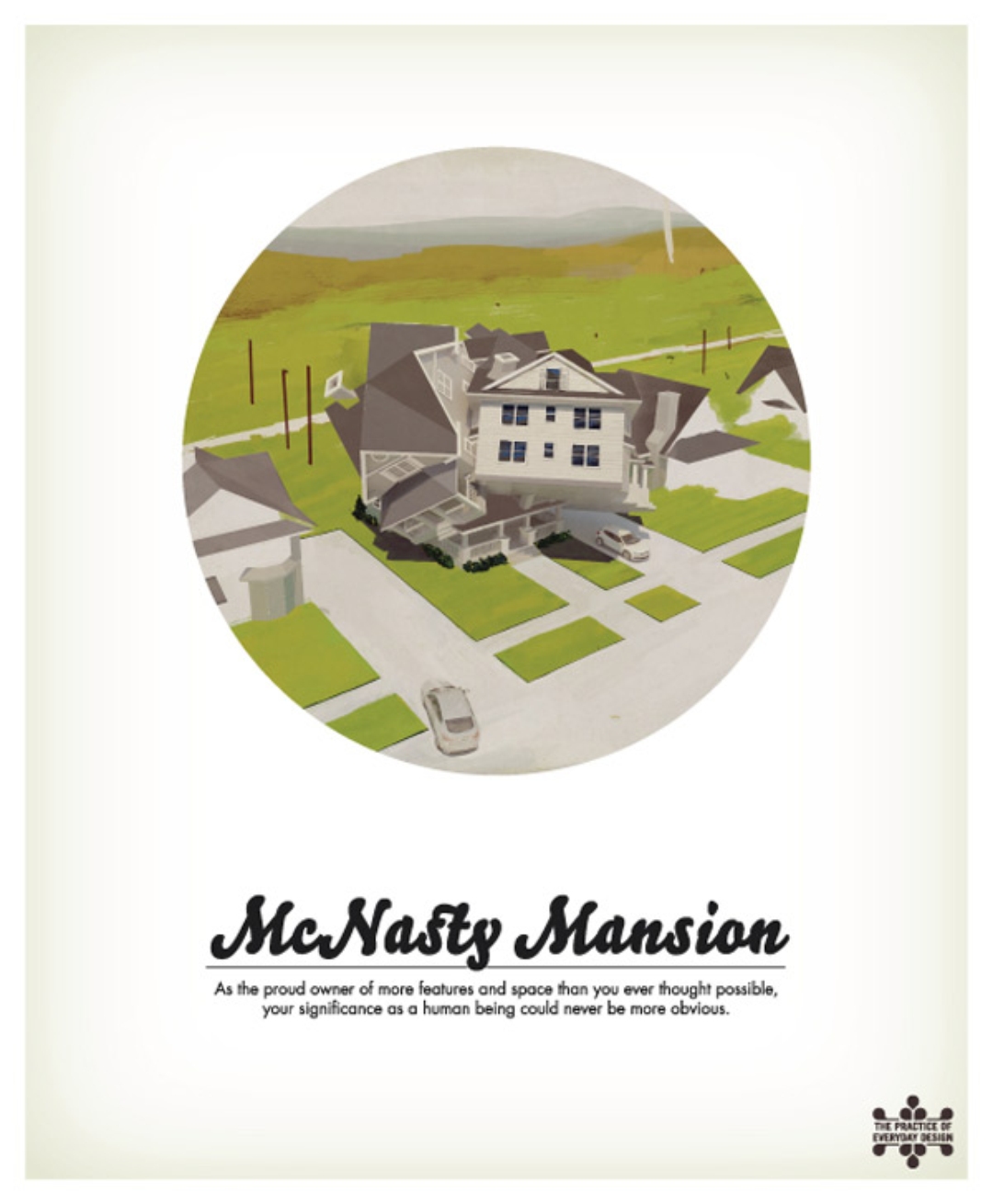
Two-year-old Canadian design office The Practice of Everyday Design searched Google 3D Warehouse (an open-source library of model files) for the most popular suburban home typologies. After culling the top examples, they fused them all together and 3D-printed the mess. They call it “Nasty McMansion,” and you can buy one! We suggest hanging it on a string and dangling it from the ceiling in your office, as a warning.

Think of it as a kind of Ringstrasse for suburban mansions. Write TOPED:

“The McNasty Mansion offers a new and more exciting typology of homes, formed off the same principals of the McMansion: more rooms than one can fill, enough mixed styles to ensure complete architectural confusion, and enough faux finishes and cheap materials to keep cost down but dimensions huge.

I’m not sure how exactly they put this image together but it looks like it was done in such a way to maximize the bizarreness. For example, that front door on the left that tilts down toward the ground would be quite difficult for the average McMansion owner to access. Wouldn’t you get a similar result even if you combined more pleasing designs? And how exactly does their 3D design incorporate “faux finishes and cheap materials” versus the real things? But, if the goal was to create a “McNasty” design that creates a startling visual, the goal was met.

Just curious: what is the general level of architectural design on Google 3D warehouse?

Possible reactions when your friend buys a McMansion

One post at DC Urban Moms and Dads provides a list of possible reactions when your friend buys a $2 million McMansion:

1.) I am very happy for the person.
2.) I hope they invite me back again because I LOVED the swimming pool or the sauna or the gym or the movie theatre or the gourmet kitchen etc. etc. And now I can enjoy it for free!
3.) How in the world did they afford this place? Are they smuggling drugs? Are they internet hackers? Something is fishy!
4.) This person is going through a midlife crisis. Even if I could afford this, I would never buy this ridiculous McMansion…
5.) This person is out of my league. I don’t want to come back.
6.) I can’t invite this person to my house because my house looks stupid by comparison.
7.) Act as if nothing has changed. As if they had the same $700,000 house they had before.

If you get invited for dinner, do you bring nothing (the person is too rich anyways), do you bring the usual stuff (average bottle of wine), do you bring the luxury goods because this is going to be an amazing dinner in an amazing place. Do you say: No Thanks, because you no longer wish to associate with this person.

Perhaps this is a hypothetical question for a certain demographic. Yet, there are some intriguing underlying issues here. How much do people judge their friends and others for the house that they purchase? Like people tend to do for other purchases and lifestyle choices(clothing, music choices, etc.), I suspect there is a lot of judging here. Notice that only 2 out of the 7 listed above are positive and 1 is neutral.

I wonder how often such an event might happen. Put another way, how often are Americans close friends with people in significantly different socioeconomic situations? McMansion owners probably tend to live near other McMansion owners but how much mixing do they do with different income/social class levels? Even if they do have friends across class levels, they might still see their neighbors or close co-workers as their primary reference group.

Don’t confuse community-building “little free libraries” for bird McMansions

Don’t make the mistake of confusing a “little free library” with an oversized birdhouse in your neighbor’s front lawn:

Zooming by in your car, you might mistake them for bird McMansions…

Based on a map on the Little Free Library website and chatter among local “stewards” — people who erect the boxes and maintain them — we’d say the Kansas City area has at least 20 little libraries so far, typically about the size of a recycling bin.

The idea germinated in a small Wisconsin town in 2009, when Todd Bol built a diminutive one-room schoolhouse out of an old garage door as a tribute to his late mom, a teacher. He stocked it with books and put it on a post outside…

“This is just a way to build community, and people can put in books that they love or just want to get rid of,” says Theiss, who’s an actual librarian. She works at Rockhurst University.

Several things are interesting here:

1. People with these libraries still believe in the power of books. How many people in the U.S. would agree?

2. From this article, it sounds like many of these small libraries are in fairly well-off suburban-type neighborhoods. The irony is that such neighborhoods are supposed to have community but need these small book outposts to bring community.

3. While these small libraries may have benefits, does this suggest people don’t want to spend the time to travel to the library? Perhaps this is more about convenience than community?

I’ll be curious to see if this is just a fad or something longer lasting.

New York City seeing a rise in super-rich mansions (not McMansions)

Curbed highlights a Gizmodo story about “McMansions” in New York City – and both get it wrong as these new homes are far beyond McMansions:

But developers may be reaching a breaking point in Manhattan, where warehouses are being bought to build $100 million single-family homes.

A handful of real estate stories this week question whether NYC is reaching peak development. First off, we have a mind-boggling report about the rise of single-family “palaces” in Manhattan. According to the New York Times, the super-rich are buying up warehouses, parking garages, and other commercial buildings to turn them into gigantic McMansion-style homes (including what will soon become the largest single-family home in the city). According to one broker, the new “benchmark” price is going to be $100 million, as opposed to the almost austere $50 million buyers expected to pay a few years ago.

It’s one thing to get rid of warehouses and garages—but another set of trend pieces alert us of a more problematic trend: The disappearance of gas stations in the city. As developers strive to find new plots of land that can be rebuilt from the ground up, they’re buying up gas stations left and right. We’ve covered at least one of these developments before, but according to the NYT and the Village Voice, it’s becoming a problem for cab drivers who can’t always find a station in time.

Note: the New York Times article cited above which starts with the story of a new 40,000 square foot home does not use the term McMansion. Calling them McMansions is just wrong; these are unusually large and expensive homes that go far beyond the typical, mass-produced, large suburban home.

More on these new homes from the New York Times:

“The town-house buyer doesn’t want a multi-unit condominium that is mass-produced,” said Wendy Maitland, a senior managing director of sales at Town Residential, who just closed a deal on a town house at 45 East 74th Street for $26 million. “This is an entirely private home, built for the lifestyle of someone who has multiple staff, a private driver. These people do not need a doorman, and they aren’t sharing amenities.”

Such buyers don’t exactly need a discount, but the value of private homes compared with condominiums is a draw anyway. “There is a gap in the marketplace — mansions are an area that is undervalued,” said Louis Buckworth, a broker at the Corcoran Group. He recently represented the British real estate magnate Christian Candy in buying a $35 million 30-foot-wide mansion for his family on the Upper East Side. (“Mansion” is typically defined as a town house at least 25 feet wide.) Mr. Candy’s new home, at 17,000 square feet, cost less than $2,100 a square foot. Meanwhile, “an 11,000-square-foot apartment at One57,” said Mr. Buckworth, referring to the glass tower in Midtown that Extell Development is building, “sold for $10,000 a square foot, making what we paid a joke.”

McMansion owners may want similar things – privacy, more space – but these homes are a step above.

Interestingly, even with their size and price, they tend to compare favorably to expensive homes in other global cities:

And for many buyers — especially foreigners who see real estate as more affordable in New York than in cities like London or Hong Kong — the numbers are eye-catching. Mr. Candy, for example, just sold a $250 million apartment in London and a $400 million home in Monaco, Mr. Buckworth said. “So as a foreigner, you say to yourself: ‘I can spend £20 million for an average-size flat in London, or get a mansion in prime Manhattan.’ And you can see why these numbers aren’t going to be particularly scary.”

So instead of pitching the story on Curbed and Gizmodo as the excesses of the American wealthy in New York City, this could be told as a story of relative value for big homes in a major global city. Same data, different contexts and narratives. Just bringing up the word McMansion implies selfish owners out to live in ostentatious homes.

Homebuyers don’t want “the same old McMansion”

Here some evidence that “the same old McMansion” is outdated and needs some new features:

New home buyers are coming back, but they don’t want the same old McMansion. They want a house they can use.

That means a “great room” where everyone can gather – and a spalike bathroom to escape from the crowd.

But usefulness also extends to lots of storage space for big-box buys. It means “drop-off zones” for recharging smartphones and pet-friendly “puppy showers.” It means a home office actually designed for work and media centers made for play. It means big closets and little nooks…

According to experts, today’s home buyers are much more budget conscious, a natural consequence of the recession. They demand more value per square foot. They’re not interested in rooms they will rarely use such as a formal dining room. Most of all, home buyers want a house that “works” for them.

“McMansions put a huge percentage (of square footage) into hallways and formal spaces that are used infrequently,” Lake said. “It adds up to a lot of square footage. We’re building homes with 1,000 less square feet but every room feels bigger because the house isn’t so cut up.”

As the article notes toward the end, these are not necessarily smaller homes. In fact, my interpretation here is that these are McMansions with different features. What counts for luxury today versus twenty years ago has changed: buyers want to see how to use their space rather than simply have large spaces, they want luxurious bathrooms, and they want exciting kitchens and great rooms. I’m guessing builders don’t mind these changes too much – they can work against the McMansion image (customize the luxury items!) and still sell expensive homes at high prices.

The question in the long run is whether these interior design changes are enough to stop these homes from acquiring the McMansion label.

One way to avoid teardown McMansions nearby: just buy all the properties yourself

Mark Zuckerberg has a way to avoid annoying teardown McMansions next door:

Facebook chief and founder Mark Zuckerberg bought four homes adjacent to his own tony Palo Alto house to prevent a developer from building a McMansion capitalizing on being next to the creator of Facebook.

Zuckerberg paid more than $30 million for the four properties next door and behind his home, and is now leasing them back to the owners, according to the San Jose Mercury News.

The 29-year-old billionaire reportedly bought the houses to prevent a developer from building a McMansion and marketing it as “being next door to Mark Zuckerberg,” according to an unnamed source.

According to public records, the home behind Zuckerberg’s was sold last December to a legal entity affiliated with Iconiq Capital, a San Francisco company that handles Zuckerberg’s finances. Last month, two more properties behind his home and one next door were also bought by associated entities of Iconiq. One of the properties sold for $14 million.

The irony of this is that defeating teardown McMansions requires having more money than the possible property owners. Have less money and residents can often have a fight on their hands.

Another issue: who would pay more money for a home just because it is next to Mark Zuckerberg? Rather than offering opportunities to spy on Zuckerberg, I wonder if this is more of a halo effect for the neighborhood: it’s such a good neighborhood that one of the world’s best-known people live here.

Bankrate.com asks “What is a McMansion?”

Bankrate.com defines financial terms and recently look at the term McMansion:

The Bankrate.com financial term of the day is: “McMansion”

“McMansion” is a disparaging term used to describe homes that are oversized and opulent, but also without a whole lot of uniqueness. McMansions are loosely defined as houses between 5,000 and 10,000 square feet with soaring, grandiose entryways and multicar garages, often shoehorned onto relatively small lots.

McMansions are giant homes that have sprouted up in the suburbs the way fast-food restaurants have — hence the name.

Three features of this definition stand out: (1) marking the term as a disparaging one – it is rarely used positively and can be used effectively when criticizing others; (2) it highlights their mass-produced nature (not very unique, sprouted up); and (3) sets some square footage limits so that McMansions are larger than most American homes but don’t run into mansion territory. Several other parts of the definition, including common design features and small lots, may be common but are not part of all McMansions. However, the video is disappointing. I was hoping for some classic images of McMansions…

I also wonder if this is Bankrate’s definition of a McMansion as Americans see them or as a financial publisher? Here is a little bit about Bankrate.com:

We at Bankrate, Inc. have over three decades’ experience in financial publishing. Bankrate was born in 1976 as “Bank Rate Monitor,” a print publisher for the banking industry…

Today, Bankrate, Inc. is the Web’s leading aggregator of financial rate information, offering an unparalleled depth and breadth of rate data and financial content. Bankrate continually surveys approximately 4,800 financial institutions in all 50 states in order to provide clear, objective, and unbiased rates to consumers. Our flagship Web site, Bankrate.com, provides free rate information to consumers on more than 300 financial products, including mortgages, credit cards, new and used automobile loans, money market accounts, certificates of deposit, checking and ATM fees, home equity loans and online banking fees.

In addition to rate data, we publish original and objective personal finance stories to help consumers make informed financial decisions.

What exactly does Bankrate think about McMansions?


Chicago McMansion battle reaches the McMansion pumpkin stage

One battle over a proposed McMansion in Chicago recently turned to pumpkins:

The large pumpkin popped up over the weekend next to his lot at 829 S. Bishop St. It was painted with the words, “When size matters … McMansion Pumpkin.”

Many neighbors have referred to Skarbek’s plan for his home as a “McMansion.” He plans to build a home much larger than the row home that had been there, and the home will eventually interrupt a string of front yards that are all set back from the street…

Later Tuesday, Skarbek’s next-door neighbor, Paul Fitzpatrick, said his wife decorated the pumpkin, which actually sits on his yard to the north of a fence surrounding Skarbek’s lot while the new home is being built.

“I meant it as a good gesture,” Carrie Fitzpatrick said. “He likes big houses, so I thought he’d like a big pumpkin. I spent a lot of money on that pumpkin, and if it backfired, I’ll feel really stupid.”

A holiday-themed McMansion fight turned petty. Both sides appear to be trying to pass it off as no big deal but even in a country of moral minimalism (the argument of M. P Baumgartner in The Moral Order of a Suburb), this is an odd way to go about things. If the neighbors are already pursuing a lawsuit, the other main way for Americans to settle irreconcilable differences, why move to the pumpkin stage?