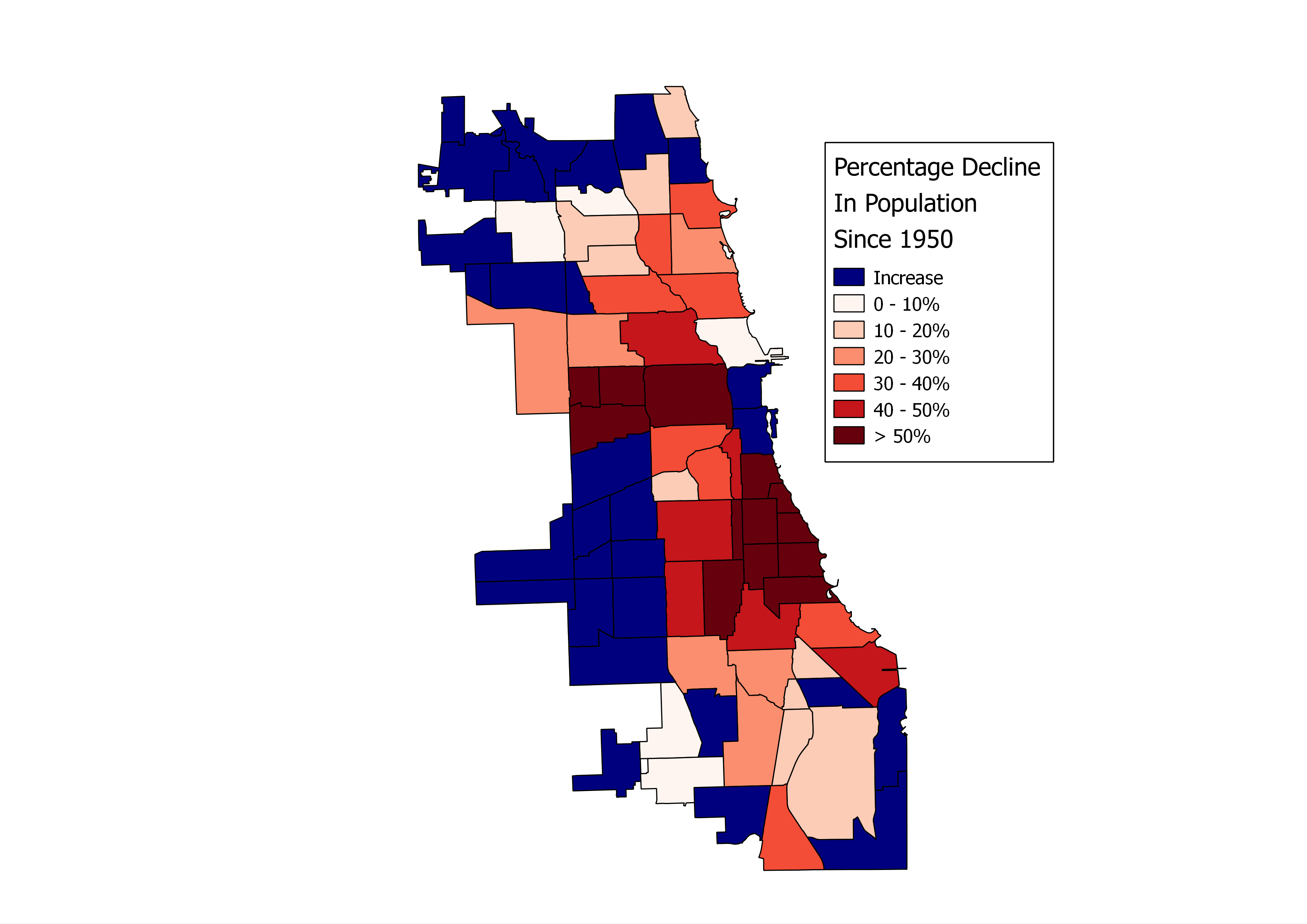
Even affluent Chicago neighborhoods, like Lincoln Park, have lost significant numbers of residents

Rust Belt cities like Chicago have declined in population since the mid-1900s and the population loss is not just limited to poorer neighborhoods:

For a long time, most accounts of Chicago’s lagging population have focused on parts of the South and West Sides where many residents, largely African-American, have decided to decamp for the suburbs or the South in search of better schools, less crime, and more jobs.But the under-appreciated flip side of population loss in those parts of the city is that places that ought to be growing like gangbusters are stagnant, often sitting 25% to 50% below their peak populations. Lakeview, for example, was once home to 124,000 people; its population is now 94,000. North Center is down from nearly 49,000 to under 32,000. West Town, which includes Wicker Park and Bucktown, has fallen from 187,000 to 81,000.
Decline5010

What explains the population loss in even popular neighborhoods? Here is one possible answer:

Since replacing a couple two-flats with a courtyard building is now illegal, developers make money by tearing down an old two-flat and building a luxury two-flat in its place. Or they build a mansion, and the neighborhood actually loses a housing unit. As a result, as a neighborhood becomes more attractive, the city encourages fewer people to live there.

Zoning (theoretically based on improving the neighborhood) plus chasing profits may just lead to population loss. This could be balanced out by approving more high-density housing in a particular area (like the Loop are in specific portions of popular neighborhoods as to limit their effect) but that leads to major changes in two places.

It is still worth noting that the areas that seen an increase in population are either (1) the Loop with a reemphasis on residential construction and (2) community areas on the edges of the city which other lower densities as well as potentially more open land since 1950.

Gentrification limited in Chicago; should worry more about neighborhoods in severe decline

Gentrification may get a lot of attention in big cities but one journalist suggests the more influential issue in Chicago is the number of neighborhoods that have undergone severe declines.

At WBEZ, a Chicago public radio station, our neighborhood bureau reporters produced a package of stories, “There Goes the Neighborhood” (found here) in December, about the changing conditions of neighborhoods in racially segregated Chicago. We partnered with the University of Illinois at Chicago, which created a gentrification index for understanding how to measure neighborhood change in the city, for better or worse. The index measures 13 indicators of neighborhood conditions, including race, income, house values, education, and even the percentage of kids attending private schools. The findings confirmed and challenged some of our own notions, but the main takeaway is that gentrification is not as pervasive throughout Chicago as conventional wisdom might suggest.

Scoring neighborhoods based on the index, Chicago’s 77 neighborhoods were grouped into nine categories ranging from “stable upper/middle class,” meaning index scores remained high since the 1970s, to “severe declines,” meaning those scores dropped significantly since the ’70s. The “gentrification” category captured neighborhoods that had low index scores in the 1970s, but grew significantly higher by 2010. There were only nine neighborhoods that fit that “gentrifying” classification, almost all of them in downtown Chicago (“The Loop”) or just north of it, areas that have been historically white. These places were basically immune to the housing crash, but meanwhile a glut of luxury high rises cast shadows over Lake Michigan.

The category you want to pay attention to, though is “severe decline” — 14 neighborhoods found mostly in South and West Chicago have populations that are, on average, two-thirds African American. Add those to the 12 neighborhoods that have remained in extreme poverty since the ’70s, of which 94.5 percent of residents are African American…

Policymakers, hence, must address the concerns of inequitable development across neighborhoods and income inequality, which are both also national issues. According to a City Observatory report examining urban poverty released last year, the problem over the past four decades is not wealthy whites infiltrating black and Latino neighborhoods with designer Pulaski hatchets and vegan cupcake shops. Governing magazine came to similar conclusions, showing low percentages of gentrified Census tracts in Chicago since 1990.

Gentrification might be the sexy topic but addressing the pressing issues in persistently disadvantaged neighborhoods would likely help more people in the long run. Of course, addressing the issues in poor neighborhoods is complex and not change may not come as quickly as it does through gentrification. Given Chicago’s long history of residential segregation, many of these poor neighborhoods – which are often heavily non-white – are not in any danger of gentrification anytime soon because they are far removed from the edges of wealthier white neighborhoods where good real estate deals or trendy spaces appealing to young, white, creative types might be found.


Following the ideals of Gautraux to deconcentrate poverty in the Chicago suburbs

The Gautreaux Program in Chicago preceded Moving To Opportunity and now there are more recent efforts to deconconcentrate poverty in the Chicago region:

After all, suburbs are no longer the bastions of privilege they once were (though majority white suburbs still, for the most part, are). Since the recession, it’s the exurbs in Chicago that have had job growth, while affordable housing near those jobs is often hard to find. Poverty is growing in suburbs across the country, including in Chicago, and moving families blindly out of the city may do more harm than good.

That’s why Chicago’s leaders are now focusing on helping low-income people live in mixed-income neighborhoods in both the suburbs and the city that have good access to transit and jobs, high homeownership rates, low commute times, walkable areas and a low percentage of people receiving public-housing assistance, said Robin Snyderman, a non-resident senior fellow at the Brookings Institution who also works as a consultant on housing policy in Chicago.

Nine housing authorities now participate in a regional pool of resources that began more than a decade ago. They include authorities in counties such as DuPage, Lake, and McHenry, using the money to build nearly 30 mixed-income developments in “opportunity areas” that are near transit and job opportunities.

“Just getting rental housing into some of these communities was hard to do for many years,” said Snyderman said.

A pilot program launched in 2011, the Chicago Region Housing Choice Initiative (CRHCI), encourages families to use vouchers to move to some of these locations, giving them counseling to help them do so.

Regional authorities and mayors have “adopted new tools for promoting inclusion and diversity, building on the lessons learned from Gautreaux,” she said. “I feel more hopeful that the historic segregation in the Chicago region can be transformed—because it’s now not all on the shoulders of the public housing authority,” she said.

See this earlier post about some of the results of the Moving To Opportunity program. These programs aren’t immediate panaceas and progress is often slow. It took decades to get Gautreaux into action and more time to assess results from MTO. Additionally, it can be difficult to get wealthier suburbs to buy in – if they do talk about affordable housing, it tends to involve seniors, young college graduates, or civil servants, not actually poorer residents.

In all, residential segregation is a difficult problem to address. If it is all left to the market, wealthier residents will move to nicer suburbs, maintaining or increasing their life chances, and then limit the access of others to move into their communities (even if they need them as workers in that community). Social programs can help but they can be costly, it takes time to assess their effectiveness, and it requires wealthier communities to get on board. This is one of those social problems that requires patience, active efforts, and time to see social change occur.

Structuralists vs. culturalists in explaining poverty

Sociologists may not have the public profile they desire but the discussion about it may have helped. The New Yorker looks at two sociological approaches to poverty and attempts to sum up the culturalist approach:

There is a paradox at the heart of cultural sociology, which both seeks to explain behavior in broad, categorical terms and promises to respect its subjects’ autonomy and intelligence. The results can be deflating, as the researchers find that their subjects are not stupid or crazy or heroic or transcendent—their cultural traditions just don’t seem peculiar enough to answer the questions that motivate the research. Black cultural sociology has always been a project of comparison: the idea is not simply to understand black culture but to understand how it differs from white culture, as part of the broader push to reduce racial disparities that have changed surprisingly little since Du Bois’s time. Fifty years after Moynihan’s report, it’s easy to understand why he was concerned. Even so, it’s getting easier, too, to sympathize with his detractors, who couldn’t understand why he thought new trends might explain old problems. If we want to learn more about black culture, we should study it. But, if we seek to answer the question of racial inequality in America, black culture won’t tell us what we want to know.

Do we have to have an either/or answer? Situations like these are complex and involve a multitude of factors. That doesn’t necessarily lend itself to quick policy making or answers the media can grab and run with. Yet, even sociologists of culture would highlight other structural factors including economics and race in addition to the power of patterns of meaning-making.

NPR photojournal looks at “The end of Chicago’s public housing”

NPR has put together an interesting site with photos and text that explores the demolition of Chicago’s public housing. Some of the more interesting lines:

Ironically, the [Robert Taylor Homes] were named for a Chicago Housing Authority board member who resigned in 1950 — in opposition to the city’s plans to concentrate public housing in historically poor, black neighborhoods…

The buildings became hulking symbols of urban dysfunction to the suburbanites who saw them from the expressway on their daily commute…

While some have described public housing as a tangle of failed policies and urban planning, to the people who lived there, it was home. But at the end of the 1990s, like the tenement residents before them, they were told that their world would be “transformed.” Many would not be able to live there anymore…

[After the demolitions:] People lost track of each other; the housing authority lost track of them.

A lot of lives were affected even as there really hasn’t been much public conversation about the fate of the public housing residents. Ironically, removing the high-rises may just have made the problems of housing in the Chicago region – and there is a lot of need for good affordable housing, evidenced by recent sign-ups for the public housing waiting lists – even more difficult to see.

See earlier posts about the demolitions of the last high-rises at Cabrini-Green here, here, and here.

Seeing 1940s Chicago in a lost promotional film

Chicago, the #7 global city today, looked quite different in the 1940s in long-lost promotional footage:

In contrast to typical city promotional films, this video offers glimpses of downtown spots like Buckingham Fountain along with the city’s manufacturing plants and meat-packing facilities. The footage also comes with all sorts of statistics and facts. For example, Michigan Boulevard (now Michigan Avenue) carried more than 55,000 automobiles on an average day.

Based on the credits, it appears the video was produced by the Chicago Board of Education, with an assist from United Airlines (for the aerial shots). The release date of the film has also been pinned to between 1945 and 1946. John Howatt, credited as the Business Manager of the Board in the video, was elected on January 8, 1945, and Johnnie Neblett, the narrator, died on September 15, 1946.

Altman writes that he thinks the video was meant to attract people or companies to Chicago, or perhaps as a resource in the classroom. But according to DNAInfo, a spokesman from the Chicago Board of Education said that staff haven’t been able to find any reference to the film in its archives.

A few quick thoughts on seeing this film:

1. The tall buildings are quite different. One, there aren’t as many. Yes, Chicago was dense but it was more due to low-rises. Two, they don’t have the shine that we have come to associate with skyscrapers and instead tend to be covered in stone or masonry and are marked by pollution. (Blame the International Style, which bloomed in Chicago.)

2. The focus on industry is interesting. Manufacturing would have made up more of the economy at the time (Chicago, like many Rust Belt cities, lost hundreds of thousands of manufacturing jobs in the late 20th century) while the emphasis today is more on finance and services.

3. Some of the footage of Lake Shore Drive seems quaint as it appears to sometimes have two lanes each direction without many barriers between each side or the paths and sidewalks nearby. This was the era before major highways as we know them which were not completed in the Chicago region until the mid 1950s.

4. What is missing and can be found in pretty much any major city? Like any growth machine which wants to promote high-quality growth, this film omits the lower-class areas of the city. Chicago at the time had numerous poor neighborhoods including the Black Belt on the South Side which was the only place where blacks could live. These areas somehow didn’t make it in…

5. I wonder at times how much the less-than-high-def footage influences our interpretations of the past. Chicago looks fairly inviting in this film – bustling, beautiful lakefront, lots of nice buildings – yet it all looks so grainy. We’ve reduced this look to a filter on our Instagram accounts but it is hard to find the HD images that might help us make an apples-to-apples comparison of scenes.

One-quarter of Americans live in areas with over 20% poverty

The Census Bureau recently released updated data showing an increased number of Americans living within poverty areas:

In 2010, the overall U.S. poverty rate was about 15 percent. However, about a quarter of all Americans lived in a so-called “poverty area”—defined as a census tract where more than 20 percent of the population lived below the poverty line. For our purposes, we can just call these places poor neighborhoods, even though the term is a little more accurate in an urban context than a rural one. The problem was especially severe in Appalachia and across the South and Southwest, where in most states 30 percent or more of all residents lived in these communities…

The South may have the greatest share of its population packed into poor neighborhoods, but the growth of concentrated poverty was actually fastest in the Midwest, as shown on the graph below. The poor-neighborhood population also became more suburban and rural compared to 2000, according to the Census…


Researchers have paid more attention to such neighborhoods in recent decades and yet the problem seems to have gotten worse.

Summarizing research on the Moving to Opportunity program

Here is a brief overview of the sociological findings regarding the federal Moving to Opportunity program that moved poor urban residents to the suburbs in the hope of improving their life chances:

The findings revealed that while many study participants “successfully” escaped dangerous and stressful neighborhoods at first, most did not escape income poverty, and many ended up living back in high-poverty areas after a few years…

The experiment was conducted in five U.S. metro areas: Baltimore, Boston, Chicago, Los Angeles, and New York. While the experiment showed that it was possible to dramatically improve quality of life for the poor, helping them escape poverty was another matter. “Many of us underestimated the barriers to employment, for example, for this highly disadvantaged group, and how small a difference relocation alone would make,” says Briggs, an associate professor of urban studies and planning…

The barriers were the greatest in sprawling Los Angeles, Briggs says. “The physical distances are so enormous, and many jobs are not accessible by public transportation. We spent time with moms who were getting up at 4 a.m. and driving 25 miles in one direction to leave their kids with a family member, and then 30 miles in another direction to work at a job where they might be put on a different shift, on a moment’s notice. The job itself was insecure, volatile, and poorly compensated. Lining up housing, work, and child care, and keeping them aligned, was immensely difficult.”

On the upside were dramatic changes in safety and security, particularly for young girls. They fared better overall in these new neighborhoods, escaping the predatory climate of their old neighborhoods. And parents in the study saw major reductions in anxiety and depression, and improvements in mental health, likely because of increased security and “freedom from fear.”

For more details, I recommend the book Moving to Opportunity: The Story of an American Experiment to Fight Ghetto Poverty. One takeaway: simply moving poor residents from one neighborhood to a better suburban one does not necessarily quickly lead to positive outcomes. Indeed, poverty is on the rise in the suburbs (here, here, and here) and it is difficult to provide services in these communities.

“Why Did Chicago’s Middle Class Disappear?”

Whet Moser explains the GIF of Chicago’s disappearing middle-class through the work of sociologist Lincoln Quillian:

What’s most striking about Hertz’s map is the transition from 1970 onwards; when the map begins, the lowest-income census tracts are extremely concentrated. Then, as if a switch was flipped, they radiate out from the city center by 1980. (It almost looks like watching Conway’s Game of Life.) The change in those 20 years is immense. And Quillian gives a clue as to why, laying the groundwork for what was happening before Hertz’s analysis begins (emphasis mine):

Modern poor urban neighborhoods, formed after 1970 or so, thus stand in sharp demographic
contrast to poor and minority neighborhoods earlier in the century. Accounts of racial succession of neighborhoods in the 1950s indicate that neighborhoods undergoing racial transition tended to increase in population density, especially in passing through a late phase in racial succession referred to as “piling up,” in which previously white-owned homes and apartments were subdivided into smaller dwellings to accommodate the housing demands of black immigrants (Duncan and Duncan 1957). Although the affluent have always made efforts to segregate themselves from the poor, immigration into cities before about 1970 was proceeding at too rapid a pace to allow inner city neighborhoods to drop substantially in population as part of this process. Indeed, a chief reason blacks desired to exit predominantly black areas of the city before 1970 was because the housing supply in black neighborhoods was insufficient to keep up with demand (Aldrich 1975). With the end of black immigration to urban areas, poor African-American neighborhoods have changed from densely packed communities of recently arrived immigrants to areas gradually abandoned by the nonpoor. The cessation of the flow of black immigrants to the nation’s cities, and the corresponding decline in the population density of poor neighborhoods, may be one unexplored factor responsible for the change in the nature of poor African-American neighborhoods in the early 1970s that Wilson (1987) describes.

The Second Great Migration ends in 1970. To paraphrase Hunter S. Thomson, Hertz’s 1970 map appears to be the point where you can see the wave break and roll back.

Quillian’s data then picks up the narrative, which adds texture to Hertz’s map. Between 1980 and 1990, there’s a substantial leap in the lowest-income-level census tracts, then things plateau from 1990-2000. Here’s Quillian again:

There is no indication in the PSID data that stayers in black and/or poor neighborhoods experienced increases in their poverty rates in the 1970s and 1980s, except during the recession of the early 1980s. During this recession, increases in the poverty rate among the nonpoor were spatially concentrated in black moderately poor neighborhoods. Since these neighborhoods were already moderately poor to begin with, this suggests that increasing poverty rates in the early 1980s had a strong effect in increasing the number of extremely poor neighborhoods.

Quillian was writing in 1998 (here’s another paper from him in 2012, addressing similar issues), but his conclusions accurately foretell the changes you can see from 2000-2012: “Neighborhoods in transition to high-poverty status empty first of whites, then of many middle-class blacks, leaving more-disadvantaged and less-populous areas. The overall result is that high-poverty neighborhoods have been becoming geographically larger and less densely settled.”

So some of these neighborhoods that changed over to high levels of poverty aren’t necessarily the result of increasing number of poor people but rather the departure of higher-income and white residents. They may be poor neighborhoods but they are not necessarily dense because few people of any background (regardless of class and race) are moving in.

Another thought: some conversation about white flight focuses on the 1950s and 1960s when whites moved to the suburbs due to (1) policies that helped make the suburbs more attractive (interstate construction, new rules about mortgages that made home purchases available to more Americans plus (2) continued waves of the Great Migration of blacks to Northern cities. All this is true but this map is a reminder that the processes affecting poor neighborhoods continued from the 1970s to 1990s. It wasn’t until the 1980s that academics started writing important books like this, whether from William Julius Wilson or Paul Jargowsky.

Of course, a key question is how much this is still happening today. Can poor neighborhoods spread even further as better-off urban residents and suburban residents move to wealthier pockets while lower-class and poorer residents are left in emptying out locales? The process may not be over yet and it is hard to find cases where truly poor neighborhoods from recent decades made substantial turnarounds.

DeSean Jackson illustrates how black Americans often retain ties to poorer neighborhoods, regardless of class

Jamelle Bouie highlights sociological research that shows blacks in America tend to live closer to and have ongoing social ties with poorer neighborhoods compared to whites:

The key fact is this: Even after you adjust for income and education, black Americans are more likely than any other group to live in neighborhoods with substantial pockets of poverty.

As sociologist Patrick Sharkey shows in his book Stuck in Place, 62 percent of black adults born between 1955 and 1970 lived in neighborhoods that were at least 20 percent poor, a fact that’s true of their children as well. An astounding 66 percent of blacks born between 1985 and 2000 live in neighborhoods as poor or poorer as those of their parents…

How does this stack up to white families? Here, Sharkey is indispensable: Among white children born through 1955 and 1970, just 4 percent live in high poverty neighborhoods. Or, put another way, black Americans live with a level of poverty that is simply unknown to the vast majority of whites…

“When white families advance in economic status,” writes Sharkey, “they are able to translate this economic advantage into spatial advantage by buying into communities that provide quality schools and healthy environments for children.” The same isn’t true for black Americans, and some of the answer has to include present and ongoing housing discrimination. For example, in one study—conducted by the Department of Housing and the Urban Institute—black renters learned about fewer rental units and fewer homes than their white counterparts…

This can have serious consequences. Youthful experimentation for a white teenager in a suburb might be smoking a joint in a friend’s attic. Youthful experimentation for a black teenager might be hanging out with gang members. As Mary Pattillo-McCoy writes in her book Black Picket Fences: Privilege and Peril Among the Black Middle Class, “Youth walk a fine line between preparing for success and youthful delinquent experimentation, the consequences of which can be especially serious for black youth.”

Even as the details of the DeSean Jackson situation trickle out, the overall point is clear: blacks and whites in America continue to live in different neighborhoods and this has consequences for adult life. One consequence is that blacks tend to live in poorer neighborhoods, regardless of class, and a second is that social ties between wealthier and poorer neighborhoods often continue even when economic opportunity allows one to move elsewhere (see the work of Robert Sampson in Great American City for his social network analysis of social ties of residents who leave poorer neighborhoods – and also where they tend to end up).

All together, the impact of on-going residential segregation is not as simple as living in different places. The social conditions of different places is related to all sorts of disparate outcomes including housing options, educational attainment, safety and crime rates, economic opportunities, and life expectancy. We should not be surprised if we see this play out in arenas like the NFL which apparently has some divided opinions about how it should be addressed (one team releases a good player, another eagerly signs him).