Taking protests for racial justice to the suburbs

Data collected over the last few years hints at new venues for protests in the United States:

woman holding a sign in protest

Photo by Life Matters on Pexels.com

The engagement of Brown and others also represents one of the most striking aspects of the current protests against police violence in the U.S., compared with previous ones. They’re everywhere, in suburbs and small towns as well as major cities. Count Love, a data-collecting effort launched in 2016 to document protest activity in the U.S., has cataloged more than 1,500 distinct racial justice events since George Floyd was killed on May 25, and the site’s founders, Tommy Leung and Nathan Perkins, expect to add many more, since they have an extensive backlog of local media and reports to review. Even in the wake of the 2017 Women’s March and widespread anti-gun actions in 2018, the physical scale of these Black Lives Matter protests is striking.

While it’s challenging to generalize, given the sheer number of events that have and continue to take place, conversations with eight protest organizers, as well as historians and researchers, suggest some commonalities amid the vibrant, multiracial, and predominantly peaceful demonstrations taking place outside of large cities. They’re often led by first-time organizers in their teens and 20s, often women, who have adapted the traditional models of urban-style political demonstrations to suburban sprawl or rural areas. And they’ve done so at incredible speeds by leveraging social media.

“One of the reasons we’re seeing these protests in suburban and exurban places is because organizers don’t need connections to movements or Black institutions or churches,” says Ashley Howard, a historian and professor at the University of Iowa working on a book about urban rebellions of the ’60s. “They already have networks in place through social media.”

These protests also reflect the demographic shifts and diversification of U.S. suburbs and exurbs in recent decades, a challenge to the stereotype of a monochromatic suburbia. While much has been said about how unexpected it may be for the current wave of protests to have moved beyond urban centers, many organizers and activists say the suburbs — where many residents may not believe there are issues of systemic racism — are exactly where these protests belong.

And Naperville, wealthy suburb home to recent racist events and protests in the last decade, gets a mention.

See my own recent thoughts on the spread of protests to wealthy suburbs. As noted above, the combination of more racially diverse suburbs, the high status of numerous suburbs, and political change in suburbs means suburban protests are more normal. Whether this translates into (1) changed suburban communities – reduced residential segregation? – and (2) changed state and national politics – led by suburban voters? – remains to be seen.

I’m glad this data is being collected and I would guess it has a lot of potential for academic research. As previous research has examined, how did these protests diffuse across the United States? What are the patterns in the communities that had protests?
Suburban police and promoting a better future for youth

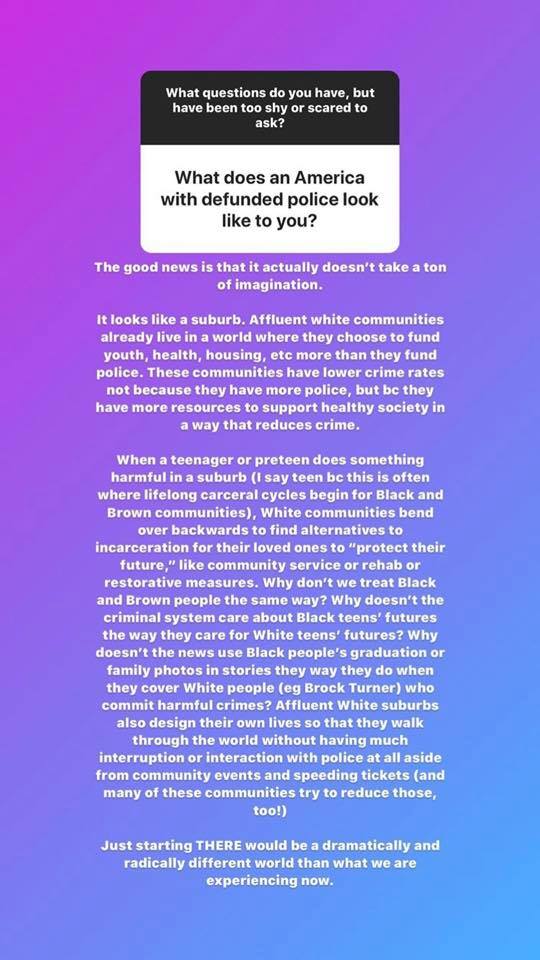
On Instagram, Congresswomen Alexandria Ocasio-Cortez connected defunding the police to what suburbs do instead:

AOCPoliceandSuburbs

A few thoughts:

1. According to sociologists and other scholars who have studied American suburbs over the last century, an overriding concern in suburbs is to protect families and let children flourish. The assumption is that suburban life – with its lower density, single-family homes, more space, better schools, lower crime – will benefit children in the long run.

2. At the same time, suburbs are also based on exclusion. For decades, only white people – and certain ones at that – were allowed in many suburbs. While this is officially off-limits today, it can be accomplished in other ways such as through exclusionary zoning, drawing school district boundaries, and through police.

3. Police can and have reinforced the race and class based exclusion in suburbs. This could range from sundown towns to watching fire bombings in Cicero, Illinois to harassing motorists, residents, and protestors in Ferguson, Missouri. Wealthier suburban residents generally do not want to involve the police in their conflicts but they can and do at times.

4. Many suburbs offer limited social services. The expectation is that residents will have the resources to provide for themselves or that corporations and local charities will provide.

5. Many suburbs like having their own police department. This allows them to retain local control, important for #2 and #3 above.

6. For an academic study of how this works in wealthier suburbia, I recommend America’s Safest City: Delinquency and Modernity in Suburbia. From the book description:

Adolescents, parents, teachers, coaches and officials, he concludes, are able in this suburban setting to recognize teens’ need for ongoing sources of trust, empathy, and identity in a multitude of social settings, allowing them to become what Singer terms ‘relationally modern’ individuals better equipped to deal with the trials and tribulations of modern life

Addressing race without addressing residential segregation?

Residential segregation is a long-standing problem in American society. Through legal and illegal means, formal and informal practices, whites often sought and still seek to keep others, particularly blacks, out of their communities and neighborhoods. While residential segregation has lessened in recent years, it is still persistent and numerous communities disadvantaged decades ago are still struggling because of this.

The ability of people of different races and ethnicities to live near each other is not just about proximity to work and access to jobs (though this is helpful too); there are numerous consequences.

-local schools

-access to local governments, and social services

-interaction with neighbors and people in the community

-political representation at higher levels such as state officials or Congress

-nearby cultural opportunities

-health as well as recreational opportunities

-could provide more options for housing and building wealth

-the chance to address local or community problems together

And the list could go on.

As one example, more minorities living in the American suburbs does not necessarily a guarantee them a better life. When many suburbs were built on and operate on the logic of exclusion, suburban residential segregation subverts the idea of the suburban single-family home representing the American Dream.

Tackling residential segregation is a difficult task. Whiter, wealthier communities are not likely to be on board (see how this plays out with affordable housing conversations). Addressing housing at a national level is hard. But, that does not mean it is not worth addressing.

A long history of violence in American society

From the beginning, the story of the United States of America is a violent one. From violence against indigenous people to slavery to armed rebellion to colonial conquests to the Civil War to vigilante violence to violence-enforced residential segregation military intervention around the Western Hemisphere and then the globe to police brutality to gun violence to celebrating the military to assassinations.

Take vigilante violence as an example. I read Sundown Towns: A Hidden Dimension of American Racism at the recommendation of a colleague and having read multiple works by sociologist James Loewen. He argues that a significant number of Northern towns and cities had informal sundown laws that prohibited minorities from being in the community after dark with violence implied if the norms were not followed.

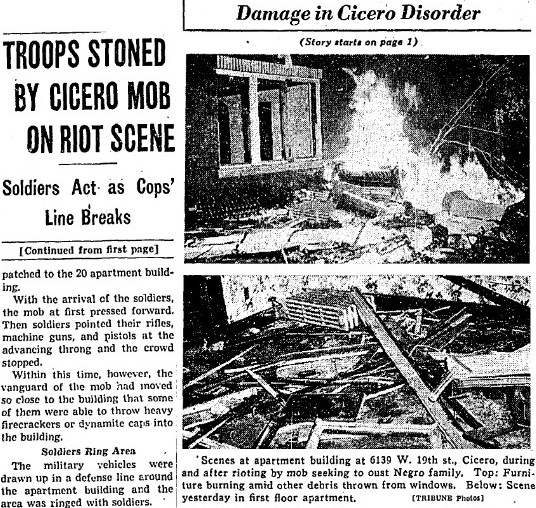
Or, take the example of the role of violence in residential segregation. After violence at a South Shore beach set off moreviolence in Chicago in 1919, residential segregation was enforced not just with restrictive covenants and blockbusting and redlining: actions involved bombings and attacks. Historian Stephen Grant Meyer detailed some of this in his book As Long As They Don’t Move Next Door: Segregation and Racial Conflict in American Neighborhoods, a book I read for a class paper. In places like Cicero, Illinois and Levittown, Pennsylvania, violence accompanied attempts of blacks to move to the suburbs.

CiceroRiot1951ChicagoTribune

Photo by Chicago Tribune, July 13, 1951

Or, take the last in the list as an example. The book that really brought this to my attention as a student was Philip Agee’s Inside the Company: CIA Diary. This led me to read a lot about the Church Committee’s work in 1975-1976 as well as assassinations in the United States and ones in which the United States played a role abroad. In several papers, I worked with the idea of assassinations, discovered databases of political violence in countries around the world that political scientists have collected for decades, and found that the political violence rates in the United States are high.

All together, the United States is awash in violence. It is part of American history, it is regularly promoted, and it is often excused or justified. Thinking about some of the examples I noted above, I found out about these through reading and research because these stories are widely taught, known, or experienced by significant segments of the population. Yet, violence is antithetical to numerous aspects of American society and ideals, including the religious beliefs of many Americans, particularly when harnessed alongside other destructive ideologies such as white supremacy or colonialism.

Divided By Faith, race, and religion

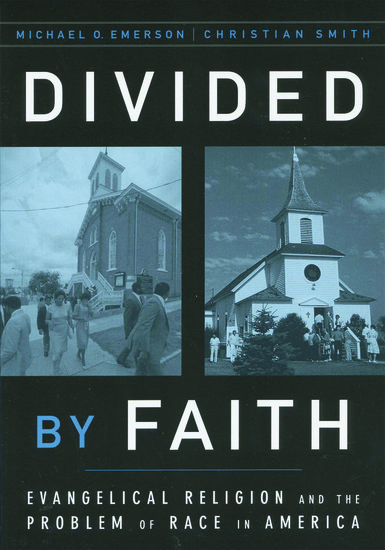
When I teach Introduction to Sociology, one of the texts I use is Michael Emerson and Christian Smith’s 2000 book Divided By Faith: Evangelical Religion and the Problem of Race in America. Here are parts of Chapter Four (“Color Blind: Evangelicals Speak on the “Race Problem””) that seem very pertinent:

The racially important cultural tools in the white evangelical tool kit are “accountable freewill individualism,” “relationalism” (attaching central importance to interpersonal relationships), and antistructuralism (inability to perceive or unwillingness to accept social structural influences). (76)

But, these perspectives are not just tied to race:

Unlike progressives, for them individuals exist independent of structures and institutions, have freewill, and are individually accountable for their own actions. This view is directed rooted in theological understanding… (76-77)

A summary later in the chapter:

On careful reflection, we can see that it is a necessity for evangelicals to interpret the problem at the individual level. To do otherwise would challenge the very basis of their world, both their faith and the American way of life. They accept and support individualism, relationalism, and anti-structuralism. Suggesting social causes of the race problem challenges the cultural elements with which they construct their lives. This is the radical limitation of the white evangelical tool kit. This is why anyone, any group, or any program that challenges their accountable freewill individualist perspectives comes itself to be seen as a cause of the race problem. (89)

And back to race:

But white evangelicals’ cultural tools and racial isolation curtail their ability to fully assess why people of different races do not get along, the lack of equal opportunity, and the extent to which race matters in America. Although honest and well intentioned, their perspective is a powerful means to reproduce contemporary racialization…

This perspective misses the racialized patterns that transcend and encompass individuals, and are therefore often institutional and systemic. It misses that whites can move to most any neighborhood, eat at most any restaurant, walk down most any street, or shop at most any store without having to worry or find out that they are not wanted, whereas African Americans often cannot. This perspective misses that white Americans can be almost certain that when stopped by the police it has nothing to do with race, whereas African Americans cannot… (89-90)

The book is twenty years old and has led to productive listening, conversations, action, and scholarship. Yet, the intersection of race and religion, the deeply embedded assumptions in faith and other spheres of life, still matters today.

(See this 2016 post titled “How white evangelicals define themselves – and what is missing” for an earlier discussion involving Divided By Faith.)

When protests make it to the wealthier suburbs, this means…

With protests spreading across the United States, including wealthy suburbs like Naperville, Illinois and Dunwoody, Georgia, this could hint at several forces at play:

NapervilleCorner

-Americans dislike or disapprove of blatant injustice. (Whether that extends to making significant changes or sacrifices is another story. The suburbs are built in part on race and exclusion.)

-The population composition of suburbs has changed in recent decades. As William Frey of Brookings Institution details in Diversity Explosion, minority populations have grown across suburbs.

-The image of primarily conservative voters in wealthy suburbs may not be as valid as it was in the past. The outcome of the 2020 election depends in part on suburban voters with suburbanites closer to big cities leaning toward Democrats and suburbanites on the metropolitan edges leaning toward Republicans. And appealing to suburban women are important for candidates.

-Certain upscale suburban locations have become important sites for attracting attention because of their status. For example, Occupy Naperville occurred in 2012 and Naperville attracts other protestors as the largest community in DuPage County, its walkable downtown with lively stores, restaurants, and recreational options, and its status.


Addressing race at Wheaton College and in Wheaton, Illinois

In late 2015, Solidarity Cabinet at Wheaton College asked me to give an evening talk alongside one of my colleagues, David Malone, then Associate Professor of Library Science and head of Special Collections at Wheaton College (and now Dean of University & Seminary Library at Calvin College). We gave talks about the history of race at Wheaton College and in Wheaton, Illinois. Afterward, we discussed how even though these had been independent projects, the data and patterns we had uncovered across the two communities appeared to overlap.

In late 2019, the Journal of the Illinois State Historical Society published our article titled “Race, Town, and Gown: A White Christian College and a White Suburb Address Race.”

RaceTownandGown2019FirstPage

The synopsis from the journal’s website:

Our final article traces the trajectory of racial attitudes and policies in an affluent Chicago suburb. In “Race, Town, and Gown: A White Christian College and a White Suburb Address Race,” Brian J. Miller and David B. Malone summarize the evolution of Wheaton College and the larger community of Wheaton, Illinois on matters of race. Before the Civil War both college and town were well-known for abolitionism and relatively enlightened racial views. By the late nineteenth century, however, that earlier openness to African American uplift was waning fast. At the college, the reform ferment of the antebellum era gave way to evangelical fundamentalism, steering the college in more conservative directions. Meanwhile, as the town of Wheaton suburbanized after World War II, the new affluence it residents enjoyed corresponded with a more conservative approach to racial integration at the heart of the postwar Civil Rights Movement. The history of racial tolerance that had defined both college and town at their founding, while remaining a point of pride to be remembered, seemed only that, a distant memory. Miller and Malone, however, point to this history to make an important point–that structural economic and social change, coupled with new ideas, profoundly influence institutional and cultural change over time. Wheaton College and the larger suburb of which it is a part can, and no doubt will, continue to evolve, perhaps in surprising directions.

In certain ways, these communities exemplify broader trends in American society: how white evangelicals and white and wealthy suburbs address race. What is more unique in these two particular cases is that at certain points in their history, they were welcoming toward Blacks and minorities, particularly compared to some of their counterparts. Then, a combination of internal decisions and larger societal pressures which then shaped subsequent actions and experiences led to them being less welcoming. The character of places and communities is malleable even as a certain inertia takes hold over time. As as we note (and the editor notes in the paragraph above), communities and institutions can change again.


Repost: race matters in American life until we can show it does not

Watching police brutality and the response from all sides reminds me of a post I made on a similar topic on September 28, 2011:

I like how Harris-Perry flips this objection: looking at the broad sweep of American history, from its days of more overt racism to more covert racism today, why don’t we assume that racism plays a role in everyday life in this society? Can we really assume, as many seem to do, that the issues with race ended at some point, either in the Civil Rights legislation of the 1960s or in the election of minority politicians or the ending of segregationist society in the South? With plenty of indicators of racial disparity today, from online comments from young adults to incarceration rates to homeownership to wealth to residential segregation, perhaps we should we see racism as a default feature of American society until proven otherwise.

I would argue the story is not any different in 2020. The disparities are still present, police actions repeat themselves, and there are predictable disagreements about what it all means (with the calls to choose between opposing police violence and “law and order”).

Disproportionate COVID-19 cases among Latinos in the Chicago suburbs

The disproportionate impact of COVID-19 includes suburban Latinos in the Chicago area who have more cases than their percent of the population.

They are factory, service and restaurant industry workers; meatpackers; cashiers; grocery store clerks. They work in health care as housekeepers, nurses and doctors at hospitals and nursing facilities, increasing their risk of exposure. Close-quarter living in extended family groups also prevents proper social distancing, contributing to the virus spreading within poor families.

Many essential workers like Guerrero must go out “to earn their daily bread to feed their families,” as she said through a Spanish-language interpreter…

State data shows 54% of Latinos tested are confirmed to have the virus ­– the highest percentage among all racial and ethnic groups. The proportions are 14.4% for whites, 31% for blacks and 30% among Asians, as of Sunday…

Experts also say many low-wage earning Latinos delay seeking medical care when symptoms arise, possibly due to fears over immigration status, lack of access to health care and having poor or no health insurance.

Covid19AmongLatinos

COVID-19 data from DuPage County in early April hinted at this based on which zip codes had higher rates of cases.

I wonder if the findings about more cases among blacks in Chicago and Latinos in the Chicago suburbs are connected to more consistent patterns across places in the United States. The hypothesis would be that those who are more economically disadvantaged in a community or area have higher rates of infection. If true, this would suggest social class is a key factor in COVID-19 or heavily intertwined with race and ethnicity. I have not seen much about social class and COVID-19 exposure, rates, and death. At the same time, there are plenty of stories about people with means leaving New York City as well as statistical evidence that more wealthy residents left their neighborhoods.

Chicago’s rail and intermodal facilities, pollution, and COVID-19

One of Chicago’s advantages is its transportation sector, particularly the railroad and truck traffic that passes in and through the region. But, the railyards and intermodal facilities where rail and truck traffic converge can cause a lot of pollution, even during COVID-19:

But for reasons that have yet to be fully explained, people in Chicago and its suburbs aren’t breathing dramatically cleaner air during the pandemic…

Likely culprits include buildings, factories and diesel engines that burn coal, oil or natural gas. Diesel emissions in particular remain a chronic problem in Chicago, a racially segregated freight hub where rail yards, warehouses and intermodal facilities are concentrated in low-income, predominantly African American and Latino neighborhoods.

“We already have roughly double the amount of heavy-duty traffic than other major cities in the country,” said Zac Adelman, executive director of the Lake Michigan Air Directors Consortium, a group of state officials from Illinois, Indiana, Michigan, Ohio, Minnesota and Wisconsin…

During the past decade, scientists at the U.S. EPA have discovered daily spikes of soot pollution near intermodal facilities in Chicago and other cities that far exceed average urban concentrations.

The article primarily focuses on Chicago where intermodal and railroad facilities tend to be located near poorer residents. Leaders have sought to move traffic away from the center of Chicago and more to the edges of the region, but this means this is also a problem for the entire region. With numerous facilities far from Chicago, such as in Will County or as far as New Rochelle near Rockford, the air quality for millions is affected. It would also be worth looking at where the suburban and exurban facilities are located; what residents are most affected? How far away are these facilities from wealthier communities?

The article also suggests new regulations mandating cleaner locomotives and trucks would help. How this would play within a region that relies on the transportation industry – Chicago was not only the convergence center for Midwest commodities, it also developed the capacity to move those goods throughout the United States and world – would be interesting to watch. Suburbanites would not like the pollution if they knew about it or were concerned about it in their own neighborhoods or elsewhere nor do they like the inconveniences of a lot of rail and truck traffic. Yet, they like cheaper goods and jobs, perhaps even more so if the immediate problems of pollution are borne by other residents of the region.