What society defines as “sinful” and ranking the most sinful cities

A recent Wallethub list of the “most sinful cities in America” is built on this definition of sin:

Photo by Pavel Danilyuk on Pexels.com

“Regardless of any particular religious tenets, certain activities are considered ‘sinful’ by society as a whole. Sometimes, these activities are always bad, like violent crimes or identity theft. In other cases, they may be relatively harmless in moderation but incredibly destructive when not kept under control, such as alcohol use or gambling. The most sinful cities are those where illicit activities and vices alike are the most widespread.” – Chip Lupo, WalletHub Analyst…

To determine the most sinful cities in America, WalletHub compared 182 cities — including the 150 most populated U.S. cities, plus at least two of the most populated cities in each state — across seven key dimensions: 1) Anger & Hatred, 2) Jealousy, 3) Excesses & Vices, 4) Greed, 5) Lust, 6) Vanity and 7) Laziness.

We examined those dimensions using 37 relevant metrics listed below with their corresponding weights. Each metric was graded on a 100-point scale, with a score of 100 representing the highest level of sinfulness.

I find intriguing the idea that sins as defined by American society are less about religious traditions and more about social constructions of sin. Where do these ideas about sin come from and who defines them? The seven categories seem like they could match up with the traditional seven deadly sins.

If Americans see a list about sins, how many connect that to a religious meaning rather than a social meaning? If Americans grow up loosely connected to religion or are not connected at all, how do they learn about sin? Perhaps sin is more like modern capitalism which sociologist Max Weber argued lost it religious motivations and meanings decades ago. Are these measures good proxies for secularized sins?

Looking at the list of cities, some would not be a surprise. Others might be. For example, a number of cities in what would be considered the Bible Belt make the top 10. There are also some cities that some Americans might assume are higher than they are (Washington, D.C., at #35 and San Francisco at #42, for two examples).

Finding the world’s “coolest neighborhoods” and considering their “nowness”

One publication just released a ranking of the coolest neighborhoods in the world:

Photo by Willian Justen de Vasconcellos on Pexels.com

If you’re daydreaming about the most exciting local spots in your next city-break destination, global listing guide, Time Out has you covered with its latest roundup of the “world’s coolest” neighborhoods.

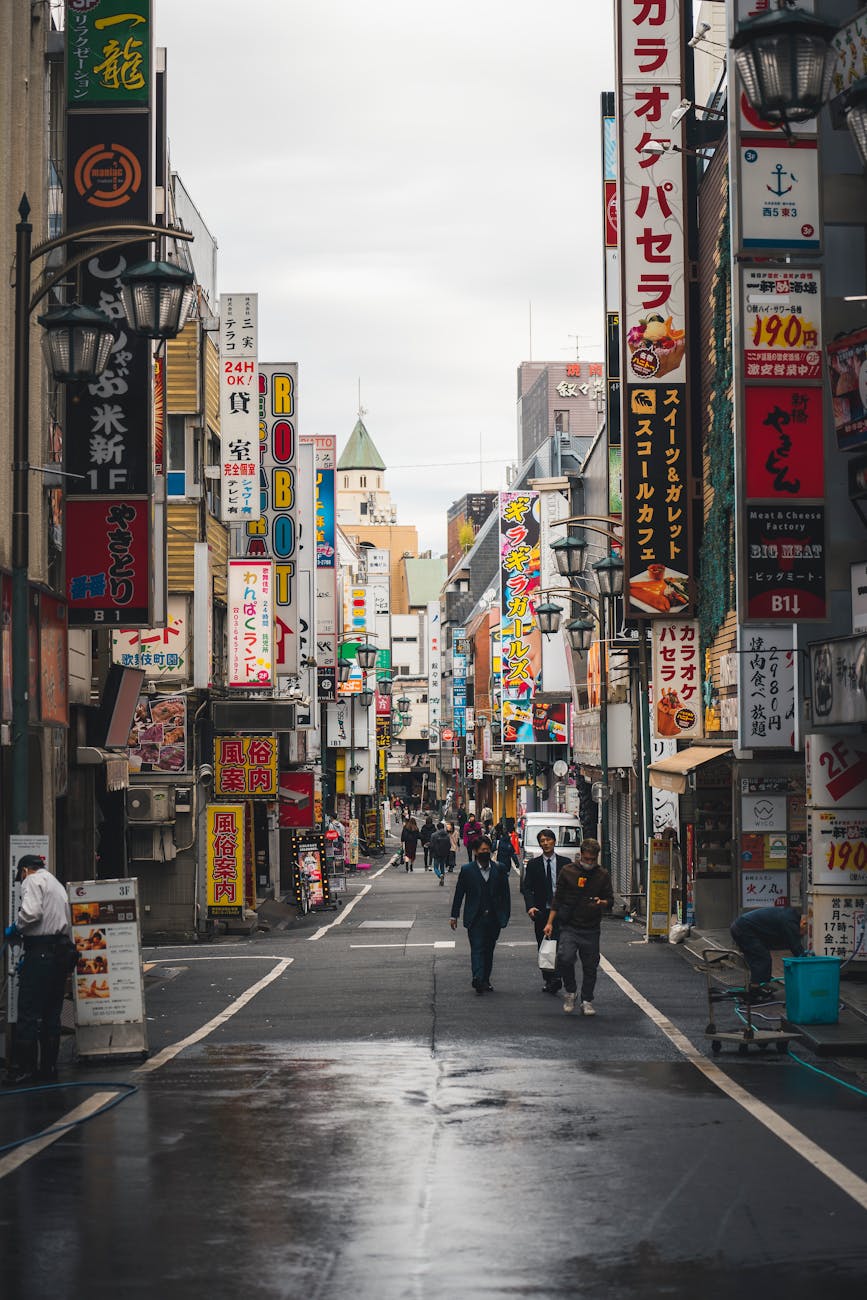
Topping the 2025 rankings is a corner of Tokyo that Time Out calls a “bibliophile nirvana.” Jimbōchō is home to some 130 vintage book stores — Time Out highlights Isseido Booksellers and Kitazawa Bookstore as great starting points for a day of bookish exploring — as well as its coffee-shop culture and delicious curry houses.

Time Out’s annual list is compiled from nominations made by its global network of editors and writers. The selections are then ranked against criteria including culture, community, livability, food and drink and what Time Out describes as “that hard-to-define sense of ‘nowness.’”

A Chicago neighborhood is a little bit down the list:

Rounding out the top five is the highest ranking US spot — Avondale in Chicago, highlighted for its wine bars, wellness studios and music venues. The neighborhood is also praised for its quirky small business scene, which includes retro bowling alley Avondale Bowl and antique mall-themed bar Consignment Lounge. Jeff Wilson, managing partner at Avondale Bowl, told CNN Travel that “seeing many of Avondale’s local, small businesses be included in a list with so many other communities around the globe really shows how many amazing things are happening right around us.”

I have multiple questions after reading about these rankings:

  1. Rankings of places often have to account for a lot of communities. Here, we could start with the many cities in the world. And then each city has numerous neighborhoods, depending on how their size is defined. There are a lot of neighborhoods to choose from.
  2. How long does “nowness” last? What is the half-life for a cool neighborhood? There is something unique about the neighborhoods at the top of list. The activity and meanings present in these neighborhoods might continue at a similar rate over time yet the neighborhood might become less cool to those experiencing the neighborhood.
  3. This list seems geared toward seeking out places to visit. But what these visitors might find attractive could differ from people who live there. Visitors want to find something unique, experience something new. How does this relate to the supply of local housing or job opportunities? Does being identified on such a list lead to more tourists, which then might alter the day-to-day life in the neighborhood? To play off the idea of Chicago as “a city of neighborhoods,” could a traveler be a connoisseur of novel neighborhood experiences?

Over and over featuring large and wealthy suburbs on Best Places to Live lists

A new list of the “Best Places to Live” was recently released. Reading through the list, I was reminded of what kind of communities often dominate the top of these lists: large and wealthy suburbs. All the top ten communities have median household incomes of over $116,000, six are over $131,000, and the top two are over $146,000.

Photo by Tara Winstead on Pexels.com

One reason for this is the methodology of rankings. US News looks for particular communities and happens to find a number of wealthy suburbs:

U.S. News & World Report’s Best Places to Live rankings help readers make the most informed decisions when choosing where to settle down. Cities in the rankings are evaluated using data from Applied Geographic Solutions (AGS) and U.S. News’ own internal resources. AGS develops its core database and specialized indexes from both private and government sources, including the U.S. Census Bureau, Department of Commerce, the Federal Reserve and the Bureau for Economic Analysis, as well as state and local sources.

This data was categorized into the five indexes listed below and evaluated using a methodology determined by Americans’ preferences. The percent weighting for each index follows the answers from a February 2025 public survey in which people from across the country voted for what they believed was the most important factor to consider when choosing where to live.

Another might be that these are the kinds of communities Americans say they want. The ratings methodology above suggests this but generally Americans like, no, love, suburbs. And wealthy suburbs tend to have traits Americans like in suburbs: big houses, nice amenities, a quiet lifestyle. How many suburbanites want to be successful and then live around other successful people?

But if we keep naming the same kind of places as the best places to live, does this reinforce a particular story about places to the exclusion of other places? Many people will not have the opportunity to live in these communities, whether because of a lack of resources or ties and connections to other places within metropolitan regions. Could it be better to focus on helping more communities be places where people can thrive? Can many suburbs within a region be successful, even if they never make it to the top of lists with particular criteria?

How to rank skylines – with Chicago finishing 3rd in the world

Architectural Digest has a new ranking of city skylines. Here is their methodology:

Photo by Pixabay on Pexels.com

The world’s most beautiful skylines are more than just collections of buildings placed close together: They’re the façades of entire cities, the front doors to many of the earth’s most vibrant metropolises. It’s these man-made horizons that often offer the first impression to visitors and imbue a sense of home to returning locals. But what exactly makes a beautiful skyline? One that is immediately recognizable? Those that are the most harmonious? The cities with the greatest number of individually striking buildings? The answer, is of course, some collection of all of the above. Like when discussing most aesthetic disciplines, visual examples are far more powerful than description will ever be. To that end, AD has rounded up 17 of the world’s most beautiful skylines, covering notable favorites like New York City and Shanghai as well as some lesser-known stunners that deserve more acclaim.

I do not know if it is better to simply make a subjective ranking or to have a pseudo-scientific ranking of weighted factors. As noted above, there are at least a few factors that could be considered. Here is what I might include:

  1. The most tall buildings. Would places with more tall skyscrapers automatically rank higher?
  2. The most lauded buildings. Does this come back to you particular architectural styles? Or the architects connected to them? Or the number of social media images with each building in them?
  3. The setting of the skyline. Does the view of the buildings include water or mountains or another impressive natural feature or other built features (the rankings above mention bridges)?
  4. The age of the skyscrapers. Does it matter if many of the buildings are older or if many are newer?
  5. The tourism connected to the skyline. Do people come to this place to see the skyline? Would someone go out of their way on a visit to try to take in the whole skyline?
  6. The opinions of a range of experts. What do they see as the best skylines? It could be interesting to see who is considered a skyline expert.

And among these possibilities, Chicago ranks #3. Here is the description:

Hugging the shores of Lake Michigan, Chicago is the third most populated city in the United States. The Midwest metropolis is made famous by many striking supertalls, such as Willis Tower, Vista Tower, and Marina City.

Several factors stand out: a setting on a vast body of water, a large population center, and multiple “striking supertalls.” Does Chicago get more points because of the number of tall buildings or the architects and styles connected to the skyscrapers or the longevity of the skyline or the tourism in the city?

Naperville as “the second largest economic engine (in Illinois)”

The last paragraph of a story about NCTV in Naperville hints at the economic activity in the suburb:

Photo by Karolina Grabowska on Pexels.com

Spencer said she views additional city funding for NCTV17 as an investment into what the station does for the community.

“We think we’re more important and more relevant than ever to Naperville as the fourth largest city and the second largest economic engine (in Illinois),” she said. “We think we provide a really big service. … With a little support from our friends at the city, (we think) we can weather this storm and arrive at port bigger and better than ever.”

What features of Naperville would mark it as such a large economic engine? Its population puts it in the top four communities in Illinois, following Chicago, Aurora, and Joliet. But population alone does not tell the full story. Some more features of Naperville

Lots of human capital and economic resources among residents: “The region has a civilian labor force of 79,726 with a participation rate of 69.2%. Of individuals 25 to 64 in the Naperville city, IL, 74.0% have a bachelor’s degree or higher which compares with 34.3% in the nation. The median household income in the Naperville city, IL is $127,648 and the median house value is $424,800.”

Nearly 80,000 jobs in the suburb.

Certain job sectors well represented: “The largest sector in the Naperville city, IL is Health Care and Social Assistance, employing 12,989 workers. The next largest sectors in the region are Professional, Scientific, and Technical Services (12,897 workers) and Retail Trade (8,375). High location quotients (LQs) indicate sectors in which a region has high concentrations of employment compared to the national average. The sectors with the largest LQs in the region are Professional, Scientific, and Technical Services (LQ = 2.22), Utilities (2.08), and Management of Companies and Enterprises (2.05).”

Lots of office space available: “The office market in Naperville, IL incorporates 10,451,396 square feet of office space across 56 buildings that are at least 25,000 square feet in size.”

-A vibrant downtown.

Lots of awards from different outlets.

Billions of dollars each year in retail sales.

-Multiple corporate headquarters in the city.

-Part of the I-88 corporate corridor, access to multiple major highways, and close to two major airports and Chicago.

As I put together this list, Naperville indeed sounds like an edge city.

In a state dominated by Chicago, it is noteworthy to be second in line as an economic engine. I wonder what other Illinois communities are trumpeting their economic prowess and how many of them are suburbs.

Naperville continues to rank highly, even for gardening

Recent rankings of cities or communities by different sources continue to include Naperville:

Photo by Lisa Fotios on Pexels.com

Since April, Naperville has made the grade in 2024 for being among the Top 100 Best Places to Live in the U.S. as determined by the publication “Livability; Safest Cities in America,” per the home security review site Safewise; Top Destinations for a “White Picket Fence” Lifestyle, from DatingNews.com; and Best Cities for Naked Gardening, from online platform LawnStarter…

Naperville earned a LivScore of 862 out of 1,000. There were only a handful of cities that received a higher score than Naperville on the 2024 ranking. Those were Carmel and Fishers in Indiana, Cary in North Carolina and Columbia in Maryland…

Last month, the site released its 10th annual safest cities report and placed Naperville in the No. 12 spot…

Naperville came in at No. 30. Several other Illinois cities also proved to be up to the bare snuff, with Chicago ranking No.11, followed by Evanston at No. 13, Elgin at No. 17, Schaumburg at No. 23 and Arlington Heights at No. 25.

Add these to the March 2024 ranking as Niche’s best place to live:

On Tuesday, the site released its 2024 lists for Best Places to Live in America. And for the first time ever, Naperville came out on top of the some 230 cities evaluated in this year’s rankings.

It was also named the No. 1 U.S. city to raise a family and the city with the best public schools.

Three things strike me about these rankings and sources:

  1. Naperville is at the top of some lists and not others. There are thousands of communities in the United States.
  2. There is a proliferation of rankings of communities. Why? I would guess it is due to the easier access to data about communities plus the rankings drive clicks and impressions.
  3. With the growing number of rankings, will communities list all of them? Will Naperville claim all three of these?

In other words, we are a long ways from Naperville ranking as the #2 place to live according to Money in 2006.

Are these 15 factors that decide the best suburb or community the ones people to use to make a decision?

In recently looking at the list of the “2024 Best Suburbs to Live in America” according to Niche, I was curious about their methodology. Here are the factors they consider:

This is a long list and it is hard to quickly think of something that should be on the list that is not.

But is this how people select a house or a community? Do they look at all of these factors? Do some of these play a more outsized role than others? Imagine a realtor having a list like this with potential buyers and going through each factor. If you put people in a more controlled setting and asked them to decide between potential suburban places to live, is this how they would decide?

I suspect making a decision is less rational than this full list suggests and is more about having a feeling about a particular house, neighborhood, and/or community. They hear from people or they enjoy driving through the community or what they see in a particular residence appeals to them. Of course, different buyers or potential residents might emphasize different factors and still arrive at the same outcome.

Naperville now top trick-or-treating community in the United States

Naperville has accumulated a number of high rankings over the years and now it can claim to be the best place to trick-or-treat in 2023:

Photo by Charles Parker on Pexels.com

For innocuous thrills and chills, the city is No. 1, according to a recently released study ranking the top safest U.S. cities to go trick-or-treating. The list, compiled by product research company Chamber of Commerce, considers factors like crime, pedestrian deaths and law enforcement presence to determine where a worry-free Halloween is most likely to happen.

Naperville came in first out of more than 300 places evaluated across the country. That’s a step up from even last year, when the city ranked No. 4 on the same tally heading into Halloween 2022…

For Naperville, the company found the city “retains the charm and security of a tight-knit community” with few registered sex offenders, an “excellent record of property crime” and relatively few violent crimes reported across the whole city over the past year.

No word on the quality of candy available among the city’s households and businesses? There has to be some way to get at the experiences of people trick or treating in the community.

This adds to earlier rankings that had Naperville as a best place to live, a good place for families, and high level of wealth within the region.

The different lists of the Best Places to Live vs. the Best Affordable Places to Live

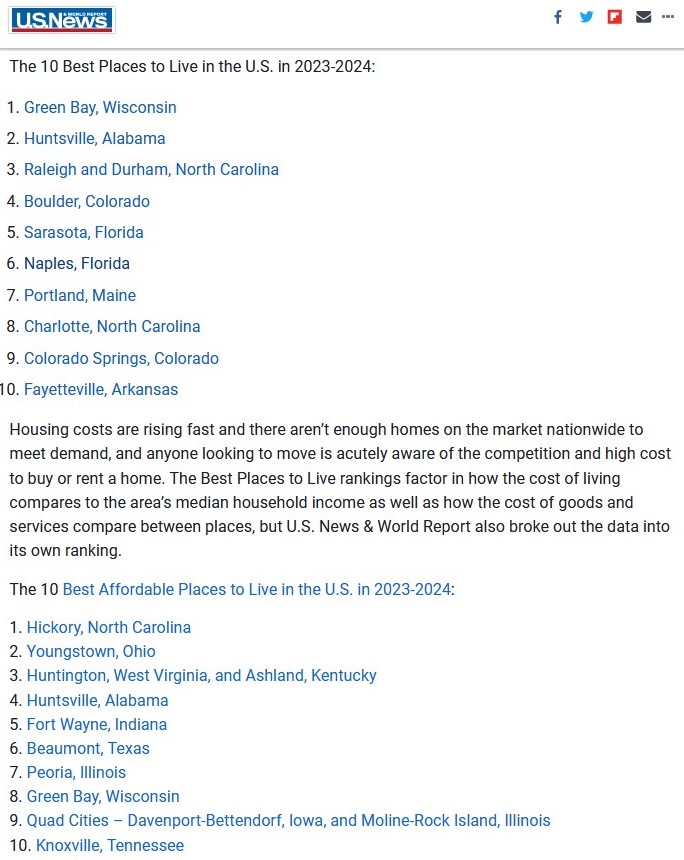
U.S. News & World Report just named Green Bay as the best city in the United States to live. One of the factors they account for is housing affordability. But, compare these lists:

There is not a lot of overlap in these top ten lists. Indeed, Green Bay is the only one on both. These lists tend to factor in affordability, but it is not the only factor that matters. Americans do not just move to places that are the most affordable.

US News uses these four categories in their methodology to find the Best Places to Live. This includes value/affordability but also reflects that people desire a certain set of economic and community opportunities:

Quality of Life Index – 36%

The Quality of Life Index measures how satisfied residents are with their daily lives in each ranked metro area, along with how affected the specific metro area is to life-impacting factors. To calculate Quality of Life scores, we evaluated multiple aspects of life in each metro area using a weighted average. To determine the weightings, we surveyed people across the U.S. to see the importance they place on each aspect evaluated in the index. The Quality of Life Index takes into account:…

Value Index – 23%

The Value Index measures how comfortably the average resident of each metro area can afford to live within their means. To accomplish this, we compared the median annual household income with the housing cost in each metro area (the Housing Affordability Index), along with a regional Price Parity Index created through data from the Bureau of Economic Analysis (BEA). The Value Index is determined by:…

Desirability Index – 22%

The Desirability Index measures whether people want to live in a given metro area. To determine this, we asked people from all over the U.S. where they’d prefer to live…

Job Market Index – 19%

The Job Market Index measures the strength of each metro area’s job market. To do this, we assessed the following two factors to determine how likely residents are to find employment in each metro area and their earning potential there:

Americans and/or those that regularly put together these lists like some level of affordability but their most desirable places have a particular status and quality of life.

How are the best places to live different from the “best cities for remote workers”?

A new list looks at the best places to live as a remote worker. Here is the description of what sets these places apart:

Photo by Pixabay on Pexels.com

We compared the 200 biggest U.S. cities based on 20 remote worker-friendliness factors, such as internet quality, cost of living, and access to coworking spaces. We even considered financial bonuses that local and state governments offer prospective telecommuting incomers.

Here are some trends in the rankings:

Live your best remote life in Plano, Texas, our 2023 gold medalist. Plano displaces fellow Dallas suburb Frisco, our former top city for telecommuters, as well as Austin, Arlington, and Dallas, which were also ahead last year…

Eight of our top 10 cities are all located in the South. This region is known for its general budget-friendliness (including no state income tax for some) and sprawling spaces, and our data maintains that reputation…

What gives? The real question is, what doesn’t California’s biggest cities give? The answer is a lot: generous square footage and affordable goods and services. There are exceptions in each category, of course, but they’re few and far between.

This list seems to roughly overlap with other lists of best places to live: there are certain factors and locations that offer opportunities in ways that others do not.

At the same time, this list and the best places to live lists tend to be skewed toward certain kinds of jobs or industries. This list depends on the kinds of jobs or sectors where people can work from home. The best places to live lists often rank highly places with lots of well-paying white collar jobs.

Does it matter that the so-called best places to live are similar to the places named as best for remote workers? Such rankings can reinforce each other and lead to population growth in some places – and not others that could also be good places for people to live.