The mostly Christian US House and Senate

How does the religious affiliation of the members of Congress compare to the religious affiliation of Americans as a whole? This came up recently in a conversation about religiosity and government so I tracked down some data.

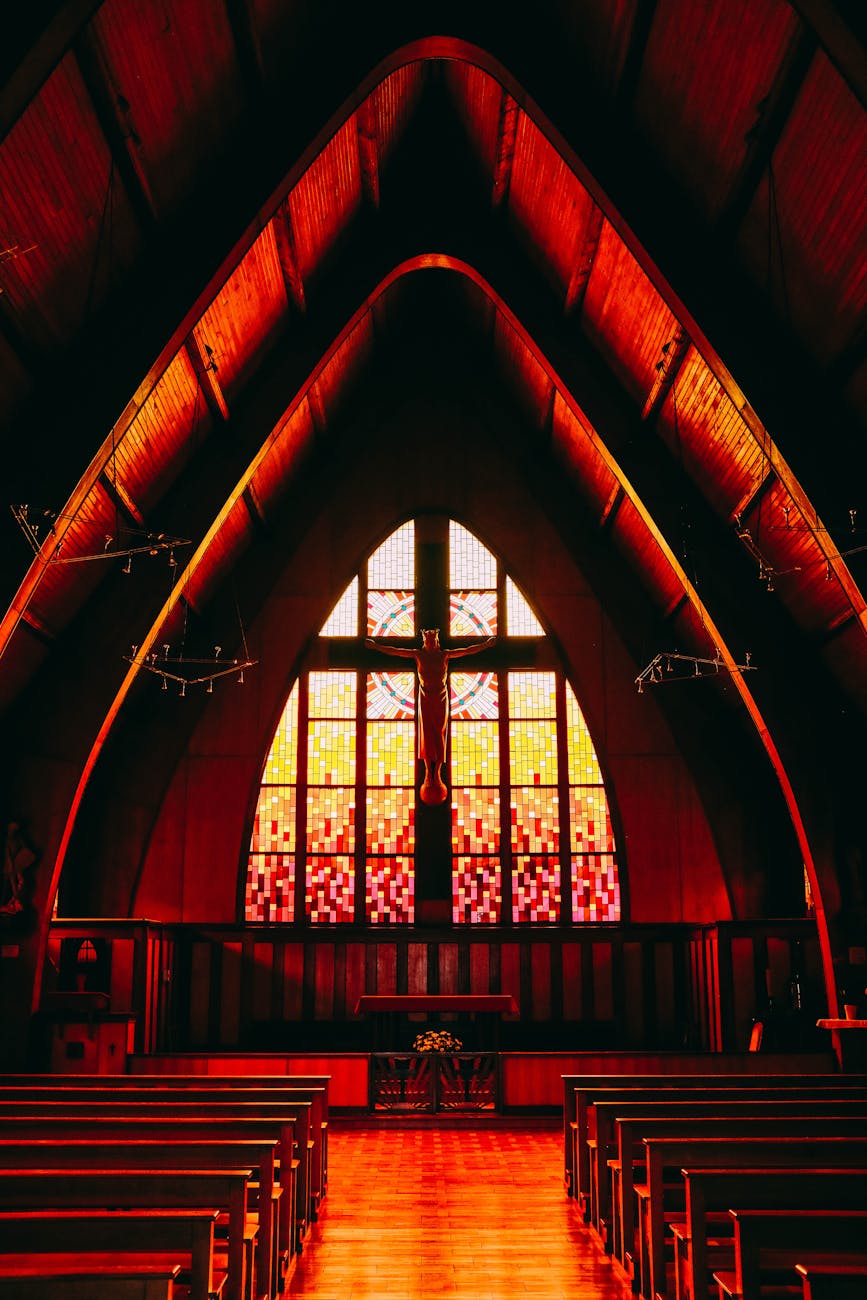
Photo by Kendall Hoopes on Pexels.com

For the religious affiliation of Americans as a whole, here are figures from the Pew Religious Landscape Survey with data collected in 2023-24 from more than 35,000 respondents. With 62% of American adults identifying as Christian, here are the percentages for particular religious traditions:

-23% evangelical Protestant

-11% mainline Protestant

-5% Black Protestant

-19% Catholic

-2% Latter-day Saint

-2% Jewish

-1% Orthodox Christian

-1% Muslim

-1% Buddhist

-1% Hindu

-29% religiously unaffiliated

For the religious affiliations of members of Congress, here is a summary of what Wikipedia has for House members and Senate members. The categories are not the same as the religious traditions for the Pew Religious Landscape Survey but there are points to compare. Starting with members of the House of Representatives:

-375 of the 435 (86%) are Christian. Of these Christians, 236 are Protestants in specified traditions (including 63 Baptists, 22 Methodists, 16 Episcopalians, 15 Presbyterians, 13 Lutherans, 10 non-denominationals) and 88 are unspecified Protestants. Of the 375 Christians, 126 are Catholics, 7 are Eastern Orthodox, and 6 are Latter-day Saints.

-24 of the 435 (6%) are Jewish.

-4 of the 435 (1%) are Muslim

-4 of the 435 (1%) are Hindus

-2 of the 435 (0.5%) are Buddhist

-18 (4%) are unknown or refused to state.

-4 (1%) are unaffiliated.

And here is the religious affiliation for members of the Senate:

-86 of the 100 (86%) are Christian. Of these Christians, 59 are Protestants in specified traditions (including 12 Baptists, 5 Methodists, 5 Episcopalians, 12 Presbyterians, 6 Lutherans, 6 non-denominationals) and 5 are unspecified Protestants. Of the 86 Christians, 24 are Catholics, 7 are Eastern Orthodox, and 3 are Latter-day Saints.

-9 of the 100 (9%) are Jewish.

-1 of the 100 (1%) are Buddhist

-4 (4%) are unknown or refused to state.

How does the religiosity of Congress compare to the country as a whole? Pew sums up:

Christians will make up 87% of voting members in the Senate and House of Representatives, combined, in the 2025-27 congressional session. That’s down from 88% in the last session and 92% a decade ago...

And yet, at 87%, Christians still make up the lion’s share of the Congress, far exceeding the Christian share of all U.S. adults, which stands at 62% after several decades of decline…

The new Congress is also more religious than the general population by another, related measure: Nearly three-in-ten Americans (28%) are religiously unaffiliated, meaning they are atheist or agnostic or say their religion is “nothing in particular.” But less than 1% of Congress falls into this category…

In a country where a majority of adults identify as Christian, Congress is roughly 25% more Christian than the population as a whole. This may change in the coming years as more American adults do not identify with any religious tradition or group.

America’s religious nones: “They. Really. Don’t. Like. Organized. Religion.”

New data on the growing number of “religious nones” in the United States, those who do not identify with any religion , shows they do not like organized religion:

Photo by Francesco Ungaro on Pexels.com

While the nones’ diversity splinters them into myriad subgroups, most of them have this in common:

They. Really. Don’t. Like. Organized. Religion.

Nor its leaders. Nor its politics and social stances. That’s according to a large majority of nones in the AP-NORC survey.

From a related article with some numbers on this:

Among the nones who say they are also not personally religious, 68% cited their dislike of organized religion as a very or extremely important reason. For 63%, a top reason is their dislike of the stances religious faiths take on social and political issues, while 54% say the same about reports of abuse or misconduct by religious leaders. Forty-six percent cite disbelieving in God as a top reason. That was true of 81% of atheists, but just 40% of agnostics and 32% of nothings in particular.

The last paragraph suggests there are multiple influential reasons the nones cite, with a dislike for organized religion leading the way.

It is interesting to see this alongside recent figures showing declines in trust in all sorts of institutions in American life.

This also makes me think about how religious or spiritual ideas can begin or start and then there are processes that transform them into institutionalized religion. Beyond just leaving religion and spirituality solely up to individuals, how do different religious groups push against institutionalization and rationalization?

More Protestant churches closing than opening – and understanding the bigger patterns

One source suggests more Protestant churches are closing than are opening:

Photo by Luis Quintero on Pexels.com

About 4,500 Protestant churches closed in 2019, the last year data is available, with about 3,000 new churches opening, according to Lifeway Research. It was the first time the number of churches in the US hadn’t grown since the evangelical firm started studying the topic. With the pandemic speeding up a broader trend of Americans turning away from Christianity, researchers say the closures will only have accelerated…

“In the last three years, all signs are pointing to a continued pace of closures probably similar to 2019 or possibly higher, as there’s been a really rapid rise in American individuals who say they’re not religious.”

The rest of the article deals with why this is happening and what happens to these buildings.

For this post, I am more interested in putting the cited numbers in context. Here are different aspects of this:

  1. As cross-sectional numbers (first sentence above), it is hard to know what do with these figures. In 2019, more Protestant churches closed than opened. This is a one year figure.
  2. Looking at trends over time is useful. The next sentence above says this is the first time that more congregations have closed than opened since Lifeway started tracking this. So this is a reversal or change to a larger trend? How long has anyone tracked this? Is it assumed that it is good or normal that more churches open than close each year?
  3. As noted above, there are fewer people claiming religious affiliation. Are there additional factors involved, such as a shift of attendees toward larger congregations?
  4. Are there other data sources for the number of churches and what does their data show?

With the attention that is paid to the declining number of religious Americans, it would be helpful to continue to look at the corresponding organizational changes including changes in the number of congregations.

Avoid “near churches” in a real estate listing

Among other phrases to avoid in writing real estate listings, one expert suggests avoiding this:

Photo by Tom Fisk on Pexels.com

Near churches

You may be amazed that this still happens, but here and there I see this pop up in property descriptions. Perhaps worse is when a specific church is mentioned as a local landmark since it suggests not only that the prospective buyer should be church-going, but that they should be from a specific denomination.

In general, much of the advice in this piece asks sellers to broaden their categories about who might purchase the home. Why mention “near churches” if there are plenty of potential buyers who are of a different faith or of no faith? With “religious nones” as the fastest growing religious tradition, to paraphrase Michael Jordan, “non-religious people buy houses too.”

At the same time, there may be unique locations where “near churches” or “near houses of worship” might make more sense. Perhaps it is a neighborhood or community known for religious activity. Perhaps there really is an important site that people might want to live near. (One less positive possibility: could such a phrase signal the amount of traffic and activity around churches? Since real estate listings do not often dwell on negative features of the property, this may be unrealistic.)

I also suspect the “near churches” information is found much more frequently in some places than other. How about the Bible Belt or Midwest much more so than the Seattle area or the Northeast?

Religion, work, and Silicon Valley

A new sociology book looks at how a number of Silicon Valley leaders embraced religion as they also created a unique work culture:

Photo by Fox on Pexels.com

Author and sociologist Carolyn Chen calls this philosophy “techtopia,” where “people find their highest fulfillment in the utopian workplace.”…

Chen’s research subjects are almost all men, and most are white or Asian. Eighty percent had moved from places outside Silicon Valley, marooned there without the support structures of family, friends or community. Chen describes them as “far from home, alone, young, impressionable.” Work is their only outlet to fill in the “meaning” gap…

While Silicon Valley may be the epicenter of experimental self-improvement (just check out how many tech workers fast or microdose psychedelics to achieve greater clarity or productivity), the “work as religion” philosophy has spread across the country. According to Chen, almost every Fortune 500 company has some kind of religiosity baked into its corporate structure — from inspiring mission statements to charismatic leaders — and many companies have actively gone “spiritual” to drive up the bottom line.

For the past 40 years, the workplace has successfully unseated religious institutions as a primary meaning maker, right after family, according to a recent Pew survey. High-income employees work longer hours than ever and are less likely to consider themselves religious, writes Chen. People who don’t have any religion — “religious nones” — have tripled in the past quarter century. At the same time, corporations have changed their strategies, using new incentive structures like gain sharing and stock options to bring people into the corporate “family.”

Going back to the early days of sociology, is the Silicon Valley marriage of religion and work more like:

  1. Marx’s suggestion that religion is a tool used by the capitalists – who own the means and modes of production – to distract workers from the reality that they are being exploited.
  2. Weber’s idea that religious ideas could transform economic systems; is this less about religion being connected to work and more about religion fundamentally changing work?
  3. Durkheim’s argument that people will no longer need religion as humans embrace a brotherhood of people and progress.

There might be some merit to all of these. If humans are meaning-making creatures, they will continue to make meaning – and ultimate meaning – in the midst of their day-to-day realities. Yet, since we are right in the middle of this transformation, it is not certain that it will necessarily continue. Do American workers like the idea that work is the primary meaning-maker?

The role of religious buildings in the decline in religiosity in the US during COVID-19

New data from Pew Research suggests religiosity declined during COVID-19:

Photo by Nikko Tan on Pexels.com

The percentage of Americans who identify as Christians now stands at 63%, down from 65% in 2019 and from 78% in 2007. Meanwhile, 29% of Americans now identify as having no religion, up from 26% in 2019 and 16% in 2007, when Pew began tracking religious identity.

Many places of worship closed during the pandemic—some voluntarily, others as a result of state and local social-distancing rules—and in-person church attendance is roughly 30% to 50% lower than it was before the pandemic, estimates Barna Group, a research firm that studies faith in the U.S. Millions of Americans moved to worshiping online, and questions linger about how many will come back in person.

A previous Pew survey, in January, found that a third of Americans said their faith had grown stronger during the pandemic—the highest share of any developed country. But overall, religious engagement trended downward at roughly the same rate as before the pandemic, according to the new Pew survey.

These findings are likely part of a longer trend away from religion that was already underway before COVID-19 hit. Sociologists and others have noted the rise of “religious nones,” particularly among younger Americans. Religion in the United States can often be individualistic and anchored less in religious traditions or denominations.

Yet, I wonder if COVID-19 presented a unique disruption to religiosity as it limited interaction with religious buildings. Sociologist Robert Brenneman and I discuss the impact of religious buildings on worship and community in Building Faith. We argue that the religious building and the ways that exterior and interior features are designed influence people who interact with them. The buildings do not just reflect religious values or doctrine; they help shape religious experiences.

When COVID-19 stopped people from being in buildings that influenced their faith, did this register as a loss and/or lead to a decline in religious engagement? With today’s technology and the ways that many congregations pivoted to online options, people can still engage with faith communities. Yet, that experience through Zoom or other video options is not the same as being in a physical structure that reinforces faith experiences. Even in congregations that tend to downplay the role of space, they still try to shape the religious building space in ways that encourages particular emotions and experiences.

Can religious faith in the United States survive as an enterprise free from the confines of a religious building? I have my doubts. While buildings themselves are unlikely to reverse the decline in religiosity in the last decade or so, they have a role in shaping communal and individual faith.

“Top Three Religious Traditions in Major Metropolitan Areas”

Data from the 2014 American Values Atlas compiled by PRRI shows the top three religious traditions in a number of large American metro areas:

Top-Three-Religions-by-City

Here are some of the takeaways according to PRRI:


  • Urban areas attract the unaffiliated; the religiously unaffiliated are among the top three religious groups in every metro area polled.
  • Catholics also love cities; Catholicism is among the top three religious groups for nearly every metro area—only Nashville, Charlotte, Indianapolis, Kansas City, and Atlanta don’t have Catholics among the top three.
  • Atlanta is the only metro area that doesn’t have Catholics, the religiously unaffiliated, or white evangelical Protestants in the number one slot; that prize goes to black Protestants.
  • Nashville has the largest percentage of one singular religious group: nearly four in ten (38 percent) residents identify as white evangelical Protestant.

Related to these takeaways, two things stuck out most to me looking at this data:

  1. The relative evenness of major religious traditions (and unaffiliated) in major cities. Few large regions have one religious tradition that comprises of more than 33% of the population. This suggests a lot of pluralism at the metropolitan region level.
  2. The pattern does not hold in every case but the leading cities for having the percent of different religious traditions tend to fall into certain regions: Catholics in the Northeast and Midwest, unaffiliated in the West, white evangelical Protestant in the Bible Belt and Midwest.

Put these two factors together and it would be fascinating to consider how the experience of religiosity differs across metropolitan regions. For example, a comparison across traditions such as between Nashville (dominated by white evangelicals) and Portland (dominated by the unaffiliated) could be interesting as would regional differences within the same leading tradition such as between Miami and Milwaukee. If metropolitan regions could be considered fields of religious activity, how might they differ in significant ways?


Religiosity of 116th Congress both does and does not reflect changes in American religion

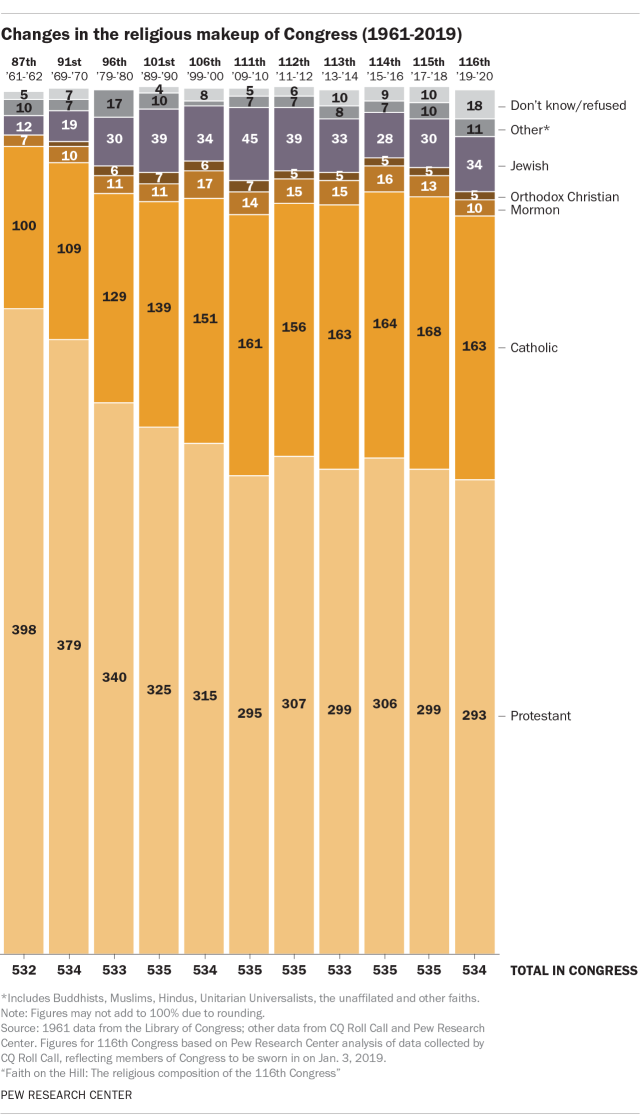
Comparing the religious makeup of the newest Congress to previous Congresses shows several interesting patterns:

http://www.pewforum.org/2019/01/03/faith-on-the-hill-116/

A few patterns to note:

  1. The number of Protestants has dropped dramatically – roughly a loss of 100 from sixty years ago – even as the percent of Protestants in Congress (54%) continues to be higher than the percent of Protestants in the U.S. population (48%).
  2. The number of Catholics in Congress increased from the 1960s into the late 1970s and early 1980s and then has stayed relatively stable. There are more Catholics in Congress (30%) than in the U.S. population as a whole (21%).
  3. The number of religious others is still low and hasn’t changed much over time.
  4. As noted in the summary of the findings:

But by far the largest difference between the U.S. public and Congress is in the share who are unaffiliated with a religious group. In the general public, 23% say they are atheist, agnostic or “nothing in particular.” In Congress, just one person – Sen. Kyrsten Sinema, D-Ariz., who was recently elected to the Senate after three terms in the House – says she is religiously unaffiliated, making the share of “nones” in Congress 0.2%.

When asked about their religious affiliation, a growing number of members of Congress decline to specify (categorized as “don’t know/refused”). This group – all Democrats – numbers 18, or 3% of Congress, up from 10 members (2%) in the 115th Congress. Their reasons for this decision may vary. But one member in this category, Rep. Jared Huffman, D-Calif., announced in 2017 that he identifies as a humanist and says he is not sure God exists. Huffman remains categorized as “don’t know/refused” because he declined to state his religious identity in the CQ Roll Call questionnaire used to collect data for this report.3

In summary, Congress is overwhelmingly religious and Christian. While America as a whole is still solidly majority religious and Christian, Congress is even more so. This seems to suggest Americans still like to elect people who have a faith affiliation even if there is less information on the actual beliefs and practices of the Representatives and Senators (this data “does not attempt to measure their religious beliefs or practices. “).

Religious change: Americans identifying as Christian drops to 70.6%

New data from Pew Research shows a drop in how many American adults identify as Christians:

The Christian share of the U.S. population is declining, while the number of U.S. adults who do not identify with any organized religion is growing, according to an extensive new survey by the Pew Research Center. Moreover, these changes are taking place across the religious landscape, affecting all regions of the country and many demographic groups. While the drop in Christian affiliation is particularly pronounced among young adults, it is occurring among Americans of all ages. The same trends are seen among whites, blacks and Latinos; among both college graduates and adults with only a high school education; and among women as well as men.

To be sure, the United States remains home to more Christians than any other country in the world, and a large majority of Americans – roughly seven-in-ten – continue to identify with some branch of the Christian faith.1 But the major new survey of more than 35,000 Americans by the Pew Research Center finds that the percentage of adults (ages 18 and older) who describe themselves as Christians has dropped by nearly eight percentage points in just seven years, from 78.4% in an equally massive Pew Research survey in 2007 to 70.6% in 2014. Over the same period, the percentage of Americans who are religiously unaffiliated – describing themselves as atheist, agnostic or “nothing in particular” – has jumped more than six points, from 16.1% to 22.8%. And the share of Americans who identify with non-Christian faiths also has inched up, rising 1.2 percentage points, from 4.7% in 2007 to 5.9% in 2014. Growth has been especially great among Muslims and Hindus, albeit from a very low base.

Changing U.S. Religious Landscape


While the drop in religious affiliation will get a lot of attention, this report has other interesting information: American Christians have become more non-white; religious intermarriage is up; Black Protestants have been stable while Evangelical Christians are growing whereas Catholics and Mainline Protestants have lost large numbers; and non-Christian groups have grown but are still quite small.

Is more Internet use correlated to a decline in religious affiliation?

A new study suggests using the Internet more is correlated with lower levels of religious affiliation:

Downey analyzed data from the General Social Survey, a well-respected annual research survey carried out by the University of Chicago, to make his findings.

Downey says the single biggest cause of religious affiliation is upbringing: those you are raised in religious households are much more likely to remain in their family’s religion as adults…

By far the largest factor, says Downey, is Internet use.

In the 1980s, Internet use was virtually non-existent, but in 2010, 53 per cent of people spent two hours online a week and 25 per cent spent more than seven hours…

Downey says that his research has controlled for ‘most of the obvious candidates, including income, education, socioeconomic status, and rural/urban environments’ to discount a third factor, one that is responsible both for the rise of Internet use and the drop in religiosity.

Since the full story is behind a subscriber wall, two speculations about the methodology of this study:

1. This sounds like a regression and/or ANOVA analysis based on R-squared changes. In other words, when one explanatory factor is in the model, how much more of the variation in the dependent variable (religiosity) is explained? You can then add or subtract different factors singly or in combination to see how that percent of variation explained changes.

2. Looking at religious affiliation is just one way to measure religiosity. Affiliation is based on self-identification (do you consider yourself a Catholic, mainline Protestant, conservative Protestant, etc.) or what religious congregation you regularly attend or interact with. But, levels of religious affiliation have been falling in recent years even as not all measures of religiosity are falling. Research about the rise of the “religious nones” shows a number of these people still are spiritual or perform religious practices.

If there is a strong causal relationship between increased Internet use and less religiosity, why might this be the case? A few ideas:

1. The Internet opens people up to a whole realm of information beyond themselves. Traditionally, people would look to those around them, whether individuals or institutions, within relatively close proximity. The Internet breaks a lot of these social boundaries and allows people to search for information way beyond themselves.

2. The Internet offers social interactions in a way that religion used to. Instead of going to a religious congregation to meet people, the Internet offers the possibilities of finding like-minded people in all sorts of areas from hobbies and interests, people in the same career field, dating websites, and people you want to sell goods to. In other words, some of the social aspects of religion can now be replicated online.

3. The Internet in its medium and content tends to be individualistic. Anyone with an Internet connection can do all sorts of things without relying on others (outside of having a service provider). This simply feeds into individualistic attitudes that already existed in the United States.

It sounds like there is a lot more here for researchers to explore and unpack.