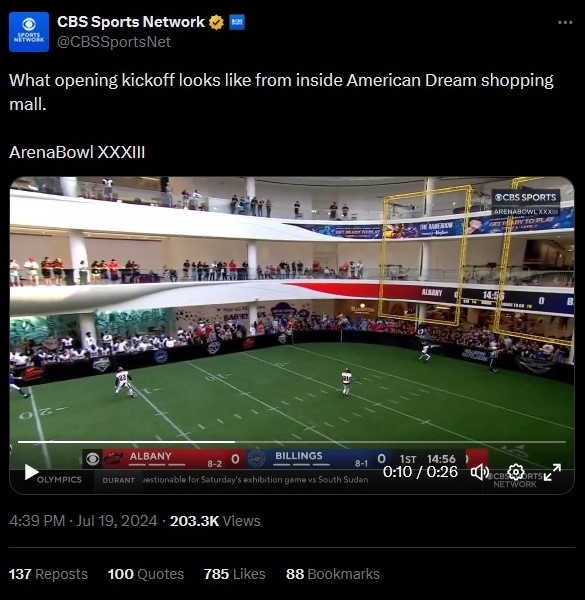
As shopping malls seek to add more entertainment options, why not add sports? It could be at the professional level or amateur level. Imagine a high school basketball tournament hosted inside a mall with space for sports. Or a kids baseball tournament. Or a tour pickleball tournament. Sports could help bring in more visitors. It puts more people in proximity to the shops and restaurants.
Even though malls are big, many may not be big enough to do this. The American Dream Meadowlands in East Rutherford Mall, New Jersey is the second-largest mall in the United States and has plenty of entertainment options – a ski slope, a hockey rink, an amusement park, an aquarium, and more – in addition to 450 stores and lots of food options. This complex has sports already in mind. Many malls would need to reconfigure space or add facilities.
Given how much Americans like football and shopping malls (even with their decline), how many events can get more American than this? And held at a place named American Dream?
Oca’s client, real estate investment firm E8 Properties, has been buying empty Sears stores, dusting them off and converting them into “Elev8 Fun,” a massive indoor family entertainment park created in partnership with Primetime Amusements, a provider of video arcade machine.
The first one, designed by Oca and his team and housed in a 120,000-square-foot former Sears building attached to the Seminole Town Center Mall in Sanford, Florida, opened in January 2022…
To his point, increasingly, more malls are morphing into family entertainment destinations where shopping may not even be what draws shoppers in.
Industry analysts said research shows that adding entertainment experiences shifts more money to mall retailers and not away from them. Through the pandemic and coming out of it, the popularity of pickleball made its way into malls with courts popping up next to skating rinks. Indoor skydiving, Legoland theme parks, virtual golf and microbreweries are other concepts catching on.
Shopping can be its own kind of entertainment. It is not just about buying goods, whether they are necessary for life or not. It is about looking, considering, interacting with people you are with, seeing other people shopping, and participating in particular lifestyles.
But these entertainment centers are offering something else: games, competition, novelty, having fun with others.
Longer-term, does this mean hopping is less entertaining and more efficient when done online? Is shopping more often a private activity since it takes place online? Do people still want to have experiences around or near others, even if the forms of doing so have changed?
Bloomingdale officials faced a similar scenario with Stratford Square, which once brought in $20 million a year in sales tax, but now is mostly empty. The village bought the mall this year for almost $9 million after filing for condemnation against the owner, Namdar Realty Group, as the property fell into disuse.
According to the FY 24 budget of the Village of Bloomingdale, they had $41 million in tax revenue. If the mall once brought in $20 million in sales tax revenue, that is a big change for a suburban community. Because the mall has declined over time, they have had time to adjust to the decreasing sales tax revenue. Still, that is a large amount.
What are the odds that the new land uses generate that amount of money? Given the state of retailers and brick and mortar establishments, this might be difficult. And there appears to be less demand for suburban office space. A mixed use setting, popular in suburban redevelopments (one example not too far away), could sustain some business and office activity. Residential development could provide more housing options but also require some different city services.
This reminds me of the long-term process redevelopment can often be. From the peak of the shopping mall to what the new development might look like, decades could pass. In the meantime, the community has changed and social and economic life has changed.
On this winter day, there were at least a few people walking laps around the mall. Others sat in the empty food court. Security walked around.
The directory was about 5-6 years old. At that point, the mall still had a lot of retailers.
In the background of the image, you can see the Sears sign. Almost all of the anchor stores are long gone. Most storefronts are empty. The movie theater is shuttered.
The decline of this mall did not happen immediately. Combine online shopping, lots of shopping options in the Chicago region, and COVID-19 and you get a nearly empty mall. And it will take years to redevelop the property and incorporate the new elements into the community.
West Dundee and Bloomingdale officials have similar visions for the mall properties in their towns.
West Dundee sees a mixed-use development with residential, office, retail and entertainment. Bloomingdale’s consultants have drawn up conceptual plans showing residential, commercial and recreational development in place of the mall’s former retail buildings and parking lots.
Typically, villages stay out of the real estate business and leave redevelopment of retail centers to developers. But for West Dundee and Bloomingdale, taking ownership of their malls and clearing some obstacles, such as multiple property owners or restrictive covenants, were deemed essential for future redevelopment.
“Almost uniformly, every developer with whom we spoke stated that the site has too many complications — too many owners, too many covenants, too many uncertainties,” Nelson said last year. “The village’s aim is to bring simplicity to the process so reliable developers with established track records will be interested in partnering to reformat the area. Without municipal intervention, that simply won’t happen.”
I wonder if this is an instance where a large property owner – the owners of these malls – can afford to sit on these properties for a while to see if there will be a bigger financial return later. I remember reading in the past about parking lots in downtown areas; they are not flashing and they are not the preferred land use but the company who owns that lot can wait until there is significant demand for the property and then make a lot of money on selling the parking lot. Compared to these suburbs, the property owners may be less interested in moving quickly on a redevelopment plan. (This could also apply to recent conversations about suburban office parks and downtown office buildings: even vacant buildings might not need to be sold or redeveloped if an owner can afford to hang on to them.)
There are hundreds of zombie malls throughout the U.S. like the Berkshire Mall, more dead than alive. The older, low-end ones have lost at least half and, in some cases, more than 70% of their value since the industry’s peak in late 2016, according to real-estate research firm Green Street…
That’s when Namdar Realty and Mason like to swoop in. The New York-based real-estate partners are among the most prolific purchasers of U.S. malls. They make money by buying malls cheap and keeping them going, even as town officials beg them to pull the plug.
Bare said the community would be better served if the Berkshire Mall was turned into something more valuable. Ideally, a mixed-use property with housing and medical offices or educational space, and maybe some retail and restaurants…
Malls typically sit on large parcels of prime real estate—which often include nearby buildings such as restaurants as well as large parking lots—that can be subdivided and sold in parts, sometimes at a value exceeding the purchase price of the mall. The partners keep the malls open, but cut costs by appealing their property-tax bills and reducing expenses such as staffing and maintenance.
All the while, they continue to collect rent from the mall’s remaining retailers. When national retailers move out, Namdar Realty and Mason try to replace them with nontraditional tenants such as call centers, local small businesses, doctors’ offices and bounce-house venues.
asdf
Here are some of the reasons communities do not like malls surviving in this state:
-They are not generating the kinds of tax revenues they did as a thriving mall.
-The land could be generating more revenue if used in different ways. Communities want to replace the tax revenues of the malls with other revenues. (And this is a reason housing might not be too appealing to some leaders.)
-A mall in bad repair and/or is partly to mostly empty is an eyesore. Gleaming and busy malls are a source of pride; struggling or dying malls are the opposite.
-Outside mall owners may not always be perceived as having the best interests of the community in mind. Imagine how locals might interpret their actions: someone is trying to profit off our struggles. They are impeding our progress just to make money for outsiders.
-Even if malls can be demolished or repurposed, it can be a hard path to putting new and worthwhile in its place. These outsiders are slowing the process or making it impossible to move on.
Even zombie malls will meet their fate eventually, either as unprofitable ventures that are sold and redone or as places that continue to generate profits. And if they can keep making money, are they really zombies?
Like other regional malls, Spring Hill Mall’s popularity has waned in recent years as large anchors, such as Sears or Macy’s, have closed, and online shopping has expanded.
Spring Hill Mall General Manager Denise Richardson said only six national chains — Hibbitt Sports, Bath & Body Works, Sbarro, Journey, Hot Topic and Shoe Encore — have spots in the mall. In all, she said the mall has about 45 tenants.
News of the pending sale surprised at least one mall tenant, who opened shop in July.
Alexandra Godinez said her parents relocated their shop, Dulces Clara, from the Elgin Mall to Spring Hill Mall in July. At the time, they were offered a one-year lease but then switched to a month-to-month lease a short time later…
The family’s store is among eight new businesses that have opened inside the Carpentersville side of the mall since May. West Dundee has not issued any occupancy permits for the portion of the mall within its boundaries.
We know that malls have lost anchor stores. These larger department stores have left in droves as they face online competition and declining prospects for malls. Americans still purchase clothes, housewares, and other items found at these anchors but they do not do so as often at these kinds of stores.
Some national chains are still in malls. Looking at the list above, it is rare to find these stores in other settings. Sbarro is not known for stand alone locations or being in strip malls. The same is true of Bath & Body Works and Hot Topic. There are stores that developed their business models around being in malls. Without malls, they hardly exist.
But, there are other stores still in this mall (45 as noted above). The one other example provided in the story is that of a local business. The candy shop is a family store that has now been located in at least two malls. How many of the other 30+ retailers are also local business owners looking for an opportunity? A less vibrant mall could provide a good value for an indoor location where additional customers could come through visiting the mall for another purpose.
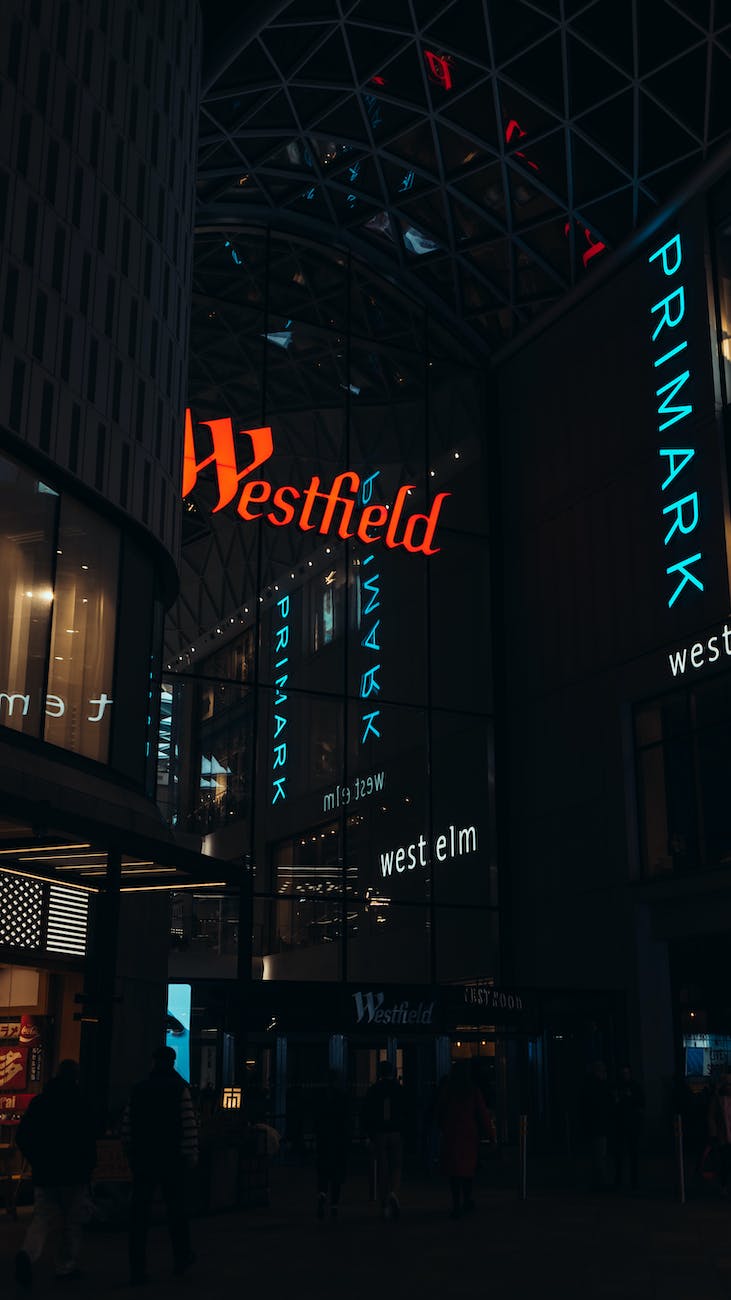
Dennis Phillips had recently taken her staff to tour the Westfield San Francisco Centre. “We have to understand the possibilities of that building,” she explained. The mall loomed so large as a harbinger of San Francisco’s struggles that I decided to see the damage myself. When I was growing up in San Francisco, at the turn of the millennium, the opening of the Westfield mall had seemed like the capstone of the city’s rise. Now I expected a ruin – the remnant of a once triumphal age.
As I approached, I found the stretch of downtown around the mall lively and crowded. People in the local office garb of slacks and zip vests brushed past, thumbing their smartphones. In front of the Dawn Club, a storied jazz bar that Sheehy reopened this year, men in suits were playing a game that they called Doomloopin Bowling on a strip of AstroTurf. Inside the mall, which as of now has no closure date, I saw customers flowing from Bloomingdale’s. To my left, a Michael Kors salesperson chatted with a couple as, on my right, young men studied fancy watches in an I.W.C. Schaffhausen. The food court was noisy, and there were no free tables at Panda Express. The grimmest space was on the top floor: a Cinemark whose lease is up in the fall had gone dark early. “They’re closed,” a bored looking guard announced to no one.
In public declarations, Westfield – like Gump’s – laid the blame for its lack of business on the condition of San Francisco’s downtown. But in the past forty years the number of malls in the United States has declined by nearly three-quarters, and a tour of downtown San Francisco today, its streets packed, its bars busy, can seem an odd me-or-your-lying eyes experience.
The closing of retail shops in San Francisco was easy to see culminating in this mall when the mall operator recently handed back the property to the lender. A once thriving mall suffered from vacant properties. Its location was once a very busy part of the downtown between regular floods of downtown workers, residents, and tourists. I have been to this mall at least a few times and it was generally a lively spot where a cosmopolitan canopy might be possible.
Like many places, urban or suburban, what the mall becomes might be more important than whether the mall survives. What becomes of potentially valuable land near an urban core that once generated property and sales tax revenue? What use could be good for residents and the city long-term? This may be harder to envision in urban downtowns where a lot of property might soon be available for new uses.
The game, a mixture of tennis, badminton and pingpong, is the fastest-growing sport in America, but it requires a large court and finding space to play has become a problem.
Enter Pickleball America, which is building an 80,000-square-foot pickleball court in what used to be a two-story Saks OFF 5th at the Stamford Town Center in Connecticut.
The group is also looking at transforming other retail spaces in New Hampshire and New Jersey.
The idea seems a perfect marriage for a sport that needs massive spaces and a dying form of retail business replaced by online shopping...
“The mall just needed little bit of a boost, so with the idea of the space, it was a perfect fit,” said Pickleball America co-owner Jay Waldner of the 28-court Stamford facility. Waldner also said pickleball at the mall could annually attract 500,000 players, who could also shop during their visits.
I assume this new pickleball space is a for-profit enterprise. Do Americans want to pay to play pickleball or would they prefer local park districts pick up the bill for these courts? Is the indoor court enough to entice people to play? Residents may prefer that pickleball noise is contained to an indoor space at a shopping mall.
Which shopping malls could support a large pickleball facility? It is not a surprise to see this attempted in wealthier suburban communities.
Frustrated by years of inaction by the owners of Stratford Square Mall, Bloomingdale has spent more than $5.6 million to buy former department store buildings and open space near the mostly deserted shopping center.
Now the village is trying to use its powers of eminent domain to take over the core of the mall itself. Bloomingdale has filed a condemnation lawsuit aimed at acquiring the property. Village President Franco Coladipietro called it an “act of last resort.”…
Bloomingdale has been buying mall real estate to facilitate a full-scale redevelopment of Stratford Square. The village paid $2.4 million for the vacant Carson’s department store, $2.15 million for the former Burlington building and $1.1 million for a vacant parcel east of the mall, between townhouses to the north and medical offices to the south…
“You have the potential of a brighter future. I understand that there’s risk. We look at it as a calculated risk,” he said. “And we’ve done the due diligence prior to engaging in the purchase of the properties.”…
To that end, the village opened a line of credit, or short-term loan, to pay for the purchase of the Carson’s, Burlington and undeveloped properties. The village also filed condemnation lawsuits targeting Kohl’s and the vacant Sears store to “keep everything on the same track,” Coladipietro said.
If all turns out well, the suburb will be able to say in ten or twenty years that the former shopping mall property is an asset for the community with new, vibrant uses.
But, this could also turn out poorly. The suburb has borrowed money to buy property. They are in court. The developer has not successfully pursued redevelopment; will the village be able to do better? What happens when the bills come due and/or the community cannot agree about what the mall property should become and/or potential developers are still not interested in the property?






 Legally Sociable