Building a suburb or a “cozy city” in a video game

A review of a new video game suggests players can build suburbs:

Photo by Kaique Rocha on Pexels.com

Town to City, developed by Galaxy Grove and published by Kwalee, is a cozy, casual city-builder that focuses on developing a small town, decorating buildings with small dynamic details, and providing a beautiful suburban environment for our voxel citizens. The game was released into Early Access recently with a decent amount of content and a relatively polished experience.

The game’s page on Steam describes it this way:

Build an idyllic 19th century Mediterranean town and help it flourish into a prosperous city. Freely place and customise each element to create the perfect home for your growing population in this cozy city builder from the creators of Station to Station.

Town, city, community, suburb. Is there a big difference in what these places look like in this game? These are not always interchangeable terms and using them hints at their overlap and their distinctions.

The majority of my experience in city-building games comes years ago with various iterations of Simcity. The goal there seemed to be to create a large city. You could build lighter density residential units but the push was to keep increasing your population, which could lead to redeveloping those lighter residential areas.

If this game is truly about creating a suburb or small town, it would be interesting to consider how the game experience could be different. How might the unique features of a small town or suburb translate into different decisions to make about development? Does this game or other games incorporate the kinds of zoning issues that come up in suburban communities? Or can players feel the reasons Americans love suburbs while they oversee the construction and maintenance of a suburban community? Do they get to consider the increasing diversity in suburbia?

And if there was a game that simulated building suburban communities in the United States, how many people would be willing to play? The majority of Americans live in suburbs but would they want to play in them, as opposed to building massive cities or playing Farming Simulator.


Learning about American housing through The Sims

Playing The Sims may just offer a few lessons about housing in the United States:

Photo by Monstera Production on Pexels.com

The Sims felt like a trial run for adulthood, exploring how you’d make use of your future autonomy. Much of this validated the importance of personal space: how to lay out a room, how to choose a sofa that balanced aesthetics and comfort, how to make a house a home…

The official trailer for The Sims 4: For Rent emphasizes the potential of “multiunit life,” promising “ample opportunity … [for] eavesdropping, snooping, or even breaking and entering”—a description that instantly evoked memories of my worst roommates…

Inevitably, a lot has changed. The peaceful suburb I remembered from childhood has been replaced by elaborate “worlds” that I can (effortfully, via a loading screen) switch between to grow my property portfolios. The Sims 4 is more immersive and finely drawn, visually, than the original was, but it’s also more involved: It took me a whole afternoon to create my first Sim and set her up in her “hovel.”…

But soon my frustration (as Edith) with Jazz’s requests started to outweigh my commitment to being the Only Good Landlord. Every notification from the rental instantly provoked my impatience. Not the damn tenant again! The slow, clunky transition within the game between Edith’s home and the rental only added to my frustration and my creeping sense of Jazz as a burden. Why did this guy need so much of Edith’s energy?

With For Rent, The Sims has perhaps moved too far toward reflecting brutal reality, forcing players to choose between being on one side or the other of an often fractious and all-too-familiar power imbalance. As a child, I was drawn to The Sims as a role-play for adulthood, a world of expansive promise and possibility; playing For Rent, I was reminded, depressingly, of how the game is rigged.

The Sims is a game, a product intended to provide enjoyment for players. Can one gamify the rental experience in the United States?

More broadly, The Sims puts a home – owned or rented – at the center of the experience. The United States has a long history of celebrating the single-family home. Renting may be common in some places but it can also be treated with suspicion in other places. Players of the game can make their own choices but they are limited by what is possible in the game as well as what is possible in our society.

Anyone able to offer an analysis of housing, landlords, and properties in general across the Will Wright creations? Simcity offered a particular take as did SimTower – has this changed noticeably over the years? Are there any video games that do a different or better job of portraying property and renting?

Why we play Simcity and not Sim Nimby

A game released earlier this year accounts for the NIMBY behavior of city dwellers:

Photo by Buro Millennial on Pexels.com

Imagine an even-simpler version of the original late-’80s “SimCity” video game: a crude digital map dotted with a handful of pixelated single-family houses. But try to click on the screen — like, say, on the icon of a bulldozer or a factory, or just anything — so you can start laying out commercial blocks and parks and creating your pretend metropolis, which is the objective of most city-building sims, and you’ll be met with a jarring sound effect and a pop-up message: “ERROR. CAN’T BUILD IN NIMBYVILLE.”

Below that is one of many snarky excuses: “Housing is a human right! Just why does it have to be here?”

Such are the Sisyphean pleasures of “Sim Nimby,” a new desktop city-building game where more clicks just lead to more error messages, and nothing ever gets built. The only winners in Nimbyville are the ones programmed to prevail: Not In My Backyard neighbors, or NIMBYs, who block new housing developments at every turn…

So Nass and Weeks hunkered down in a Park Slope bar one evening and hashed out the litany of anti-development NIMBY-isms — more than 50 in total — that the game spits back at prospective builders as a jazzy 8-bit music theme plays. There’s some comic hyperbole at the expense of preservationists (“We can’t tear down that historic brownstone. It’s where Gene Quintano wrote ‘Police Academy 3: Back in Training’”) and some dad-joke-grade gags (“The only thing urban I want to see here is Keith Urban”). Other one-liners — “This is a NICE neighborhood,” “Will someone please think of the property values?” and “Affordable housing? What, you gonna build them an affordable country club too?” — are perhaps less fanciful to housing advocates.

How realistic should city building games be? I have wondered this for years starting with playing Simcity in the late 1980s. How much does the game reflect actual city planing practices and urban outcomes versus presenting a glamorized experience where it is easy to plop in properties, development happens easily, and issues are quickly addressed (as long as the player has enough money and a little bit of sense). Overall, it is pretty easy to build a thriving city.

This version might be too realistic. Players of video games want some level of difficulty or obstacles to overcome but not ever-present problems that make it difficult to do anything. Random disaster? Okay, a player can deal with that. A never-ending chorus of NIMBY concerns? It is too much to handle. The concerns of residents in Simcity are usually addressable; for example, move the residence further from industry, quickly put a park nearby to quiet the criticism, or find another way to improve the quality of life.

I do not know if the player gets some extreme options to address the NIMBY concerns. Have them annex themselves into their own community and build in a neighboring community? Remove all of the residences via eminent domain? Wage a political battle against them? If this is a Simcity where the residents do not want anything new, then growth is not possible and that does not work even in video games.

Limiting the presence of people in city-building video games

A recent review of several city-building video games suggests they focus more on buildings and landscapes than residents:

Photo by RODNAE Productions on Pexels.com

What’s missing from these titles are people, but this is arguably part of the fantasy they’re presenting. Citizens are complicated; they have needs and wants, which of course influence the way towns, virtual or otherwise, are laid out. On the one hand, the absence of people could be interpreted as an unintentional but darkly misanthropic view of the city. On the other, perhaps these are exercises in utopian thinking; cities are filled with compromises that these city-builders allow us to calmly transcend.

I have not played any of these games – my video game attention is elsewhere – but I have a lot of experience with SimCity where the role of residents was interesting, to say the least. The people themselves were not often present on the screen. Instead, the focus was on land and how it could be transformed into different uses.

Where citizens tended to show up were in their reactions to your choices as mayor. Perhaps it was demanding a police station or a school. Perhaps it is was in the mayor’s approval rating. Perhaps it was in the construction of new residences, suggesting your community had some attractive features.

But, they were just abstract concepts. If you wanted to deal with people directly, you could play The Sims. SimCity was about systems, not characters. While this broke ground in some ways, it also obscures the real and productive roles residents play in cities. SimCity encourages a top-down view of cities: development happens at the behest of one leader, a mayor/tyrant urban planner or leader, who is only curbed by a budget, complaints, and the occasional disaster. This is not the participatory community building that can help link residents to their neighborhoods and communities.

It is hard to imagine a city-building game that fully incorporates residents and community members as part of the process. The mayor wants to build a new bridge but residents complain about the effects on the environment and demand input? The mayor wants to put a highway through to reduce traffic but the community believes it will scar their neighborhoods? Imagine a virtual reality game where the leader makes decisions, walks through the places they have helped create, and has to interact with the people there. Perhaps this is the next step, games about communities and the people that inhabit them rather than cities as systems easily changed.

What are the odds that a proposed 5 million person American city built from scratch gets off the ground?

A recently unveiled plan from an American billionaire for a new large city verges on the utopian:

Photo by Una Laurencic on Pexels.com

The cleanliness of Tokyo, the diversity of New York and the social services of Stockholm: Billionaire Marc Lore has outlined his vision for a 5-million-person “new city in America” and appointed a world-famous architect to design it…

The former Walmart executive last week unveiled plans for Telosa, a sustainable metropolis that he hopes to create, from scratch, in the American desert. The ambitious 150,000-acre proposal promises eco-friendly architecture, sustainable energy production and a purportedly drought-resistant water system. A so-called “15-minute city design” will allow residents to access their workplaces, schools and amenities within a quarter-hour commute of their homes…

The first phase of construction, which would accommodate 50,000 residents across 1,500 acres, comes with an estimated cost of $25 billion. The whole project would be expected to exceed $400 billion, with the city reaching its target population of 5 million within 40 years…

On Telosa’s official website, Lore explains that he was inspired by American economist and social theorist Henry George. The investor cites capitalism’s “significant flaws,” attributing many of them to “the land ownership model that America was built on.”

From what I read here, I would say the odds are low that this comes close to the proposed population. Playing Simcity is one thing; building a large city from scratch and with such a master plan is difficult to pull off in the United States. At the same time, having a good plan and incorporating the latest ideas could help avoid problems later that cities face as they age (such as with infrastructure). Taking the best of older cities and adding more recent ideas could break through the problem of updating existing communities.

One factor I could see in favor of this plan is a significant public-private partnership developed with a state or a local government. The United States has a long history of public-private partnerships to address public goods. Imagine a state or county or public agency that is looking for a unique opportunity or a way to generate economic activity. Starting a new city with multiple funding sources could help provide jobs, residences, and a new sense of community. This could be the “garden city” of the twenty-first century on a grander scale compared to the smaller American efforts in the twentieth century.

SimCity, Jane Jacobs, and real estate values near the High Line

In a recent walk along New York’s High Line, I was reminded of two competing claims about how parks enhance nearby land uses.

In SimCity’s take on urban planning, building a park was a good way to help adjacent properties. If nearby residential and commercial properties suffered from low property values – perhaps due to higher crime rates or locations near industry – building a park could help enhance their values. This seems to make intuitive sense: people like being near greenery and this land use can distract or suppress less desirable land uses.

Jane Jacobs, in contrast, suggests parks are not the automatic panacea some planners suggest. More important than simply having green or recreational space is having a steady mix of people flowing through and around the park. It is human activity that makes the park, not just green space. Indeed, negative activity can thrive and recreational space can easily become part of a dull or blighted area.

HighLineAug19

In a simplistic take, the High Line seems to support both of these views. The conversion of an unused railroad line to a thriving park has enhanced nearby property values. The park is regularly filled with people – from tourists to local walkers to vendors – during much of the day. This is a success story for both the SimCity and Jane Jacobs school of urban planning.

Yet, how exactly such an urban space came about and has both positive (new development!) and negative (those same values limiting who can live nearby!) consequences is more than just plopping a park into an area that could use more development. If it worked this way, every city would have such a successful project.

HighLine2Aug19

In a complex environment like Manhattan where land is highly prized and regulated, putting together such a project takes collective efforts spanning activists, residents, local officials, developers, and others who have an interest in this land and who may have competing interests. Property values may indeed be high and the park full but the long-term effects of this on the neighborhood and the city are harder to assess.

Playing SimCity, becoming an urban planner

Building a city on a computer screen led to a future career for some SimCity players:

Thirty years ago, Maxis released “SimCity” for Mac and Amiga. It was succeeded by “SimCity 2000” in 1993, “SimCity 3000” in 1999, “SimCity 4” in 2003, a version for the Nintendo DS in 2007, “SimCity: BuildIt” in 2013 and an app launched in 2014…

Along the way, the games have introduced millions of players to the joys and frustrations of zoning, street grids and infrastructure funding — and influenced a generation of people who plan cities for a living. For many urban and transit planners, architects, government officials and activists, “SimCity” was their first taste of running a city. It was the first time they realized that neighborhoods, towns and cities were things that were planned, and that it was someone’s job to decide where streets, schools, bus stops and stores were supposed to go.

“I used to draw maps of cities for fun. I had no idea it was an actual career,” said Nicole Payne, now a program official for the National Assn. of City Transportation Officials in New York City. When she was 10, a librarian saw her drawings and told her there was a video game she should try…

In more than a dozen interviews for this article, people who went from “SimCity” enthusiasts to professional planners talked about what they liked about the game: The way you can visualize how a single change affects a whole city. The ability to see how transit, livability and the economy are all connected. The fact that no one likes to live near a landfill.

This could be my story too: I enjoyed drawing cities as a kid, reading about cities, and visiting Chicago. I discovered SimCity during elementary school, playing for the first time on a green monochrome monitor. It opened up new possibilities, particularly as the game evolved. I spent endless hours creating cities and, like some of the people interviewed in this story, trying to make them pristine as well as based around different principles. We played Simcity as enrichment time in middle school and I probably trailed off in playing by early high school when I was more taken by Civilization II and franchise mode of sports games. All of that SimCity playing did push me to think about urban planning and serving in local government.

At the same time, as this article notes, SimCity likely shaped how I thought cities worked. SimCity is not neutral in its planning philosophy. At the least, it presented the idea that a planner from above could shape everything, even down to the terrain. The speed at which it could happen was also impressive: a mouse click could add residences or take them away while the game speed could be paused or sped to impressive speeds (usually to add money to the coffers if one was not playing with the cheat codes). Cities and communities do not work this way; even powerful leaders usually need at least a team of elites to get things done and significant urban projects often take a long time.

The urban theory behind SimCity

In constructing the game SimCity, Will Wright worked with the ideas of James Forrester:

Looking to understand how real cities worked, Wright came across a 1969 book by Jay Forrester called Urban Dynamics. Forrester was an electrical engineer who had launched a second career as an expert on computer simulation; Urban Dynamics deployed his simulation methodology to offer a controversial theory of how cities grew and declined. Wright used Forrester’s theories to transform the cities he was designing in his level editor from static maps of buildings and roads into vibrant models of a growing metropolis. Eventually, Wright became convinced that his “guinea-pig city” was an entertaining, open-ended video game. Released in 1989, the game became wildly popular, selling millions of copies, winning dozens of awards, and spawning an entire franchise of successors and dozens of imitators. It was called SimCity

Largely forgotten now, Jay Forrester’s Urban Dynamics put forth the controversial claim that the overwhelming majority of American urban policy was not only misguided but that these policies aggravated the very problems that they were intended to solve. In place of Great Society-style welfare programs, Forrester argued that cities should take a less interventionist approach to the problems of urban poverty and blight, and instead encourage revitalization indirectly through incentives for businesses and for the professional class. Forrester’s message proved popular among conservative and libertarian writers, Nixon Administration officials, and other critics of the Great Society for its hands-off approach to urban policy. This outlook, supposedly backed up by computer models, remains highly influential among establishment pundits and policymakers today…

Forrester spent months tinkering with this model, tested and corrected it for errors, and ran a “hundred or more system experiments to explore the effects of various policies on the revival of a city that has aged into economic decline.” Six months after beginning the project, and over 2000 pages of teletype printouts later, Forrester declared that he had reduced the problems of the city to a series of 150 equations and 200 parameters…

Forrester thought that the basic problem of urban planning—and making social policy in general—was that “the human mind is not adapted to interpreting how social systems behave.” In a paper serialized in two early issues of Reason, the libertarian magazine founded in 1968, Forrester argued that for most of human history, people have only needed to understand basic cause-and-effect relationships, but that our social systems are governed by complex processes that unfold over long periods of time. He claimed that our “mental models,” the cognitive maps we have of the world, are ill-suited to help us navigate the web of  interrelationships that make up the structure of our society.

Three quick thoughts:

  1. How many people dream that cities could be reduced to equations and parameters? Cities are both fascinating and frustrating because they are so complex. And the quest to find overarching rules governing urban life continues – see the work of Geoffrey West as an example.
  2. Figuring out when more government intervention is helpful or not is a difficult task, particularly when it comes to complex cities. Housing is an area I have written about before: free markets do not bring about fair results and the federal government has promoted one kind of housing, single-family homes, over others for decades.
  3. This is a reminder that game users can learn about how the world works – they are not just mindless entertainment – but they also do so under the conditions or terms set up by the designer. Cities are indeed complex and SimCity presents them in one particular way. All games have a logic to them and this may or may not match reality. How much theory do we imbibe on a daily basis through different activities? At the least, we are forming our own individual theoretical explanations of how we think society operates.

Teaching kids about Chicago’s Deep Tunnel project

Kids should know about one of the largest civil engineering projects in the world: the Deep Tunnel project in and around Chicago.

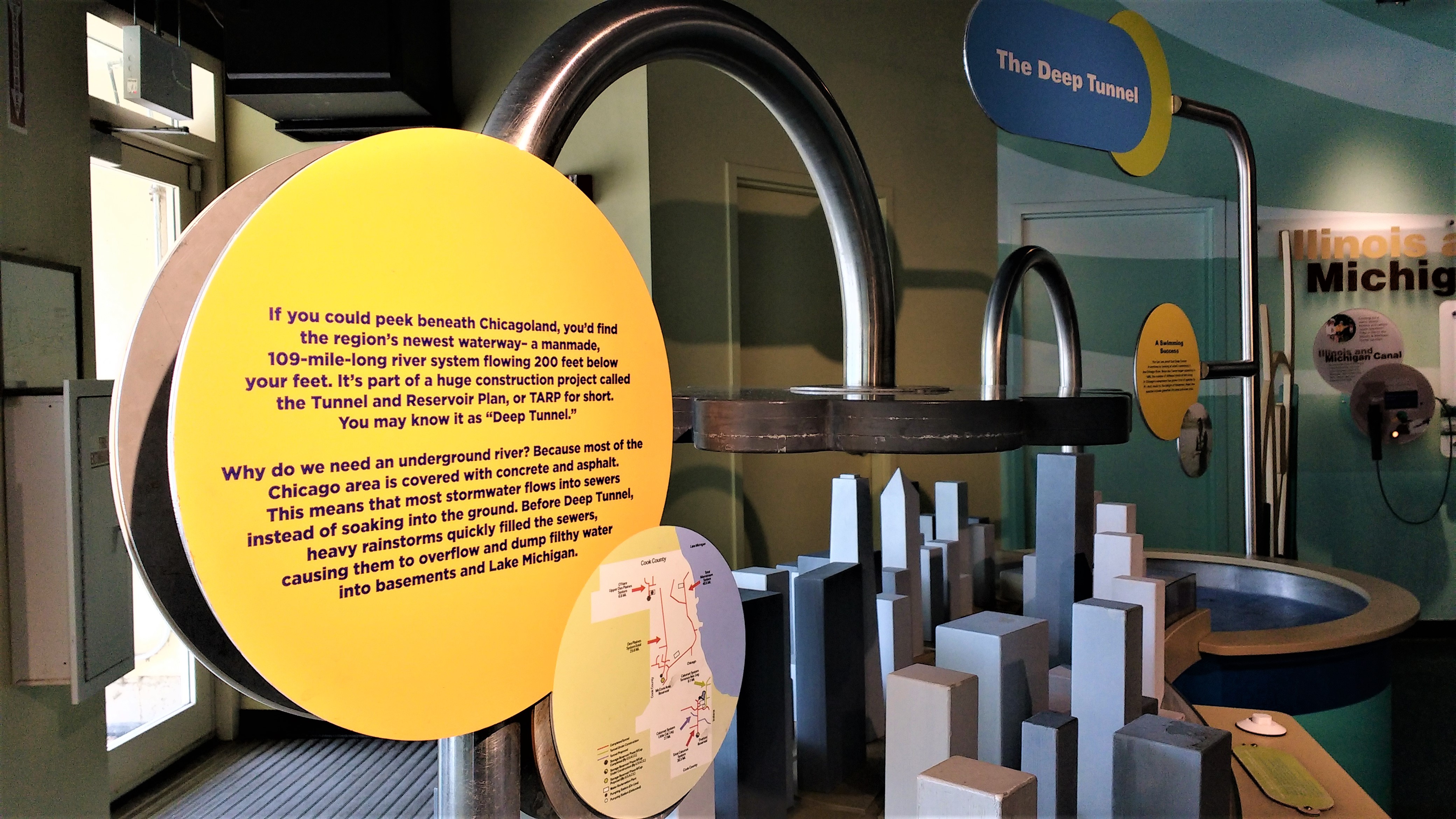
DeepTunnelNotebaertNatureMuseum

This is from the Riverworks exhibit at the Peggy Notebaert Nature Museum in Chicago. While some of the pieces of the exhibit failed to work the day we visited, I think I could see the purpose of the The Deep Tunnel exhibit: the floodwaters would be diverted away from the city.

The concept may appear simple and explainable to kids but the execution in real life is not. The exhibit suggests the flooding the past is now alleviated by Deep Tunnel. Yet, the problems are likely to go on in a region that continues to expand and change. Remediating water and flooding issues is a very difficult task compared to altering development at the beginning.

It is interesting to think how else this engineering feat could be presented to children. I could imagine a scaled model that kids could walk through to help give them a sense of the size of the sewers needed as well as the size of some of the water reservoirs. Deep Tunnel is not intended for minor amounts of water; this is supposed to help protect millions of people on a fairly regular basis. Communicating the sheer size could fascinate kids. Or, perhaps some sort of computer game where kids play the role of an engineer or expert as they make choices about where to divert water. Come to think of it, where is this version of Simcity or Roller Coaster Tycoon – “Infrastructure Builder” or “Sewer Wars” or something catchier.

Argument: regionalism = “play[ing] Sim City with residents’ lives”

One critic charges new regional plans in Minneapolis-St. Paul threatens a democratic way of life:

Here in the Twin Cities, a handful of unelected bureaucrats are gearing up to impose their vision of the ideal society on the nearly three million residents of the Minneapolis-St. Paul metro region. According to the urban planners on the city’s Metropolitan Council, far too many people live in single family homes, have neighbors with similar incomes and skin color, and contribute to climate change by driving to work. They intend to change all that with a 30-year master plan called “Thrive MSP 2040.”…

While minority residents have been streaming into the Twin Cities’ suburbs for the past 15 years, the Met Council wants to make sure there is a proper race-and-income mix in each. Thus it recently mapped every census tract in the 2,800 square-mile, seven-county region by race, ethnicity and income. The purpose was to identify “racially concentrated areas of poverty” and “high opportunity clusters.” The next step is for the council to lay out what the region’s 186 municipalities must do to disperse poverty throughout the metro area…

The Thrive plan’s most radical element may be to evaluate all future development policies through the “lens” of climate change. Over time, this could give the council a license to dramatically remake the entire metro area…

Once implementation begins, however, Twin Cities residents will likely realize that Thrive MSP 2040’s centralized decision-making and Orwellian appeals to “equity” and “sustainability” are a serious threat to their democratic traditions of individual liberty and self-government. Let’s hope that realization comes sooner rather than later.

This is an argument several conservatives (another example here involving the UN) have made in recent years: the government wants to use urban planning as a means to control people’s lives, forcing them to live in denser areas with people they would not choose to live near. It violates property rights, individual liberty, local government, etc.

Here is an issue with these arguments: they tend to ignore the real issues present in metropolitan areas that involve both cities and suburbs. Adopting a free-market approach to planning, growth, and mobility leads to the outcomes we have today: ongoing residential segregation (both by race and class, affecting everything from school districts to health outcomes to location mismatches between employees and jobs), a lack of affordable housing, local governments that are numerous (and possibly inefficient), often can’t agree with each other and thereby hold up helpful projects or promote unhelpful competition (like a race for the bottom in tax breaks), transportation options that are expensive (whether maintaining a car or trying to make mass transit work in the suburbs), and a general defensive crouch of not wanting to deal with any problems outside of one’s immediate community. All of this reinforces existing inequalities in society: those with resources can afford nicer communities while those with less live in places where it is more difficult to move up.

Is there some middle ground here? To be honest, government is already heavily involved in local and regional decisions and conservatives probably like some of this (such as zoning). And some of the regional options allow for higher levels of efficiency by leveraging certain resources in effective ways. Maybe the real issue is that few residents of urban areas – whether conservative or liberal – want to live near public housing or affordable housing and/or want to retain the right to use their money to move to a more advantageous location should something not work out (like the neighbors).

As a final note, earlier versions of SimCity didn’t allow much control over the lives of individual residents. Similarly, the game was geared toward more urban environments as sprawling communities were more costly and didn’t provide the kind of density that would lead to better things.