Internal migration and international immigration changes affect urban and suburban populations in the US

William Frey at Brookings details population changes in American metropolitan areas:

Photo by Ryutaro Tsukata on Pexels.com

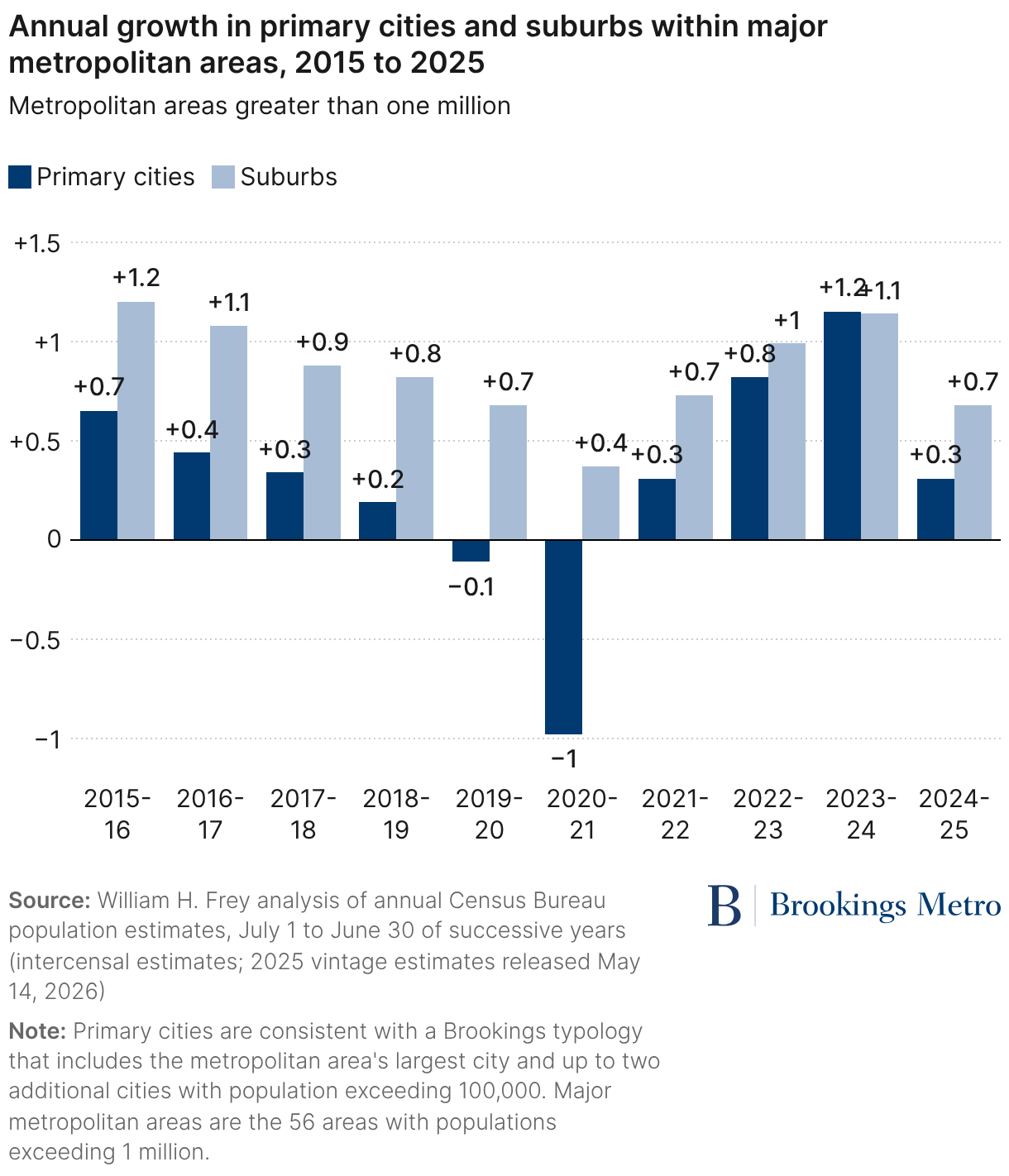
Clearly, migration dynamics have played a huge role in big cities’ roller coaster of population shifts over the past five years. Analyses of state and metropolitan area population changes over this period have highlighted the importance of domestic migration (movement within the U.S.) in shifting movement from coastal and Midwest states to the South and parts of the West during the peak pandemic years, only to have that movement pull back in the past few years. What’s more, it was international migration that led to both upward growth in many areas (as net immigration to the U.S. rose sharply through 2023-24) as well as later declines (as federal policies curtailed immigration in 2024-25)…

In the peak pandemic year of 2020-21, there was a sharp decline in the combined primary city populations of these metro areas, while the suburban portion of these areas exhibited positive growth, albeit smaller than in prior years. (In fact, these large metro areas, as a group, registered an absolute population decline during this year.)

Since then, both primary cities and their suburbs, in the aggregate, have registered population gains, with the former making greater strides so that their 2023-24 growth exceeded those of their suburbs. What’s more, 21 of the 56 metro areas exhibited primary city growth that was higher than suburb growth. This was true in metro areas such as New York, Los Angeles, Chicago, Washington, D.C., Miami, Detroit, Seattle, and Pittsburgh (see downloadable Table D).

Of course, in 2024-25, as big city and large metro area growth slowed, the primary cities of these major metro areas showed sharp population declines that were greater than that of their suburbs—though most individual primary cities as well as suburbs experienced growth slowdowns or shifts to losses. Still, primary cities took the greater hit and, among the 56 major metro areas, primary cities in 40 of them saw greater growth slowdowns than their suburbs, and primary cities in just 14 of them grew faster than their suburbs.

Reading through the details in this report, I am struck by two features:

  1. We have data on metropolitan populations (estimates) at a year to year level.
  2. Tracking population changes over time – year to year – show changes and variation.

Looking across places and times allows for considering causes of the patterns. Frey notes multiple forces affected US metropolitan areas including the COVID-19 pandemic and changes to immigration policies.

It might be harder to know exactly how much these social, political, and economic changes contributed to the population changes versus what we might expect to see year to year. Population growth or decline in major centers can be helpful to look at in a longer historical view. Did changes due to COVID-19 represent a blip or were they part of larger patterns? Immigration policies might lead to longer-term changes even as policies can be changed (by a new administration? By a later administration? Not at all?) I am thinking of the scholarship looking at how many major legislative and policy shifts in the US regarding immigration in the 1920s and then in the 1960s affected American communities.

Put all the data and possible causes together here and it looks like growth has slowed in many American cities and suburbs in recent years. What could American metropolitan areas look like in a decade or two if they have no to little growth? In a country where (population, economic, technological, etc.) growth is good, this could be interesting.

Sociological study says junk food sales in middle schools don’t lead to weight gain

A new study in the Sociology of Education provides some insights into the current debate over whether public schools should be selling junk food to students:

The authors found that 59.2 percent of fifth graders and 86.3 percent of eighth graders in their study attended schools that sold junk food. But, while there was a significant increase in the percentage of students who attended schools that sold junk food between fifth and eighth grades, there was no rise in the percentage of students who were overweight or obese. In fact, despite the increased availability of junk food, the percentage of students who were overweight or obese actually decreased from fifth grade to eighth grade, from 39.1 percent to 35.4 percent.

“There has been a great deal of focus in the media on how schools make a lot of money from the sale of junk food to students, and on how schools have the ability to help reduce childhood obesity,” Van Hook said. “In that light, we expected to find a definitive connection between the sale of junk food in middle schools and weight gain among children between fifth and eighth grades. But, our study suggests that—when it comes to weight issues—we need to be looking far beyond schools and, more specifically, junk food sales in schools, to make a difference.”

According to Van Hook, policies that aim to reduce childhood obesity and prevent unhealthy weight gain need to concentrate more on the home and family environments as well as the broader environments outside of school.

“Schools only represent a small portion of children’s food environment,” Van Hook said. “They can get food at home, they can get food in their neighborhoods, and they can go across the street from the school to buy food. Additionally, kids are actually very busy at school. When they’re not in class, they have to get from one class to another and they have certain fixed times when they can eat. So, there really isn’t a lot of opportunity for children to eat while they’re in school, or at least eat endlessly, compared to when they’re at home. As a result, whether or not junk food is available to them at school may not have much bearing on how much junk food they eat.”

This study has a big sample of nearly 20,000 students and the findings were so counterintuitive that the authors waited two years to publish the results.

While this study suggests schools don’t contribute to weight gain, it doesn’t necessarily mean that schools should suddenly revert to selling all kinds of junk. At first glance, this could be the sort of study that people worried about the “nanny state” could jump on. For example, see the response of the Center for Consumer Freedom: “Maybe it’s time for the “food police” to educate themselves. All the attempts to limit choices apparently won’t do the students any good.” At the same time, schools can be part of a larger package of social forces pushing for better eating and exercise but they aren’t likely to solve the problems by themselves or by operating in simplistic ways.

I wonder if this points to a bigger issue: Americans expect that schools will be able to even a lot of social ills. In this case, being obese and overweight is a complex issue that schools themselves can’t overcome. As the authors note, there are a lot of other factors at play and by the time students reach middle school, they have already been shaped in significant ways. While education is one of the best ways to promote upward mobility and the opportunity to compete in a rapidly-changing world economy, it is not a silver bullet for all problems. Of course, public policy is limited in what it can feasibly or popularly change and politicians and advocates only have so many levers they can move.

Another thing to note: I wonder how some might see an admission from one of the authors. One author said, “We were really surprised by that result and, in fact, we held back from publishing our study for roughly two years because we kept looking for a connection that just wasn’t there.” Some might be suspicious and wonder if there is an ethical issue: did the authors data mine looking for other connections? Were the authors afraid of how some might respond to their findings? At the same time, scientists can also be surprised by their findings and I would guess they were simply being thorough before exposing their work to the public.

Page: Policies based on social class, not just race

Columnist Clarence Page writes today on comments made last week by Virginia Democratic Senator James Webb. While writing in the Wall Street Journal, Webb “called for an end to government diversity programs.” Page’s conclusion on Webb’s (in Page’s opinion: sometimes muddled) thoughts: “Our colleges and workplaces could benefit from diversity by social and economic class, too, and not just by race.”

This reminds me of William Julius Wilson’s suggestion that Americans don’t like social policies that benefit one group over others. Instead, Wilson suggested we need programs that benefit people from many or all groups in order for such programs to draw widespread support. Webb’s and Page’s suggestions about providing help by social class across races would seem to fit this idea.