The 28-21 vote against lowering the speed limit followed a spirited and emotional debate that pitted traffic safety advocates, many of them on the North Side, against African-American alderpersons concerned about uneven enforcement and a surge in pretextual traffic stops targeting Black drivers.
West Side Ald. Jason Ervin (28th), Mayor Brandon Johnson’s handpicked Budget Committee chair, led the charge against the lower speed limit.
Ervin said he “understands the logic that, if you go slow,” there will be fewer traffic fatalities and serious injuries. But when Johnson’s 2025 budget is balanced, in part, by installing more speed cameras, he is concerned about an avalanche of speeding tickets that struggling Chicagoans cannot afford to pay…
Wednesday’s vote was a bitter and emotional disappointment to Ald. Daniel La Spata (1st), an avid cyclist who represents Bucktown, Wicker Park, West Town and Logan Square, where several fatal accidents have occurred…
La Spata has estimated the lower speed limit could save the lives of more than 300 Chicagoans over the next decade.
The summary of the discussion hints at the meaning of speed limits. Are they about safety and discouraging higher speeds? A good number of American roads are built to be wide and straight such that the design itself can help drivers feel comfortable in going faster. And since many drivers go above whatever speed limit is posted, is a lower limit necessary to reign in the higher speeds?
Or are they about police enforcement? Are they about collecting revenue? Whether administered via law enforcement personnel or a speed camera, there is a legal process at work. In a society where driving is often required, the enforcement element matters.
Trying to think outside the box a bit, couldn’t the Council meet in the middle and settle for a 28 mph speed limit? Do all speed limits need to be in 5 or 10 mph increments?
This likely will be an ongoing discussion given the amount of driving in Chicago, interest in biking and pedestrian options in the city, and concerns about police activity.
The National Highway Traffic Safety Administration is running radio ads that tell people to follow the speed limit in order to increase safety on roads. From their website:
For more than two decades, speeding has been involved in approximately one-third of all motor vehicle fatalities. In 2022, speeding was a contributing factor in 29% of all traffic fatalities.
Speed also affects your safety even when you are driving at the speed limit but too fast for road conditions, such as during bad weather, when a road is under repair, or in an area at night that isn’t well lit.
Speeding endangers not only the life of the speeder, but all of the people on the road around them, including law enforcement officers. It is a problem we all need to help solve.
Traveling at higher speeds mean it is harder to control a vehicle and those vehicles that do hit other things sustain more damage.
But speed limits can also serve other goals. Perhaps they are also about traffic and the number of vehicles on the roads. Having fewer vehicles means it is possible to go faster, having more vehicles means going at a slower speed makes more sense. Hence, more variable speed limits on highways as speed limits adjust to traffic and conditions.
The National Maximum Speed Limit (NMSL) was a provision of the federal government of the United States 1974 Emergency Highway Energy Conservation Act that effectively prohibited speed limits higher than 55 miles per hour (89 km/h). The limit was increased to 65 miles per hour (105 km/h) in 1987…
The law was widely disregarded by motorists nationwide, and some states opposed the law,[3][4] but many jurisdictions discovered it to be a major source of revenue. Actions ranged from proposing deals for an exemption to de-emphasizing speed limit enforcement. The NMSL was modified in 1987 and 1988 to allow up to 65 mph (105 km/h) limits on certain limited-access rural roads. Congress repealed the NMSL in 1995, fully returning speed limit-setting authority to the individual states.
Montana, once known for its wild, limitless roads, did not want to be left behind as other Western states increase their speed limits. Idaho, Nevada, South Dakota, Utah and others have set 80 mile per hour speed limits on at least some sections of road.
It is rare to find drivers on major roads that will only go as fast as the speed limit. If anything, the speed limit seems like an anchor at the bottom end of possible speeds so that people do not just drive at whatever speed they want. If the speed limit is 45, few will go only 42 or 44 but the speed limit might keep them from going 75 because that is far away from 45. Future technology might change this: if cars have speed limiters, where will the line be set?
One way to address this is to have no speed limit. Only a few places do this.
Why not try a speed range? Imagine Chicago highways that have a speed limit of 50-70. Some people might feel more comfortable at the lower end, some at the higher end.
Is the real issue that drivers will not follow any limit unless there is enforcement? Technology could lead to automatically fining drivers (speed cameras, GPS, toll devices, etc.). Or, is it about current conditions (less traffic can lead to higher speeds, more congestion slows speeds)? Some roadways now have variable speeds where digital signs change the speed limits for the given conditions.
All this to say, a speed limit seems more like a number that most American drivers treat as a recommendation and not an imperative. This has big implications for the driving experience, how Americans regard driving, and safety.
When school started in our area in mid-August, I noticed more signs on streets near schools asking drivers to slow down and pay attention because children are present. But, we are now weeks past this and I wonder at what speeds drivers are going.
I am guessing the signs had limited effect, if any at all. School zones may be important to a few drivers, particularly with increased vehicular and pedestrian traffic at certain times in the morning and afternoon..
Many communities struggle with people driving fast through residential streets with speed limits of 20-30 mph. These suburban roads can often be wide, fairly straight, and have limited obstacles on the sides. Even the possibilities of children being present may not be enough to
Communities have multiple techniques to try to address this. There are warning signs, signs that flash the speed of oncoming drivers, and traffic control devices like speed bumps. The presence of crossing guards on foot and/or police vehicles can help reinforce the need to slow down.
As long as driving is the dominant mode of transportation and communities prioritize the fast flow of cars, it will be hard to slow down drivers around schools. Fewer students walk or bike to school than in the past but those who do and those who might if it could be safer would benefit from safer pathways.
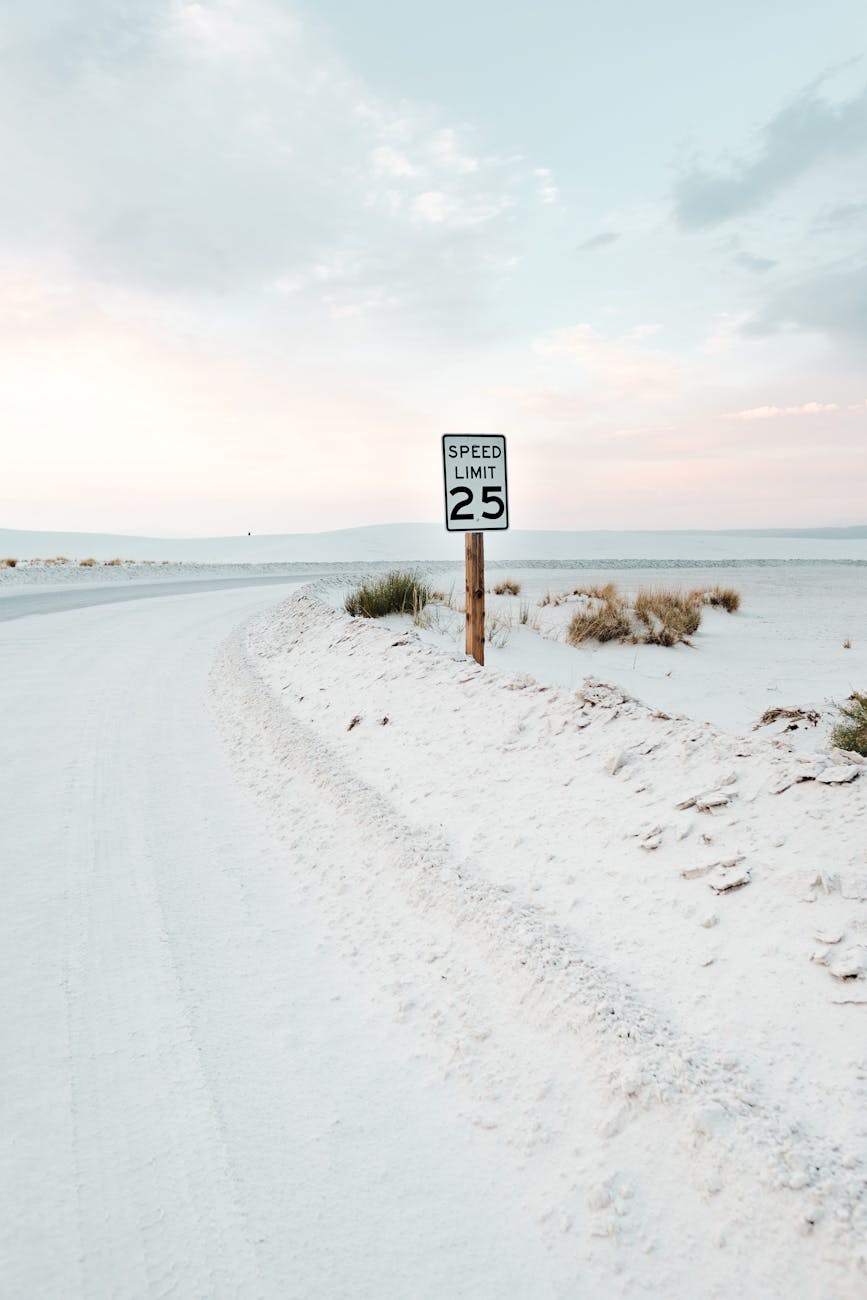
Could more unusual speed limits help improve safety on the roads? Here is one speed limit I saw recently along a road coming out of a shopping plaza:
Most speed limits are in increments of 5. I assume this is, in part, due to standardization of roadways throughout the United States. But, why not throw in some more unusual numbers to catch the attention of drivers? Would I be able to stick to the occasional 13 or 31 or 67 more easily than the standard 15, 30, or 65? If every speed limit was a number off of the 5/10s pattern, they might make the problem worse. The key could be to have some numbers off from typical numbers.
The switch to more digital speedometers in cars could help with this. A good number of speedometers are also in increments of 5 and 10 so matching 13 mph could be hard. If more drivers have digital displays where a 5/10 increment does not exist, then escaping the rigidity of 5/10s could be easier.
When Delphi took its prototype Audi robocar from San Francisco to New York in April, the car obeyed every traffic law, hewing to the speed limit even if that meant impeding the flow of traffic.
“You can imagine the reaction of the drivers around us,” Michael Pozsar, director of electronic controls at Delphi, said at a conference in Michigan last week, according to Automotive News. “Oh, boy. It’s a good thing engineers have thick skin. All kinds of indecent hand gestures were made to our drivers.”
And that indicates that a problem is brewing, argues Prof Alain Kornhauser, who directs the transportation program at Princeton University. “The shame of the driving laws is that they all sort of have a ‘wink’ associated with them,” he says. “It says 55 miles per hour, but everyone knows that you can do 9 over. If that’s the situation, why isn’t it written that way—with a speed limit at 64?”…
In fact, if all cars were autonomous and connected to each other wirelessly, they wouldn’t need stop signs even at the intersections of multilane highways…
I imagine following the speed limit in the Chicago area would lead to some very unhappy drivers. Theoretically, we might not even need speed limits with driverless vehicles as it would all be dependent on the conditions. This might mean that vehicles would go slower at times than drivers might like (perhaps in inclement conditions) but could go a lot faster and more safely even with a good number of drivers nearby.
But, if traffic laws need to be changed, when exactly would this happen? Presumably, it will take some time to introduce these vehicles onto the road and some time for them to grab a large part of the market. Of course, the government could push all new cars in this direction – particularly since they could be so much safer – but older models would still be on the road for some time. To change the laws, all the cars need to switch over at once, an unlikely event. Until all cars are driverless, traffic laws would have to be more conservative to account for drivers but that probably wouldn’t make the new owners happy.
Overall, I haven’t seen much discussion of how automated cars and cars with drivers will mix even as we creep closer and closer to this eventuality.
Higher speed limits on parts of I-294, I-88 and I-355 were recommended for approval Thursday by the Illinois Tollway’s customer service and planning committee.
According to the state’s vehicle code, the tollway is required to conduct an engineering and traffic investigation before raising its maximum speed limits.
The investigation — which took factors like prevailing speed, high-crash segments, access point density and the volume of traffic congestion into consideration — determined that the 70 mph maximum that is allowed by the state is not a “safe and reasonable increase in the speed limit” for certain sections of the highway…
Once all the necessary approvals are complete the Illinois Secretary of State can publish the updated rules and the new speed limit signs can be installed. Tollway officials estimate that the new speed limit signs could be posted this summer.
Only a few are obeying the law. In those stretches, an average of 1 out of 20 motorists drives at or below that limit…
The data, gathered in April, May and September, showed that, depending on which tollway stretch was tested, 91 to 98 percent of drivers exceeded the 55 mph speed limit. In those stretches, the average speed ranged from 66 to 70 mph.
The studies followed a 2012 National Highway Traffic Safety Administration report that showed that average highway speeds increased to almost 71 mph in 2009 from 65 mph two years earlier. At the same time, traffic fatalities — 33,561 last year — are dropping, except for a slight increase in 2012. The report concluded that the higher speeds might have been the product of less speed enforcement in 2009 and fewer cars on the road that year, leading to less congestion…
But perhaps the most fundamental metric in deciding where to set a speed limit is a concept known as the 85th percentile, or the speed at which 85 percent of drivers are either traveling at, or below. In essence, it measures the limit that most drivers place on themselves, regardless of posted speed limits.
Tollway data showed that the 85th percentile speed ranges from 71 to 75 mph.
Read on for more discussion of then how Illinois might or might not increase speed limits.
I’ve talked to numerous people over the years who are nervous about driving in the Chicago area because of these speeds. On one trip that involved driving through the Chicago region, I was asked to drive since I was used to it. While the speed is one factor, I wonder how much the overall traffic, particularly the large trucks, matter. It is one thing to drive fast in more open spaces – Michigan, for example, has had 70 mph speed limits for at least several years but it often doesn’t feel as bad with less people around. It is another thing to have at least three lanes and often four in each direction full of drivers of different sizes and speeds.
One thought: if we end up with a world of driverless cars in a few years, what speed would these cars travel on a highway? Presumably, the cars could go faster because the cars would share information and maximize the speed. But what then would be considered “safe”?
Traffic experts say that motorists tend to drive at a speed they feel comfortable, regardless of the posted speed limit. And according to Michigan Department of Transportation spokesman Rob Morosi, comfortable drivers generally make for safe roads.
“There’s a misconception that the faster the speed limit, the more dangerous the road,” said Morosi, “and that’s not necessarily true. Speed limits are most effective when the majority of people driving are comfortable at that speed.”…
Common sense, then, would suggest that increasing a speed limit would lead those motorists to increase their speed at a similar rate. But Megge, pointing to I-96 in Flint as a striking example, says that belief is not supported by the research.
Before 2005, traffic studies indicated that most motorists were traveling the Interstate at roughly 73 mph, he said. After the speed limit was increased, most motorists still traveled the Interstate at roughly 73 mph.
“When we raise a speed limit, traffic speed does not automatically increase. That’s a myth,” Megge said. “I’ve been doing this 15 years and raised 300 speed limits, and never have we seen or observed a wholesale increase in traffic speeds. It’s a very counter-intuitive idea. But the science and engineering works. We want to ensure it’s safe and fair to the public.”
Common sense approaches often don’t apply to traffic. This finding about speed limits fits with another finding about traffic signs: drivers don’t necessarily pay attention. Read about several places in Europe that have no traffic signs and few traffic markers and safety improves. In the case of driving speed, drivers seem to pay more attention to nearby drivers rather than the official speed limit. So even as people often drive solo and might argue their actions on the road are the result of their own individual choices, driving is indeed a social activity.



 Legally Sociable