The United States will celebrate 250 years in 2026 and postwar suburbia will be roughly 80 years old at the same time

However the United States celebrates 250 official years in 2026, the year could mark another important anniversary: eight decades of postwar suburbia.

Photo by RDNE Stock project on Pexels.com

With World War Two ending, the United States shifted more focus to domestic concerns. Returning veterans wanted houses. The economy which had been hit with a depression and then global war looked to rev up and wanted new outlets. Americans already had a ideal of suburbia and single-family homes though relatively few people could access it. The population started growing faster again. People needed housing.

Over the next few decades, postwar suburbia took shape. Big developers. Highways. Land annexations. Single-family home subdivisions. Driving all over the place. Fast food stores and shopping malls. Expanding metropolitan regions. Suburban music and TV shows. New structures for mortgages.

All of this required policies, resources, and cultural shifts. It did not happen all at once or necessarily have one origin point in time. Did it start with the beginning of construction of Levittown, New York? Did it begin with a new idea? Did it start with a particular policy (which may have happened before the late 1940s but did not have the other pieces)? How about the invention of the Model T or balloon frame housing?

Thus, we may have to settle for roughly 80 years of postwar sprawl in 2026. Perhaps some group or movement could argue for a particular year. But this also means that almost one-third of the time since the United States started (ignoring the history leading up to that) involves sprawling suburbs. Is this a big amount of time or relatively little?

Trying to remember the farm life that came before today’s suburbia

I was recently looking at aerial photographs of our suburban area from nearly 100 years ago. The outline of suburban communities were there – small sets of houses clustered around railroad lines – but much of the land use involved farming plots. Today, hardly any of that farm land can be seen, let alone evidence of farming life. How can suburban communities remind people of that past?

Photo by Brandon Randolph on Pexels.com

An editorial in the Daily Herald suggests preserving an old farmhouse and providing exhibits and demonstrations can help suburbanites today:

The Forest Preserve District of DuPage County is seeking formal statements of interest from individuals or organizations with a vision for rehabilitating and reusing the 1850s farmhouse at the southeast corner of Greene and Hobson roads…

Our hope is that it could pave the way for Oak Cottage — and a neighboring barn — to someday become an educational resource similar to Kline Creek Farm, a forest preserve district-owned living history museum in West Chicago that depicts what local farm life was like in the 1890s…

Restoring the farmhouse — along with opening the Greene Barn to the public — could help educate future generations about DuPage County’s farming past. We applaud forest preserve officials for at least being open to one of those ideas and wanting to partner with a group to breathe new life into Oak Cottage.

Such efforts can have multiple benefits:

  1. It helps people know their local history. If suburbs are sometimes characterized as “no places” as people move in and out or the landscape looks similar to any other suburbs in the US, such sites can remind people of a particular local history.
  2. It could remind people of a particular connection to land and nature beyond that of suburban lawns. Farming can involve intense agricultural and livestock activity but this is a different interaction with soil and creatures than what suburbanites typically experience.
  3. Land and places go through change. Prior to farming, Indigenous groups lived in the area. White settlers starting in the 1830s cleared much of the land for their preferred methods of subsistence. Sprawling suburbia picked up in the postwar era, leveling the landscape for single-family homes and roadways. The future use of land does not necessarily have to look like it does now.

NIMBY has come to sprawling Sun Belt metropolitan areas

Recent research looks at why housing costs have increased so much around numerous Sun Belt cities:

Photo by lil artsy on Pexels.com

Although the Sun Belt continues to build far more housing than the coasts in absolute terms, Glaeser and Gyourko find that the rate of building in most Sun Belt cities has fallen by more than half over the past 25 years, in some cases by much more, even as demand to live in those places has surged. “When it comes to new housing production, the Sun Belt cities today are basically at the point that the big coastal cities were 20 years ago,” Gyourko told me. This explains why home prices in the Sun Belt, though still low compared with those in San Francisco and New York, have risen so sharply since the mid-2010s—a trend that accelerated during the pandemic, as the rise of remote work led to a large migration out of high-cost cities…

The Sun Belt, in short, is subject to the same antidevelopment forces as the coasts; it just took longer to trigger them. Cities in the South and Southwest have portrayed themselves as business-friendly, pro-growth metros. In reality, their land-use laws aren’t so different from those in blue-state cities. According to a 2018 research paper, co-authored by Gyourko, that surveyed 44 major U.S. metro areas, land-use regulations in Miami and Phoenix both ranked in the top 10 most restrictive (just behind Washington, D.C., and L.A. and ahead of Boston), and Dallas and Nashville were in the top 25. Because the survey is based on responses from local governments, it might understate just how bad zoning in the Sun Belt is. “When I first opened up the zoning code for Atlanta, I almost spit out my coffee,” Alex Armlovich, a senior housing-policy analyst at the Niskanen Center, a centrist think tank, told me. “It’s almost identical to L.A. in the 1990s.”

These restrictive rules weren’t a problem back when Sun Belt cities could expand by building new single-family homes at their exurban fringes indefinitely. That kind of development is less likely to be subject to zoning laws; even when it is, obtaining exceptions to those laws is relatively easy because neighbors who might oppose new development don’t exist yet. Recently, however, many Sun Belt cities have begun hitting limits to their outward sprawl, either because they’ve run into natural obstacles (such as the Everglades in Miami and tribal lands near Phoenix) or because they’ve already expanded to the edge of reasonable commute distances (as appears to be the case in Atlanta and Dallas). To keep growing, these cities will have to find ways to increase the density of their existing urban cores and suburbs. That is a much more difficult proposition. “This is exactly what happened in many coastal cities in the 1980s and ’90s,” Armlovich told me. “Once you run out of room to sprawl, suddenly your zoning code starts becoming a real limitation.”

Glaeser and Gyourko go one step further. They hypothesize that as Sun Belt cities have become more affluent and highly educated, their residents have become more willing and able to use existing laws and regulations to block new development. They point to two main pieces of evidence. First, for a given city, the slowdown in new housing development strongly correlates with a rising share of college-educated residents. Second, within cities, the neighborhoods where housing production has slowed the most are lower-density, affluent suburbs populated with relatively well-off, highly educated professionals. In other words, anti-growth NIMBYism might be a perverse but natural consequence of growth: As demand to live in a place increases, it attracts the kind of people who are more likely to oppose new development, and who have the time and resources to do so. “We used to think that people in Miami, Dallas, Phoenix behaved differently than people in Boston and San Francisco,” Gyourko told me. “That clearly isn’t the case.”

This is an interesting American phenomenon: people benefit from moving to new development that they can afford and then later they resist efforts to offer some of the same opportunities to others who might want to live in the same places but happened to get there later. The residents would surely talk about changes more development would bring. Countless examples of arguments about changes in character, more traffic, more noise, how those who live in apartments do not contribute to the community in the same way. These residents found suburbia just as they loved it and they often do not want it to change. I have seen this across my research and unless there is a major movement in the other direction, it seems like it is going to continue.

This puts people today in difficult situations. Can sprawl keep going and going beyond what already exists? How many people have the resources to live in places with higher housing costs? Will new places become the Sun Belt of today? How these questions are answered will affect American metropolitan regions in the decades to come.

“Little Boxes” song critiquing suburbia now used to sell SUVs to suburbanites

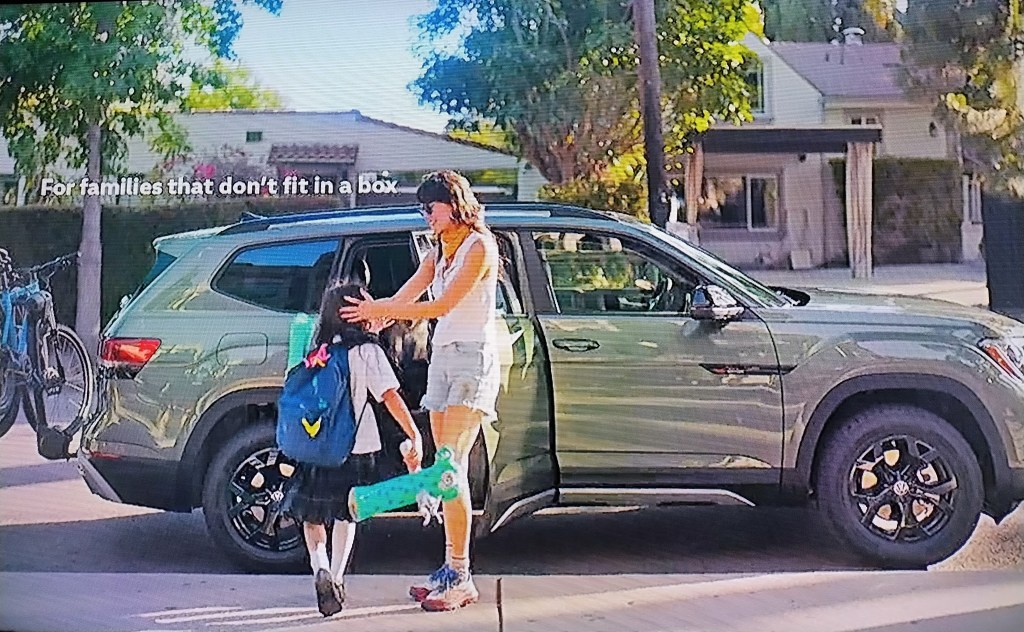
A new Volkswagen TV commercial features the song “Little Boxes” sung by Malvina Reynolds. This song originally critiqued the sprawling mass suburbs of the postwar United States but now is used – and in a remixed version! – to sell an SUV:

Four thoughts related to this advertising campaign:

  1. The song was protesting conformity in sprawl. Does buying a particular SUV counter conformity and sprawl?
  2. The tagline above – “For families that don’t fit in a box” – seems to suggest that people who own this vehicle are doing things outside the box. This vehicle allows you to escape the normal suburban life. Can this happen when almost everyone has an SUV already?
  3. The song said houses were boxes; are SUVs boxes? This particular model might be less boxy than some others but it still looks like a box. Are SUVs cool boxes where as suburban ranches houses were considered by some to be uncool boxes?
  4. If the primary target of this campaign is suburbanites, then a song critiquing suburbia is being used to sell products suburbanites. We have come full circle: do what you can to sell SUVs to suburbanites!

John Grisham describes American sprawl

In his latest work of fiction, John Grisham opens a chapter by describing a scene:

Photo by Kindel Media on Pexels.com

Across the Camino River and headed west away from the island, the busy highway was lined with shopping centers, fast food restaurants, car dealerships, car washes, churches, and big box retailers, the typical American sprawl. Billboards advertised cheap loans, scowling lawyers, and plenty of subdivisions. Construction was in the air. New developments, new “neighborhoods,” new retirement villages were up to seemingly overnight. Realtors’ signs clogged the intersection. Every other truck belonged to a plumber, an electrician, a roofer, or an HVAC specialist advertising a deep concern for your comfort and quality of life.

This paragraph contains multiple traits of suburban sprawl as described by numerous people in recent decades. This includes:

  1. Highways lined with particular businesses (a “typical” American streetscape?).
  2. Lots of vehicles on the roads.
  3. Fast growth (developing happening “seemingly overnight”).

Perhaps the biggest thing missing – though hinted at with “realtors’ signs” – are single-family homes that loom large in American suburbs.

On one hand, the book gets at the problems of sprawling waterfront growth in Florida. This has its own unique features. On the other hand, would the description above be out of place around Las Vegas, Nashville, or Dallas or decades ago outside New York, Chicago, or Minneapolis?

Wildfires approaching homes in sprawling suburbia

Wildfires threaten communities and homes fairly regularly in the United States. How often are these wildfires in suburban communities? Here is a current example outside of Los Angeles:

Photo by RDNE Stock project on Pexels.com

Driven by triple-digit heat, gusting winds and tinder-dry vegetation, the three fires burned at speeds firefighters have never witnessed, scorching over 110,000 acres (44,510 hectares) – an area twice the size of Seattle.

The Bridge Fire, California’s largest current wildfire, swept through communities in the San Gabriel Mountains less than 40 miles (65 km) northeast of central Los Angeles, where people priced out of the city have built homes…

Southeast of Los Angeles, the Airport Fire has destroyed homes in the Elsinore Mountains and injured at least 10 people…

“The Airport Fire remains a significant threat to Orange County and Riverside County communities,” emergency agencies said in a statement.

One way to think about this is that metropolitan areas keep spreading outward. This provides more space for fire to threaten and more interaction with space and land less developed.

A second way to address this is to consider how suburban development – housing, roads, land uses, etc. – can encourage or discourage wildfires starting and spreading. Do yards and the ways homes are built contribute to wildfires? Does the design of American suburbs as we know them help fires spread?

Could this also be addressed in terms of financial trade-offs? Some might move to further-flung suburbs or new subdivisions on the edges because housing prices are cheaper. But how much cheaper is it if there are increased threats of wildfires?

It is one thing for wildfires to be in places with few residents and another if they are regularly occurring in suburbs and close to population centers.

“Phoenix is a guide to our future”

A new cover story in The Atlantic looks at Phoenix, Arizona and considers what the United States is and what it could be:

NASA Satellite Captures Super Bowl Cities – Phoenix [annotated] by NASA Goddard Photo and Video is licensed under CC-BY 2.0

The Valley is one of the fastest-growing regions in America, where a developer decided to put a city of the future on a piece of virgin desert miles from anything. At night, from the air, the Phoenix metroplex looks like a glittering alien craft that has landed where the Earth is flat and wide enough to host it. The street grids and subdivisions spreading across retired farmland end only when they’re stopped by the borders of a tribal reservation or the dark folds of mountains, some of them surrounded on all sides by sprawl.

Phoenix makes you keenly aware of human artifice—its ingenuity and its fragility. The American lust for new things and new ideas, good and bad ones, is most palpable here in the West, but the dynamo that generates all the microchip factories and battery plants and downtown high-rises and master-planned suburbs runs so high that it suggests its own oblivion. New Yorkers and Chicagoans don’t wonder how long their cities will go on existing, but in Phoenix in August, when the heat has broken 110 degrees for a month straight, the desert golf courses and urban freeways give this civilization an air of impermanence, like a mirage composed of sheer hubris, and a surprising number of inhabitants begin to brood on its disappearance.

Growth keeps coming at a furious pace, despite decades of drought, and despite political extremism that makes every election a crisis threatening violence. Democracy is also a fragile artifice. It depends less on tradition and law than on the shifting contents of individual skulls—belief, virtue, restraint. Its durability under natural and human stress is being put to an intense test in the Valley. And because a vision of vanishing now haunts the whole country, Phoenix is a guide to our future.

Several thoughts in response:

  1. How many Americans know Phoenix is the fifth-largest city in the country – growing from over 106,000 residents in 1950 to over 1.6 million today – and the tenth-largest metropolitan area?
  2. Like many American communities, Phoenix and the region depends on growth. More residents, more business activity, more infrastructure. What happens to Phoenix when/if growth slows? How would a mature region in 50 or 100 years look similar or different?
  3. The environment plays a role in Phoenix and the region. At the same time, Phoenix expanded at a particular point in American history, later than many big cities. How do these two factors intersect?
  4. How would urban sociologists think about Phoenix compared to other American cities and region? Is it more unusual or does it follow similar patterns to other sprawling regions? What marks Phoenix as unique? Do the same social, political, and economic factors propel the region or is there something different going on?

More sprawl = more storm damage

With more sprawling development in the United States comes more damage from storms:

Photo by Sebastian Arie Voortman on Pexels.com

But a more significant influence on the rising storm damage trend has little to do with the weather: Growth and development patterns mean there are many more homes and businesses in the way of tornadoes, hail and damaging winds than there were decades ago…

The trend is a product of growing populations in regions where severe storm impacts are also increasing, said Adam Smith, a NOAA economist and scientist who tracks the events.

Researchers call it the expanding bull’s eye effect — a larger target for storms and tornadoes makes it easier for them to inflict damage.

For example, in outlying parts of a city like Wichita, a tornado that might have affected 20 homes several decades ago could now damage 2,000 homes in the same footprint, said Walker Ashley, an atmospheric scientist at Northern Illinois University.

The United States has pursued sprawl for decades now. Metropolitan regions have expanded as Americans, for multiple reasons, have loved suburban growth plus the status and profits they can bring.

A hypothetical using a notorious Chicago area storm could illustrate this. In August 1990, an F5 tornado touched down in Plainfield, Illinois. The tornado killed 29, injured hundreds, and destroyed numerous buildings. At the time, Plainfield was a small community of 4,557 residents on the edge of the Chicago region. How much damage might a similar storm following a similar course cause today? The suburb had nearly 45,000 residents in the 2020 Census and development in the region has moved further out past Plainfield. Some local residents said the 1990 tornado helped show the community’s spirit and contributed to later growth.

Given the propensity toward sprawl in the United States, would any developer or local leader or potential suburban resident say no to more sprawl to avoid storm damage?

McMansions and combating climate change

A letter to the editor in California includes McMansions on a list of items that need attention in order to fight climate change:

Photo by Guduru Ajay bhargav on Pexels.com

Wildfires are increasing but McMansion developments are underway in brushland.

McMansions have long been connected to environmental concerns. This includes their presence within sprawling suburbs and neighborhoods where driving is necessary and a lot of land is used. It includes the materials required for each home and yard. It includes the use of resources to heat and light such homes.

The concern expressed above is more specific. McMansions are linked to wildfires and brushland. This suggests these homes are being built in places where they should not be built or in places that are vulnerable to wildfires. If McMansions were not in these locations, wildfires would affect fewer people.

I wonder, however, if McMansion is shorthand here for any larger single-family home. Do expanding metropolitan regions in California and other states have climate implications? When people move to what used to be small towns surrounded by more open land or continue to move out into dry suburban fringes, isn’t this more problematic than large McMansions with bad architecture?

From the first post-WWII house constructed in Naperville (by Harold Moser) to today

Can one property help highlight the changes in Naperville, Illinois in the last century? I ran into this news item first published May 30, 1946 in The Naperville Sun:

The Moser Fuel and Supply company has just completed the first new house to be built in Naperville since the outbreak of the war in 1941. This “No. 1” house, as it is referred to by Moser employees, is at 417 S. Sleight St., and is a little dream in brick veneer with chocolate-color mortar. Ten other Moser houses are going up around No. 1, eight of which are in the 400 block of south Sleight Street and two on South Wright Street.

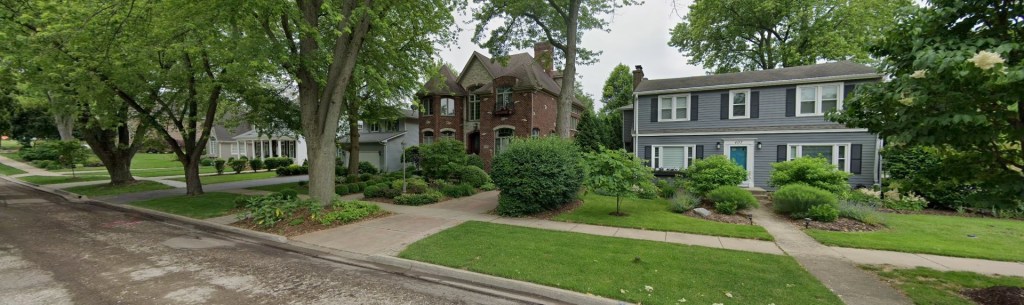
According to multiple real estate websites, the current house on the property was constructed in 2004 and is worth over $1 million. Here is a June 2019 Google Street View image of the block, including the newer home on the property:

Several patterns worth noting:

-Naperville was a different place after World War Two: much smaller in population, lots of farms and agriculture around.

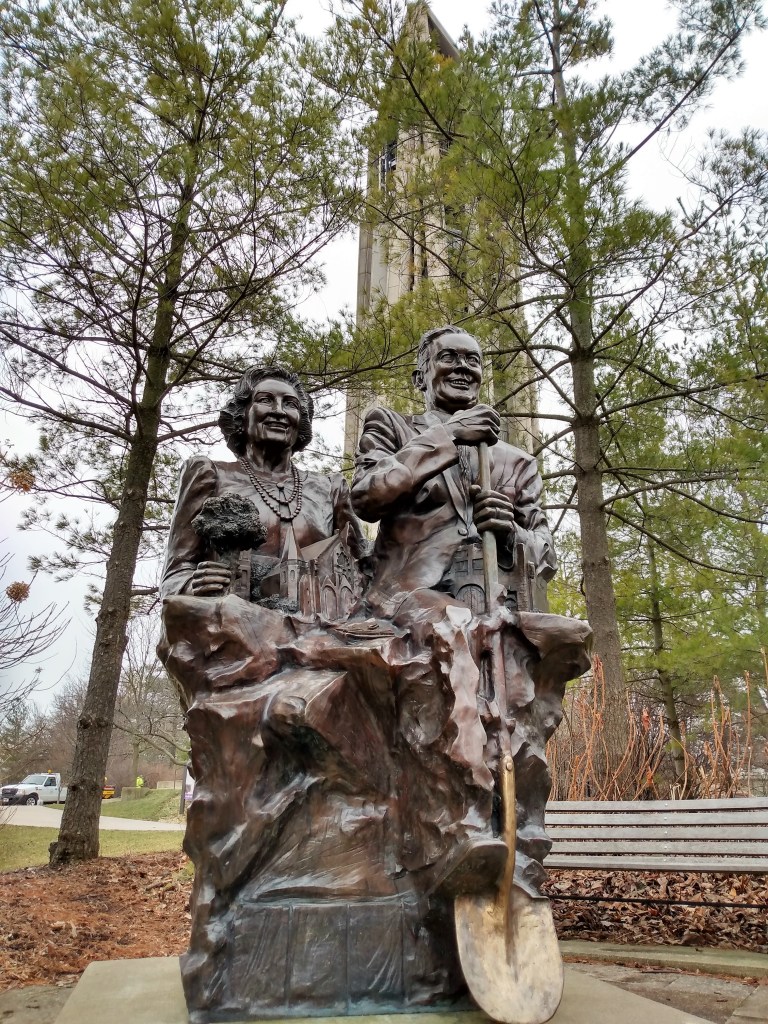
-Harold Moser and his firm ended up building thousands of units in Naperville. Moser Highlands, one of his first subdivisions, is just south of this location. He and his wife are honored in a statue along the Naperville Riverwalk:

-There are lots of teardown homes in Naperville, particularly near the downtown. As Naperville expanded in population and its status grew, some of the older suburban homes built decades earlier gave way to larger structures. I studied patterns in some of these new homes in a 2021 article.

In other words, this was not just one home constructed by a resident who owned a local business; it was part of larger changes to come in a suburb that became large and wealthy.