Musician raised in the suburbs “grateful for the thousands of hours of sitting in my room playing guitar”

How might being raised in a quiet suburban community affect a musician’s career?

Photo by billy Lopez on Pexels.com

You grew up in Wheaton. What was that like?

Quiet. It’s a nice suburb, I enjoyed it. I was homeschooled, so I had a very different experience than probably a lot of people did. My mom kept our world very big — we traveled a lot. Wheaton is where I fell in love with music. I’m grateful for the thousands of hours of sitting in my room playing guitar.

Practice is required to become skilled at many tasks. Having the time, space, and skills to practice well is helpful.

Suburban bedrooms are a private space in the American suburban home. It is a place to get away from the world. One can be alone with their thoughts. In the case of practicing music, playing guitar in a bedroom isolates the activity and noise from the rest of the house. The practicing goes unobserved.

Add to this that suburbs are sometimes portrayed as being creative wastelands. Suburbs are said to be conformist, conservative, cookie-cutter. Many narratives suggest there is a suburban facade of success and attainment – happy families, polite interactions – but just below the surface are problems and divisions.

Can suburban bedrooms produce artistic talent and creativity? The majority of Americans live in the suburbs and multiple generations have grown up in the suburbs. Presumably at least a few artists, novelists, filmmakers, playwrights, and musicians have honed their craft in the suburbs, and perhaps even in their bedrooms.
Could American suburbs not be a “hollow imitation of the place they aspire to be”?

A common critique of American suburbs – and numerous other American places – is in a review of the recent film Holland:

Photo by Jeffrey Czum on Pexels.com

The town thus becomes representative of people like her, it’s merely a hollow imitation of the place they aspire to be in, but comes nowhere close.

The critique of the suburbs means that the suburbs are not what they say they are, that the American Dream of single-family home ownership, middle-class life, and success is more illusion than reality.

I have also heard this critique applied to retail spaces, Disney World, and resorts. They project one image but they are not what they seem. They are real places – you can walk around, you can buy things, etc. – but not real at the same time. They lack authenticity. (This might imply there are places that are authentic, not imitations. They are what they are. This is another matter.)

Are there suburbs that are real places, where the facade is not a facade, that feel like what they actually are? Or suburbs that are honest about the challenges they face alongside the possibilities they might offer? How accurate is the narrative that the American suburbs are inauthentic or is this more prevalent in cultural works?

“Suburban Screams” and the horror of the suburbs

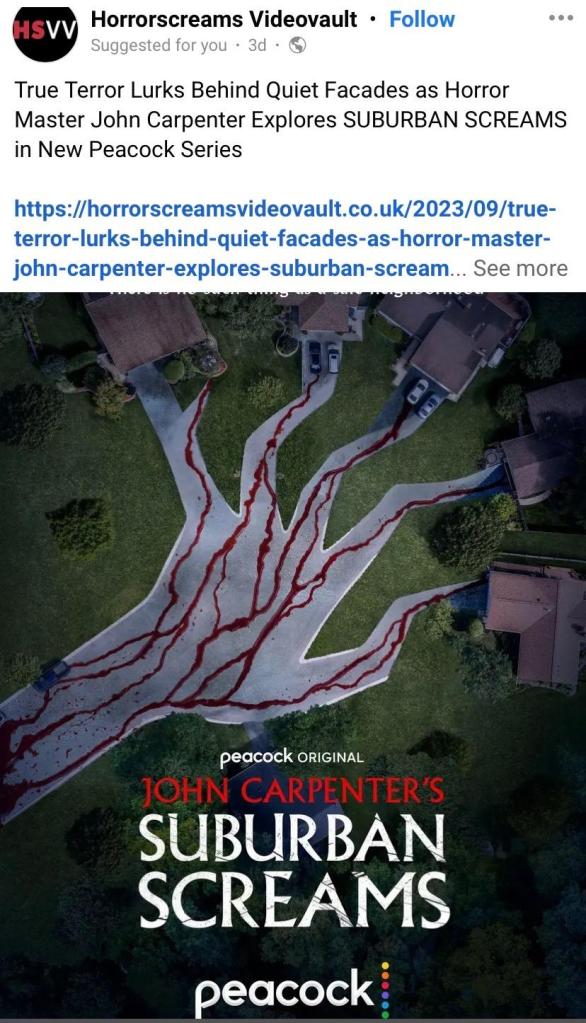
A new television show debuting in a few weeks involves horror in the suburbs:

It is an evocative image: the pleasant suburban cul-de-sac has been replaced by a street and driveways shaped like a hand with blood flowing from the homes.

Here is a description of the show from the Peacock website:

Peacock has shared the official trailer for John Carpenter’s Suburban Screams, a six-episode horror anthology series from the mind of the legendary namesake director, writer, and producer, exploring true tales of terror in suburbia. 

Each episode will delve into the monstrous evil that lurks beneath the surface of friendly suburbia through the lens of one frightful tale. In addition to firsthand accounts, the episodes will include cinematic reenactments, personal archives, and historic town press coverage.

Many cultural products in the last one hundred or so years have endeavored to tell the dark truths of suburbia. Behind the smiling nuclear family or the facade of the new suburban single-family home are less desirable practices and relationships. These stories suggest the suburbs put on a particular face but they are actually something else.

Placing horror in the middle of the suburbs builds on this. Not only might viewers or readers want to learn about the dirtier parts of suburbia; they might want scares and terror.

“Terror” is not typically a term used to describe the suburbs nor is the idea of “monstrous evil.” But that both are “lurking beneath the surface of friendly suburbia” continues an ongoing narrative that the suburbs are not what they seem.

Satirizing the suburbs by poking fun at past depictions of suburbia

A review of a new television comedy notes that part of its appeal is that it plays with previous portrayals of the suburbs:

Photo by Curtis Adams on Pexels.com

The layers of brilliance within the writing continue. While the series satirizes the suburbs, the trio takes it a step even further. The show also makes fun of all the clichés in film about American suburbia – from Blue Velvet to American Beauty toThe Stepford Wives. Because each one of those films is trying to say something about the darkness of the suburbs, Three Busy Debras pokes fun at them by doing exactly not that. The series is so perplexing and over the top, not a single character learning anything to “progress” in their worldview, that it pokes fun at these tropes through their use of absurdist comedy. You can immerse yourself in the surreal world of Lemoncurd and witness the masterful work of Three Busy Debras for yourself by streaming the latest season on HBO Max.

The genre of suburban critique is alive and well in numerous culture industries including poetry, books, music, film, and television. For at least seven decades, these works have depicted the darker sides of suburbia, the true issues facing suburbanites beyond the shiny single-family homes and nuclear families. This is a familiar genre that both speaks to some realities in suburbs and tells similar stories over time.

Thus, I am intrigued by an absurdist or surrealist take on this. Are the suburbs just absurd and the only way to deal with them is to laugh rather than to try to overcome them or find out what is truly going on?

It will also be interesting to see how this fits in the long run with the other critical depictions of suburbia. Laughter and humor can be good ways to address difficult situations. Would suburbanites, the majority of Americans, laugh gently at absurd or surreal depictions or would it be the laughter of realizing how absurd the suburbs actually are?

Familiar story: suburb that looks like paradise but is not, The Villages edition

The Florida community The Villages has roughly 80,000 residents living northeast of Orlando. Is it paradise or a sinister place?

Photo by Sebastian Voortman on Pexels.com

For the residents, it’s one of the most successful experiments ever undertaken in creating a community from scratch…

But critics say there’s something not quite right about The Villages, a sprawling suburb an hour’s drive north of Orlando in Florida…

She likened The Villages to Jim Carrey film The Truman Show about a flawless but ultimately fake town.

The filmmaker has now produced a documentary about the world of The Villages called The Bubble which has its Australian premiere at this month’s Sydney Antenna documentary film festival

Days for its residents are crammed with exhausting rounds of golf, cardio drumming, belly dancing and cheerleading lessons, even synchronised golf cart displays. And day drinking – lots and lots of day drinking…

The company that runs The Villages were none too keen on Ms Blankenbyl and her film crew’s presence.

On one hand, this is a familiar suburban story told for decades: the suburbs present themselves as the place for happy and successful family life. They aim to be green, quiet, and friendly. But, are they really? When a crime is committed, this might be a crack in the facade. Or, family life is not what it seems. Or, the community is built on the basis of exclusion and who is not welcome and/or present. There are plenty of real-life examples of this plus numerous films, novels, and stories that explore these themes.

On the other hand, The Villages appears to have some unique features that might set it apart from typical suburban experiences. It is a 55+ community which changes the entire social structure. The American suburbs broadly are built around protecting children and providing them room to thrive and succeed. It is in Florida so there is warmth and sun in levels that many suburbs cannot match. It is relatively new with a limited history and set of traditions and practices plus a particular architectural and natural approach that still looks new.

Is it a bubble? Many middle to upper-class suburbs might be accused of this. Is it different than many suburbs? Just by its population composition, yes. I look forward to seeing this documentary and thinking about it more.

Halting new development out West due to lack of water

Drought conditions in Utah and other Western states means communities are rethinking development:

Photo by Pixabay on Pexels.com

So this spring, Oakley, about an hour’s drive east of Salt Lake City, imposed a construction moratorium on new homes that would connect to the town’s water system. It is one of the first towns in the United States to purposely stall growth for want of water in a new era of megadroughts. But it could be a harbinger of things to come in a hotter, drier West…

Yet cheap housing is even scarcer than water in much of Utah, whose population swelled by 18 percent from 2010 to 2020, making it the fastest-growing state. Cities across the West worry that cutting off development to conserve water will only worsen an affordability crisis that stretches from Colorado to California…

Developers in a dry stretch of desert sprawl between Phoenix and Tucson must prove they have access to 100 years’ of water to get approvals to build new homes. But extensive groundwater pumping — mostly for agriculture — has left the area with little water for future development.

Many developers see a need to find new sources of water. “Water will be and should be — as it relates to our arid Southwest — the limiting factor on growth,” said Spencer Kamps, the vice president of legislative affairs for the Home Builders Association of Central Arizona. “If you can’t secure water supply, obviously development shouldn’t happen.”

Critics of sprawl have discussed this for decades: new subdivisions and development in arid areas taps already precious water supplies. It is not just about drinking water; it includes the water used for lawns, agriculture, parks, and other uses that come with expanding populations.

As the article notes, numerous communities are trying to encourage homeowners and residents to use less water. Replace lawns. Limit watering. Use greywater. Some have argued that water in the United States is too cheap, encouraging more use.

But, simply having more people and business might be the problem. If drought conditions continue, it will be worth watching how development – often assumed to be necessary for a good community – is treated.

Chicago’s suburbs as quintessential American suburbs in cultural products

A number of Chicago suburbs have appeared on television and in movies in recent decades:

Photo by Chait Goli on Pexels.com

Rightly or wrongly, I concluded that suburbia was segregated and snobbish, an attitude I’ve never been able to shake. I didn’t get that attitude from movies about just any suburbs, I got it from movies about Chicago’s Northern suburbs, which, over the last 40 years, have come to be seen as representative of all American suburbia. (My first job in Chicago was covering the Lake County suburbs for the Tribune. That didn’t change my mind.)

During the first wave of suburbanization, in the aftermath of World War II, the suburbs of Northeastern cities got all the attention, in movies such as Mr. Blandings Builds His Dream House, and in the fiction of John Updike, John Cheever and Richard Yates. When Hollywood rediscovered Chicago in the 1980s, though, it also discovered Chicago’s suburbs, through the work of writers and directors who grew up there. Paul Brickman, who directed Risky Business, was from Highland Park; Hughes was from Northbrook.

In the 1980s, suburbia was in its prime. Back then, nobody with money wanted to live in urban America. Rich people wouldn’t start moving back to cities for another decade. The suburbs are often mocked as a cultural wasteland, but towards the end of the 20th century, that’s where a lot of Chicago’s cultural energy was coming from. Even The Blues Brothers, which is revered as a document of post-industrial, pre-gentrification Chicago, was co-created by John Belushi of Wheaton. Steppenwolf Theatre Company was co-founded by Jeff Perry of Highland Park and Gary Sinise of Blue Island. According to his National Lampoon colleague P.J. O’Rourke, Hughes in particular was eager to rescue his native grounds from the notion that “America’s suburbs were a living hell almost beyond the power of John Cheever’s words to describe.”Chicago’s 1990s alternative music scene may have been born in Wicker Park, but its leading lights were suburbanites: Liz Phair of Winnetka, Billy Corgan of Elk Grove Village, Local H of Zion. Urge Overkill formed at Northwestern University. High Fidelity, the movie which celebrated that scene, starred Evanston’s own John Cusack as Rob Gordon, a guy from the suburbs who opens a record shop on Milwaukee Avenue.

Chicago’s suburbs continue to define suburbia in popular culture. The 2004 movie Mean Girls, the quintessential depiction of high school cliques, was set at fictional North Shore High School (i.e., New Trier). The characters even shopped at Old Orchard, although it was inaccurately depicted as an indoor mall. Greater Chicagoland also makes an appearance, and provides a contrast: Wayne’s World, set in Aurora, and Roseanne, set in the fictional, Elgin-inspired collar-county town of Lanford, are on the outside, physically, culturally and economically.

As someone who has researched locations and television shows, this raises several responses:

  1. Would viewers of these different suburbs know that the Chicago suburbs were unique in some way or do they look like suburbs all over? For example, does North Shore High School look or feel different than schools in Westchester County or outside Boston? One of the films cited, Ferris Bueller’s Day Off, clearly shows Chicago locations but the suburban shots could fit in many American suburbs.
  2. There is an empirical question here: were Chicago suburbs depicted more often than suburbs of other locations? Or, based on viewers or ticket revenue or albums sold, how does the creative energy of the Chicago suburbs compare to cultural products linked to other locations?
  3. There is still some sense that suburbs are not creative places. This stereotypes dates back to at least the mid-twentieth century when suburbs were criticized as conformist and bland. True creative energy can only come from cities, not homogeneous and exclusive suburbs. Yet, as more Americans lived in suburbs compared to cities starting in the 1960s, it is not a surprise that cultural products would come from suburbanites.
  4. Even as a number of creatives grew up in suburbs, how much did their adult work and products rely on cities, including Chicago? The major culture industries in the United States are often located in big cities so even suburban or rural themes are mediated through more populous and denser communities.

The random name generator for Chicago suburbs

After thinking about Chicago suburbs with elevation clues in their names, I was reminded of the names of Chicago suburbs more broadly. To quote again from the WBEZ story:

One-hundred years ago we named places very differently, Callary says. Places were named after a town founder, or family member, or after something that indicated the place’s actual, physical presence in the world. Today, it’s more common to name a place after what you want it to be, rather than what’s actually there.

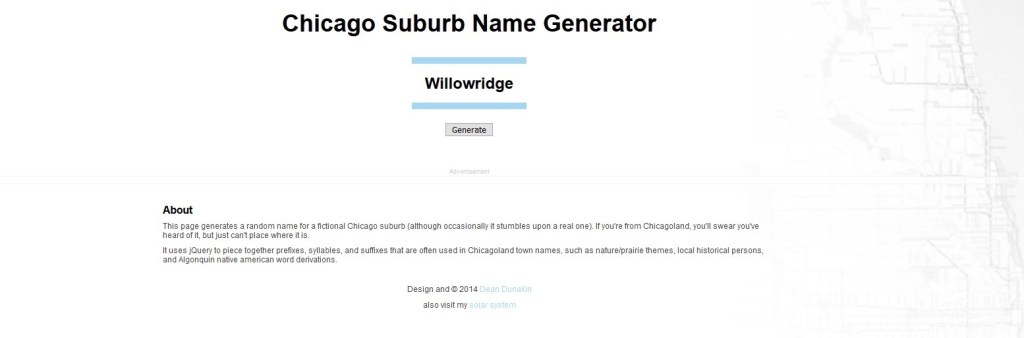
So how exactly did developers and local leaders come up with all of the existing Chicago area names? It could have looked like this:

I had to check on Willowridge because it puts together two commonly used words in suburban place names. I found some companies with this name as well as one suburban street but no official place.

Here are the next ten names generated:

Romeowoods

Franklinsville

Elmburn

Hillhurst

Musmukda

Glenside

Rolling Bluff

Hillwoods

Highfield

Crystalfield

Out of these, I would vote for Glenside as the most probable.

On one hand, this all makes sense: suburbs often want to invoke nature and idyllic settings. On the other hand, such anodyne names invoke the conformity and dullness of suburbs many suburban critiques have noted.

McMansions as a symbol of excessive consumption, end of life satisfaction edition

One of the more interesting definitions of McMansions I encountered in my 2012 study involved the homes serving as a symbol of excessive consumption. Here is a recent example:

Photo by Gary Barnes on Pexels.com

The survey shows—and it’s not even close—that the No. 1 way in which people define a good life is “having family and friends that love me.” The answer was nearly universal, cited by 94% of respondents. After this came “making a positive impact on society (75%). Having a high-powered job or bunking down each night in a McMansion might be nice, but in the end such things don’t mean that you’re loved or respected or that you’ve made your community a better place.

This finding is a common one: people at the end of life say relationships matter more than what they bought or consumed. For example, see the results of the Grant Study:

“When the study began, nobody cared about empathy or attachment. But the key to healthy aging is relationships, relationships, relationships,” Vaillant says. Close relationships, the data indicates, are what keep people happy throughout their lives. The study found strong relationships to be far and away the strongest predictor of life satisfaction, and better predictors of long and happy lives than social class, wealth, fame, IQ, or even genes. That finding proved true across the board among both the Harvard men and the inner-city participants.

Yet, the comparisons made to what really matters – relationships – are interesting as they target key markers of success in the United States. The first is a high-status job. Adults often define their worth and status by their job. Second is the home. In a country that idealizes owning a single-family home, this makes for a striking alternative to prioritizing people.

Why pick a McMansion here as opposed to a typical suburban single-family home? There could be several reasons. A McMansion is a particular symbol of success, a home whose facade tries to exude status. A McMansion is larger than a typical single-family home, usually coming in between 3,000 and 10,000 square feet. And, perhaps most important here, the McMansion is a symbol of the wrong kind of consumption. Owners are trying too hard with their home to show off. The home is poorly designed. Compared to life-giving relationships, the McMansion pales in comparison. Rather than think of people who are McMansion-rich but house poor, think of people who own a McMansion but have poor relationships…a furthering of a long-standing suburban plot where people look like they have achieved the American Dream but their lives are falling apart.

The Limbaugh soundtrack to suburban life

For decades, the suburbs were said to be more politically conservative. One writer describes hearing Rush Limbaugh in his suburban childhood:

Photo by rikka ameboshi on Pexels.com

As a kid growing up in Sacramento, I had a few friends I liked, but dreaded going to their houses to play. I suggested riding bikes, playing tag or hide and seek — anything to avoid their homes. I avoided their houses because their families usually had the radio tuned to KFBK, listening to a guy who was always furious about nothing, as though he was pleasant background noise — elevator music for single family, one story homes in the suburbs.

To my young ears, there was an uncanny vibe about his voice. He sounded like Santa Claus if Santa swallowed another Santa whole, but that Santa got stuck in his throat. Boots, beard, and furry coat, all jammed against his larynx as he croaked on and on, complaining about “illegal” elf workers wanting fair pay, health care and for him to stop grabbing their tiny butts.

My friends’ “nice” families had him on, all the time, stinking up their homes with hate the way others baked to make homes smell like cookies.

I wondered what that did to us, constantly breathing in his vitriol — for non-white people, for women, for gay people, especially if they were richer, smarter or more powerful than him. I wondered what he’d think of me, what they all think me — a Black kid with a working mom and absent dad — skin so light it sometimes camouflaged me from their sight.

The main contrast here is between the “nice” suburban families and the constant sounds of Rush Limbaugh. On the whole, the suburbs are often pitched as idyllic: single-family homes for families, middle-class people who have made it, green lawns and a quieter life compared to cities. The suburbs are supposed to be the retreat from the difficulties of the world.

Yet, from the beginning, whether the suburbs have delivered on these claims is debatable. Who could make it to these locations? How idyllic was it really or was it perceived to always be under threat? Did the gloss of suburbia cover up darker truths involving race, class, gender, broken families, and more?

It would be interesting to back and see if there is evidence of suburban talk radio listening patterns. Or, to mirror current political patterns, was Limbaugh more popular in exurbs and the outer suburbs and his listernship dwindled closer to the big city?