“Jennifer Aniston leads fight against giga-mansions” in Beverly Hills

Even the wealthy don’t want “giga-mansions” in their neighborhood:

Her own $21 million (£13 million) Bel Air mansion covers a rather more modest 8500 square feet.

But it has been rapidly overtaken by a new trend for the giga-mansions. The ultra-wealthy are buying and bulldozing some of the area’s biggest villas, to build even bigger homes, filled with fountains, swimming pools and space for entertaining.

Opponents say they bring months of construction noise, threaten existing homes by destabilising the ground and that their huge size represents an invasion of privacy as they tower over neighbours.

Prince Abdul Aziz, a Saudi Arabian prince and deputy foreign minister of his country, is among the buyers to have angered neighbours. He bought a Spanish colonial residence from Jon Peters, the film producer behind Superman Returns and Man of steel, before promptly tearing it down and lodging plans for an 85,000-square-foot estate.

But the real fury is reserved for the 30,000-square-foot creation of Mohamed Hadid, a real estate developer and father of Gigi Hadid, the model.

Two quick thoughts:

1. These really are some large homes. They might work on larger pieces of property but not so well when neighbors are relatively close by. A 103 foot tall home is more like a 10 story skyscraper in a small size city than a welcomed member of a residential neighborhood.

2. This does invite questions about how large of a home is too large. A $21 million 8,500 square foot home in Beverly Hills is expensive and large by all measures. Presumably, the Los Angeles regulations allow for this size. But, how exactly does a municipality decide on the cut-off? The way around this in many communities that address teardowns is to insist on certain guidelines and styles that effectively limit the square footage.
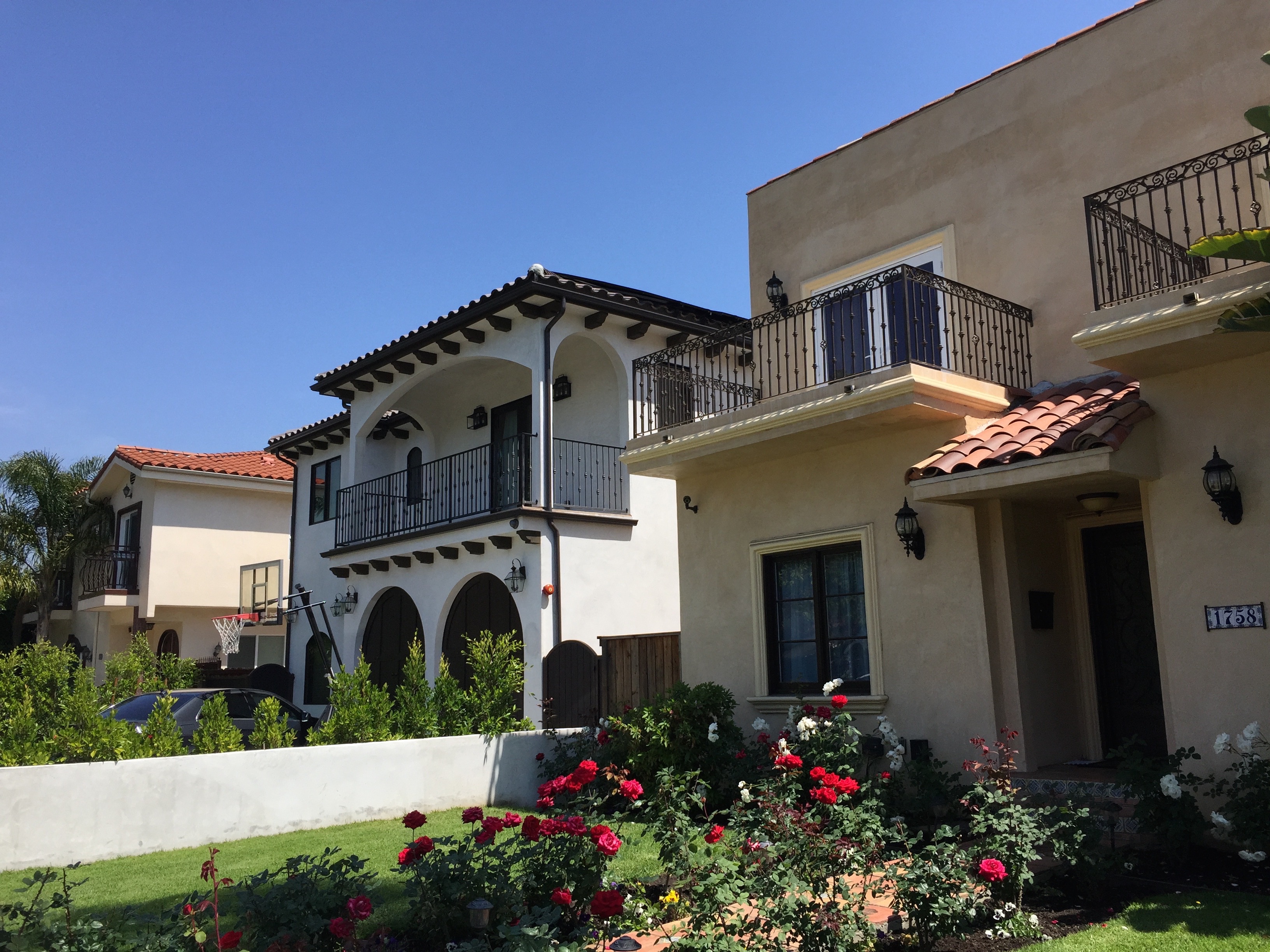
Photo essay demonstrating LA’s mansionization

Here is a photo essay that shows the incongruity of a number of teardown McMansions in Los Angeles:

A developer wants to make as much money as he can as quickly as he can, where the only people whose feelings or quality of life he cares about are himself and whoever buys his newly-built mansion. A normal, thinking, feeling person could find many reasons why she would not want to rob her neighbor of privacy or sunlight by building a looming addition onto her house, with perhaps the most powerful reason being that her neighbors would hate her for it. A developer who will never live in a house he has built doesn’t have any relationships with neighbors to preserve. He actually stands to benefit from being indifferent/contemptuous to neighbors’ concerns, especially if it means he is able to build a bigger, more expensive, more obtrusive structure without the impediment of a guilty conscience. And don’t forget the long, noisy, messy, utterly unpleasant experience of living near a house under construction…

And that’s perhaps the biggest danger of mansionization. Regardless of what you think about mansionization and how it should or shouldn’t be regulated, there’s something about it that I’ve found to be consistently true.

When the first mansion goes up on a block of more modestly-sized homes, it sticks out like a garish eyesore. But if a second mansion is built on the same block, that first mansion suddenly doesn’t look nearly as big and out of place as it did before…

2015-07-01-1435742962-2381680-3inaRowGOOD.jpg
Three of a kindAnd at that point, the entire block might as well be mansionized — and chances are it will be. Having one mansion next to you is bad enough, but if the house on the other side of you gets mansionized, blocking sun and privacy from two sides, who would want to stay? Better to take what you can get and sell, leaving the house to a developer or new buyer who would inevitably go big — and another reminder of the now “old” neighborhood will be gone.

The critique of these new homes focuses on three areas:

1. It is often developers, and not neighbors, who go forward with the oversized homes. Neighbors might be more sensitive to the needs of others but developers are simply trying to maximize the property for profit. This may be true though there are plenty of cases where people buy properties with smaller homes and then make the decision to build a huge home. Developers aren’t the only ones to blame here.

2. The architecture and design of these new large homes are lacking. The homes are unnecessarily large and depart from traditional Southern California styles (stucco, clay tile roofs, etc.). These new homes clash with the older, smaller homes.

3. McMansions spread like a contagion: once a neighborhood or block has one, newer ones are soon to follow. The hint is that the teardowns need to be stopped at the start. A number of LA neighborhoods have been pushing for housing restrictions. But, it may be that one of these homes has to be built before neighbors really rally around the cause.

Opponent of teardown McMansions switches sides

One owner of an older suburban home says she can see the benefits of a teardown McMansion:

I would have taken Huetinck’s explanation personally several months ago, when I used to sigh as I walked by these construction sites that were seemingly engulfing us. But now that our kids are getting older and our space feels tighter, I can see the benefits of these “shiny and new” homes.

Although my husband and I like taking our two toddlers on walks to the farmers market at Bethesda Elementary School on the weekends and for strolls to the playground around the corner, I’ve found myself growing increasingly frustrated trying to navigate our living room without stepping on a toy, cramming clothes into closets that seem to grow smaller by the day, and making do with no garage. As much as I hate to say it, I’m starting to lose my allegiance to these older homes.

That’s not because I want to see our neighborhood turn into a cookie-cutter development, but it’s because I see the ease that something as simple as a mudroom can provide, especially with kids and a dog…

But the allure of a mammoth open kitchen, a two-car garage and a walk-in closet in the master bedroom is hard to ignore.

These sterile, user-friendly McMansions are looking better to me every day. Unlike our friend and neighbor Marjorie, I think we could come up with a price.

I would be interested to hear about what kind of interactions this writer/resident has with her neighbors after writing this piece in the Washington Post. It sounds like the neighbors have taken sides, pitting those who have lived a long time in the neighborhood and what to see it preserved or stay the same versus those who either want or need to sell and like the higher prices they can now get or those who can see the usefulness of a newer home.

Could a teardown McMansion may more defensible if the owner has a larger family? Although more American households than ever are single members, families with children might want more space to spread out. Yet, I imagine at least a few of those opposed to McMansions might also be opposed to overpopulation…

Finally, are there any teardown owners who stay in the same neighborhood? Or, is the act of buying a teardown so disruptive that one can’t remain a neighbor in good standing if they are the one bringing the disruption?


Teardown McMansion owner asks why people hate their home

A teardown McMansion owner in McLean, Virginia wants to understand why people don’t like the home:

I don’t understand why people get so upset on this board. When we bought a new build a few years ago, we were very excited and actually liked the brick over the hardieplank.

We live in a teardown area in McLean with many original homes. We always keep our lawn nice and upkeep our landscaping.

Why do you dislike my house and maybe me or family?

[edited for original errors]

The responses come pretty quickly and include a number of arguments:

1. Building any newer home within a “historic” neighborhood (even if just from the post-World War II era) would be a problem for disrupting the existing character.

2. Specific design elements of teardowns are problematic, particularly certain kinds of siding.

3. Maintaining the lawn and exterior of the house might be necessary in many suburban neighborhoods bu it probably isn’t going to make up for the design of the house itself.

Despite the objections – which sound fairly permanent and independent of the people actually living in the home – the pace of teardowns has actually increased.

Chevy Chase woman files lawsuit after lawsuit against her neighbor’s teardown

Chevy Chase, Maryland has experienced a number of discussions over redevelopment including this one-woman “all-out war” against her neighbor’s teardown:

First, in 2009, she sued the town of Chevy Chase in an attempt to block its approval of the Schwartzes’ building permit — but that failed. Then she appealed — and was denied. “I would say Chevy Chase has spent upwards of $50,000 because of Deborah,” Hoffman said. “Not just in legal bills, but in all the staff costs in answering her letters and telephone calls.”Vollmer next filed a similar lawsuit against Montgomery County and lost again. Soon afterward, she watched in horror as the Schwartzes erected a handsome, stone-encrusted house at 7200 44th St. The house, which she excoriated for its size, offers evidence of the neighbors’ clashing lifestyles.

Vollmer drives a Prius. The Schwartzes have a Mercedes. Vollmer prizes rough-hewn back yards with lots of vegetation. The Schwartzes appreciate a more manicured aesthetic. “Some people may question my motives,” Vollmer said. “But what’s happening in this town, these developers, tearing down old homes. I’m standing up for my rights. .?.?. And then this whole thing just kind of evolved” from that.

The dispute’s next evolution occurred in court. Vollmer sued the Schwartzes in Montgomery County Circuit Court — not once, but twice — over arguments involving the shared driveway. She lost both…

“We have had to go to court more than 16 times because of her multiple lawsuits and her behavior,” Schwartz said. “We love our home and our neighborhood, and we can only hope that reason will prevail in the future.”

And there is more here including an arrest for destruction of property, another lawsuit over paving the shared driveway, and a second arrest. In the end, is Vollmer simply standing up for her property rights (and she apparently has the resources and legal training to do so) amidst the bullying of mansionizing new residents or is she a public nuisance against inevitable change and wasting taxpayer money?

One thing this article does not explain: how in the world was the new house approved with a shared driveway? The picture with the story suggests the teardown was built close to the lot line:

Given Vollmer’s behavior, it is not clear this would have solved the issue. But, having a shared driveway could lead to issues even if the new neighbors didn’t build a new large home. Perhaps this is why suburbanites need passive aggressive signs to fight each other rather than lawsuits…

Teardowns increase

Demonstrating again that people with means are doing fine in the housing market, the number of teardowns is on the rise:

Home teardowns are becoming common in U.S. suburbs such as Pimmit Hills, a 65-year-old neighborhood just beyond the borders of the growing Tysons Corner area near Washington. Builders, lured to locations where land is more valuable than the aging housing stock, are transforming communities outside of major employment hubs to take advantage of demand for real estate where schools are decent and commutes are short.

Knockdowns across the country are increasing, said Robert Dietz, an economist with the National Association of Home Builders. The trade group estimates that builders tore down and reconstructed about 32,000 homes last year, representing 5 percent of all single-family housing starts. Beyond the nation’s capital, the trend can be found in suburbs of cities from Boston to Minneapolis and Los Angeles.

“It’s all about traffic jams — people can have nice houses far out in outer suburbs but the commute time is impossible,” Lawrence Yun, chief economist of the National Association of Realtors, said in a telephone interview. “This is an ongoing process because older-built homes happen to be closer to job centers and may not meet the needs of modern homebuyers.”…

More builders are ripping down existing homes because well-located vacant lots are becoming difficult to find and structures in communities close to urban areas are among the oldest. In 2013, about 47 percent of owner-occupied homes in the U.S. were at least 40 years old, up from 27 percent in 1991, according to an analysis of Census Bureau data by the homebuilder group.

If you have the resources, you can get the bigger home with the shorter commute in a desirable suburb. The figure cited above about a dated housing stock is intriguing; many people today seem to want new and turnkey construction but many older suburbs – even ones founded right after World War II – could have primarily older homes.

I like the picture they chose to accompany this story as it highlights why many communities have fierce debates over large teardowns:

Northern Virginia’s Pimmit Hills

That is quite a difference in size and shape.

“The McMansions are coming!” to Modesto

Maybe the broader statistics don’t matter – opposition to McMansions is often strongest at the local level, like when teardowns arrive in Modesto:

In the old College area of Modesto, I’ve spotted an unsettling trend – the sprouting of what folks in the Bay Area call “McMansions.”…

These behemoths bring nothing to the locales, and basically boil down to somebody wanting to live in an older neighborhood in a development-style home with maximum square footage. You can imagine how people who have lived among one-story neighbors feel when a McMansion glares down at them. Many choose to move or erect tall plants as barriers in an effort to recapture a sense of privacy.

McMansions are a hot issue in the Bay Area, with existing homeowners protesting the intrusion. But few cities have any restrictions or guidelines in place for protecting and/or building in older neighborhoods. Those who do have recognized the value of managing older neighborhoods to bring value to their town. Along the same lines as preserving historic downtowns for their appeal, they preserve historic neighborhoods.

Large homes equal larger tax revenues from the city’s point of view. But as historic old neighborhoods succumb to McMansions, it’s just a matter of time before these areas look like the row houses in the 1970s Archie Bunker sitcom; they will have ruined the “old” neighborhood ambiance they sought.

Not a positive view of teardown McMansions. I wonder how this works in communities like Modesto which have been hit hard by foreclosures (though some Central Valley cities are not below national foreclosure rates). Can a city afford a NIMBY approach to McMansions if the housing stock isn’t doing so well on the whole? At least the teardowns suggest there is some demand for living in certain neighborhoods in Modesto – not all communities have even that.

This question regarding teardowns could also apply elsewhere: are big teardowns and gentrification better than no development at all? Both involve changing the character of a neighborhood, particularly upgrading the housing options. Both are often viewed negatively by residents already there. Both typically involve outsiders and new residents. Of course, these aren’t the only choices available in neighborhoods but are they better than negative conditions or decline?

When neighbors sue over a teardown McMansion

Can this end well? One Sioux Falls family sues their neighbors over the construction of a teardown McMansion and alleged violations of local ordinances:

In court documents, Pierce and Barbara McDowell charge that the new house is too close, too tall and negatively impacts use of their own property.

Not only does it block natural sunlight from reaching the McDowell house, the lawsuit charges, but the McDowells have been stopped from using their wood-burning fireplace because its chimney now is too close to the house being built by Joseph “Josh” Sapienza and Sarah Jones Sapienza…

The McDowells are asking for a permanent injunction to stop further construction at the Sapienza residence until it comes in compliance with the city’s 2013 Shape Places Zoning Ordinance and it is relocated so the McDowell house no longer violates the city’s Residential Code…

When completed, the Sapienza house at 1323 S. Second Ave., just south of the McDowell residence, will be a two-story single-family house containing almost 5,000 square feet. The permitted offset from property now is five feet, putting seven feet between the two houses…

The original house on the Sapienza property was multilevel with a total of 1,811 square feet on the main and upper levels. The lot measures 69 by 143 square feet. It had been built in the 1950s, and the Sioux Falls Board of Historic Preservation approved its removal from Second Avenue since it did not fit the neighborhood’s historic character. At a recent board meeting, however, two members referred to the new house as “a McMansion.”

To answer my own question, this cannot end well for all parties involved. The burden seems to be on the city to show that the proposed home did not violate any ordinances or guidelines. But, if it made it through the entire approval process even when neighbors had concerns, perhaps this won’t be difficult to demonstrate. Possible outcomes might include:

1. The neighbors are upset long-term feeling that the historic district is not protected or that the city doesn’t have a strong enough set of guidelines. Developing guidelines that will satisfy everyone can take quite a bit of time. Just look at Austin or Los Angeles.

2. The city feels like it can’t win in trying to balance competing interests. This is typically expressed as allowing collections of residents to have some control over their neighborhoods but also wanting individual homeowners to have some property rights (including pursuing teardowns). Such a lawsuit can take up time and money that could be better utilized elsewhere, particularly in an era of tight municipal budgets.

3. The property owners could have a tough time for years to come. If the lawsuit succeeds, how much do they have to change their home and at what cost? If the lawsuit fails, it is unlikely that the neighbors will suddenly like the home. I would be interested in reading a follow-up story in a few years to see if these owners are still living in the neighborhood.

At best, the disagreement between these neighbors will fade away and the city will have clearer guidelines that will help residents avoid such issues in the future. But, I would guess a more negative outcome is likely.

Fighting the “McMansion Wars” in Toronto

The fourth-largest city in North America has its own issues with McMansions. Here is the latest cover of Toronto Life:

That’s quite the house on the cover. Watch a video here with the writer behind the cover story. It sounds like a lot of the same issues with McMansions teardowns as found in many wealthier American neighborhoods: disagreements about taste; new residents wanting new things; existing residents not liking the change in character; desirable neighborhoods close to downtown; lots of money being thrown around in an expensive market.

One strategy against McMansions as explained in the video: if you have lots of money, you can just buy up the homes around you and demolish the houses to make sure you have a sizable yard around you.

Teardowns back on the rise in the Chicago area

Teardowns are back in wealthier Chicagoland communities:

Wilmette, for example, saw 48 teardowns last year. That’s way up from the 15 to 20 the North Shore town experienced annually from 2009 to 2011. “We’re almost back to the old average of 50 a year,” says John Adler, Wilmette’s community development director. “And the resurgence is attributable to developers getting involved again on the speculative side—not just people of means building their dream homes.”

Hinsdale, the priciest west suburban housing market, had 60 teardowns last year, versus 47 in 2013, says its community development director, Robert McGinnis. All but six of the single-family homes that started construction there in 2014 replaced teardowns. McGinnis estimates at least half of the new projects are being built on spec, as opposed to being custom-built…

The teardown candidates aren’t just tiny bungalows this time. Developers are targeting larger houses as well, particularly if they sit on coveted property. Antiquated plumbing, the absence of upscale amenities such as media rooms, and the high cost of gut rehabbing (roughly $300 a square foot, versus $200 for new construction) are pushing homes on North Shore lots near the lake into early retirement. Two properties that sold for around $4 million each in 2014—one in Wilmette and one in Winnetka—are on their way to the scrap yard, says Berkshire Hathaway HomeServices KoenigRubloff agent Joseph Nash. Both were on three-quarter-acre lots with private beaches, and the Winnetka house had seven bedrooms—big and nice, but apparently not nice enough.

While there will always be preservationists who bemoan these changes, Boyle says he hasn’t witnessed as much handwringing this time over the evolving neighborhood character in La Grange: “Most people are happy that people are updating homes, because they’re seeing the value increase for their own property.”

I want to know more:

1. Are some people (like the neighbors who get upset about such homes next door) going to be happy that teardown McMansions are back just because they signal a more vibrant housing market? Or, are these teardowns just another sign of the bifurcated market where the wealthy still have money to burn?

2. Do these teardowns today look significantly different than those of the early 2000s? Did builders learn any lessons or has the market shifted dramatically?

3. We might know that the housing market has really returned when teardowns are happening in communities that aren’t the usual suspects like Hinsdale, Naperville, Elmhurst, and the North Shore. Any activity in other suburbs?