McMansion tourism in Austin

One visitor to Austin, Texas wants help from Reddit in finding good examples of McMansions:

I’m visiting Austin and heard about these McMansions. It’d be really cool to drive around and see some of these beasts. Which neighborhoods or streets are worth seeing?

The other thread participants then offer some good feedback for a city that recently instituted guidelines intended to reduce the number of new McMansions. But, if your city is known for its big houses, why not take advantage of this? Most cities would love to bring in more tourists who then spend money and demonstrate that the city is worth visiting. According to critics, McMansion owners want these homes in part because they want to impress others with the square footage and attention-grabbing architecture. Match this desire for visitors with the attention McMansion owners want (at least according to critics) and you could include such homes as important sights to see.

Of course, some cities might not want to highlight McMansions that are criticized for a variety of reasons. I’m guess Austin wants to be known for creativity and tech, not the poor architecture of overlarge homes. Similarly, I imagine many McMansion owners would not be thrilled if tour buses started regularly driving slowly past their homes giving tours.

At this point, I could only imagine regular McMansion tours being given by those who don’t like McMansions.

How much money a third observation deck in Chicago might generate

Potential buyers of the Aon Tower in downtown Chicago are looking into making money through the addition of an observation deck:

A third observatory could generate tens of millions of dollars in annual revenue for the 1,136-foot-tall office building overlooking Millennium Park. The building, owned by Johns Creek, Ga.-based Piedmont Office Realty Trust, is attracting bids above $650 million, people familiar with the sales process say…

It would cost millions of dollars to design the space, to create an entrance and elevator access separate from those used by office tenants, and to promote and operate the observatory. Plus, unlike in most cities, two formidable competitors already are in place.

“It’s not a build-it-and-they-will-come type of operation,” says Randy Stancik, who has been general manager of the Skydeck for 10 years after eight years at the Hancock’s observatory. “You really have to work at it to build a visitor attraction. You have to be prepared to stay with it through some rough times.”…

There is little precedent to indicate whether a third observatory can thrive here. New York is the only city in the world with three, says Daniel Thomas, executive director of the World Federation of Great Towers, a group dedicated to generating tourism for its 49 member towers. New York has the Empire State Building Observatory, Top of the Rock at Rockefeller Center and the recently opened One World Observatory atop the new One World Trade Center.

This could be another front of the ongoing Chicago-New York City feud: could the two cities have an equal number of observation decks?

I would guess the Aon Center could have two major selling points compared to its competitors:

1. A different location. The Sears Tower deck is quite good for looking out into the suburbs but its views to the east are filled with buildings. The John Hancock observation deck offers different views to the north and over Lake Michigan. But, the Aon Center would be the only one with unobstructed views of Millennium and Grant Parks.

2. It is the newest. This may not mean much these days with a sort of arms race between the other two observation decks: the glass floor protruding deck at the Sears Tower and the Tilt at the John Hancock. I imagine the Aon Center buyers could come up with something unique that could attract people.

Perhaps this could lead to some sort of price wars between three observation decks leading to great deals for visitors…this is something I imagine people could get behind.

Chicago Epic marketing cut due to state budget

Chicago rolled out an “Epic” campaign this spring to attract tourists but it is now no more due to a lack of state funding:

Chicago’s latest tourism campaign, Epic, is about to end two months early thanks to epic budget cuts at the state level.

Choose Chicago, the city’s tourism program, is losing 40 percent of its operating budget in the latest set of state budget cuts, according to Crain’s. That means Epic, the (perhaps unimaginative) summer tourism campaign launched in April with a TV ad encouraging viewers to “be part of something epic,” would end July 1 rather than run through the summer. Unless they are talking about an epically rainy June, the campaign ending this early wouldn’t leave much sizzle in the summer tourism industry.

Choose Chicago CEO Don Welsh said in statement that the program will lose most of its funding, from the state hotel tax, unless there is a last-minute approval of the state’s 2016 fiscal budget—increasingly unlikely as the week progresses…

The loss of Epic could deal a blow to Mayor Rahm Emanuel’s vow to boost tourism to 55 million visitors by 2020. Crain’s says Rauner, who was once the chairman of Choose Chicago, believes tourism is a boon to the local economy.

Two quick thoughts:

1. If you go with a catch term like “epic,” it is bound to be used sarcastically if something goes wrong (like the campaign ends early). Not exactly epic…

2. How do we – the public – know that such marketing campaigns work? Even though the Epic campaign is ending early, did it have any influence? Did the slogan catch on? What does this mean for future Chicago marketing campaigns? Just because a big campaign was out there doesn’t mean that it did much in this media and advertising saturated world.

Branding battle: “Chiraq” vs. “Chicago Epic”

Spike Lee and the city of Chicago have opposing views of how the city should be viewed. First, from Lee:

No sooner did the Wrap report that notable director Spike Lee has been tapped by Amazon Studios to make a movie titled Chiraq did the controversy and backlash begin to grow online because of the movie’s title. It wasn’t Lee who coined “Chiraq,” however. Chicago residents who have experienced the deadly shootings in “The Chi” gave it the moniker of Chiraq. The term combines Chicago with Iraq to compare the violence of the two places, as witnessed in the below documentary video previously released about “Chiraq,” but unrelated to Spike’s forthcoming movie…

Alderman Anthony Beale says Chiraq should have a new title, reports CBS Local. Beale adds that he doesn’t care what other name Lee uses for his new movie, but that it shouldn’t be Chiraq due to the violent images it brings forth. The alderman from the 9th ward didn’t make mention of the nickname coming from other sources than Lee.

Another politician was more forgiving of the Chiraq title. Senator Dick Durbin said he’d first like to give Spike a chance to explain what the Chiraq movie is all about before passing judgment. Although he says the Chiraq title is worrisome, he admitted he doesn’t know much more about the movie than the title.

Other politicians weighed in on Spike’s Chiraq, reported the Chicago Sun-Times?. Although Alderman Beale continued to point out criticisms, claiming Lee was stigmatizing Chicago with the Chiraq nickname, Mayor Rahm Emanuel refused to go that far. The mayor would only say that he’s focusing on the safety of the city.

Second, this news comes as the city is launching a national ad campaign to bring more tourists to Chicago:

The campaign, dubbed “Chicago Epic,” features a visually diverse 30-second TV commercial and far-flung ambitions. Target markets include San Francisco and Denver, but viewers throughout the country will likely see the spot over the next six weeks. Whether it changes minds about Chicago, or travel plans, remains to be seen…

Choose Chicago is funding the summer campaign with $2.2 million, up slightly from last year. About half of that budget will go to TV and online video. The rest will go to digital advertising, social media and paid search, hoping to sway online travel bookers as they plan their getaways…

Created by ad agency FCB Chicago, an 80-second long-form video was whittled down to a 30-second spot for the TV campaign. The spot features a distinctively Chicago voice urging visitors to be “part of something epic,” incorporating scenes of Divvy bikes, Lollapalooza, North Avenue Beach, Wicker Park and Alinea, recently named the best restaurant in the world by Elite Traveler. The forearms of renowned mixologist Charles Joly, which feature a tattoo of the Chicago flag, also have a starring role. Michael Jordan, the Chicago Theatre marquee and even the Chicago skyline ended up on the cutting-room floor for the edited TV spot…

“I think we’ll make ‘Chicago Epic’ as famous as ‘I Love New York,'” Fassnacht said. “That’s one of our goals — we have to make this iconic.”

There are several ways to view these competing narratives that could go a long way to influence the branding of the city:

1. Both contain elements of truth. Both don’t tell the full story. Chicago has experienced a lot of violence, even with murder rates that are significantly lower than in the past. Chicago has numerous interesting sites, even if many of its neighborhoods don’t match the glittering tourist locations.

2. The city of Chicago has said they want to boost tourism. This would help bring in more money and boost the city’s profile. Tourism is the sort of industry that can take advantage of existing locations and infrastructure (like the world’s busiest passenger airport) without requiring many big changes.

3. Chicago is clearly a global city and yet there is ongoing anxiety about whether Chicago can hold to its spot or whether it can truly compete with the cities at the top of the list.

4. It is unclear which narrative will win out.

The Worlds islands in Dubai haven’t quite made it

A slideshow of failed tourist projects includes The Worlds project in Dubai:

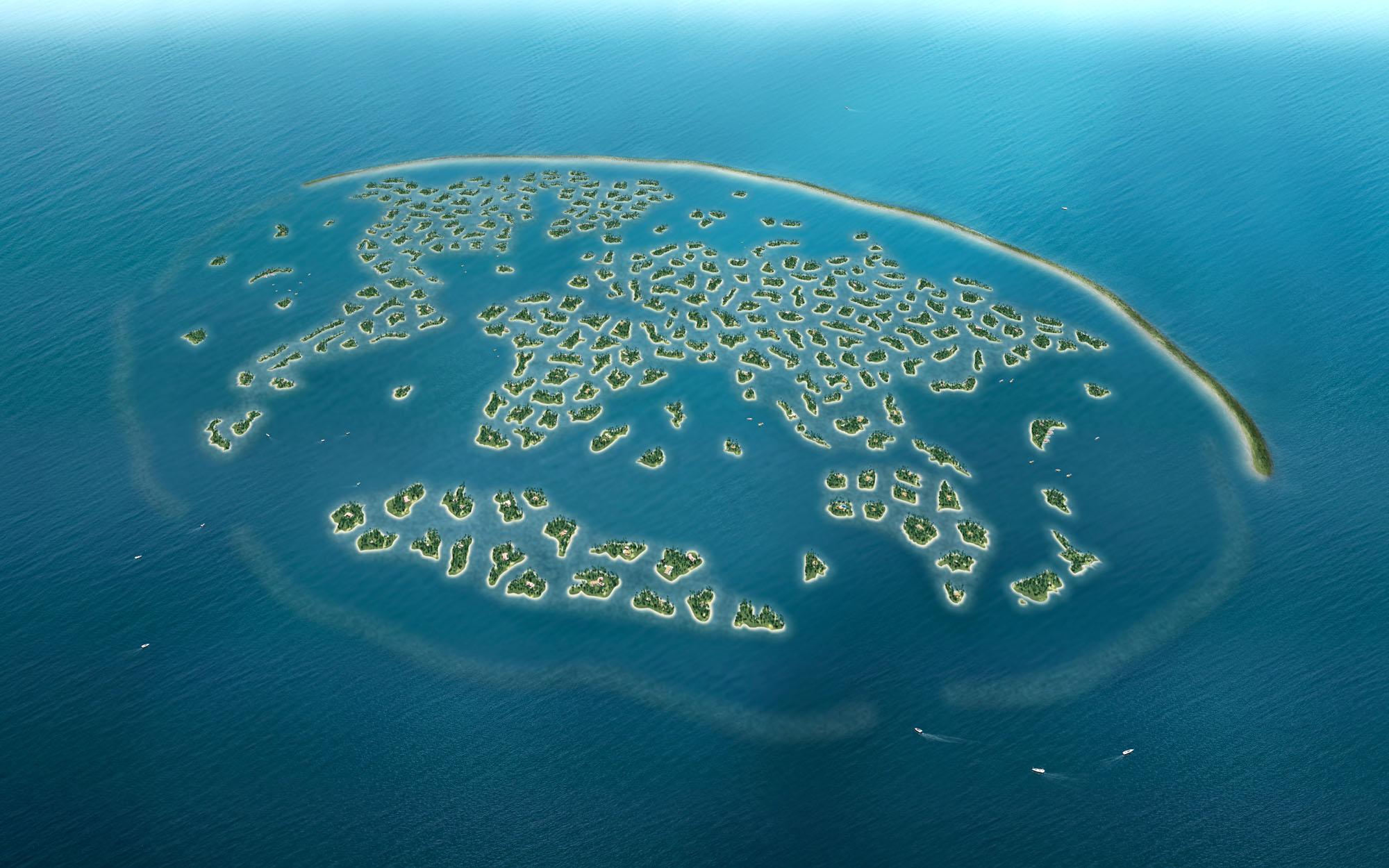
The World Islands, Dubai

This artificial archipelago of small islands was dreamt up by Sheikh Mohammed bin Rashid Al Maktoum, the ruler of Dubai, to look like the map of the world. And his hope was to turn the World Islands into the playground for the rich and famous. Construction of the 300 islands — made entirely of dredged sand — began in 2003. But when the financial crisis in the real world, it brought production of this $14 billion-dollar fantastical world to a halt. To date only two of the islands have come to fruition.

The World Islands, Dubai

It looks cool but it is hard to imagine (1) how much money and work it would take to finish such a project and then (2) who might purchase all of these unique properties.

But, if it did all go forward:

1. Who would purchase what spots in the world? Who wants the awkwardly placed Antarctica?

2. Does the development allow connections between the locations? How about bridges only where Risk lines are drawn?

Plans for a temperature controlled, 48 million square foot indoors “city” in Dubai

The building boom in Dubai continues with plans to build a massive indoor city:

united arab emirates’ vice president and prime minister, sheikh mohammed bin rashid has announced the world’s first temperature controlled city to be constructed in dubai. the vast 48 million square foot project, entitled ‘mall of the world’, will contain the planet’s largest shopping mall and an indoor theme park covered by a retractable glass dome that opens during winter months…

envisioned as an integrated pedestrian city, seven kilometer promenades connect the design, bringing together a wide variety of leisure, retail and hospitality options under one roof. a cultural district forms the hub of the site, with a dedicated theater quarter comprising a host of venues. the ‘celebration walk’ modeled on barcelona’s las ramblas will connect the district with the surrounding mall containing a range of conference, wedding and celebration halls.

The pictures are quite interesting. The scope of the project raises several questions:

1. At what point does an indoor space transition from being a mall to being a city? Others have proposed towns or cities within buildings (even immortalized in arcologies in SimCity). But, this development is clearly within Dubai and the comments from officials indicate it is closely tied to tourism. So, it doesn’t quite sound like a city unless you want to make it sound more impressive.

2. With the emphasis on tourism, just how authentic will this space really be? If this is just for tourists, that is a lot of space to maintain and make exciting. If it is more mixed-use and include residential units, then some genuine street life could develop. Put differently, is this a Dubai version of the Las Vegas strip or something different?

Regardless, if this all is completed, it would be a sight to behold.

The public to ride the mail delivery system once used under London

The Post Office Underground Railway once used below London is set to open soon to the public:

The Post Office Underground Railway—AKA the Mail Rail—was the world’s first driverless electric railway. It launched in 1927 and was used to transport tons of post from one side of London to another, with stops at large railway hubs such as Liverpool Street and Paddington Station, where post could be collected and offloaded for transportation around the rest of the country…

The idea is to create special battery-powered passenger carriages to take people from the car depot and some of the tunnels in a one-kilometer loop. Visitors will be taken 70-feet underground, through Mount Pleasant Station, and will stop to view audiovisual displays recounting the history of the network and what it was like to work down there…

The railways have a 61cm gauge (the width of the track), on top of which small carriages traveled without drivers thanks to electric live rails. In the stations there are two tracks, with carriages going in each direction.

The service continued to operate until 2003, when it was closed down—it had become much cheaper to transport mail by road.

Looks like a cross between a Disney ride and the Tube. I suspect there may just be a tourist market for this ride…see this post from April 2011 about people exploring the system as well as the interest in looking at underground Paris.

Such lines underneath cities may not be all that unusual. Chicago had an underground delivery system as well since it was far more efficient to move some items underground away from the street-level traffic. This was also the impetus behind creating Lower Wacker Drive. How many major cities have such tunnels underground, how many of them are well secured (free from ne’er-do-wells or flooding issues), and are these all tourist opportunities waiting to be opened?

Exploring the meanings of Chicago’s underground Pedway

A Chicago artist and teacher has spent years exploring and analyzing Chicago’s large underground Pedway:

You want to know the best thing about the Chicago Pedway? It’s not that, despite this Polar Vortex winter, you can cover almost 40 city blocks on the Pedway without ever stepping foot outside. It’s not that the Pedway began modestly in 1951 and now stretches through the North Loop, jogs beneath Millennium Park and ventures as far east as the mouth of the Chicago River. It’s not that the Pedway could be regarded as a kind of yardstick of municipal progress, always seeming as though it might extend just a little bit longer someday. It’s not even that the Pedway’s generally mundane, charm-free hallways offer little to see — look, another “For Rent” sign! — and therefore it works perfectly as a daily treadmill for ambulatory meditation…

Where you see putty-colored corridors leading to a job in a cubicle farm, she sees dreams of the American frontier. You pass convenience stores selling gum; Tsen, 38, a native of Cambridge, Mass., passes through a long, winding metaphor for a Chicago never realized — “the by-product of projected futures,” she writes in “The Pedway of Today,” her new, perversely compelling guidebook/consideration of the Pedway’s cultural meanings.

Indeed, Tsen, a graduate of the School of the Art Institute of Chicago and photography/video teacher at Wilbur Wright College on the Northwest Side, has come to see the longtime walkway as her canvas. About four years ago, the Chicago artist — and former Wendella Boat tour guide, who says travel and The Path Not Taken have become the preoccupations of her art — began offering tours of the Pedway (she has since stopped). But she never charged her audiences, she said, because the tours would also quietly double as performance art, as free-associative strolling lectures in which your guide (Tsen) would dole out not dates or landmarks but thoughts on Jules Verne, revolving doors and how the Pedway is like Florence…

Eventually she stumbled across an entrance to the Pedway in the back of the Renaissance lobby, the path itself so low-key that you can see it every day without quite recognizing it. “The Pedway struck me not as the frontier that I had been looking for but a reminder of the glamour of early cities and a promise of future frontiers.” At this point in her guide Tsen asks readers to imagine that it’s 1893 and — though the Renaissance was built a century later — they are relaxing in the lobby before returning home from the World’s Fair, where they “attended Frederick Jackson Turner’s fabled lecture ‘The Significance of the Frontier in American History’ … still pondering his words: ‘The frontier has gone, and with its going has closed the first period of American History.”

Sounds like a very interesting and interpretive tour. All sorts of large infrastructure and urban projects would benefit from people who know them well enough and are enthusiastic about what they offer to share it with others.

If Chicago tried to advertise the Pedway more, would regular users complain that too many tourists are clogging the passages a la New Yorkers and the subway?

“Chicago’s RIverwalk To Be the Next Times Square?”

The City of Chicago just announced what it desires for its Riverwalk:

In the Mayor’s attempt to turn the Chicago Riverwalk into Times Square Jr. or Hong Kong Lite, the city may soon be installing some new lights. A lot of lights. The Mayor wants to boost tourism in the city by 10 percent, or attract 55 million annual visitors by 2020 and thinks that adding a light show to the city would be the key. The lights are intended to highlight Chicago’s architecture and skyline, but also to open up tourists’ wallets by extending the day into night.

This “bright” initiative, headed up by the president of Broadway In Chicago, will start with an international call for submissions. Plans show that the lights won’t only be noticeable in the loop, as the Mayor’s vision is to expand the project into the neighborhoods. Perhaps some think Chicago’s world famous architecture can’t speak for itself.

More on the plans:

“It will make nighttime in Chicago an experience unto itself. It will make us North America’s city of lights. People will come from far and wide to see what we’ve done and enjoy our city,” Emanuel told a clout-heavy audience at the Museum of Science and Industry.The light-up Chicago initiative is being spearheaded by Lou Raizin, president of Broadway in Chicago.

If artists, architects and engineers “work together as teams,” Raizin said he’s certain they will find ways to use Chicago’s world-renowned architecture, the city’s iconic bridges, Lower Wacker and the river itself as a “canvas” to “imagine lighting in a unique and different” way.

“It’s about creating a spectacle that winds up allowing us to be sensitive to the assets that we have, but making a pivot that takes the old guard to the vanguard. It’s not just washing a building with light. It’s about creating theater. It’s about engaging. It’s not just color. It’s three-dimensional. It’s really creating events in light,” Raizin said.

One can only hope this is done tastefully and doesn’t turn out to be garish. But, there is a lot of potential with the riverwalk and I’m still surprised it has taken this long to do much. This may seem particularly odd since since Chicago has a long history of protecting land along Lake Michigan. Yet, the city has never quite respected the river in the same way as the lake. The river has always been much more functional: a connection to the Mississippi or a place to dump sewage. Perhaps the lights indicate a new era might soon begin…

What foreign governments say to warn their citizens about Chicago and other big American cities

Here is a brief look at what some other countries say about American big cities in order to warn travelers:

Well, just as State warns Americans about dangerous places to travel, so too do foreign ministries in other countries — and some countries warn their citizens to avoid heading to certain cities in the U.S. France, in particular, warns travelers to be careful in a large number of specific cities…

Chicago: Stay away from the West Side and anywhere south of 59th Street…

Boston: Avoid walking at night in Dorchester, Mattapan and Roxbury, and be wary of “petty crime” in Chinatown, the North End and Fenway.

New York: Be wary in Times Square and at the Statue of Liberty, and don’t go to Harlem, the Bronx or Central Park at night.

Washington: Northeast and Southeast should be avoided, and Union Station is dangerous at night. “Le quartier Anacostia n’est pas recommandable de jour comme de nuit.” Translation: Don’t go to Anacostia, day or night.

Interesting instructions that seem to be based around avoiding poorer or higher-crime areas of big cities. Perhaps the better question is how many Americans would give the same instructions to family members or friends.