Increased demand for airport lounges is a sign of elite overproduction?

More travelers want to use airport lounges. Does this signal a broader problem in society?
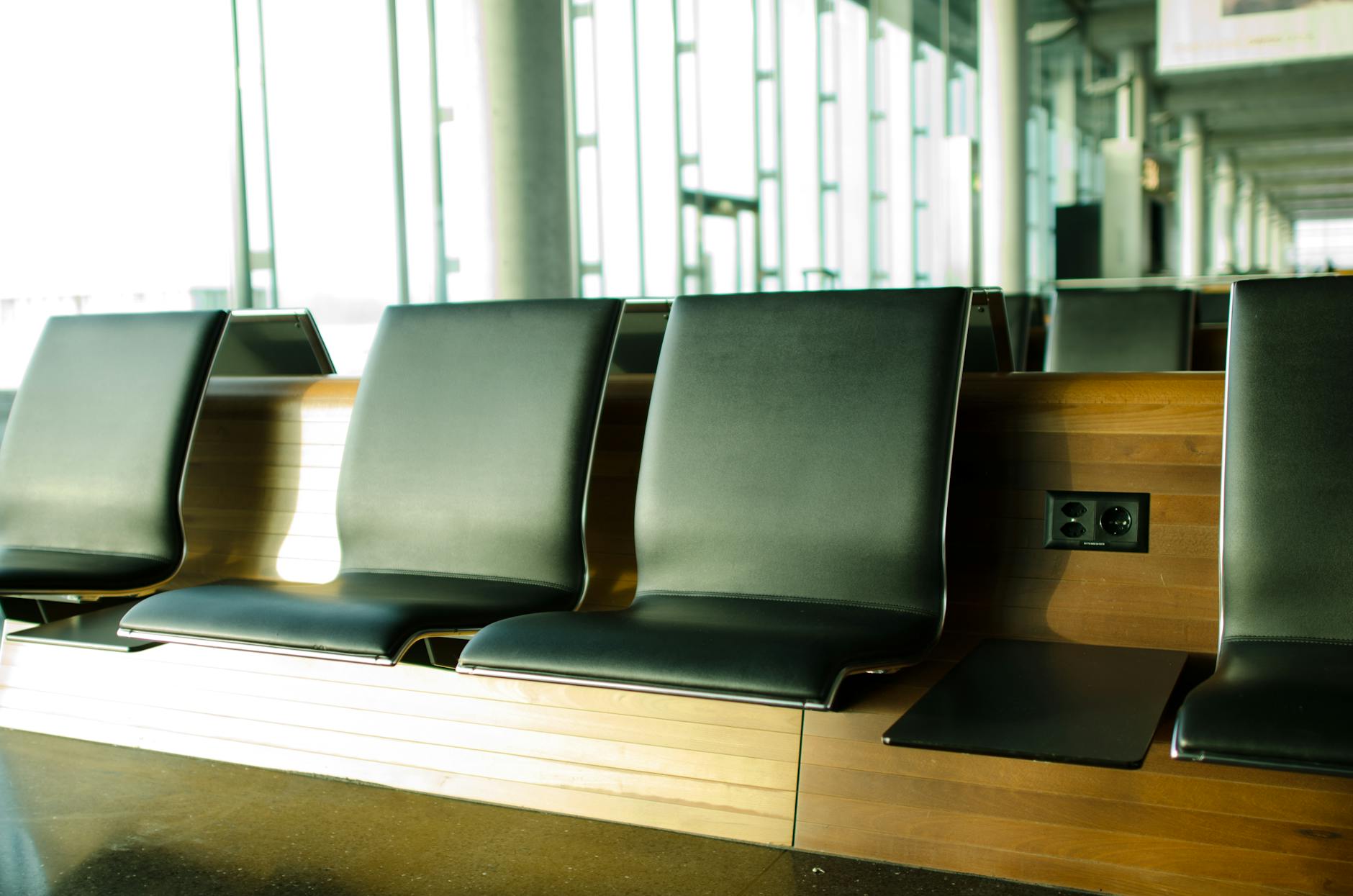
Photo by Download a pic Donate a buck! ^ on Pexels.com

In the context of airport lounges, the “elite” are not just the ultra-wealthy, but the vast upper middle class—armed with a combination of higher degrees, status, and premium credit cards—now jostling for the same perks. But what if much of society has been turning into some version of an overcrowded airport lounge?

In an interview with Fortune Intelligence, Turchin said this theory makes sense and fits with his thesis when presented with the similarities. “The benefits that you get with wealth are now being diluted because there are just too many wealth holders,” he said, citing data that the top 10% of American society has gotten much wealthier over the past 40 years. (Turchin sources this statement to this working paper from Edward Wolff.)…

When asked where else he sees this manifesting in modern life, Turchin said “it’s actually everywhere you look. Look at the overproduction of university degrees,” he added, arguing that declining rates of college enrollment and high rates of recent graduate unemployment support the decreasing value of a college diploma. “There is overproduction of university degrees and the value of university degree actually declines. And so the it’s the same thing [with] the lounge.”

Noah Smith argues that elite overproduction manifests as a kind of status anxiety and malaise among the upper middle class. Many find themselves struggling to afford or access the very symbols of success they were promised—be it a prestigious job, a home in a desirable neighborhood, or, indeed, a peaceful airport lounge. He collects reams of employment data to show that Turchin’s theory has significant statistical support from the 21st century American economy.

The article suggests an increased number of travelers can access airport lounges and this hints at more people with money to spend. But I wonder how these other factors play in:

  1. Different standards of living. How do expectations shift over time about accessing airport lounges or other luxury goods? How many other goods or services over time have moved from luxury goods to being available to masses of people?
  2. Expectations about travel. A standard Internet narrative goes like this: airplane travel was once luxurious (forget the slow speeds). Then it became a mass phenomena and customers were treated poorly. Are airport lounges a way travelers are reclaiming a better travel experience?
  3. The airlines helped create this demand by introducing this perk; now they are surprised it is popular? Do they want it to remain exclusive or do they want more travelers to access lounges (and then the airlines benefit further)? Put another way: did customers want this first or did airlines push the lounges?
  4. Why not offer an upgraded experience for all travelers? Does this not generate as much revenue or status for the airlines?

If Delta is able to figure out how to make the lounge “work,” would their practices then translate to other areas of society?
Chicago suburb Oak Park named in list of global places to visit in 2025

On the Travel Lemming list of “Our 50 Best Places to Travel in 2025,” one suburb makes the list of global destinations:

Photo by Element5 Digital on Pexels.com

At first glance, you may think that Oak Park is nothing more than an affluent suburb of Chicago. But it’s so much more.

Stunningly beautiful, Oak Park is the birthplace of American author Ernest Hemingway. Meanwhile, prominent architect Frank Lloyd Wright lived and worked here. A casual stroll around the suburb will take you past numerous examples of his work.

Come in the fall to watch or run in the Frank Lloyd Wright races. These 5K, 10K, and youth mile races weave through some of the suburb’s most notable architecture.

Even among this global range of destinations – cities, natural spots, beaches, mountains, etc. – this one suburb stands out. It may be the only suburb on the list. Oak Park is unique in several ways. As noted above, it does have some unique architecture and the ability to learn more about Frank Lloyd Wright. Hemingway was born there. It is also a suburb that has pursued racial and ethnic diversity for decades.

At the same time, is one reason an American suburb could make such a list is that visitors get to experience a suburban lifestyle? If they went to Oak Park, beyond some of the unique features discussed above, would they have a sense of what American suburban communities are like?

What other American suburbs might make a global list of top travel destinations?

Thanksgiving travel to set records this year – because there are more people in the first place?

At Thanksgiving each year come the stories about how many millions of Americans are going to travel for the holiday. But is this partly because there are more people in the country? From the story first:

Photo by Oleksandr P on Pexels.com

Just as sure as the turkey will taste dry, airports and highways are expected to be jam-packed during Thanksgiving week, a holiday period likely to end in another record day for air travel in the United States…

Auto club and insurance company AAA predicts that nearly 80 million Americans will venture at least 50 miles from home between Tuesday and next Monday. Most of them will travel by car…

The Transportation Security Administration expects to screen 18.3 million people at U.S. airports during the same seven-day stretch. That would be 6% more than during the corresponding days last year but fit a pattern set throughout 2024.

The TSA predicts that 3 million people will pass through airport security checkpoints on Sunday; more than that could break the record of 3.01 million set on the Sunday after the July Fourth holiday. Tuesday and Wednesday are expected to be the next-busiest air travel days of Thanksgiving week.

What could be other possible reasons for increased travel? Some options:

  1. Cheaper prices to travel and/or more money travelers are putting toward it. Are flights cheaper this year than in the past?
  2. The timing of Thanksgiving. The article hints that it might be different this year because Thanksgiving is so late. Does this happen every time Thanksgiving is later?
  3. An increased emphasis on or interest in visiting family.

If the media is going to report that more people are traveling, how do we know it is not just because there are more people? The US Census Bureau population clock says there are more than 337 million people in the United States now and there were more than 331 million in 2020.

The states and cities with restricted activity with other states and cities

I recently found a description of the states and cities limiting their activity with other governments/places within the United States:

Photo by cottonbro on Pexels.com

At least six states and the District of Colombia over the last six years have prohibited their employees from taking work trips to states with laws that, in their view, discriminate against lesbian, gay, bisexual, and transgender people. California’s prohibition is by far the most sweeping, barring state-funded travel to nearly half the country: 22 states, including four additions – Arizona, Indiana, Louisiana, and Utah –last week.

California, Connecticut, Minnesota, New York, Vermont, Washington, and the District of Columbia all have sought to financially pressure several other states in some form or another – creating a confusing patchwork of bans, with some states lifting previous travel bans on other states, such as Indiana, that revise laws applying to the LGBTQ community after a national or statewide uproar…

After witnessing the impact on Indianapolis, several mayors of liberal cities, including New York, the District of Columbia, San Francisco, Seattle, Minneapolis, and others sprang into action. They announced bans on city-funded travel to North Carolina amid a national backlash over House Bill 2, which prevented transgender people in the state from using bathrooms aligned with their gender identity. North Carolina lawmakers quickly devised a compromise that helped convince collegiate sporting events to return to the state. Still, several big-city mayors kept a ban on employees traveling there.

Add this to the actions of private actors and you have interesting geographic conflicts across the United States.

It is less clear what these travel restrictions lead to in the long run. Does this connect to lower levels of geographic mobility among American residents as a whole? Is it part of “the big sort” by political affiliations and commitments? Does it lead to social networks that skip over some geographies and not others? How does it fit with the urban/rural divide in politics and each spaces sense of place and country?

New York City, Los Angeles on different COVID-19 trajectories

To this point, COVID-19 has had different effects in the two most populous cities in the United States:

Public health officials are keeping a wary eye and warning that LA could end up being as hard hit as New York in coming weeks, in part because a planned increase in testing may uncover a dramatic surge in cases. Testing in Los Angeles County is expected to increase from 500 per day to 5,000 by the end of the week…

In both cities, schools have been canceled, many businesses shuttered and employees who can have been ordered to work from home. New York City, with roughly 8.5 million residents, had nearly 45,000 cases and at least 366 deaths as of Friday, according to a tally by Johns Hopkins University. Los Angeles County, which contains its namesake city of 4 million people plus an additional 6 million residents, had nearly 1,500 cases and 26 deaths.

Health experts don’t know why there is such a big difference in the number of cases, but believe several things could be at play, such as urban density, differences in the use of mass transportation and slightly earlier moves by authorities to enact social distancing policies. A difference in the speed and amount of tests could also be factors, as officials warn that many people who get COVID-19 don’t necessarily have symptoms…

While a shortage of tests in California during the early weeks of the crisis is one reason for a much lower number of cases, it doesn’t alone explain the difference. New York has tested about three times as many patients, but it has 10 times as many cases as all of California.

There are a lot of possible moving parts (and combinations of these) that could explain the differences. I’m guessing there will be a lot of interesting research that comes out eventually that examines the interaction between place (and all the factors associated with that) and both the spread and consequences of COVID-19. The virus may spread to all areas eventually but the early stages suggest some differences across places.

Let’s say future research finds some differences between locations not just related to policies but to fundamental features of physical space such as density, mass transit use, and levels of social interaction. Will places be willing to change their behavior for the potential of a pandemic? In a world where locations brand themselves and look to attract residents and businesses (recent example), could traits that mean less exposure to infectious diseases represent a selling point?

One factor that I do not see mentioned in this article is the rate of travel in and out of each of these cities. Both are very important places located on coasts that experience a lot of travel in and out as well as much mobility across the region. But, does New York’s location in the the Northeast corridor matter and does New York City have significantly higher rates of global interaction and trade?

A predicted 1 billion international tourists in 2012 illustrates global mobility

The UN suggests international tourism will hit a new high in 2012:

The U.N.’s World Trade Organization says 1 billion people will cross international borders as tourists this year for the first time…

That figure would be about 4 percent higher than last year’s total. Back in 1950, the figure was 25 million. The UN counts only people who stay at least one night. It does not include cruise ship passengers.

“It is quite iconic when you realize 1 billion people crossed borders,” Vogeler said at a Caribbean Hotel and Tourism Association conference in Puerto Rico. “It shows from a sociological point of view how things have changed. If you go back 20-30 years, many people would die without traveling more than 100 miles from home.”…

The organization also projects that there will be 1.4 billion in 2020 and 1.8 billion in 2030.

Some of the sociological factors behind this:

1. More people with income that allows them to travel internationally. Such travel is not cheap but with rising incomes and a growing middle class in developing nations, there are more people who can travel. In other words, more people can afford to travel.

2. A growing cultural emphasis on the value of tourism and seeing different parts of the world. Perhaps part of this is due to more widespread information about other parts of the world. Or perhaps it reflects an idea that a well-rounded person is an international traveler. Regardless of the specific reason, this would mean more people want to travel.

Of course, other factors like cheaper and quicker transportation matter as well as a growing interest many countries (and cities) have in growing their economies through tourism and “selling” their attractions to visitors.

On the whole, I imagine the United Nations would want to promote this quite a bit. More international travel suggests more money will be flowing across borders and more international understanding is possible.

A world where people can travel between any two cities in two hours

Basic modes of transportation have not changed much in the last half-century. Sure, planes are bigger, cars are more fuel efficient and have more features/gadgets, and trains can go faster. But harnessing space travel could make it possible to move between any two cities in the world in two hours:

Michiel Mol, 42, a Dutchman who co-owns the Force India Formula One team and made his fortune in computer software, said over the weekend, “Being able to travel from London to Sydney in an hour and 45 minutes, that is the future. It is also the reason why KLM joined our firm [Space Expedition Curacao, or SXC] as a partner.”…

Mol intends to follow [Sir Richard Branson] in early 2014 and says he has already sold 35 tickets at $93,000 for flights from the Caribbean island of Curacao. Regulatory approval is still under negotiation…
Passengers, who will be entitled to call themselves astronauts if they reach an altitude of 62 miles (100km), will be required to pass physical tests which he says are no more stringent than would be expected of an air steward. The first generation spaceship will travel at 2,200mph (3,540kph), but the second generation will need to reach a velocity of 13,750mph (22,100kph) to achieve the desired orbit…
“Flying from London to Barcelona would still take an hour or so while London to Tokyo would be about one hour and 30 minutes and London to Sydney, one hour and 45 minutes. “

This sounds like something different than just space tourism where wealthy people take off, float weightless for a short while, snap some pictures of the earth while in a quick orbit, and then descend. This could be the basis for a new transportation system that makes traveling from New York to China just like a drive from Chicago to Milwaukee. It would take some time to set up a viable system, to put the infrastructure together, but this would be a big step forward from the Dreamliner and high-speed rail.

Is this the physical answer to the “instant” connectedness of the Internet? Currently, it still takes a decent amount of time to travel between major cities but it is still valuable for business, politics, and deeper relationships.

Beyond space commuting, what could be quicker? A mass-produced flying car? Teleporting?

And Americans vote again for the automobile

Surveys from AAA suggest Americans will be traveling by car in record proportions for Thanksgiving:

Next week, 94 percent of Thanksgiving travelers nationally are expected to drive — up from 86 percent in 2008 and 80 percent in 2000, according surveys conducted by AAA.

The air-travel share is projected at 3.8 percent this Thanksgiving, the lowest figure in a decade. Air travel accounted for 13 percent of Thanksgiving travel in 2000, AAA said.

A quick interpretation might be that people are fed up with airport security. But interestingly, these surveys were conducted before the TSA announced more intrusive search procedures:

AAA officials noted that the data on Thanksgiving travel, which are based on the plans of people surveyed, were collected before the TSA announced it was switching to more intensive pat-downs of airline passengers and increased use of the full-body scanners.

“Those folks who said, ‘I’ve had it with the airport hassle and I’m traveling by auto,’ did so before the TSA’s new rules were put in place,” said Beth Mosher, spokeswoman for AAA Chicago. “We’ve seen a lot of people grousing. It’s hard to say if people will eventually get used to the changes. We’ll know more once we see Christmas travel numbers.”

I haven’t seen these survey figures and whether they ask people specifically why they chose the travel mode they did.

But I’ll quickly offer another take: Americans don’t need much of an excuse to travel by car. Our love affair with the car (or more appropriately for family travels this weekend, the SUV or minivan) is well-established and could be an important factor in this story. Ultimately, travel within a certain radius (roughly 6-14 hours of driving one way) could either be done by airplane or car (or as some hope, by faster trains in the future). Certain factors, such as ticket prices, weather, availability, gas prices, and other odd factors, such as new airport security measures, can push people back to their vehicles which they might have been reluctant to leave behind anyway.

The importance of perceptions: thinking about the golden age of flying

There seems to be a lot of grousing about air travel these days, particularly with a flood of recent stories about full-body scanners and more aggressive pat-downs. These complaints raise a question: is flying today more troublesome and less glamorous than in the past? Some experts say today is actually the golden age for flying:

Whether it’s fees, crowded planes, no food or surly service, people will complain about the current state of air travel.

They’ll talk wistfully about the good old days of flying, of a bygone era when a glamorous stewardess delivered white-glove service with a smile, they had meals with real silverware and a courtesy cocktail was offered free on such carriers as Pan Am, TWA, Braniff or Eastern.

The so-called golden age of air travel in the 1950s, ’60s and ’70s has passed, they’ll say, just as those airlines have.

But has it? No, say some veteran fliers and industry analysts. With historically affordable fares to nearly everywhere, greater options for service if you’re willing to pay, and new information and entertainment technology, there’s never been a better time to fly, they say.

So some experts that suggest by some objective measures, such as price and service level, flying is now better than it was in the past. But the issue really seems to be whether passengers feel that this is the case. And this is what matters for airlines – if potential customers perceive that flying is difficult and then choose other forms of travel, these perceptions are real indeed.

What could be going on here? A few thoughts:

1. Memories and nostalgia are tricky things. People can romanticize the past and forget the troubles they experienced then.

2. Some of the security procedures instituted after 9/11 seem to irritate people. It adds an extra level of hassle and can make people feel like they are not trusted. On the other hand, there has not been a major airline incident in the US since 9/11.

3. Service and entertainment options may have increased but perhaps passengers expect even more. Does having more entertainment options offset sitting in cramped airplane seats?

4. I would be curious to know how many people actually enjoy flying versus feeling that it is the best, or perhaps only, transportation option to get them where they want to go.

h/t The Infrastructurist

Extra airline fees are here to stay

All those fees recently enacted by airlines are adding up and they are likely here to stay. The Chicago Tribune reports that ancillary revenues reached $13.5 billion in 2009. United Airlines led the way by collecting $1.9 billion.

On our recent trip to California, we paid $25 a piece for two bags on each leg of our American Airlines flight. The fares were reasonable – but adding on the extra $100 for luggage squelched any joy produced by finding a decent deal.