Four options for road diets

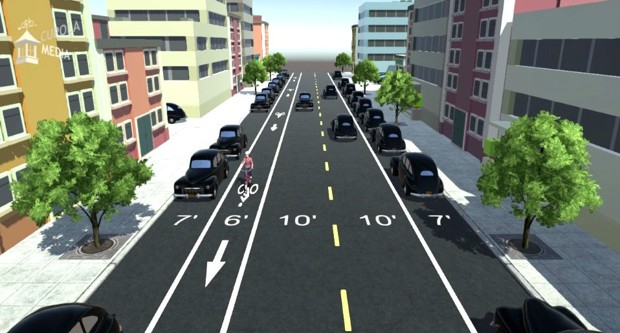
Watch planner Jeff Speck explain how four different road diet strategies might work. Here is an example of one approach:

40-footer lane insertion

(Jeff Speck / Spencer Boomhower)

This time we focus on a 40-foot street with two 12-foot lanes of opposing traffic and two parking lanes at the curb. Many cities have adopted 12-foot lanes with the assumption that they move more traffic; in fact, as Speck has argued at CityLab before, they present a major safety hazard for cities by encouraging faster driving. He recommends slimming them down to 10 feet—a design configuration that leaves room for a bike lane and makes the street safer, even as it more or less preserves traffic flows.

This is a reminder of some of the paradoxes of road design. Provide bigger lanes and more lanes and cars tend to drive faster and traffic increases. Narrow the lanes and drivers have to slow down and pay more attention, leading to improved safety. And all of this might actually free up space for other uses – like bike lanes or more pedestrian space.

If you want more on such techniques, read Speck’s Walkable City.

Planning bicycle-only highways in Munich

Officials are looking into constructing 400+ miles of highways for bicycles:

The ambitious plan calls for a network of 14 two-way bike paths, each 13 feet wide and fully segregated from automobile traffic, that would spread out over an area of about 400 square miles. No crossroads, no traffic lights. It’s an autobahn for cyclists, or, as the Germans obviously call it, a Radschnellverbindungen

The Radschnellverbindungen is designed to do for bikes what highways do for cars: make traveling long distances more efficient and pleasant. Cyclists will be able to ride at about 12 mph, Kastrop says, without the need the need to slow down then get back up to speed at intersections. There are no nearby cars to worry about, and with wider lanes, you don’t risk getting stuck riding single file behind some slowpoke…

This idea of networks made for bike commuting has been catching on lately. As usual with this kind of thing, the Netherlands is out in front, with 28 long-distance, cyclist-only paths, according to City Lab. London’s planning a network of “direct, high capacity, joined-up cycle tracks.” Copenhagen’s got a “bike skyway.” Paris’ $160 million plan to boost cycling includes five proposed “highways” that will be almost entirely protected from car traffic, on some of the city’s biggest corridors, including the Champs-Elysées.

Building the Radschnellverbindungen’s not a done deal yet. Local authorities must approve the project before construction starts, and it won’t be cheap. The German newspaper Süddeutsche Zeitung pegs the estimate at $1.75 million per mile.

Three quick thoughts:

1. It would be interesting to see what it takes to plan such paths around existing infrastructure like roads, rail lines, power lines, and other obstacles. To not have any interruptions on the paths could require some ingenuity.

2. Would bicycle highways require their own rules of the road or traffic laws? You don’t want riders in the middle of the paths or riding three abreast. What happens when needing to make an exit from the path?

3. If you are curious about the cost per mile of construction, one group estimates it costs $8-10 million per mile of highway construction in urban areas.

Early American urban planning at the Boston Common

Several weeks ago we visited the Boston Common which has this plaque located at its eastern corner:

BostonCommonPlaque

Established in 1634, the Boston Common provided common space for grazing and later served as a military camp, site for public hangings, place for public assemblies and speeches, and a major urban park. But, it is hard to imagine central Boston without this large open space. What would it be otherwise – more space for office buildings and residences? To have it set aside at an early date and originally toward the edge of the city just like Central Park looks quite prescient today. Having the city grow up “organically” around it also helped compared to new cities and major developments where parks may be planned but have a difficult time developing a welcoming atmosphere. (Perhaps this is where Jane Jacobs’ ideas about parks needing more than just existence to be successful could be useful.)

Although this area isn’t really nature (too much ongoing human interference), it still is a welcome respite from the activity all around it. Indeed, urban parks like these really do help make cities all that they are even if they might be “negative space” in their lack of buildings.

Argument: regionalism = “play[ing] Sim City with residents’ lives”

One critic charges new regional plans in Minneapolis-St. Paul threatens a democratic way of life:

Here in the Twin Cities, a handful of unelected bureaucrats are gearing up to impose their vision of the ideal society on the nearly three million residents of the Minneapolis-St. Paul metro region. According to the urban planners on the city’s Metropolitan Council, far too many people live in single family homes, have neighbors with similar incomes and skin color, and contribute to climate change by driving to work. They intend to change all that with a 30-year master plan called “Thrive MSP 2040.”…

While minority residents have been streaming into the Twin Cities’ suburbs for the past 15 years, the Met Council wants to make sure there is a proper race-and-income mix in each. Thus it recently mapped every census tract in the 2,800 square-mile, seven-county region by race, ethnicity and income. The purpose was to identify “racially concentrated areas of poverty” and “high opportunity clusters.” The next step is for the council to lay out what the region’s 186 municipalities must do to disperse poverty throughout the metro area…

The Thrive plan’s most radical element may be to evaluate all future development policies through the “lens” of climate change. Over time, this could give the council a license to dramatically remake the entire metro area…

Once implementation begins, however, Twin Cities residents will likely realize that Thrive MSP 2040’s centralized decision-making and Orwellian appeals to “equity” and “sustainability” are a serious threat to their democratic traditions of individual liberty and self-government. Let’s hope that realization comes sooner rather than later.

This is an argument several conservatives (another example here involving the UN) have made in recent years: the government wants to use urban planning as a means to control people’s lives, forcing them to live in denser areas with people they would not choose to live near. It violates property rights, individual liberty, local government, etc.

Here is an issue with these arguments: they tend to ignore the real issues present in metropolitan areas that involve both cities and suburbs. Adopting a free-market approach to planning, growth, and mobility leads to the outcomes we have today: ongoing residential segregation (both by race and class, affecting everything from school districts to health outcomes to location mismatches between employees and jobs), a lack of affordable housing, local governments that are numerous (and possibly inefficient), often can’t agree with each other and thereby hold up helpful projects or promote unhelpful competition (like a race for the bottom in tax breaks), transportation options that are expensive (whether maintaining a car or trying to make mass transit work in the suburbs), and a general defensive crouch of not wanting to deal with any problems outside of one’s immediate community. All of this reinforces existing inequalities in society: those with resources can afford nicer communities while those with less live in places where it is more difficult to move up.

Is there some middle ground here? To be honest, government is already heavily involved in local and regional decisions and conservatives probably like some of this (such as zoning). And some of the regional options allow for higher levels of efficiency by leveraging certain resources in effective ways. Maybe the real issue is that few residents of urban areas – whether conservative or liberal – want to live near public housing or affordable housing and/or want to retain the right to use their money to move to a more advantageous location should something not work out (like the neighbors).

As a final note, earlier versions of SimCity didn’t allow much control over the lives of individual residents. Similarly, the game was geared toward more urban environments as sprawling communities were more costly and didn’t provide the kind of density that would lead to better things.

Identifying the pockets of carless Chicagoans

With more Americans living alone and significant transportation costs for middle-class Americans, where do the carless Chicagoans tend to cluster?

So where do those carless Chicagoans live, and how many of them are there? A lot, it turns out. If you break down Chicago by cars and household size using 2012 census numbers, these are the only groups of more than 100,000:

One person, one vehicle 193,174
One person, no vehicle 168,004
Two people, one vehicle 135,143

Along the northern lakefront, around half the households don’t have a car; there are pockets in the Near North Side and Lake View over 60 percent. In one Edgewater tract, it’s over 70 percent. It’s not the highest percentage, though—there are two tracts in one of the poorest stretches of the South Side, between U.S. Cellular Field and 47th Street along the Dan Ryan, above 80 percent.

As you move north and west and the city gets less dense, the percentage of carless households drops off. There’s an exception, though: one tract in Logan Square, adjacent to the California Blue Line stop, where 41 percent of households don’t own a car. The “twin towers” transit-oriented development that’s going up at 2293 N. Milwaukee, and causing controversy as it goes, will live right next to that tract.

If I had to guess, this is related to income, age, more expensive parking options (for example, having to pay for a garage spot as opposed to plenty of street parking), and housing types (single-family homes which are more attractive to families versus apartments, condos, etc.). How well would these clusters line up with where the Creative Class lives?

The headline suggests that this is has led developers to respond with what they are proposing and building. Yet, the article doesn’t say much regarding these changes. For example, how about more shared streets like have been proposed for a few spots in Chicago? How about more bike lanes in these areas? How about more high-rise housing? If these population clusters hold and developers are indeed responding, these could be very unique places in a few decades.

Translating communism into urban design principles

Here is a look at how the Soviet Union designed cities:

With this assumption, Soviet planners made some logical steps to promote density. They built nurseries and preschools as well as theatre and sports halls within walking distance to worker’s homes.   Communal eating areas were arranged. Also, wide boulevards were crucial for marches and to have a clear path to and from the factory for the workers. The goals of the “socialist city” planners were to not just transform urban planning but human behavior, helping such spaces would breed the “urban human”…

Alexei Gutnov and his team set to create “a concrete spatial agenda for Marxism”. At the center of The Communist City lay the “The New Unit of Settlement” (NUS) described as “a blueprint for a truly socialist city“. Gutnov established four fundamental principles dictating their design plan. First, they wanted equal mobility for all residents with each sector being at equal walking distance from the center of the community and from the rural area surrounding them. Secondly, distances from a park area or to the center were planned on a pedestrian scale, ensuring the ability for everyone to be able to reasonably walk everywhere. Third, public transportation would operate on circuits outside the pedestrian area, but stay linked centrally with the NUS, so that residents can go from home to work and vice versa easily. Lastly, every sector would be surrounded by open land on at least two sides, creating a green belt.

Gutnov did acknowledge the appeal of suburbia — “…ideal conditions for rest and privacy are offered by the individual house situated in the midst of nature…”, but rejected the suburban model common in America and other capitalist countries. Suburbs, he argued, are not feasible in a society that prioritizes equality, stating, “The attempt to make the villa available to the average consumer means building a mass of little houses, each on a tiny piece of land. . . . The mass construction of individual houses, however, destroys the basic character of this type of residence.”

The author is insistent on comparing these to current planning practices but let’s be honest: all urban planning is based on some sort of ideology. Many Americans may prefer suburbs to these Soviet cities but suburbs have their own logic based around private property, individualism, and local control. In other words, neither Soviet cities or American suburbs “just happen”; there are a series of historical events, decisions made by key leaders (often in government and business), and meanings that contribute to particular spatial landscapes.

Shopping malls have to renovate and adapt in order to survive

Even successful shopping malls like Woodfield Mall in Schaumburg have to innovate in order to stay relevant:

With shopping habits having been permanently reshaped by memories of the recession and the availability of new technology, traditional malls like Schaumburg’s must find new reasons for people to make the trip, said Phyllis Ezop, president of Ezop and Associates, a business strategy and marketing information firm in La Grange Park…

The factors that seem to separate the two categories are location, demographics, the strength of tenants and the availability of other amenities, such as restaurants and movie theaters, that can make the mall more of a destination, Stern said…

With the rising popularity of the largely outdoor lifestyle center, Woodfield’s 44-year-old indoor structure is especially challenged, Stern said.

One Woodfield’s negatives that a cosmetic renovation is unlikely to fix is its split-level nature. This makes the mall harder to navigate for the shopper and causes some spaces to be better than others for the tenant, he said…

“They need to have destinations there,” Aron said. “I really see it going in that direction. You can order things online, but you can’t have a great dinner online.

I’ve seen this idea in numerous discussions of planning, whether thinking about reviving a downtown or a shopping mall or a tourist locale: potential visitors need a destination, something unique to get them there. In this sense, Woodfield already is ahead of the game: it is one of the largest malls in the United States, has over 2 million square feet of retail space, and companies located there treat it as an important location (flagship stores, special concepts, etc.). But, it is not guaranteed that people will continue to visit shopping malls. These days, the hook seems to be entertainment. Sure, the mall has shopping but eating, movies, special events, and unique spaces offer entertaining experiences.

Urban planning for the billions who will live in global megacities

A new MoMA exhibit features different urban planning visions for how to plan for the billions of people who will live in megacities within the next few decades:

Gadanho invited six teams of architects, urban planners, and researchers to propose tactical urbanisms, or urban planning solutions that draw on existing (and not always legal) infrastructure and patterns in human settlement. Each team spent 14 months on scenarios for one of six cities: New York, Rio de Janeiro, Mumbai, Lagos, Hong Kong, and Istanbul. Each city is growing rapidly, and each has tremendous inequality. The teams were selected based on their work and methodology. “I cherry picked practices that were already on the terrain, doing their own take on the idea of tactical urbanism. So they were already working with committees, researching how people were appropriating space, and proposing models for a different kind of city,” Gadanho says. “Many of these proposals are based on the idea that top-down planning has been failing people in many aspects.”

In scale and ambition, the results run the gamut. For instance, 85 percent of Hong Kong is surrounded by water, yet the city’s population is expected swell by 50 percent. MAP Office, Hong Kong Network Architecture Lab, and New York’s Columbia University reasoned that with so little land, the city has three options: develop sanctioned natural parks, extended the shoreline further into the water, or building artificial islands near the coastline. They ultimately proposed building eight new islands, each dedicated to an economic or social activity unique to Hong Kong, like fishing. Naturally, building these would create jobs.

In Istanbul, housing development in the 1970s led to a city where the middle class mostly inhabits TOKI buildings, or clusters of towers in gated communities. For the people of Istanbul, acquiring a TOKI apartment is part of a middle class dream, one that also includes owning a car, and the latest gadgets. As Superpool and Istanbul Atelier d’Architecture Autogérée see it, that consumer-driven culture could soon become a society in debt. They propose a new kind of utopia, where the TOKI clusters get retrofitted with micro-farms, solar panels, and shared car services. Called R-Urban, the services would be open-source and connected through a series of apps. It builds a sharing economy layer on top of the TOKI clusters, which reinforces, rather than destroys, the sense of community that drew inhabitants there in the first place.

After 14 months of gestation, each project is still highly hypothetical and probably only viable under a certain set of circumstances, like municipal cooperation, or the availability of funds for construction. They’re all pie-in-the-sky utopian ideals. In that light, the exhibit is a mental exercise, one that considers how to build according to what people are already doing. Governments might want to eradicate favela housing, because they can’t control it, but that improvisational style of living exists in part because of the skills and community values that already live in a city. That’s an opportunity, not an obstacle.

There will be a lot of urban planning opportunities in the future in major cities. However, there are also some major issues at play:

1. How much redevelopment is possible? This typically requires displacing people and this is difficult on a mass scale.

2. Related to #1, how much undeveloped land is available for new ideas? One of the projects at MoMA goes so far as to create new land off the coast of Hong Kong.

3. Who gets to make decisions about these new urban planning ideas? Top-down approaches from governments will not always be met with happiness. How connected are planners and others to people on the ground?

4. How are such major projects going to be funded? Even if change is desirable, the costs of major redevelopment or new land creation could be steep.

These issues aren’t insurmountable and I suspect that would be tackled uniquely in different places. Yet, going from the design stage to implementation to completion can be quite the process.

Spain’s global lead in elevators tied to housing policies

Spain leads the world in elevators per 1,000 people and this is the result of certain housing policies:

Compared to other countries, Spain’s elevator supply looks remarkably, well, elevated.

Spain Has Risen to the Top of Global Elevator Rankings
Quartz

At face value, there’s a pretty simple reason why. Spaniards are some of the world’s pre-eminent apartment-dwellers. In 2012, roughly 65 percent of the population lived in apartment buildings, much higher than the euro-area average of 46 percent. (The only other European countries that compare to Spain in terms of apartment-living are Latvia and Estonia, which are both also around 65 percent.)…

Top-down planning gave rise to relatively high-density urban building, often by politically connected construction companies in a building boom that stretched from the 1960s into the late 1970s.

“The dominant form of this housing was estates (apartment complexes) with over 1,000 dwellings,” wrote then Harvard academic Eric Belsky and colleague Nicolas Retsinas, in a paper on the Spanish housing market back in 2004. “These estates replaced many of the shantytowns that developed near cities like Barcelona and Madrid in the late 1940s and early 1950s.”

Thus was the modern Spanish city born.

With the emphasis on agricultural land in the Franco regime, dense cities and elevators were the result.

Given all this, what are the implications?

1. Do all those elevators detract from or enhance walking (taking the stairs versus having denser communities where walking is the norm)?

2. Are there any unique features of Spanish elevator culture?

3. Do the Spanish any sort of edge in elevator technology or maintenance?

Google wants to build cities and airports?

Google has its hands in many things but now it is planning to build cities?

Google’s seemingly limitless ambition has seen the company take on drones, self-driving cars and even the problem of aging, but the company’s founders have even grander plans – to build cities and airports.

A report from The Information (paywall) says the co-founder Larry Page has set up a ‘company within a company’ dubbed ‘Google 2.0’ that will look at the tech giant’s long-term future – presumably for when advertising revenue from search traffic (inevitably) dries up.

This could even include building “a model airport and city.” Page has argued that although rival billionaire Elon Musk might be in favour of a ‘hyperloop’ (a train concept that could travel from San Francisco to Los Angeles in 30 minutes), the problem with long-range transport is not that planes are slow, but that airports are inefficient.

It might sound far-fetched, but Google’s executives are already building their own private air terminal at San Jose International Airport for $82 million to handle the eight private jets owned by Page and fellow co-founders Sergey Brin and Eric Schmidt.

It would be fascinating to know how exactly Google would go about planning and building a city. What urban planning techniques would they adopt? Is building a city primarily a way to get more people to see their ads and use their products? At this point, if you Google “what is the best way to build a city,” the top search results focus on SimCity.

I’m sure this doesn’t ease the minds of those worried about the reach of tech companies – they don’t only want your devices and money, they think they have answers for everything…