Building a suburb or a “cozy city” in a video game

A review of a new video game suggests players can build suburbs:

Photo by Kaique Rocha on Pexels.com

Town to City, developed by Galaxy Grove and published by Kwalee, is a cozy, casual city-builder that focuses on developing a small town, decorating buildings with small dynamic details, and providing a beautiful suburban environment for our voxel citizens. The game was released into Early Access recently with a decent amount of content and a relatively polished experience.

The game’s page on Steam describes it this way:

Build an idyllic 19th century Mediterranean town and help it flourish into a prosperous city. Freely place and customise each element to create the perfect home for your growing population in this cozy city builder from the creators of Station to Station.

Town, city, community, suburb. Is there a big difference in what these places look like in this game? These are not always interchangeable terms and using them hints at their overlap and their distinctions.

The majority of my experience in city-building games comes years ago with various iterations of Simcity. The goal there seemed to be to create a large city. You could build lighter density residential units but the push was to keep increasing your population, which could lead to redeveloping those lighter residential areas.

If this game is truly about creating a suburb or small town, it would be interesting to consider how the game experience could be different. How might the unique features of a small town or suburb translate into different decisions to make about development? Does this game or other games incorporate the kinds of zoning issues that come up in suburban communities? Or can players feel the reasons Americans love suburbs while they oversee the construction and maintenance of a suburban community? Do they get to consider the increasing diversity in suburbia?

And if there was a game that simulated building suburban communities in the United States, how many people would be willing to play? The majority of Americans live in suburbs but would they want to play in them, as opposed to building massive cities or playing Farming Simulator.

How to “win” at civilization (according to Civilization VII)

What does it look like for a civilization to “win”? The game Civilization VII has five paths to victory (with quoted descriptions from here):

Photo by Marco Alhelm on Pexels.com

-Domination: defeat all other civilizations.

-Scientific: “You must complete 3 Space Race Projects. After completing them all, you unlock the First Staffed Space Flight victory condition.”

-Cultural: “You must house 15 Artifacts in your empire. Completing this Legacy Path unlocks the World’s Fair victory condition.”

-Economic: “You must gain 500 Railroad Tycoon Points from manufacturing goods in your Factories. You gain points each turn for each Factory Resource slotted into a Settlement with a Factory and connected to your Rail and Port network. When this is completed, you unlock the World Bank victory condition.”

-Military: “You must gain 20 points from conquering Settlements. However, before you adopt an Ideology, conquered Settlements count as only one point. After adopting an Ideology, conquered Settlements count as two, and if you conquer Settlements from an opponent with a different Ideology from you, they count as 3. When this Legacy Path is completed, you unlock the Operation Ivy victory condition.”

What if people around the world were asked how their civilization or nation or people group might “win.” Would it be peace and collaboration? Would it be mobility and success for individuals? Would it be amassing military victories and territories?

Some of these are captured in the Civ 7 conditions and some are not. And what people across the world want in “winning” (and this language may strike many as strange) could differ quite a bit.

While this is just a new version of a game in a long-running series, this could easily move to a larger and important conversation: what are humans doing through their efforts? Don’t contexts strongly influence our desired goals (and how we regard the goals of other groups or civilizations)?

(Back to the game: across the various iterations over the years, I have spent time pursuing different victory paths. For example, if one wants to win via culture, they need to make numerous choices along the way that limit success along the other paths.)

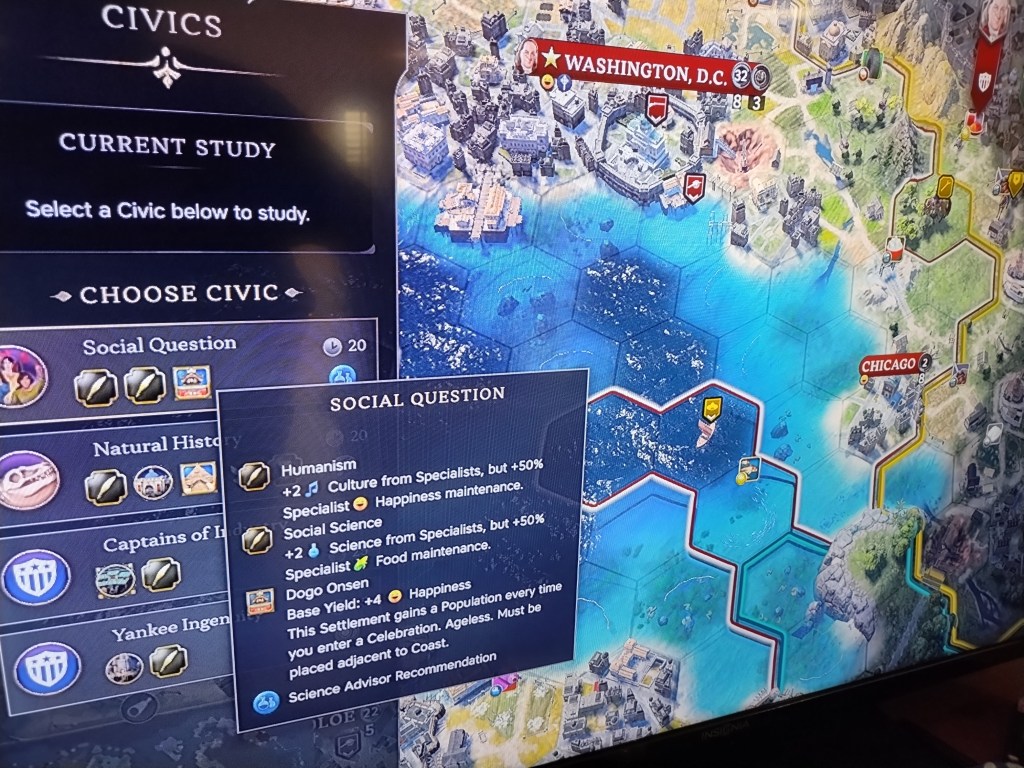
Researching social science in a video game

In Civilization VII, players can research and have the civic “Social Question.” Upon doing so, they gain the benefit of social science:

From a Civilization wiki regarding the Social Question:

Civic life in the 19th century was in a state of flux, as the old medieval order began to decay and former farmers flooded into the city. Under feudal arrangements, local lords were at least putatively responsible for the well-being of their subjects, but in the city, no such noblesse oblige existed: workers were alone to face exploitation, squalid living conditions and poverty – the profits and industry that drove the industrial revolution were directly dependent upon the exploitation of those working the machines. Perhaps more influentially, those with power could see directly the suffering of those around them.

This, then, raised the “social question:” what is to be done? Is there a sense of justice that the state must respond to, or is this a matter for churches and humanitarian organizations? Workers began to see themselves as a collective force, to whom some justice was owed. From here came a wide variety of responses: welfare, humanitarianism, socialism, etc., which had in common a notion that squalor and suffering were not a natural occurrence that extends from the soil, but something that society both caused and could remedy. It is a question with which we still contend today.

The start of sociology and other social sciences came around the same time as industrialization, urbanization, revolutions, the rise of the nation state, and rationality. I wonder how many players would see this civic as key to progressing through the game; does a society need to address this social question or can we just get on to other exciting features of modernity?

I may just have to report back on what happens when the civic Social Question is enabled and social science is possible. While I have logged many hours of playing Civilization II earlier in my life, I have little experience with more recent iterations of the game. As a sociologist, shouldn’t a robust social science sector lead to a civilizational victory?

Learning about American housing through The Sims

Playing The Sims may just offer a few lessons about housing in the United States:

Photo by Monstera Production on Pexels.com

The Sims felt like a trial run for adulthood, exploring how you’d make use of your future autonomy. Much of this validated the importance of personal space: how to lay out a room, how to choose a sofa that balanced aesthetics and comfort, how to make a house a home…

The official trailer for The Sims 4: For Rent emphasizes the potential of “multiunit life,” promising “ample opportunity … [for] eavesdropping, snooping, or even breaking and entering”—a description that instantly evoked memories of my worst roommates…

Inevitably, a lot has changed. The peaceful suburb I remembered from childhood has been replaced by elaborate “worlds” that I can (effortfully, via a loading screen) switch between to grow my property portfolios. The Sims 4 is more immersive and finely drawn, visually, than the original was, but it’s also more involved: It took me a whole afternoon to create my first Sim and set her up in her “hovel.”…

But soon my frustration (as Edith) with Jazz’s requests started to outweigh my commitment to being the Only Good Landlord. Every notification from the rental instantly provoked my impatience. Not the damn tenant again! The slow, clunky transition within the game between Edith’s home and the rental only added to my frustration and my creeping sense of Jazz as a burden. Why did this guy need so much of Edith’s energy?

With For Rent, The Sims has perhaps moved too far toward reflecting brutal reality, forcing players to choose between being on one side or the other of an often fractious and all-too-familiar power imbalance. As a child, I was drawn to The Sims as a role-play for adulthood, a world of expansive promise and possibility; playing For Rent, I was reminded, depressingly, of how the game is rigged.

The Sims is a game, a product intended to provide enjoyment for players. Can one gamify the rental experience in the United States?

More broadly, The Sims puts a home – owned or rented – at the center of the experience. The United States has a long history of celebrating the single-family home. Renting may be common in some places but it can also be treated with suspicion in other places. Players of the game can make their own choices but they are limited by what is possible in the game as well as what is possible in our society.

Anyone able to offer an analysis of housing, landlords, and properties in general across the Will Wright creations? Simcity offered a particular take as did SimTower – has this changed noticeably over the years? Are there any video games that do a different or better job of portraying property and renting?

Why we play Simcity and not Sim Nimby

A game released earlier this year accounts for the NIMBY behavior of city dwellers:

Photo by Buro Millennial on Pexels.com

Imagine an even-simpler version of the original late-’80s “SimCity” video game: a crude digital map dotted with a handful of pixelated single-family houses. But try to click on the screen — like, say, on the icon of a bulldozer or a factory, or just anything — so you can start laying out commercial blocks and parks and creating your pretend metropolis, which is the objective of most city-building sims, and you’ll be met with a jarring sound effect and a pop-up message: “ERROR. CAN’T BUILD IN NIMBYVILLE.”

Below that is one of many snarky excuses: “Housing is a human right! Just why does it have to be here?”

Such are the Sisyphean pleasures of “Sim Nimby,” a new desktop city-building game where more clicks just lead to more error messages, and nothing ever gets built. The only winners in Nimbyville are the ones programmed to prevail: Not In My Backyard neighbors, or NIMBYs, who block new housing developments at every turn…

So Nass and Weeks hunkered down in a Park Slope bar one evening and hashed out the litany of anti-development NIMBY-isms — more than 50 in total — that the game spits back at prospective builders as a jazzy 8-bit music theme plays. There’s some comic hyperbole at the expense of preservationists (“We can’t tear down that historic brownstone. It’s where Gene Quintano wrote ‘Police Academy 3: Back in Training’”) and some dad-joke-grade gags (“The only thing urban I want to see here is Keith Urban”). Other one-liners — “This is a NICE neighborhood,” “Will someone please think of the property values?” and “Affordable housing? What, you gonna build them an affordable country club too?” — are perhaps less fanciful to housing advocates.

How realistic should city building games be? I have wondered this for years starting with playing Simcity in the late 1980s. How much does the game reflect actual city planing practices and urban outcomes versus presenting a glamorized experience where it is easy to plop in properties, development happens easily, and issues are quickly addressed (as long as the player has enough money and a little bit of sense). Overall, it is pretty easy to build a thriving city.

This version might be too realistic. Players of video games want some level of difficulty or obstacles to overcome but not ever-present problems that make it difficult to do anything. Random disaster? Okay, a player can deal with that. A never-ending chorus of NIMBY concerns? It is too much to handle. The concerns of residents in Simcity are usually addressable; for example, move the residence further from industry, quickly put a park nearby to quiet the criticism, or find another way to improve the quality of life.

I do not know if the player gets some extreme options to address the NIMBY concerns. Have them annex themselves into their own community and build in a neighboring community? Remove all of the residences via eminent domain? Wage a political battle against them? If this is a Simcity where the residents do not want anything new, then growth is not possible and that does not work even in video games.

Limiting the presence of people in city-building video games

A recent review of several city-building video games suggests they focus more on buildings and landscapes than residents:

Photo by RODNAE Productions on Pexels.com

What’s missing from these titles are people, but this is arguably part of the fantasy they’re presenting. Citizens are complicated; they have needs and wants, which of course influence the way towns, virtual or otherwise, are laid out. On the one hand, the absence of people could be interpreted as an unintentional but darkly misanthropic view of the city. On the other, perhaps these are exercises in utopian thinking; cities are filled with compromises that these city-builders allow us to calmly transcend.

I have not played any of these games – my video game attention is elsewhere – but I have a lot of experience with SimCity where the role of residents was interesting, to say the least. The people themselves were not often present on the screen. Instead, the focus was on land and how it could be transformed into different uses.

Where citizens tended to show up were in their reactions to your choices as mayor. Perhaps it was demanding a police station or a school. Perhaps it is was in the mayor’s approval rating. Perhaps it was in the construction of new residences, suggesting your community had some attractive features.

But, they were just abstract concepts. If you wanted to deal with people directly, you could play The Sims. SimCity was about systems, not characters. While this broke ground in some ways, it also obscures the real and productive roles residents play in cities. SimCity encourages a top-down view of cities: development happens at the behest of one leader, a mayor/tyrant urban planner or leader, who is only curbed by a budget, complaints, and the occasional disaster. This is not the participatory community building that can help link residents to their neighborhoods and communities.

It is hard to imagine a city-building game that fully incorporates residents and community members as part of the process. The mayor wants to build a new bridge but residents complain about the effects on the environment and demand input? The mayor wants to put a highway through to reduce traffic but the community believes it will scar their neighborhoods? Imagine a virtual reality game where the leader makes decisions, walks through the places they have helped create, and has to interact with the people there. Perhaps this is the next step, games about communities and the people that inhabit them rather than cities as systems easily changed.

Paying to dirty and clean up your (Sims) house

Players of The Sims can now pay for the ability to dust and vacuum their homes in the game:

Photo by cottonbro on Pexels.com

In March, EA released new ways to enhance your Sims 4 experience called “kits,” which are more scaled down and less expensive than the game’s other downloadable content packs. Two of those kits, Country Kitchen and Throwback Fit, are pretty straightforward furniture and clothing packs that add new customization options to the game. In The Sims, you are essentially keeping these virtual people alive and designing their entire existence, from clothing to homes—these kits just offer a little more variety. But Bust the Dust is a little different than the rest, in that its primary purpose is to make your Sims’ lives dirtier. “Dust off the vacuum and tidy up in The Sims™ 4 Bust the Dust Kit!” the kit’s description boasts, making a mockery of the exclamation point by using it to try to sell one of the very worst IRL chores…

What makes Bust the Dust unusual is not just that it adds the new element of household grime to the game, but that it also only adds the new element of household grime to the game. Roaches and dog poop are very minor features of the aforementioned expansion packs, and even a more narrowly focused pack like Laundry Day, which gives your Sims the ability to wash their clothes, comes with a bunch of furniture and some new looks.But Bust the Dust isn’t interested in bells and whistles. It’s just … dust.

Maybe that’s not totally fair. The kit also provides vacuums you can buy (to bust the dust) and new character aspirations (so your Sims know how to feel about the dust and busting it). But mostly, paying $5 gets you a bunch of virtual dust, which accumulates over time on the floors of your Sim’s house, both in a thin coating and in interactive clumps around the room. Early reviews last month complained that the dust accumulated way too quickly—within a matter of in-game hours—but it took around two and a half in-game days for my house to go from clean to dusty. My Sim was thrilled when this happened, because it made the house feel “homey,” and presumably because Sims can’t have asthma. Around this time, a dust bunny moved in and became a kind of companion that you can feed (it eats dust) and pet (which again, is sentient dust).

One of the marks of adulting is the need to clean up after yourself. Dishes need to be washed. Laundry needs to be picked up, cleaned, and put away. Bathrooms need scrubbing. Dusting and vacuuming need to be done.

So why try to replicate this in a game? I suppose this is the point of the franchise: to simulate daily life. The various Sim titles over the years have replicated city building, ant life, towers, and more for multiple decades. Isn’t cleaning up part of daily life just as building water pipes?

Perhaps the odd thing here is paying for the luxury of doing this. The “Bust the Dust” is an add-on. And was this the plan all along: to get more money from users for the ability to clean? There are some people who like to clean. Some who will want the complete simulation. Others will want the twists here (you can feed the dust bunnies?). Some might have never known they wanted this until it became an option.

The commodification of the world continues: you can play a computer game where you pay to dirty and clean your house. Does it inspire players to stop the game and clean their own house? Does it stimulate the imagination? Maybe it is just fun to take what is often a mundane task and play it out on a screen.

Videogames under the tree to sizable global industry

The flood of new gaming consoles and new game titles to Americans for the Christmas season hints at the size of the video gaming industry:

Photo by lalesh aldarwish on Pexels.com

Global videogame revenue is expected to surge 20% to $179.7 billion in 2020, according to IDC data, making the videogame industry a bigger moneymaker than the global movie and sports industries combined. The global film industry reached $100 billion in revenue for the first time in 2019, according to the Motion Picture Association, while PwC estimated global sports would bring in more than $75 billion in 2020

The videogame industry has boomed in recent years because of the variety of ways to play games. Gone are the days when all one had to track were console sales and games sold for their respective consoles and PCs. With the rise of digital-copy game sales, mobile games, in-app purchase freemium games, cross-platform games that aren’t limited to a specific console, streaming game services like Microsoft’s Game Pass, games-as-a-subscription models, and online distribution services like Steam, along with varying levels of transparency, anyone wanting to make apples-to-apples comparisons encounters an unwieldy fruit basket.

While console sales will get a boost from new versions, that’s not the biggest chunk of the industry, nor the fastest-growing. The biggest gain is expected to come from mobile gaming, with China playing a big role in smartphone and tablet gaming revenue, Ward said. Excluding in-game ad revenue, world-wide mobile gaming revenues are expected to surge 24% from a year ago, to $87.7 billion.

The gamification of the world is well underway.

Seriously, it is interesting to compare the status of videogames compared to the two industries mentioned in the article: movies and sports. These are established industries with prominent actors around the world. They have been established for decades. Videogames, on the other hand, are more recent – only several decades in the hands of the global public – and still have negative connotations for many (too violent, a waste of time, played only by a certain segment of the population, etc.). Since videogames are big business and part of their spread is due to the smartphone, which many have, will videogames have a different status in a few years?

Playing SimCity, becoming an urban planner

Building a city on a computer screen led to a future career for some SimCity players:

Thirty years ago, Maxis released “SimCity” for Mac and Amiga. It was succeeded by “SimCity 2000” in 1993, “SimCity 3000” in 1999, “SimCity 4” in 2003, a version for the Nintendo DS in 2007, “SimCity: BuildIt” in 2013 and an app launched in 2014…

Along the way, the games have introduced millions of players to the joys and frustrations of zoning, street grids and infrastructure funding — and influenced a generation of people who plan cities for a living. For many urban and transit planners, architects, government officials and activists, “SimCity” was their first taste of running a city. It was the first time they realized that neighborhoods, towns and cities were things that were planned, and that it was someone’s job to decide where streets, schools, bus stops and stores were supposed to go.

“I used to draw maps of cities for fun. I had no idea it was an actual career,” said Nicole Payne, now a program official for the National Assn. of City Transportation Officials in New York City. When she was 10, a librarian saw her drawings and told her there was a video game she should try…

In more than a dozen interviews for this article, people who went from “SimCity” enthusiasts to professional planners talked about what they liked about the game: The way you can visualize how a single change affects a whole city. The ability to see how transit, livability and the economy are all connected. The fact that no one likes to live near a landfill.

This could be my story too: I enjoyed drawing cities as a kid, reading about cities, and visiting Chicago. I discovered SimCity during elementary school, playing for the first time on a green monochrome monitor. It opened up new possibilities, particularly as the game evolved. I spent endless hours creating cities and, like some of the people interviewed in this story, trying to make them pristine as well as based around different principles. We played Simcity as enrichment time in middle school and I probably trailed off in playing by early high school when I was more taken by Civilization II and franchise mode of sports games. All of that SimCity playing did push me to think about urban planning and serving in local government.

At the same time, as this article notes, SimCity likely shaped how I thought cities worked. SimCity is not neutral in its planning philosophy. At the least, it presented the idea that a planner from above could shape everything, even down to the terrain. The speed at which it could happen was also impressive: a mouse click could add residences or take them away while the game speed could be paused or sped to impressive speeds (usually to add money to the coffers if one was not playing with the cheat codes). Cities and communities do not work this way; even powerful leaders usually need at least a team of elites to get things done and significant urban projects often take a long time.

The urban theory behind SimCity

In constructing the game SimCity, Will Wright worked with the ideas of James Forrester:

Looking to understand how real cities worked, Wright came across a 1969 book by Jay Forrester called Urban Dynamics. Forrester was an electrical engineer who had launched a second career as an expert on computer simulation; Urban Dynamics deployed his simulation methodology to offer a controversial theory of how cities grew and declined. Wright used Forrester’s theories to transform the cities he was designing in his level editor from static maps of buildings and roads into vibrant models of a growing metropolis. Eventually, Wright became convinced that his “guinea-pig city” was an entertaining, open-ended video game. Released in 1989, the game became wildly popular, selling millions of copies, winning dozens of awards, and spawning an entire franchise of successors and dozens of imitators. It was called SimCity

Largely forgotten now, Jay Forrester’s Urban Dynamics put forth the controversial claim that the overwhelming majority of American urban policy was not only misguided but that these policies aggravated the very problems that they were intended to solve. In place of Great Society-style welfare programs, Forrester argued that cities should take a less interventionist approach to the problems of urban poverty and blight, and instead encourage revitalization indirectly through incentives for businesses and for the professional class. Forrester’s message proved popular among conservative and libertarian writers, Nixon Administration officials, and other critics of the Great Society for its hands-off approach to urban policy. This outlook, supposedly backed up by computer models, remains highly influential among establishment pundits and policymakers today…

Forrester spent months tinkering with this model, tested and corrected it for errors, and ran a “hundred or more system experiments to explore the effects of various policies on the revival of a city that has aged into economic decline.” Six months after beginning the project, and over 2000 pages of teletype printouts later, Forrester declared that he had reduced the problems of the city to a series of 150 equations and 200 parameters…

Forrester thought that the basic problem of urban planning—and making social policy in general—was that “the human mind is not adapted to interpreting how social systems behave.” In a paper serialized in two early issues of Reason, the libertarian magazine founded in 1968, Forrester argued that for most of human history, people have only needed to understand basic cause-and-effect relationships, but that our social systems are governed by complex processes that unfold over long periods of time. He claimed that our “mental models,” the cognitive maps we have of the world, are ill-suited to help us navigate the web of  interrelationships that make up the structure of our society.

Three quick thoughts:

  1. How many people dream that cities could be reduced to equations and parameters? Cities are both fascinating and frustrating because they are so complex. And the quest to find overarching rules governing urban life continues – see the work of Geoffrey West as an example.
  2. Figuring out when more government intervention is helpful or not is a difficult task, particularly when it comes to complex cities. Housing is an area I have written about before: free markets do not bring about fair results and the federal government has promoted one kind of housing, single-family homes, over others for decades.
  3. This is a reminder that game users can learn about how the world works – they are not just mindless entertainment – but they also do so under the conditions or terms set up by the designer. Cities are indeed complex and SimCity presents them in one particular way. All games have a logic to them and this may or may not match reality. How much theory do we imbibe on a daily basis through different activities? At the least, we are forming our own individual theoretical explanations of how we think society operates.