Skyscrapers happened because real estate was really expensive

A quick history of the Chrysler Building in New York City provides a reminder of a key reason skyscrapers emerged in American cities:

Photo by Following NYC on Pexels.com

Dominating the New York skyline brought prestige and publicity, but tall towers also resolved a more prosaic problem: As land prices climbed, developers had to build upward to turn a profit, pushing their projects as high as engineering, natural light and, eventually, zoning would allow. “Skyscrapers were a self-fulfilling prophecy of the heated real estate market,” writes Neal Bascomb in his 2003 book Higher: A Historic Race to the Sky and the Making of a City. By the 1920s, with Europe in ashes after World War I, these buildings became brash totems of a new world order. Manhattan in particular had become the “harbor of the world, messenger of the new land … of the gold diggers and of world conquest,” wrote the German architect Erich Mendelsohn in his seminal 1926 book Amerika, published the year after New York overtook London as the world’s most populous city.

In a dense space like Manhattan, demand for land pushed prices up. To make more money from the same plot of land, skyscrapers offered more space. The addition of thousands of square feet of office space, even if it could be hard to fill at times, provided profit.

I would be interested to see analysis shows the profits of a skyscraper over a lifetime compared to other options builders, developers, and companies could have pursued. Instead of building up in major cities, here are other options they could have pursued: building underground; building dense and wide buildings (imagine ones that cover several city blocks at a height of ten stories or so); constructing large buildings in other parts of the city and suburbs; and pursuing multiple business districts rather than centralized locations where everyone wants to gather.

Even if there was profit at stake, there is also the matter of the prestige of skyscrapers. Skyscrapers are important symbols in a city skyline. Were skyscrapers both profitable and status-enhancing or did the increased status mean that the absolute numbers did not matter quite as much?

New design choices at Barnes & Noble stores

Chain stores are predictable and often have a common aesthetic. Barnes & Noble is headed a different direction in some of its locations:

Photo by Engin Akyurt on Pexels.com

Other stores will have a different look. The design of a new location in Brooklyn reveals the polished concrete floors from its past life as a Barneys New York. A Barnes & Noble recently opened in California with cerulean walls, and an experiment in robin’s egg blue is in the works for some East Coast locations…

The result has been an idiosyncratic approach to mass retail. Mr. Daunt, who describes himself as “an independent bookseller in background and ethos,” is pushing the chain to act more like the indie stores it was once notorious for displacing — and to embrace lighter, brighter interiors with modular shelves designed for maximum flexibility…

In its darkest hours, the stores began to resemble the discount aisle at Spencer’s. A layout known as “the racetrack prototype” — which Ms. Flanigan identified as “my least favorite design” — borrowed from big-box stores like Target, with cash registers by the door and impulse-purchase temptations around the perimeter. Only after wading through a sea of tchotchkes would customers encounter books…

The new look aims to encourage browsing, which Mr. Daunt believes improves customer satisfaction. “If you just want to buy a book, the guys in Seattle will sell you a book,” Mr. Daunt said. “The enjoyment and the social experience of that engagement with books in a bookstore? That’s our game.”…

Bookstores, in Mr. Daunt’s view, are fundamentally different from other retail businesses, partly because of the range and variability of the products. Under his leadership, local managers are given a free hand, meaning that the Upper West Side store may offer a shopping experience quite different from the one in Spanish Fort, Ala.

If the primary competition is not other retailers but rather an online store, this might make some sense. The hopefully pleasant idiosyncrasies of different locations provide an alternative to an app or website experience.

But, this goes against the ethos of a lot of American retail and restaurants. As consumers drive near and far across a big country, they often expect uniformity and predictability. Sociologist George Ritzer described the process as “McDonaldization.We can point out instances when locations deviate from the expected.

By definition, can a chain retailer express itself this way? If this is successful, I suspect others might follow, even if they are not engaged in selling books.

Reporting the average credit card debt by household tells us something – but the median might be better

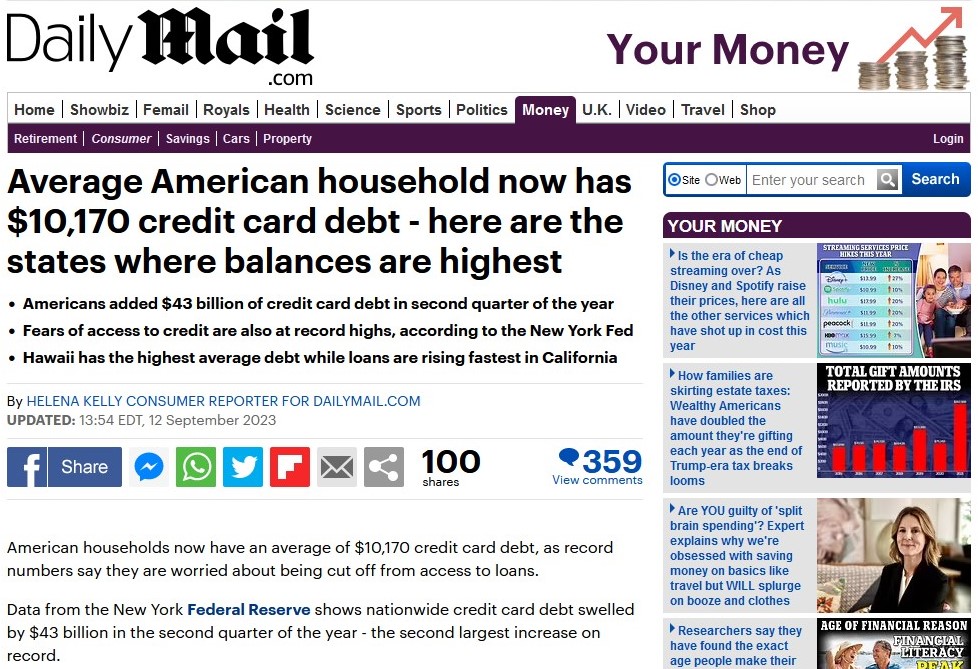
Headlines yesterday reported on a rising average credit card debt among American households:

Is the average the best measure? With credit card debt possibly ranging from $0 to who knows how much, is the average a good measure of what is typical?

Previous data I have seen suggest the average might not be very helpful. A July 2023 story based on survey data reported this:

A recent GOBankingRates survey found that 30% of Americans have between $1,001 and $5,000 in credit card debt, 15% have $5,001 or more in credit card debt and about 6% have more than $10,000 in credit card debt.

From 2022 data:

Unfortunately, most people with an active credit card account don’t always pay their bills in full. A November 2022 LendingTree survey found that just 35% of cardholders say they always pay their credit card balance in full every month, while 65% say they carry a balance at least some of the time. Nearly half (46%) of those cardholders who have card debt say it would take them at least a year to pay it off.

And tables on this site based on 2019 Federal Reserve survey data suggest the median credit card debt is quite a bit lower than the average.

I am guessing the median credit card debt is a better measure of the typical debt as it better accounts for all the households without any credit card debt. There is a place for the average or the total amount of credit card debt, particularly if one wants to emphasize the growing amount of debt.

The Chicago suburbs have 99 million square feet of office space

The suburbs are not just places where people live. The Chicago suburbs have a lot of office space:

Photo by 500photos.com on Pexels.com

While higher-end properties are outperforming less expensive options among the suburbs’ 99 million square feet of office space, they still saw a decline in the year’s second quarter, ending a yearlong run of gains, according to data collected by the Chicago-based firm.

The Pentagon has 6,500,000 square feet of space so the suburban office space is over 15 times that of the Pentagon. The Willis Tower in Chicago has roughly 4,000,000 square feet of space so the suburbs have roughly 25 times more space. A football field is 57,600 square feet is the office space covers over 1,718 football fields. If the average new American home is about 2,500 square feet, this office space is nearly 40,000 new average homes.

Note: another website suggests the Chicago suburbs have 162 million square feet of office space, putting the Chicago suburbs behind the Washington D.C. suburbs, the Dallas-Forth Worth suburbs, the Bay Area suburbs, and the New Jersey suburbs.

Whichever number is correct, it is hard to put this much space in perspective. The suburbs may be primarily about single-family homes but they have plenty of space for business.

Potentially different logics for land: from a church that “nourished thousands” to million dollar homes

Reflecting on the tearing down of a Catholic church in Chicago, one long-time parishioner describes what will replace the structure:

Photo by Pixabay on Pexels.com

It’s a “good’ neighborhood now. And the land that Transfiguration once occupied will be turned into about a dozen single-family homes, where, in an area that was zoned for and still is largely home to two- and three-flats, the starting price of a new house is $1.35 million. Talk to me about the zoning on that one.

This week is the one I dreaded: the physical building, Transfiguration of Our Lord, is being torn down. I held out hope that the building that had welcomed and taken care of so many would be preserved. At the very least, I hoped that the land that nourished thousands of families would house a few more of them in the middle of a nationwide affordable housing crisis. But why build homes for two or three families when you can get rich selling a house to just one?

So the fences have gone up, and the building is coming down.

Processing the closing of a long-time religious congregation can be difficult.

But, there is also a suggestion above that these are two very different uses of land. According to this member, the church nourished families and the community. The church welcomed immigrants. Its school educated kids. The church was a gathering place. Churches in the United States do not pay property taxes, but they can provide services for the neighborhood.

In contrast, the buildings that will replace the church will be expensive single-family homes. These will provide private space for households within a desirable neighborhood. There is money to be made in the developing and selling of the buildings.

This could lead to a question: is land better used for organizations that serve the community or for single-family homes? If people care more about money, creating more real estate is the answer. If people want to emphasize community, there might be room for religious congregations and other neighborhood organizations, but they may need to sustain themselves. Americans value single-family homes and like making money. When congregations close, it is a relatively easy step in many communities to redevelop this land or reuse the buildings in ways that generate money and revenue.

How much would empty urban office buildings affect municipal tax revenues?

With talk of empty urban office buildings leading to a decline in property values, how might this affect tax revenues collected by cities? Here is one estimate:

Photo by Bekir Du00f6nmez on Pexels.com

Municipal governments have even more to worry about. Property taxes underpin city budgets. In New York City, such taxes generate approximately 40 percent of revenue. Commercial property—mostly offices—contributes about 40 percent of these taxes, or 16 percent of the city’s total tax revenue. In San Francisco, property taxes contribute a lower share, but offices and retail appear to be in an even worse state.

These are not huge numbers but they do contribute to the overall local budget picture. Office or commercial buildings in cities that are not being used or are being turned over to lenders or are prospects for building conversions will not generate as much tax revenue as they might when demand for such properties is higher.

How will cities address this? It will be interesting to see different approaches that could be affected by local real estate markets, housing needs, and budget specifics. If there are a few cities that are able to limit the revenue damage, they might serve as models for others.

(This is also a problem for suburbs with large amounts of office and commercial space.)

How suburbs can lose millions in revenue when office parks sit empty

The changes to offices in one Minneapolis suburb illustrate the money at stake for suburban communities:

One surprising victim might be the Twin Cities suburbs. Take the 64,000-person suburb of Eagan, Minnesota where, earlier this year, two announcements upended the commercial landscape. Two of the city’s largest employers terminated leases at massive office parks, both of which served as local corporate headquarters…

Because commercial property is taxed at a higher rate than residential, for a city like Eagan, with a $42 million budget, the loss of two large corporate headquarters is a hit to its bottom line. In 2022, the two office parks provided about $3 million in tax dollars to the city, county and school board. (The city of Eagan’s cut of the tax revenue sits at around a third of that total.) 

Whatever happens to these two sites, they’ll likely be assessed at much lower values moving forward, likely swaying the rest of the suburban commercial real estate market. This puts pressure on Eagan’s single-family residential property to make up the difference, shifting the low-tax balance that draws people to live second-ring suburbs in the first place.

For their part, Eagan city leaders say these kinds of economic changes are nothing new, and the city is well-positioned to survive…

She cited the changing loss of previous corporate headquarters in the city, including Lockheed Martin and Northwest Airlines, both of which disappeared due to mergers or outsourcing.

Multiple forces are at work:

  1. Corporate offices change over time, before and after COVID-19. This suburb has seen companies go before and they found different businesses to lease office space.
  2. It is less clear the direction of the current office space market and financial markets are nervous. With more work from home and more Internet business, how much physical office space is necessary in the coming years?
  3. Filled office parks can help suburbs generate significant revenues and reduce tax burdens for others. Vacant buildings do not this at the same rate.
  4. Buildings that are vacant long-term are negative symbols. Communities want to have thriving businesses, not empty buildings. The longer the vacancy stretches, the bigger the consequences.
  5. Communities can redevelop such properties but this requires money, proactive local officials, and partners.

If we could come back to Eagan in a decade or two, will these properties be redeveloped mixed-use properties, vacant sites, or office parks operating at a decent capacity?

How empty are American offices right now?

A headline of an analysis of office space and vacancies in the United States suggests “American offices are half-empty.” Is this true? Here is how the analysis starts:

Photo by Pixabay on Pexels.com

From Dallas and Minneapolis to New York and Los Angeles, offices sit vacant or underused, showing the staying power of the work-from-home era. But cleardesks and quiet break rooms aren’t just a headache for bosses eager to gather teams in person.

Investors and regulators, on high alert for signs of trouble in the financial system following recent bank failures, are now homing in on the downturn in the $20 trillion US commercial real estate market.

After detailing the economic effects of this, particularly how banks might be affected, here is some evidence for the headline:

Office properties have been getting hammered the hardest. Hybrid work remains popular, affecting the rents many building owners can charge. Average occupancy of offices in the United States is still less than half March 2020 levels, according to data from security provider Kastle.

And then it is back to the possible fallout, including:

Trouble may build as the economy slows. Hill thinks US commercial property valuations could fall roughly 20% to 25% this year. For offices, declines could be even steeper, topping 30%.

The headline suggests half of offices are empty. The primary piece of evidence in the article says that average office occupancy “is still less than half March 2020 levels.” Does that mean average office occupancy was 100% in March 2020? Does this mean half of office buildings have no people in them? Even if the real figure about empty offices is 30% or 40%, this would be a big number with lots of ramifications.

An earlier article on the same site had a similar headline and evidence. From early March 2023, the headline: “Offices are more than 50% filled for the first time since the pandemic started.” The evidence:

Office occupancy across 10 major US cities crossed 50.4% of pre-pandemic levels for the first time since early 2020, according to security swipe tracker Kastle Systems. That marks the first time occupancy has crossed the 50% mark since March 2020, when many offices sent workers home because of Covid.

Again, the comparison is pre-COVID levels, not necessarily 50% of total possible occupancy. Again, this is a significant change that is a little different than claiming offices are more than 50% filled.

This all might be pedantic, but, if we should pay attention to offices, working from home, and the consequences of changes to commercial real estate, what are the actual figures regarding how much office space is occupied and/or leased?

Big box stores in Michigan can have their property taxes assessed on their value as an empty building

Having a vacant big box store in a community can be a big problem. But, what if the store if in business and generating revenue and it is being assessed for property tax purposes at a value closer to its value as an empty property? Such is the case in Michigan:

Photo by Craig Adderley on Pexels.com

The dark store theory was born, in part, out of the 2008 recession.

Big box stores closed. The massive buildings that housed them had few other obvious uses and, in some cases, restrictions on selling the buildings to competitors put in place by the companies themselves reduced the pool of potential buyers. They often sold for far less than they’d cost to build.

Michigan law allows assessors to determine the value of a property in three ways: based on replacement cost minus depreciation, based on the income a property generates and based on the sales of similar properties.

Retailers began to argue that sales of empty stores were the best indicator of what their properties were worth. The Michigan Tax Tribunal generally agreed…

Of the 110 cases brought before the tribunal by Walmart and its subsidiaries since 2018, 93 have resulted in lower taxable values, often millions of dollars lower. All but one was a negotiated settlement. Eleven of the 110 cases are ongoing.

Two factors may be at play here. Retailers and businesses want tax breaks. They want to pay fewer taxes and boost their profits. If communities are willing to offer tax breaks like this (or others), why not ask for them and utilize them?

On the other side, communities want to bring in businesses and jobs. These retailers still provide some work for local residents and they are still generating some tax revenue. Even if they do not pay in taxes what they might, would a community be willing for a big box store to move to a nearby community and the money go elsewhere? Some development or even bad development might be preferable to no development or an empty building.

The news story quoted above details how this may change in Michigan due to a court case. If these large corporations do have to pay more in property taxes, will they change their operations at all? And how might communities make use of the extra revenue to improve local lives?

Closing Walmart and Whole Foods locations and their responsibilities to urban neighborhoods

Walmart announced yesterday it is closing four locations in Chicago:

Photo by Evgeni Lazarev on Pexels.com

The simplest explanation is that collectively our Chicago stores have not been profitable since we opened the first one nearly 17 years ago – these stores lose tens of millions of dollars a year, and their annual losses nearly doubled in just the last five years. The remaining four Chicago stores continue to face the same business difficulties, but we think this decision gives us the best chance to help keep them open and serving the community.

Over the years, we have tried many different strategies to improve the business performance of these locations, including building smaller stores, localizing product assortment and offering services beyond traditional retail. We have invested hundreds of millions of dollars in the city, including $70 million in the last couple years to upgrade our stores and build two new Walmart Health facilities and a Walmart Academy training center.

It was hoped that these investments would help improve our stores’ performance. Unfortunately, these efforts have not materially improved the fundamental business challenges our stores are facing.

Chicago officials decried the closures:

Nedra Sims Fears, executive director of the Greater Chatham Initiative, said the closure of the store and health center in Chatham was “deeply disappointing.”…

“All communities in Chicago should have access to essential goods and services,” Lightfoot said in the statement. “That is why I’m incredibly disappointed that Walmart, a strong partner in the past, has announced the closing of several locations throughout the South and West sides of the City. Unceremoniously abandoning these neighborhoods will create barriers to basic needs for thousands of residents.”…

In a statement, Mayor-elect Brandon Johnson said his administration “will be committed to identifying ways to fill the gaps these closures will leave in neighborhoods, and also to finding other ways to ensure families have direct access to groceries in their communities.”

Ald. Sophia King, 4th, and Ald. Jason Ervin, 28th, whose wards include locations slated to close, both called the closures disappointing in statements Tuesday. “The west and south sides need committed partners to reverse decades of disinvestment and discrimination, and I hope Walmart will work hard to invest in the communities in Chicago that desperately need their presence,” Ervin said.

In San Francisco, a Whole Foods that opened downtown in 2022 closed earlier this week:

Whole Foods Market opened a new “flagship” branch Downtown, at Eighth and Market near the Trinity Place development, with much fanfare in March 2022. But just 13 months on, the supermarket chain has decided to close the store, which was shuttered at the end of business on Monday.

Residents and leaders expressed disappointment:

News of the store’s closure also sparked dismay online. Residents on Twitter described losing the supermarket as “disappointing,” and “disheartening,” while one warned: “As whole foods goes, so goes the neighborhood.”

The Whole Foods Market fell within the district of San Francisco District 6 Supervisor Matt Dorsey, who posted a thread about its closure on Twitter on Monday.

“I’m incredibly disappointed but sadly unsurprised by the temporary closure of Mid-Market’s Whole Foods,” he wrote. “Our neighborhood waited a long time for this supermarket, but we’re also well aware of problems they’ve experienced with drug-related retail theft, adjacent drug markets, and the many safety issues related to them.”

Residents of all communities need access to food. Certain neighborhoods are invested in less than others. A sizable grocery store can help anchor other business activity. Filling a vacant large commercial space can be difficult.

If a company says it cannot keep a store open – the two companies give different reasons above – what reasons might be acceptable to a community?

I would hope retailers and corporations want to go beyond just making money in a location. At the least, as corporations and politicians often remind us, they provide jobs. But, they can also be much more.