Could giga-mansions relieve the negative attention directed toward McMansions?

The term McMansion is likely to stick around (even if is used poorly at times) but more interest may be shifting to the giga-mansion.  A Motley Fools podcast provides some information:

First we had mansions. Then we had mega-mansions. And McMansions. Now we have giga-mansions. Yes, it’s a growing trend of massive houses usually built in the LA area on spec. They are massive, expensive, and outrageously ostentatious. Let’s see if you two can answer some trivia around some of the most expensive pieces of residential real estate on the market…

The One will be America’s largest house on the market at 100,000 square feet. It will be the most expensive private residence when it comes to market. It boasts four swimming pools, a nightclub, a room where the walls and ceiling are filled with jellyfish. It will have a 30-car gallery. Because of this price you don’t call it a garage. Of the 20 bedrooms, how many are in a separate building just for your staff?…

Let’s move on and talk about the house called Billionaire. It’s 38,000 square feet. It was America’s most-expensive house on the market when it was listed for $250 million in 2017. The property is in the exclusive Los Angeles suburb of Bel Air. It has 12 bedrooms, 21 bathrooms, three kitchens, a 40-feet James Bond-themed cinema, six bars, two fully stocked champagne cellars, and the helicopter from what 1980s television series? Rick knows this. He can’t wait to say it…

Southwick: A $1 billion lot. Now we’re going to go to The Manor. The largest home in LA was actually built in 1988 by the TV show producer Aaron Spelling and his wife Candy. The 56,000 square foot, 14-bedroom, 27-bath home originally was built for $12 million. They sold it all in a cash deal for $85 million in 2011 to the 23-year-old daughter of someone wealthy. Don’t worry about it. She renovated much of the house, since it had some very quirky spaces, including a flower-cutting room, a humidity-controlled silver storage room, a barber shop, and three rooms for doing what common birthday and Christmas activity?

One of the major critiques of McMansions involves their symbolic nature: they are associated with sprawl, wealth, and conspicuous consumption. All of these appear to be in play with the examples from the Los Angeles area cited above: a region known for cars and highways, entertainment celebrities and executives along with other wealthy people, and a constant need to stand out from the rest of the area.

But, McMansions have key differences from this supersized homes. They are generally smaller – roughly 3,000-10,000 square feet – and more often found in “typical” neighborhoods. They are often mass-produced. They are often criticized for their architecture while megahomes take more flak for their size. Perhaps most importantly, McMansions are within the reach of more Americans. Depending on the housing market, an upper-middle class household can acquire a McMansion but these giga-mansions are only for the wealthiest.

If the ultimate concern behind critiques of McMansions is their unnecessary size and flaunting of wealth, then the spread of giga-mansion might relieve some of the pressure. Granted, there will always be more McMansions but it is easy to focus on these outsized homes and their owners. Why criticize the top 10-20% of American homeowners for their McMansion choices when the giga-mansions of tomorrow constructed and owned by the top 0.1% of homeowners are so ridiculous and unnecessary?
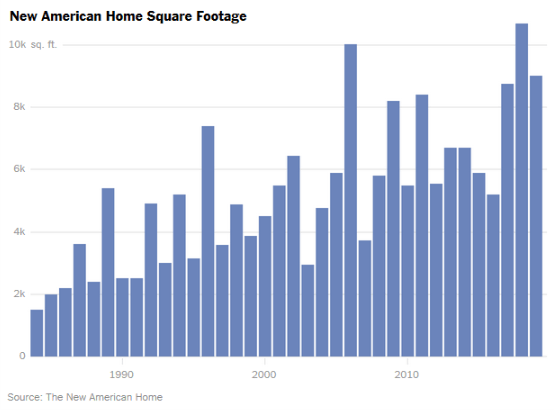
The bigger and feature-filled “New American Home”

What the National Association of Home Builders displays as the “New American Home” just keeps getting bigger and bigger:

The first New American Home that N.A.H.B. built, in Houston in 1984, was 1,500 square feet and cost $80,000. By 2006, at the peak of the housing bubble, the N.A.H.B. home – a lakeside McMansion in Florida with a tri-level kitchen island and a waterfall off the master suite – was over 10,000 square feet and listed for $5.3 million in what is today one of the nation’s foreclosure capitals, Orlando.

That 1984 project was the smallest; square footage hasn’t dipped below 2,200 since 1985. The 2018 version, also in Florida, is “Tuscan”-inspired and is close to 11,000 square feet, with eight bathrooms and both an elevator and a car elevator in the garage. The 2019 version, to be unveiled soon, is 8,000 square feet and has an “inner sanctum lounge” and a view of the Vegas strip.

NewAmericanHomeSquareFootage

The N.A.H.B. house may be meant to highlight trends, but they’re not necessarily the trends homeowners want (and certainly not what most people need). Instead, they’re what builders, kitchen and bath manufacturers and real estate agents would like to sell them: Think cathedral ceilings, granite countertops, gift-wrapping rooms and, more recently, “smart” appliances like a refrigerator that can text you when you’re low on milk and eggs.

Many builders will tell you that though these houses are large, they are more efficient – even that they have a small carbon footprint. But this is like bragging about the good gas mileage of an S.U.V. While a 10,000-square-foot house built today uses less energy than a 10,000-square-foot house built a decade ago, a home of this size requires a phenomenal amount of energy to run. (And most likely has an S.U.V. or two in the garage.)

I see enough from the NAHB to guess that they have some influence in the housing industry, particularly among national or larger builders. That their show home put together each year keeps getting bigger on average and with more and more features suggests the emphasis is on new and profits. At the same time, it might be hard to show a direct causal link between these annual productions and what homes are actually built. Builders in the United States have constructed many large homes in recent decades but the median square footage has dropped slightly in the last few years.

I suspect it would also be interesting to analyze the architectural and design choices for the New American Homes. Americans may like big homes but not necessarily modern ones. How many of these homes are modernist, Craftsman, or Mediterranean (and which styles are studiously avoided)? Are they all open concept in the main living areas? Is storage a priority and/or large garages? This sort of project could then be expanded to model homes in different areas or among different builders to think about how what builders present influence buying patterns.

New Bel Air homes of over 17,500 square feet cannot be called McMansions

In recent years, a number of extra large houses have been constructed in Bel Air. But, these are not just regular McMansions:

Rosen rallied his neighbors in a mini-revolt against City Hall. The result was 2017’s Bel Air mansion ordinance, a more rigid version of the ordinance imposed on the rest of Los Angeles. While many of the hauling trucks are now gone, the wealthy enclave is still grappling with the legacy of its McMansion years. Between 2014 and early 2017, the city issued 28 permits for mansions in Bel Air of 17,500 square feet or larger, most of which are still under construction, according to an analysis by The Real Deal. The projects are exacerbating a spec-home building spree that rattled longtime Bel Air residents and is dramatically altering the landscape of the area, not to mention its real-estate market.

As of Wednesday there were 12 homes in Bel Air of 15,000 square feet or larger currently sitting empty and unsold in, according to MLS data cited by Steve Lewis, President of CORE Real Estate Group in Beverly Hills.

These are not regular McMansions in suburban neighborhoods: these are megahomes going for megaprices and constructed by and for the ultra-wealthy.

Meanwhile, on Chalon Road, Thomas Barrack Jr., the Colony Capital CEO and pal of President Donald Trump, is nearly done building out an eight-acre compound with a 77,000-square-foot mansion being designed by Peter Marino. Barrack is building it on behalf of the royal family of Qatar. Other competing giant offerings, including the Mountain, a 157-acre plot in Beverly Hills Post Office now listed for $650 million, and a 120-acre site owned by an entity linked to the late Paul Allen asking $150 million, don’t have plans or permits in place for mega-mansions, Blankenship said.

Massive spec mansions on the market right now include Bruce Makowsky’s 38,000-square-foot estate at 924 Bel Air Road, asking a much-reduced $150 million, and the Mohamed Hadid-developed mansion at 901 Strada Vecchia, which is the subject of an FBI probe and a lawsuit from neighbors who want to see it torn down.

Granted, it sounds like some of the activity in Bel Air may be consistent with several features of McMansions: big homes, teardowns, and status symbols for the wealthy. For those who live in Bel Air, it could be disconcerting to see the scale of new construction. But, this article focuses primarily on the really big homes, the ones that are not just someone upgrading from a 2,000 square foot ranch to a 5,000 square foot home with a mishmash of architectural features. The last example in the piece illustrates this difference between a McMansion and mansion: a billionaire/actress couple want to tear down a home under 8,000 and more than double the square footage in a new home. Again, that is a scale far beyond the average upper middle-class American (and that does not even include the price it takes to buy into this particular neighborhood). Perhaps the real goal of using the term McMansion here is to denigrate the new homes and not grant them the status of mansion.

I would argue McMansions are roughly 3,000 square feet to 10,000 square feet. The bottom end may seem rather small but this size home could be quite large if constructed in a home of small homes. The upper end is a rough cutoff when a home goes from regular big home to extra large/wealthy big home. Size is a critical factor in defining a McMansion and these Bel Air homes are way beyond McMansion limits.

McMansions lead to water runoff damage in Kirkwood, Missouri

The construction of new housing can lead to water issues for existing homeowners. See the ongoing case of Kirkwood, Missouri homeowners dealing with more water due to the construction of McMansions:

Next week, a new Kirkwood water runoff regulation will take effect, but longtime residents say it’s all too little too late…

Like many other longtime Kirkwood residents, Liskew said water began invading her home when new construction started near her neighborhood. Behind her home, she noticed new, large homes—often called ‘McMansions’—were being built on small lots…

That special council created a new storm water management regulation. The ordinance requires all “infill development” to capture rainfall runoff, and submit a plan to the Metropolitan St. Louis Sewer District for review and approval prior to the issuance of any building permits…

And she said it’s been an expensive, never-ending problem to worry about. In addition to several French drains, Liskew has installed a sump pump, taken out basement windows, graded a large portion of her yard and even commissioned a water runoff study to find out where the water was originating. The study found the water was coming from the neighborhood directly behind her home, and heading directly into her backyard.

See an earlier blog post on the Kirkwood situation. To some degree, the construction of any new residential units is likely to affect water runoff. Switching land from non-use or agricultural use to homes, driveways, yards, and streets will have an effect. Add to that the pejorative term McMansions used here: big homes take up more space and in the interest of keeping water away from them even more water is channeled elsewhere.

I sometimes wonder if the way water issues in suburbia work is like this: every new development attempts to push the water somewhere else and the problem simply moves onto someone else’s property. Generally, developers and municipalities do their best to move the water away from existing buildings and uses but this may not be possible depending on the topography and existing infrastructure. Cleaning up the water issues after the fact – such as in Kirkwood or the Deep Tunnel project in the Chicago region – is costly and very frustrating. But, without a commitment to avoid sprawl or widespread adoption of greener techniques, the water problems will just get pushed down the road. Flooding will continue to be a major suburban problem.

Publication on the Soprano’s McMansion

The home of Tony Soprano and his family on HBO’s The Sopranos is a key setting for the show. It is here that Tony considers his own unrest and anxiety, where the family interacts with each other alongside Tony’s other “family,” and the home embodies the search for the suburban good life as encapsulated in a spacious home in a wealthy neighborhood.

I am grateful for the opportunity to explore this in more detail in a recently published paper: “A McMansion for the Suburban Mob Family: The Unfulfilling Single-Family Home of The Sopranos” in the Journal of Popular Film and Television.

Showing a McMansion while saying, “I love all the brick. I love all the character.”

In a recent HGTV episode intro, the host is driving through a Chicago suburb. He says, “I love all the brick. I love all the character.” And this is the home we see as he says this:

HGTVMcMansionMidwestCharacter.jpg

This is a McMansion due to at least four features:

1. The two story entryway.

2. The multi-dimensional roofline.

3. The three car garage and large driveway.

4. The lighter brick and other style choices that date the home as roughly a 1990s build.

(For aesthetic purposes, the dangling power lines in the front do not help.)

This home may have plenty of brick but critics of McMansions might argue the brick is deployed poorly. This home may have character – but of the negative kind rather than the charming variety.

Can you tidy up with Marie Kondo in a McMansion?

A review of the new show Tidying Up with Marie Kondo contrasts organizing with purchasing a McMansion:

Stylistically, Tidying Up is gentle. Marie Kondo is a soothing presence—never soporific, somehow, but always engaging. She is twee, almost unbearably so, which is an affect not really seen in American television personalities. About 15 minutes into every episode, Kondo takes a moment to commune with the house, selecting a spot in the residence and kneeling in silent reverence. This goes on for longer than feels comfortable; sometimes the subjects join her, and sometimes they seem like they’re enjoying it. Conflict, when it happens, feels softer than it would on House Hunters, where couples routinely argue with increasing venom over the necessity of a mudroom in the home of their dreams.

The beauty of Marie Kondo’s world is that tidying is not punishment. She subverts the chore of cleaning by imbuing it with a radical sense of self-improvement. Unlike the underlying economic status anxiety that colors all of HGTV’s offerings, Tidying Up is more self-help than self-defeat. The home improvements, and by extension, life improvements, come not from buying a McMansion in Indiana, but from clearing life’s detritus out of your home to make way for something else.

The end of the review posits a dichotomous choice: either buying a McMansion to assuage status anxiety or tidying up to feel better.

But, I imagine many Americans would want to try to do both: purchase the McMansion or a large home and find a way to organize and declutter that home so that they feel better. Yet, this path seems to go against the path Kondo and others would prefer where Americans can’t have it all and have to make choices about their lives to prioritize well-being. Having a large home helps people feel like they can purchase and acquire more stuff. Having a bigger home is part of a consumer culture where buying bigger and more is a good thing.

One important step to the Kondo life would then be to not purchase the biggest home possible. How many Americans would be willing to do that or is it simply easier to buy into a tidying strategy that could be utilized in any home?

When saying that Harry Reid lives in a McMansion, is this meant as a negative?

The term McMansion is rarely used in a positive manner. Yet, a recent profile of former Senator Harry Reid’s life after politics describes his home as a McMansion:

Early on the afternoon of Dec. 11, about an hour after an Oval Office meeting between President Trump, the Senate minority leader Chuck Schumer and the incoming House speaker Nancy Pelosi devolved on live TV into a shouting match — a “tinkle contest with a skunk,” in Pelosi’s postgame grandiloquence — I pulled up to a McMansion in a gated community outside Las Vegas. I presented my ID and pre-issued bar-code pass to a security guard. Another guard emerged from a sedan in the driveway, instructed me to leave my rental car across the street and pointed me to the front door.

And a later paragraph says more about the location of the home:

Reid has decided to live out his last years in Henderson, a fast-growing and transient Las Vegas suburb. His house is in the upscale Anthem neighborhood: a fortified village of beige dwellings of various sizes and otherwise indistinguishable appearances. There is a Witness Protection Program vibe to the place, accentuated by the security detail.

The descriptions of Reid’s home draw on several traits of McMansions: an “indistinguishable appearance,” located in a gated and wealthy suburban neighborhood. Presumably, the home is large though little is said about this.

To the main point: few people use McMansion as a positive term. By saying that Reid lives in a McMansion, the writer is suggesting the home is a negative. And in the way that Americans tend to operate – what you own says something about you – then Reid himself is a negative figure. This may fit with the overall tenor of the article which suggests Reid is an unusual and odd guy:

One of Reid’s assets as a leader, when he was in office, was his willingness to feed the egos of his colleagues before his own; he was happy to yield credit, attention and TV appearances. Yet when I visited Reid in Nevada, I detected a whiff of, if not neediness per se, maybe a need to remind me that he has not been forgotten. He told me that he received a lovely call that morning from Barbara Boxer, the former Democratic senator from California. He gets calls from his former colleagues all the time, he said, and they tell Reid he is missed. He had a final conversation with John McCain over the summer, just before McCain died, punctuated with “I love you”s.

Reading Reid can be difficult. Is he playing a game or working an angle or even laughing at a private joke he just told himself? When speaking of his final goodbye with McCain, he broke into a strange little grin, his lips pressed upward as if he could have been stifling either amusement or tears. It occurred to me that Reid, typically as self-aware as he is unsentimental, could have been engaged in a gentle playacting of how two old Senate combatants of a fast-vanishing era are supposed to say goodbye to each other for posterity.

Do odd or hard-to-read politicians live in McMansions? Can a leading Senator truly be a person of the people if he lives in a McMansion in a wealthy suburban neighborhood? The choice of calling Reid’s home a McMansion at least hints at these possibilities.


A vote against urban McMansions in 2018

One design and architecture writer takes aim at urban McMansions as a tired trend from 2018:

Allison Arieff (columnist, New York Times):

Urban McMansions. I gotta ask these folks—was it always your dream to live in the Apple store? And if you want to live in 10,000 square feet, maybe you should move to the suburbs?”

Arieff draws attention to three traits of McMansions which she sees as negative:

  1. Their large size. She pegs the size at 10,000 square feet though I would argue that once you are at 10,000 square feet and above, this is more of a mansion than a McMansion.
  2. Their poor or low quality architecture. The comparison here is to an Apple store, presumably a structure of a lot of glass and silver metal. This may be appropriate if you are selling trendy phones and tablets but perhaps not so much in a new residence.
  3. A connection to the suburbs. Whereas McMansions are expected to arise from empty fields, plopping a large McMansion in an urban neighborhood, particularly an older one, could be viewed more negatively. How exactly does a big and poorly-designed single-family home contribute to a vibrant and cosmopolitan city scene?

Together, these homes are an inappropriate size, do not look good, and are meant for a different kind of streetscape and lifestyle. For more, refer to my four traits that can define a McMansion.

Natural disasters provide opportunity to build even bigger homes

In the spirit of “never let a good crisis go to waste,” homeowners in five areas that experienced natural disasters in recent years ended up with larger homes:

To estimate the mean change in real estate, Lazarus and his team gathered satellite data, from sources like Google Earth, of five hurricane-prone places: Mantoloking, New Jersey; Hatteras and Frisco, North Carolina; Santa Rosa Island, Florida; Dauphin Island, Alabama; and Bolivar, Texas. They looked at images taken before the most recent hurricane and compared them to satellite data gathered post-recovery.

Even with conservative study inclusion criteria (any structure that experienced a 15 percent or smaller change in size was excluded, Lazarus says, because with “satellite imagery, there’s tilt, the sun can glare in places, and you have to be careful with what you’re digitizing”), the results were striking. The study found that rebuilds were between 19 and 50 percent larger than the original structure. New construction increased in mean size between 14 percent and 55 percent compared to the buildings that stood before a given storm…

“This is where the moral hazard comes in: the risk of some choice you make is not entirely yours, it’s distributed to other people,” he says. In the United States, for example, taxpayers fund the National Flood Insurance Program, a financially-beleaguered federal entity that insures many of these enormous beach constructions. As a result, every taxpayer is inadvertently “supporting development in risky places,” he says.

There’s also concern that such disasters may be displacing poor and middle-class homeowners, allowing developers to swoop in after a catastrophe and build a wealthy renter or buyer’s dream McMansion from the ashes. In a blog post accompanying the study, Lazarus cited several such events, documented by newspapers around the country. “The one that really continues to hold my attention is the New York Times piece on the Jersey shore,” he says, citing a story about developers who were able to buy bigger lots at depressed prices, permanently changing the community.

I can see why this seems odd. An argument can be made that homes constructed in disaster-prone areas should be more modest. Perhaps homes should not be rebuilt in these locations at all. Building even bigger homes may appear to be throwing caution to the wind.

At the same time, the trend in the United States for a long time has been toward bigger and bigger homes. Regardless of the reason a home is destroyed, would a majority of Americans respond by building a larger home? And this might be especially true in this areas near the beach where homes and land can have a high value (even if there is a threat of disasters).

If a bigger home equals a better home for many Americans, it will be difficult to argue otherwise, regardless of the situation.